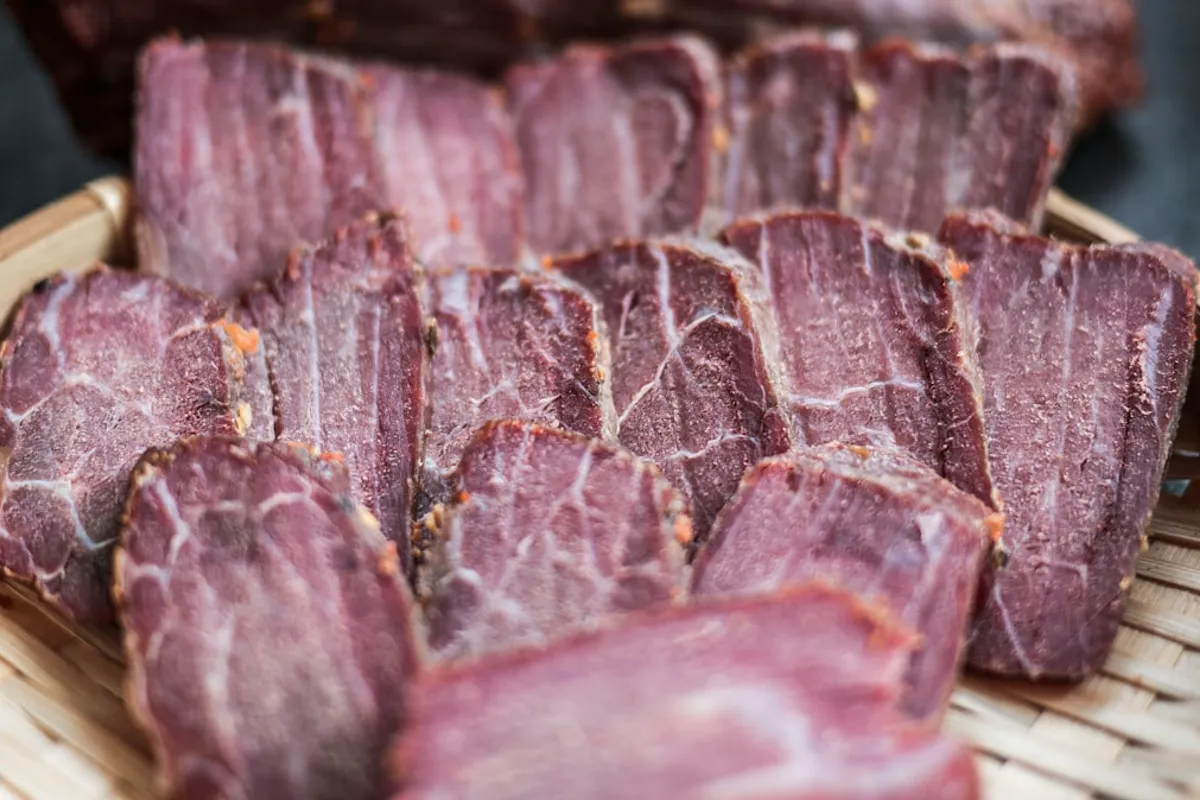
Weigh your beef before it goes in the dehydrator, then weigh the jerky that comes out. Three pounds in, about one pound out. Most of what you paid for is now water vapor that drifted off into your kitchen over the last eight hours.
That single fact is why so many jerky makers quietly lose money on every bag they sell. They cost the meat by what it weighed on the way in — and price the bag as if a little 3-ounce pouch only holds 3 ounces of beef. It holds closer to 9 ounces of beef that shrank down to fit. Let's fix that, because once you cost jerky the right way, the pricing gets a whole lot less mysterious.
The shrink is the whole story
Every craft that transforms an ingredient has a yield problem. Roasters lose beans to moisture, potters lose clay to trimming, coffee people call it the same thing you should: yield. Jerky just happens to have one of the most dramatic yield losses of any home food product. Lean beef is mostly water — well over half its weight — and drying it to a safe, shelf-stable snack means driving most of that water out.
The practical result is a raw-to-finished ratio that commonly lands near 3:1 for lean beef — three pounds of trimmed raw meat yielding about one pound of jerky. It varies with the cut, how lean it is, how thin you slice, and how dry you take it. Fattier meat and thicker slices shrink less; a hard, snappy jerky shrinks more. The only ratio that matters for your pricing is the one you measure in your own kitchen, on your own dehydrator, with your own cut. But whatever it is, it's the hinge your entire cost sits on.
Here's the trap in one sentence: the meat in a bag of jerky costs about three times what the finished weight suggests. Skip that, and no amount of clever marketing saves the margin.
Worked example 1: Find your real yield ratio
Do this once, with a kitchen scale, before you cost anything.
- Weigh the trimmed raw meat. Sam — a composite weekend jerky maker we'll follow through the math, with figures chosen to be illustrative — trims the fat and silverskin off a bottom round and puts 9.0 lb of clean meat on the scale.
- Make the batch as you normally would — marinate, slice, dry to your usual doneness.
- Weigh the finished jerky. Sam's batch comes off the racks at 3.0 lb.
- Divide. 9.0 ÷ 3.0 = 3.0. Sam's yield ratio is 3:1.
Write that number on the wall of your workshop. Every batch you cost from here forward multiplies your raw meat cost by three to land on the cost of the finished pound. If your scale says 2.6:1 or 3.4:1, use that instead — the point is to use a measured number, not a number you read on the internet.
Worked example 2: Cost the meat at the finished weight
Now watch how much the shrink changes the number.
Sam pays $6.50/lb for bottom round. The naive way to cost a 3-ounce bag is to say "3 ounces of meat, and there are 16 ounces in a pound, so that's 3/16 of $6.50":
0.1875 lb × $6.50 = $1.22 of meat per bag ← this is wrong
That $1.22 is the cost of 3 ounces of finished jerky pretending it only ever weighed 3 ounces. But 3 ounces of finished jerky started life as roughly 9 ounces of raw beef (3 oz × the 3:1 ratio). The honest meat cost is:
3 oz finished × 3.0 ratio = 9 oz raw = 0.5625 lb × $6.50 = $3.66 of meat per bag ← this is right
Same beef, same bag, and the meat line just tripled. If you've been pricing off the first number, you've been selling nine ounces of beef and charging for three. Nobody makes that up on volume.
Worked example 3: The costs that aren't the meat
The meat is the biggest single line, but it isn't the whole cost — and the non-meat lines are exactly the ones makers wave off as "rounding errors." They add up fast. Here's Sam's full 9-lb batch, which yields 3 lb of jerky = 16 bags at 3 ounces each.
Cure, marinade, and seasoning. Soy sauce, Worcestershire, brown sugar, spices, and — critically — a nitrite cure (the pink stuff, cure #1) if Sam is drying at lower temperatures for safety. Call it $4.80 for the batch, or $0.30/bag.
Packaging. This is where jerky quietly gets expensive. A resealable stand-up pouch runs about $0.45, an oxygen absorber (not optional — it's what keeps jerky shelf-stable and safe) about $0.08, and a printed label about $0.12. That's $0.65/bag, and it does not shrink, so it's already a fifth of what the meat costs.
Energy. A dehydrator pulling ~500 watts for 8 hours is about 4 kWh. Electricity rates vary widely by region — the U.S. residential average was about $0.18/kWh in early 2026 (EIA, Average Price of Electricity to Ultimate Customers (opens in new tab)), and many states run lower — so at an illustrative, slightly-below-average $0.16/kWh this batch runs roughly $0.64 per batch, or $0.04/bag. Small, but it's real, and a smoker running longer costs more.
Hands-on labor. Trimming, slicing thin, mixing marinade, loading trays, checking doneness, and packaging 16 bags with absorbers is about 2 hours of actual work — not counting the 8 passive hours of drying. At a modest $20/hour, that's $40 per batch, or $2.50/bag. Labor is the second-biggest line, and it's the one that's invisible on every receipt.
Equipment reserve. A dehydrator, a decent slicer, and a bag sealer might run $600 and last a few years and hundreds of batches. Setting aside about $0.20/bag means the machines pay for their own replacement instead of ambushing you later.
Loss and reject reserve. Over-dried batches, a scorched tray, a pouch that doesn't seal. A 5% reserve on everything above adds roughly $0.37/bag — cheaper to plan for than to eat.
Worked example 4: Put the bag together
Stack it all up, per bag:
| Cost layer | Per 3-oz bag |
|---|---|
| Beef, after the 3:1 shrink | $3.66 |
| Cure, marinade & seasoning | $0.30 |
| Packaging (pouch + O₂ absorber + label) | $0.65 |
| Energy (drying) | $0.04 |
| Hands-on labor | $2.50 |
| Equipment reserve | $0.20 |
| Loss / reject reserve (~5%) | $0.37 |
| Fully loaded cost, before selling it | $7.72 |
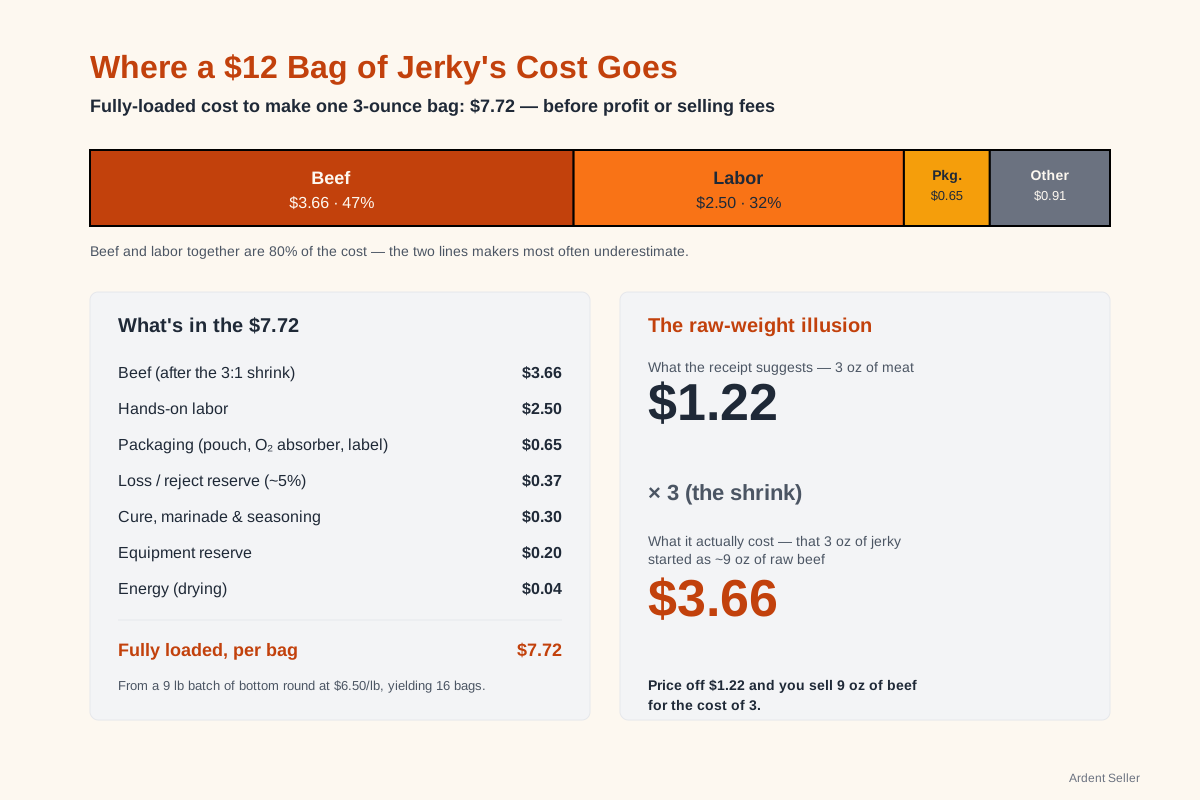
Notice two things. First, meat and labor together are $6.16 — 80% of the cost — and both are the lines makers underestimate. Second, that "rounding error" packaging line ($0.65) is by itself half the size of what the naive maker thought the entire meat cost was ($1.22). The small stuff isn't small.
Now the part that stings: a maker who costed this bag the naive way would have added up $1.22 meat + a hand-waved "dollar or so" for everything else and decided the bag "cost about $2.50." They'd price it at $8, feel a healthy margin, and be losing money on every single sale. The real floor is $7.72 before a cent of profit or a nickel of selling cost.
Price from the loaded cost, not the receipt
Once you know the bag costs $7.72 to exist, pricing is just a decision about margin and channel — and the channel matters more than jerky makers expect, because selling costs stack on top of the $7.72.
At the farmers market. Sam sells the bag for $12. Spread the booth fee across a typical day's bags and it's about $0.50/bag of selling cost, so the fully-loaded-and-sold cost is $8.22. Gross profit: $3.78/bag, about a 31% margin. Workable — and it rewards Sam for showing up, which is the whole point of the market channel.
Online. Sell the same bag for $12 on a marketplace like Etsy and the math tightens. A 6.5% transaction fee (opens in new tab) ($0.78) plus Etsy Payments processing (opens in new tab) of about 3% + $0.25 (~$0.61), both as of mid-2026, comes to about $1.39/bag before you've paid a cent of shipping, and jerky, while light, still needs a mailer and a label. The margin that felt fine at the booth gets thin fast online, which is why a lot of makers price their online bags a couple dollars higher, or build shipping into the price honestly rather than eating it.
The lesson isn't "charge $12." It's that $12 means two completely different things depending on where you sell it, and you can only see the difference if you started from the real $7.72 instead of an imagined $2.50.
One number worth watching: if a wholesale account asks you for a 50%-off case price, they're asking for $6 a bag on something that costs you $7.72 to make. Know your loaded cost before that conversation, not after.
A word before you sell a single bag
Costing is the fun part. The part that isn't optional is the legal one: dried meat is regulated very differently from baked goods. In most states, jerky and other meat snacks are not allowed under cottage food law — the exemptions that let home bakers sell cookies and jams almost always exclude meat, which typically requires a state- or USDA-inspected facility or a specific license to sell. The rules vary a lot by state and by whether you're selling direct, wholesale, or across state lines. Before you scale past "gifts for friends," check with your state department of agriculture or health so your beautifully-costed jerky is also a legal product to sell.
Where the bookkeeping gets easier
The reason jerky costing goes wrong is almost never bad math — it's that the yield lives in your head instead of in your numbers. You know three pounds becomes one, but the spreadsheet doesn't, so every batch you re-derive the meat cost from scratch and usually forget the multiplier.
This is exactly what production-and-recipe costing tools are built for. In Ardent Seller, you set up a jerky batch as a production run with a yield — 9 pounds of raw beef in, 3 pounds of jerky out — and the cost per finished bag falls out automatically, shrink and all, every time you log a batch. Change your meat supplier's price and every bag re-costs itself. Add the packaging and label as tracked materials and they stop being the "rounding errors" that were quietly eating your margin. You weigh the meat; the software remembers the multiplier so you don't have to.
You don't need software to get this right — a scale, a notebook, and the 3:1 discipline will do it. But if you're making batches every week and the mental math keeps slipping, letting the yield live in your system instead of your memory is the difference between guessing and knowing.
Weigh your next batch in and out. Find your real ratio. Then cost one bag, honestly, all the way down — and you'll finally know whether that $12 is a good price or a slow leak. If you'd like the tool that does the shrink math for you, start a free Ardent Seller account and set up your first batch.
Related reading
- Coffee Roast Yield: Why Costs Run Higher — The same shrink problem in a different craft: green beans lose weight to roasting, so the true cost per bag hides behind a yield ratio most roasters never measure.
- Recipe Costing 101 — The foundation under all of this: how to build a per-unit cost from materials, labor, packaging, and overhead so nothing gets waved off as a rounding error.
- Why Are My Margins Shrinking? — If your jerky sells well but the money never shows up, this walks the six quiet leaks — supplier drift, packaging creep, marketplace fees — that eat margin a nickel at a time.
Free resources
Free companion downloads if you want to put any of this into practice:
- Cottage Food Laws by State: The 50-State + DC Quick Reference — Before you cost a single bag, check whether your state lets you make jerky at home at all — most treat meat products very differently from baked goods.
- Product Pricing Calculator — Drop in your loaded per-bag cost and target margin to sanity-check your jerky prices across channels.
- Maker Hourly-Rate Pricing Calculator — Pin down the labor rate that goes into every batch so those two hours of trimming and slicing actually get paid.
This article is provided for educational purposes only and does not constitute legal, regulatory, financial, or tax advice. Costs, pricing examples, and yield ratios are illustrative and will vary by your specific circumstances. Meat-processing rules, licensing, and food-safety requirements vary by jurisdiction and change frequently. Consult a qualified accountant and your state department of agriculture or health before making financial or compliance decisions based on this content.