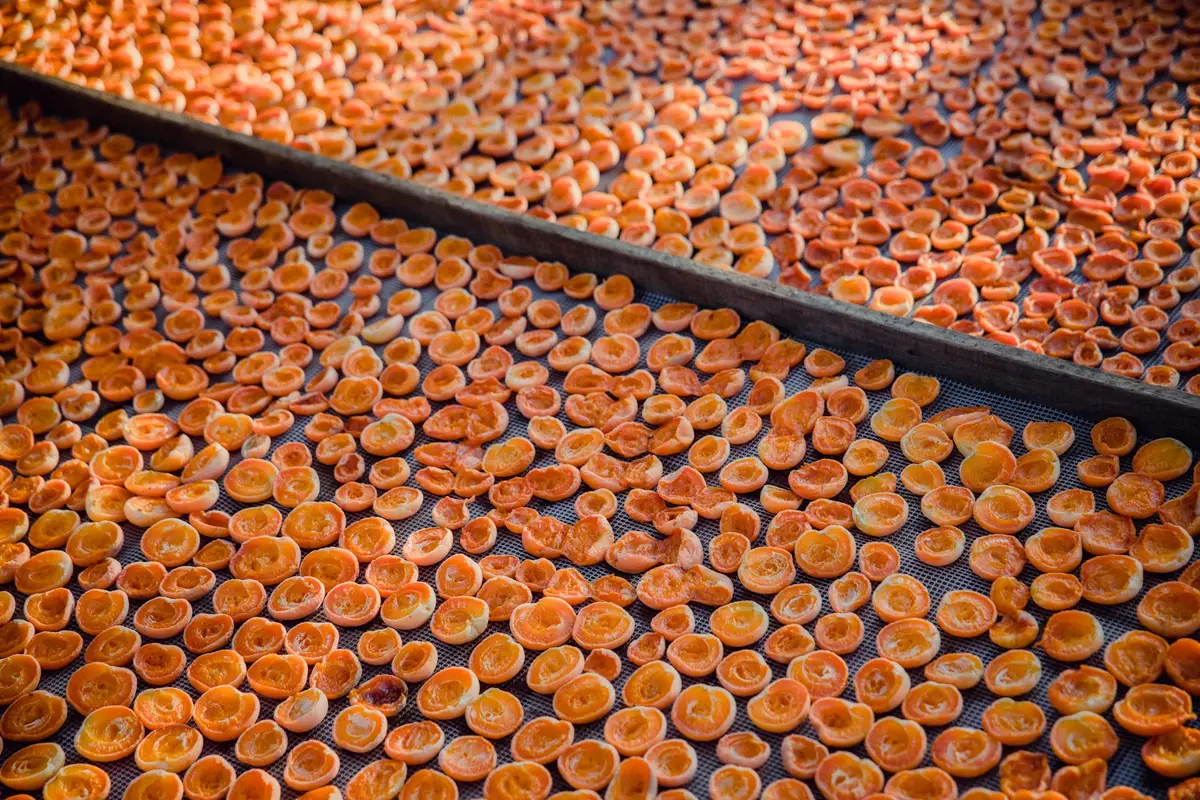
A pet bakery takes a holiday wholesale order for 40 pounds of sweet potato chews. The dehydrator on the counter holds about three pounds of raw slices per run. After drying, that comes out to roughly three-quarters of a pound of finished chews. That is more than 50 runs for one order. Somewhere around the twelfth run, the owner starts pricing a bigger machine and finds two families of dehydrators that look nothing alike: round stackables that cost about $100 and square-tray boxes that cost two to five times as much.
The sticker price is the wrong number to compare. The right one is what each machine costs per finished dry pound, counting the electricity it burns and the time you spend loading and emptying trays. On that measure the expensive box often wins, and the reason is simple: its trays are bigger.
The short answer: which commercial dehydrator to buy
- Testing recipes, or two runs a week or fewer (about 1.5 dry pounds of sweet potato chews): a stackable like the Nesco FD-75PR ($99.99). It is cheap, and you can add trays later.
- More than that, every week: a square-tray box. At prices checked October 5, 2026: the Excalibur 6 Tray Select ($199.99 on sale, $219.99 regular) or, if you want fewer runs per order, the 10 Tray Performance Digital ($379.99 on sale, $499.99 regular; sold out that day). Their 1.6-square-foot trays cut the number of trays you handle per pound by a third or more.
- Your inspector asks for NSF-listed equipment: Excalibur's commercial EXC10EL, the only unit in the comparison table that claims NSF and UL approval (Excalibur's larger COMM models do too).
- Meat or poultry treats: none of them, on their own. The kill step happens before the dehydrator. More on that next.
The full decision list, including adding trays to a Nesco you already own, is at the end.
What no dehydrator does: the kill step
It's easy to assume the dehydrator makes meat treats safe. USDA's Food Safety and Inspection Service says otherwise. Its jerky guidance (opens in new tab) warns that pathogenic bacteria "are likely to survive the dry heat of a warm oven and especially the 130 to 140°F temperature of a food dehydrator." It recommends heating meat to 160°F and poultry to 165°F before drying. It also notes that "a dehydrator may not reach temperatures high enough to heat meat to 160°F or 165°F."
The reason is evaporation. FSIS explains that moisture leaving the food absorbs most of the heat, so the meat's own temperature barely rises until it is mostly dry. By then, the page says, the bacteria have become more heat resistant.
That page is written for people making jerky at home, but the same physics applies to a liver treat or chicken strip, and pet treats have their own federal stakes. FDA's compliance policy on Salmonella in food for animals (opens in new tab) defines pet food to include "treats and chews for pets." It says FDA considers a pet food adulterated when it is contaminated with Salmonella and won't get a later heat step that kills it. The stated reason is that people handle these foods and can pick up Salmonella from their hands or utensils at feeding time.
Two practical consequences for the purchase:
- The top of the dial is an air temperature, not a kill step. Nesco's units top out at 160°F, Excalibur's home and EXC10EL units at 165°F, and the big Excalibur COMM1 at 180°F. None of those numbers means the meat inside reached 160°F.
- Budget for an oven or steamer step for meat treats. Steam or roast to 160°F (165°F for poultry), checked with a food thermometer, then dry. That step adds its own labor and needs a thermometer in the same budget as the dehydrator.
Whether you are allowed to sell treats from your kitchen at all is a separate question. The answer to "do I need AAFCO approval to sell dog treats" covers registration and the in-home exemption. This post assumes you have sorted that out and are choosing equipment.
Box vs. stackable: five machines on one table
A stackable has a fan and heater in the base or lid and round trays stacked on top. You add capacity by buying more trays. A box has a fixed cabinet with square trays that slide in like oven racks, with a fan blowing air across them. Every figure below comes from the manufacturer's own product page or brochure, checked on October 5, 2026.
| Model | Type | Drying area | Area per tray | Watts | Temp range | Price on Oct 5, 2026 | Price per sq ft |
|---|---|---|---|---|---|---|---|
| Nesco FD-75PR (opens in new tab) | Stackable, 5 trays (max 12) | 4.0 sq ft | 0.8 sq ft | 600 | 95–160°F | $99.99 | $25.00 |
| Nesco FD-1010 (opens in new tab) + 8 trays | Stackable, 12 trays (max 30) | 12.0 sq ft | 1.0 sq ft | 1000 | 95–160°F | $227.95 | $19.00 |
| Excalibur 6 Tray Select (opens in new tab) | Box | 9.6 sq ft | 1.6 sq ft | 600 | 85–165°F | $199.99 | $20.83 |
| Excalibur 10 Tray Performance (opens in new tab) | Box | 16.0 sq ft | 1.6 sq ft | 800 | 85–165°F | $379.99 | $23.75 |
| Excalibur EXC10EL (PDF brochure) (opens in new tab) | Box, commercial | 16.0 sq ft | 1.6 sq ft | 600 | 95–165°F | dealer-priced | not published |
How to read it:
- The FD-1010 row is the base unit's $139.99 plus four two-packs of Add-A-Trays (opens in new tab) at $21.99 each, which takes it to 12 trays. Nesco says it expands to 30. That would spread the same 1,000 watts over 30 square feet, and Nesco doesn't publish a drying time for a full stack. If you plan to run it tall, time a full-height batch before you count on it.
- Both Excalibur prices were sale prices when checked: the 6 Tray Select marked down from $219.99, and the 10 Tray Performance from $499.99. The 6 Tray Select was in stock; the 10 Tray Performance showed as sold out. Price and stock can change from week to week.
- Price per square foot is closer than the sticker prices suggest. Across the four priced configurations it runs from $19 to $25 at these prices, or up to $31.25 for the 10-tray at its regular price. The gap that matters is in the Area per tray column.
- The EXC10EL is the only unit in this table that claims NSF certification. It is sold through restaurant-supply dealers rather than Excalibur's own store. Neither Nesco product page and neither Excalibur home-model page claims NSF certification.
Worked example: cost per dry pound of sweet potato chews
Sweet potato is a popular single-ingredient dog chew, and USDA publishes its water content, which makes it a good test case. Three inputs drive the result.
1. Yield. USDA FoodData Central lists raw sweet potato at 77.3 grams of water per 100 grams (opens in new tab), or 77.3% water. If you dry it to 10% moisture (an assumption for this example; set your own target and test it), the dried chews, which are the solids plus the 10% water left in them, weigh (1 − 0.773) ÷ (1 − 0.10) = 0.252, or about 25% of the raw weight.
The same math for raw beef liver at 70.8% water (opens in new tab) gives about 32%. For meat, FSIS offers a rough check: a pound of meat "weighs about four ounces after being made into jerky," which is 25%.
2. Load. This example assumes 0.75 lb of raw slices per square foot of tray. That number is illustrative and depends on how thick you slice. Weigh one full tray of your own product once and use that figure instead.
3. Run costs. A 10-hour run, priced as if the heater drew its full rated wattage the whole time. That is a ceiling, since heaters cycle on and off. Electricity is EIA's July 2026 U.S. average residential price of 18.31¢ per kWh (opens in new tab) (EIA updates that table monthly, so a later visit shows a newer month). Labor is 2 minutes per tray to load and unload, at $20 an hour. Both of those are illustrative too.
| Machine | Raw load | Dry output | Electricity | Labor | Electricity per dry lb | Labor per dry lb | Total per dry lb |
|---|---|---|---|---|---|---|---|
| Nesco FD-75PR (5 trays) | 3.0 lb | 0.76 lb | $1.10 | $3.33 | $1.45 | $4.40 | $5.85 |
| Nesco FD-1010 (12 trays) | 9.0 lb | 2.27 lb | $1.83 | $8.00 | $0.81 | $3.52 | $4.33 |
| Excalibur 6 Tray Select | 7.2 lb | 1.82 lb | $1.10 | $4.00 | $0.60 | $2.20 | $2.80 |
| Excalibur 10 Tray Performance | 12.0 lb | 3.03 lb | $1.46 | $6.67 | $0.48 | $2.20 | $2.68 |
Back to the 40-pound wholesale order. The Excalibur 10-tray turns out about three dry pounds per run, so it takes 14 runs. The 5-tray Nesco, at about three-quarters of a pound, takes 53. At the per-pound rates in the table, 40 dry pounds costs about $234 in electricity and labor on the Nesco and about $107 on the Excalibur 10-tray, a saving of roughly $127. At the sale prices checked October 5, the 6 Tray Select's $100 premium over the Nesco pays for itself after about 33 dry pounds, and the 10 Tray Performance's $280 premium after about 88. At regular prices ($219.99 and $499.99), those paybacks stretch to about 39 and 126 dry pounds.
Between the two Excaliburs, cost per pound is nearly identical ($2.80 against $2.68), so the extra money for the 10-tray buys capacity, not savings: the 6 Tray Select needs about 22 runs for the 40-pound order, the 10 Tray Performance 14.
Where the labor hides: tray count
Electricity is the smaller cost in every row. Labor is the larger one, and labor is driven by how many trays you handle per pound, not by how many watts the machine draws.
A Nesco FD-75PR tray holds 0.8 square feet, so every square foot of drying costs you 1.25 trays of handling. An Excalibur tray holds 1.6 square feet, which works out to 0.63 trays per square foot, half the handling for the same area. That is why the 6-tray Excalibur and the 10-tray Excalibur land at the same $2.20 per dry pound for labor: the area per tray is identical. Round trays with a center hole can also be harder to fill with flat slices, which this example doesn't count.
Change the assumptions and the numbers move, but the order rarely does. Liver's higher yield lowers every per-pound figure by about a fifth and leaves the ranking alone. A faster hand at the trays shrinks the gap without closing it. If you have already counted your real minutes per tray, use that figure. If you haven't, time the next batch.
Measuring those inputs once is easy. Remembering them is the hard part, especially when a new bag of sweet potatoes dries differently from the last one. In Ardent Seller, a treat recipe lists the raw ingredients and its planned output, and each production run records the raw weight used and the finished weight that actually came off the trays. The Batch Yield & Efficiency report compares each run's actual output with the plan and shows the real material cost per finished unit, so a batch that dries light shows up as a yield shortfall instead of a surprise at pricing time. That figure covers materials only, so add the labor and electricity from the worked example yourself. The dehydrator itself can go in as an equipment item, with each run logged against it.
When the commercial units earn their price
Two situations justify going past a home-model box.
An inspector who wants NSF-listed equipment. Excalibur's commercial brochure (PDF) (opens in new tab) says its commercial dehydrators are NSF and UL approved. It adds that "Many inspectors look for the NSF Mark on your equipment." Whether yours does depends on your state's feed program or whoever inspects your kitchen, so ask before buying. The EXC10EL holds the same 16 square feet as the 10 Tray Performance at 600 watts, with stainless trays and a 99-hour timer.
Volume that outgrows a countertop. The brochure's COMM1 offers 50 square feet across 12 trays, with a thermostat range of 70 to 180°F, and draws 4,500 watts on a 120 V or 208 to 240 V supply. That is more than three of the 10-tray units side by side, from one cabinet, one door and 12 trays. It also probably means an electrician, because a typical kitchen outlet won't feed it. By the same per-tray logic, its trays (about 4.2 square feet each) cut handling much further. The 180°F ceiling is still an air temperature, though, so the kill-step rule above still applies.
Which one to buy
- You are still testing recipes, or do two runs a week or fewer (about 1.5 dry pounds): Nesco FD-75PR. At $99.99 it costs little to find out whether liver or sweet potato sells.
- You dry more than about 1.5 pounds a week (more than two FD-75PR runs): Excalibur 6 Tray Select, or the 10 Tray Performance if you want fewer runs per order (check stock first). Both have the same per-tray labor advantage.
- You already own a Nesco and want more capacity this month: an FD-1010 with extra trays is the cheapest square foot on the table. Just time a tall stack before you rely on it.
- Your inspector asks for NSF: the EXC10EL. Ask a restaurant-supply dealer for a quote.
- Wholesale volume and a 240V circuit: request a quote on the COMM1.
Whichever you pick, the next step is to weigh what goes in and what comes out. That ratio sets your real cost per bag, and it changes with every crop of sweet potatoes and every case of liver. Start costing your treat batches on their actual yield in Ardent Seller free, so every batch of chews is costed on what came off the trays.
Related reading
- How to Start a Pet Treat Business at Home — the full path from test batch to first sale, with feed licensing, labeling and pricing, if the dehydrator is your first big purchase.
- Do You Need AAFCO Approval? Dog Treat FAQ — whether you can sell treats from your kitchen at all, answered before you spend money on a dehydrator.
- Pet treat labeling requirements — the label and packaging costs that go into the bag along with your cost per dry pound.
- Beef Jerky Cost per Bag — the same shrink math applied to human jerky, with trimming loss added on top of water loss.
- Equipment Depreciation for Makers — how to write off a new dehydrator once it is a business asset.
Free resources
Two free tools for the production side:
- Recipe Scaling & Batch Calculator — scale a treat recipe up to a full dehydrator load, so the raw weight matches the trays you have.
- Small-Batch Production Planning Playbook — plan run counts against an order deadline, like the 40-pound wholesale order above.
This article is provided for educational purposes only and does not constitute legal, regulatory, financial, or food-safety advice. Costs, pricing examples, equipment specifications, and pet food and state feed laws vary by jurisdiction and change frequently. Consult a qualified accountant, pet-food regulatory consultant, or attorney before making financial or compliance decisions based on this content.