The sweet-potato chews have been in the dehydrator since six, and the whole house smells like a caramelized vegetable. Twelve dozen peanut butter biscuits are cooling on racks across the dining table, because the kitchen ran out of flat surfaces an hour ago. The labels came back from the print shop on Thursday — four hundred of them, matte finish, with a line drawing of a terrier that took three weeks to get right.
Then somebody at the farmers market asks whether the treats are AAFCO approved.
The honest answer is that nothing is AAFCO approved, because AAFCO does not approve anything. The organization says so itself. But that answer lands badly at a market table, and it is only the first of a handful of things a new pet treat business tends to discover in the wrong order, sometimes after the labels are already printed.
Here is the sequence in the right order.
"Do I need AAFCO approval?" There is no such thing
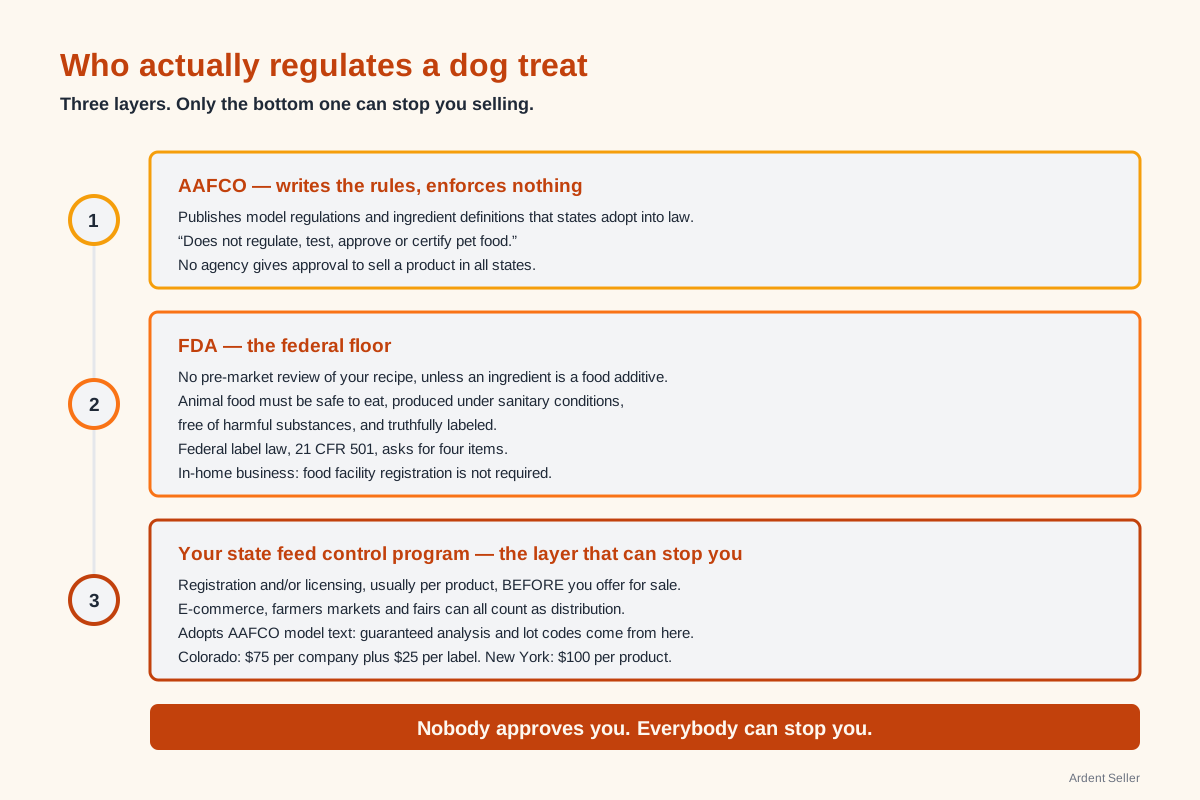
AAFCO is the Association of American Feed Control Officials — a non-profit whose members, per its guidance for small manufacturers (opens in new tab), are "charged by their state or federal laws to regulate the manufacture, sale, and distribution of animal feeds and animal drug remedies." It has been publishing ingredient definitions and label standards for more than a century. What it has never done is regulate a product.
The organization's consumer guidance is unambiguous:
AAFCO does not regulate, test, approve or certify pet food. It establishes model language that states and other governing bodies may adopt into law.
— Association of American Feed Control Officials (opens in new tab)
Its licensing guidance for small manufacturers closes the door from the other side as well: "There is no single agency or group that will give you approval to sell your product in all states" (AAFCO Pet Food and Specialty Pet Food Licensing and Registration Guidance (opens in new tab)).
So "AAFCO approved" on a competitor's packaging is not a credential you are missing. What AAFCO writes matters enormously — states adopt its model regulations, which is why your state's label rules will look a great deal like AAFCO's list — but the adoption happens in state law, and it is the state that enforces it.
Notice the shape of what follows from that. Nobody pre-approves you. Everybody can stop you.
"Doesn't cottage food law cover me?"
This is the assumption that costs the most, because a maker who holds it can skip registration entirely for a year or two.
Cottage food laws are written for food that people eat. A dog biscuit is not that, however carefully you sourced the peanut butter. Michigan's Department of Agriculture and Rural Development puts the question and its answer on the page verbatim:
Are pet treats included under the Cottage Food exemptions to Michigan Food Law? No. The Cottage Food exemptions only apply to human food.
— Michigan Department of Agriculture and Rural Development (opens in new tab)
Your treats are commercial feed. AAFCO's model definition of that term covers "all materials or combination of materials which are distributed or intended for distribution for use as feed or mixing in feed," and pet food is a subset of it. That single reclassification moves you out of the food-safety division cottage bakers deal with and into the state's feed control program — a different office, different forms, different fees, and frequently a different building.
If you have been reading your state's cottage food page and finding nothing about dog treats, that is why. You are reading the wrong page.
"Does the FDA want anything from me?"
Less than most people expect, and more than they would like.
FDA does not review your recipe. The agency draws a sharp line between animal drugs, which need approval before sale, and food for animals, which does not: "food for animals doesn't need FDA's pre-market review to be legally marketed (unless the substance is a food additive)" (FDA's Regulation of Pet Food (opens in new tab)).
What the Federal Food, Drug, and Cosmetic Act does require is that animal food be safe to eat, produced under sanitary conditions, free of harmful substances, and truthfully labeled. There is no filing that satisfies those four duties and no certificate that proves you have met them. They simply apply, from the first batch, and they are what an enforcement action would be built on.
The registration question has a more surprising answer. FDA publishes a requirements chart covering the three most common animal food business scenarios — in-home, on-farm, and other businesses or industry — and the Food Facility Registration Requirement row reads no for in-home businesses and yes for commercial ones (How do I Start an Animal Food Business? (opens in new tab)). The reason sits in the definition of a facility at 21 CFR 1.227 (opens in new tab), which states that "The private residence of an individual is not a facility."
Four rows of that same chart read yes for every business type, in-home included: adulteration, ingredients and additives, labeling and marketing, and state regulations.
Watch this threshold. The in-home answer is tied to the private residence, not to your revenue. Rent time in a commissary, take a corner of a commercial kitchen, or move into a leased production space, and food facility registration — along with the preventive controls regime in 21 CFR part 507 (opens in new tab) — comes into scope. Price that in before you sign, not after.
"Can I make them in my home kitchen?"
Sometimes — and the answer turns on your process, not your square footage.
Colorado allows pet food and treats to be made in a home kitchen with no commercial kitchen required, provided good manufacturing practices are followed and contamination is avoided (Colorado Department of Agriculture (opens in new tab)). New York also allows home production, but narrows it hard: non-perishable, shelf-stable snack items such as biscuits and cookies, and explicitly not products "processed by specialized method such as dehydration, freeze-drying, canning, acidification" (New York State Department of Agriculture and Markets (opens in new tab)).
Read that exclusion against the dehydrator running in the opening scene: sweet-potato chews are not a biscuit.
Answer this one before you buy equipment — it is a separate question from the FDA facility rule above. That one turns on leaving your private residence; this one turns on whatever test your state applies, and only some states test the production method at all. Where they do, a dehydrator changes your regulatory position and not just your product line — so ask your state feed control official what their home-production allowance covers before the machine arrives.
"Then who do I register with, and what does it cost?"
Your state. And, in practice, every state you ship to.
AAFCO's small-manufacturer guidance is blunt about the scope: "Almost all states have some sort of registration and/or licensing requirements that you must meet before all products can be offered for sale; including ecommerce," and "The laws in most states require that you register your products and/or license your company BEFORE you offer your products for sale in that state." The same document lists homemade food and treats explicitly among the products subject to licensing and registration, and says distribution "may include the selling of pet and specialty pet foods, including treats, at farmers markets, fairs, fund-raising events, and other venues." On products you intend to give away rather than sell, it stops short of a rule and tells you to check your state's regulations — worth doing before you hand out samples at an adoption event.
The fee structures differ in ways that matter more than the headline numbers.
| Detail | Colorado | New York |
|---|---|---|
| Company-level fee | $75 per year, not pro-rated | None separate from product fees |
| Product-level fee | $25 per year per small-package label (10 lb or under) | $100 per year per product |
| Registration year | February 1 to January 31 | Calendar year; all registrations expire December 31 |
| What the product fee attaches to | Each small-package label, registered individually | Each product; the same product in different quantities needs no separate registration |
| How packages over 10 lb are charged | Reported as tonnage, $50 minimum per company per year | Not addressed as a separate tier on the state's pet food page — confirm with the department |
| How to apply | Application by email or mail, then labels uploaded to an online account | Traditional mail only; electronically-submitted applications are not accepted |
Sources: Colorado Department of Agriculture (opens in new tab) and New York State Department of Agriculture and Markets (opens in new tab).
Now consider what counts as a "product," because that is the multiplier. New York treats a size-targeted variant as its own registration: "ABC Dog Treats for Medium Dogs" and "ABC Dog Treats for Large Dogs" are two products, at $100 each. A different name or a different formulation also creates a separate product. Selling the same product in a 4 oz bag and a 12 oz bag does not.
So the bill scales with formulation count, not with sales. Six flavors sold into three states is eighteen registrations before a single treat moves. A seventh flavor that sells forty units a year is not a $40 decision; it is a $40 decision plus whatever those three states charge to carry it, every year, indefinitely. Makers who discover this late tend to discover it at renewal.
Registration is only the entry ticket. Lab work, label reprints and pet-specific liability insurance land on top of it, and the companion post on pet treat labeling requirements budgets that full annual load.
"What has to be on the label — and which government is asking?"
Both are, and it is worth knowing which is which, because they are not the same list.
The federal requirements for animal food labels live in 21 CFR part 501 (opens in new tab), and FDA summarizes them as four items: proper identification of the product, a net quantity statement, the name and place of the manufacturer or distributor, and a listing of all ingredients. Ingredients must appear by their common or usual name "in descending order of predominance according to weight" under 21 CFR 501.4(a).
Notice what is not on the federal list: the guaranteed analysis, the nutritional adequacy statement, feeding directions. Those come from state law that has adopted AAFCO's model regulations — which is why a maker can read the federal rule, comply with it exactly, and still have a label rejected by their state.
Two of those state-level items are lighter for treats than for complete foods. A product "conspicuously identified on the principal display panel as a snack, treat, or supplement" is exempt from the nutritional adequacy statement, and feeding directions are optional for treats so long as they are not labeled complete and balanced (AAFCO required labeling items (opens in new tab)).
The guaranteed analysis is the one that costs money. The Colorado Department of Agriculture (opens in new tab) is specific about the order — crude protein minimum, crude fat minimum, crude fiber maximum, moisture maximum, "in that order only" — and equally specific that the state's own laboratory cannot produce those numbers for you, because it tests only for regulatory purposes. You send a sample to a commercial animal food testing laboratory, and every genuinely new formulation is a new analysis.
The ingredient statement, at least, you already own. Ordering ingredients by weight is a bill-of-materials question, and Colorado's instruction for drafting a label reads like one: "determine the final recipe for the product and sort the ingredients by weight." If you are working from a handwritten recipe, the free Recipe Scaling & Batch Calculator will lay a batch out by weight in the order the label needs. If your recipes live in a costing system such as Ardent Seller instead, that ordering falls out of the recipe you already built in order to cost the batch — and it re-sorts itself when you reformulate, which is the moment an old label quietly becomes wrong.
For the element-by-element walk through what a compliant label contains, including the product-name percentage rules, see the companion post on pet treat labeling requirements.
"What can't I say?"
The claims rules are the ones that turn a food into something else.
Expressed or implied claims that a product will "cure, treat, prevent, or mitigate disease, or affect the structure or function of the body in a manner other than for food purposes" indicate an intent to market a new animal drug, which would have to clear the new animal drug approval process before the claim could appear on a label (FDA: Animal Food Labeling and Pet Food Claims (opens in new tab)). The Colorado Department of Agriculture (opens in new tab) draws the practical line: no claims to treat disease or physical issues, but an ingredient "may support" an animal's health.
Three further restrictions trip up home producers, and that same Colorado FAQ answers all three:
- "Human grade" is not a description of your ingredients. The Colorado FAQ's answer is a commercial kitchen, plus the human food manufacturing license to prove it. The New York State Department of Agriculture and Markets (opens in new tab) states the same rule in different words: a home-processed pet treat cannot make the claim on a label, website or advertisement, and to make it the product must come from a commercial facility complying with the 21 CFR part 117 CGMPs.
- "Organic" requires the product and its packaging to carry a National Organic Program seal. Using organic ingredients earns you the right to say so in the ingredient statement, and nothing more.
- CBD is not approved by FDA for use in any pet food or treat.
The reach of all of this is wider than the package. AAFCO defines labeling as "all written, printed, or graphic matter accompanying the product," and names websites, social media and brochures. Colorado says it just as plainly: "Labeling includes websites and social media that market your product." A disease claim carefully kept off the pouch does not become legal in an Instagram caption.
None of this is a reason not to sell dog treats. It is a reason to sequence the work differently: call your state feed control official before you name the product, register before you list it anywhere, and get the recipe itself written down in a form that can produce a correct ingredient statement on demand. That last one is the piece you control entirely — set up your first recipe in Ardent Seller and the ingredients come back sorted by weight, in the order a label reviewer expects to read them, every time you reformulate.
Related reading
- Pet Treat Packaging, Labeling, and Cost Tracking — The element-by-element walk through pet treat labeling requirements, including the product-name percentage rules and what compliance maintenance costs each year.
- Batch Tracking for Food Sellers — Colorado's required label items include a lot code (Colorado Department of Agriculture (opens in new tab)); this is the batch tracking discipline that makes the code mean something when a customer calls.
- How to Label Handmade Products — The labeling logic for everything else on your table, where the rules come from an entirely different regulator.
Free resources
Free companion downloads if you want to put any of this into practice:
- Recipe Scaling & Batch Calculator — Lays a formulation out by ingredient weight, which is the same work as putting the ingredient statement in its required descending order.
- Craft Seller Startup Checklist — The rest of the setup around the feed registration: the business-formation and record-keeping steps a first-year treat maker still owes regardless of which state they register in.
This article is provided for educational purposes only and does not constitute legal, regulatory, food-safety, or health advice. Commercial feed registration requirements, AAFCO model regulations as adopted by individual states, pet food labeling rules, and federal animal food requirements vary by jurisdiction and product, and change frequently. Registration fees cited were current at publication and are set by the individual states. Consult your state feed control official, a qualified pet-food regulatory consultant, or an attorney before making compliance or safety decisions.