How to start a coffee roasting business
A practical, step-by-step playbook for turning green coffee into a roastery — from your first sample roast to your first wholesale account, with the food-safety, sourcing, and pricing details most "how to roast coffee" guides skip.
- Startup cost
- $1,000 – $20,000
- Time to first sale
- 1 – 3 months
- Note: A home or sample roaster testing at a farmers market can move in weeks; a registered commercial roastery with a 1 kg+ machine, food-facility registration, and packaging usually takes 1–3 months.
- Difficulty
- Moderate
Last reviewed · Rates, fees, and regulatory thresholds in this guide can change — verify the linked sources before acting.
The short version
Coffee roasting sits between an approachable craft and a regulated food business. The craft side is cheap to start learning: a small home or sample roaster, a bag of green beans from an importer, and free roast-logging software put a drinkable roast in your cup within an afternoon, and a few weeks of practice (and cupping your results) gets you to a profile worth selling. The business side is where the real work is — roasting coffee for sale is food manufacturing, so in most states you need a licensed production space and FDA-compliant labels, plus federal FDA facility registration for most non-retail operations, before you can legally sell. The unit economics turn on green-cost-plus-roast-loss (you lose roughly 12–20% of green weight in the roast, commonly 15–18% for a medium), packaging, and labor rather than a simple markup. The biggest strategic choice is your channel: retail bags carry the best margin but you drive every sale, while wholesale to cafes is lower-margin but gives predictable repeat volume that fills a roaster. This guide walks each step in order, with rough cost ranges and free tools for the yield, cupping, and pricing math.
Good fit if…
- You enjoy the sensory, iterative side of roasting — tasting, logging, and dialing in a profile over many batches
- You have $1,000–$20,000 to invest, or want to start small on a home/sample roaster and reinvest
- You can dedicate a legal production space (a registered commercial kitchen, shared roastery, or compliant facility)
- You like the idea of building wholesale cafe accounts, a subscription, or a local retail following
Probably not for you if…
- You need revenue within a week or two — standing up a legal production space, registration, and labels takes time before a first sale
- You expect passive income — fresh coffee is perishable, so roasting, packing, and shipping are ongoing weekly work
- You can only roast in an unvented home kitchen — roasting produces smoke, chaff, and requires ventilation
- You aren't willing to learn the green-cost, roast-loss, and per-bag COGS math that decides whether you make money
Tip: The craft is learnable in weeks — small roasters and free roast-logging software make it cheap to start practicing. The harder part is operating as a food business: roasting for sale is food manufacturing, so a production space, labeling, and (for most) facility registration come before your first legal sale.
End-to-end timeline for a new roastery
The craft comes quickly; the food-business setup is what sets the calendar. These stages overlap in practice — you can source green and dial in profiles while your space and registration are still in progress — so the total runs shorter than adding the stage ranges end to end. Expect the faster end if you rent roaster time and sell at a market, the slower end if you're building out a registered space.
- Set up + register2–6 weeks
Secure a legal production space (or co-roasting access), register the business, handle food-facility registration, and design labels.
- Source + practice1–3 weeks
Buy green samples, roast and cup to dial in profiles, and lock repeatable recipes for your launch coffees.
- Package + photograph1–2 weeks
Order valve bags and labels, set bag sizes, shoot product photos, and build listings or a line sheet.
- Launch + first orders1–4 weeks
Open the store, work a market, and pitch first wholesale samples. Wholesale ramps slower than retail.
1–3 months to first sale
The 8-step playbook
Run these in order. Skipping ahead is the most common reason new makers ship inconsistent product or under-price their work.
Step 1: Choose your roaster type and scale
Before sourcing a single bean, decide how you'll roast. Roaster size drives your batch volume, your space and ventilation needs, and most of your upfront cost — and it's the decision that's most expensive to over-buy on early.
Roaster options compared
Bigger machines mean more volume but more cost, power, and ventilation — and a used roaster can lower the entry price at any size.
| Option | Upfront cost | Green batch size | Best for | Main trade-off |
|---|---|---|---|---|
Home / hobby roaster Air or small drum, plug-in. | $200–$1,000 | ~100–500 g | Learning to profile; tiny market test batches | Too slow for wholesale volume |
Tabletop / sample commercial roaster ~1 kg drum (e.g. Aillio Bullet). | $3,000–$8,000 | ~0.5–1.2 kg | Nano-roastery: retail bags + small wholesale | Caps out as wholesale grows |
Shop roaster (5 kg+) Commercial drum machine. | $10,000–$40,000+ | 5 kg and up | Serious retail + wholesale volume | Power, exhaust/afterburner, dedicated space |
Co-roasting (rent time) Shared roastery, hourly. | ~$0 equipment; hourly rate | Varies by host machine | Demand validation before buying a machine | Scheduling around the host; less control |
Costs are illustrative for new/entry equipment and move with brand, condition (used roasters are common), and your local power and venting requirements. Get a real quote — and confirm electrical and exhaust needs — before committing to a machine size.
Roasting capacity is measured by green batch size — the weight of unroasted beans a machine takes per batch. The right size depends on whether you're learning, selling at a market on weekends, or supplying cafes.
- Home / hobby roaster — an air roaster or small drum (roughly 100–500 g per batch). Cheap, plug-in, and ideal for learning to profile and for selling tiny test batches at a market. Too slow to supply wholesale.
- Tabletop / sample commercial roaster — a 500 g to ~1.2 kg drum roaster (for example an Aillio Bullet or a similarly sized 1 kg drum machine). The realistic entry point for a "nano-roastery": enough to fill retail bags and small wholesale orders, with proper drum control for repeatable profiles.
- Shop roaster (5 kg and up) — a commercial drum roaster for serious retail and wholesale volume. Higher cost, three-phase power and an exhaust/afterburner are common requirements, and it usually lives in a dedicated space.
- Co-roasting / rent roaster time — many cities have shared roasteries that rent machine time by the hour. Near-zero equipment cost, no facility build-out, and a fast, low-risk way to validate demand before buying a machine.
Most people who turn roasting into a business either start by renting time at a shared roastery or buy a ~1 kg tabletop roaster, then move up to a 5 kg+ machine once wholesale demand is proven. The comparison table above lays out the trade-offs.
Step 2: Handle the legal, food-safety, and labeling rules
Roasting coffee for sale is food manufacturing, and that's the part new roasters most often underestimate. The craft is unregulated; selling the result is not. Get the production space, registration, and labels right before your first sale.
Beyond the ordinary business setup, coffee carries food-business obligations that vary by state — verify the specifics with your state department of agriculture or health before you sell:
- A business structure. Coffee roasters commonly start as a sole proprietorship or a single-member LLC for liability separation. The SBA's guide to choosing a business structure (opens in new tab) is a good starting point, and you can apply for a free EIN from the IRS (opens in new tab).
- A licensed production space. In many states, food production for sale must happen in an inspected commercial kitchen or registered food facility rather than a home kitchen, though the specifics vary widely. A shared commercial kitchen or co-roasting space is the common low-cost route. Cottage food laws (which let some foods be made at home) frequently don't cover roasted coffee — confirm what your state allows before you roast for sale.
- FDA food facility registration. Facilities that manufacture, process, pack, or hold food for U.S. sale generally must register with the FDA and renew biennially; retail establishments selling directly to consumers may be exempt (the requirement is set out in 21 U.S. Code § 350d (food facility registration) (opens in new tab)). The FDA's Registration of Food Facilities (opens in new tab) page explains the process and links to its current portal — check your own situation.
- FDA-compliant labels. Packaged coffee needs a statement of identity, net weight, your business name and address, and an ingredient statement (and allergen statement if applicable). Roast date or a "best by" date is standard practice for freshness. These requirements are codified in 21 CFR Part 101 (food labeling rules) (opens in new tab); the FDA's plain-language Food Labeling Guide (opens in new tab) is a useful summary.
- A state sales-tax permit in states that levy sales tax (most do). Marketplaces and your own store have different collection rules — verify your state's.
Don't over-build at this stage: forming an LLC and buying accounting software before any sales is a common waste. A separate business checking account on day one is enough — but the production space and labeling are not optional, so price them in from the start.
Regulatory notice: Roasting for sale is food manufacturing — a home kitchen usually isn't enough
The legal prerequisites for a first sale — a licensed production space, FDA-compliant labels, and (for most non-retail operations) federal FDA facility registration — are detailed in this step. State rules vary and change over time, so confirm the current requirements with your state department of agriculture or health before you sell.
Step 3: Source your green coffee
Green (unroasted) coffee is your single biggest recurring cost and the foundation of everything in the cup. Start with small lots from a reputable importer, taste widely, and only commit to volume once a coffee earns it.
Green coffee is sold by origin, process, grade, and lot, in bag sizes from a few pounds up to full export bags (often ~30–70 kg). For a new roaster, buy small and buy variety before committing to volume.
- Importers and green sellers. Specialty importers and green-coffee sellers (for example Sweet Maria's (opens in new tab) for small lots, or larger importers such as Royal Coffee / Café Imports for full bags) publish origin, process, cupping notes, and price per pound. Many offer sample-sized bags so you can roast and taste before buying a full lot.
- Buy for the season. Green coffee is an agricultural product with harvest seasons and freshness windows — green keeps far longer than roasted, but it's not infinite. Buy what you can roast through in a reasonable window rather than over-stocking a coffee that fades.
- Track every lot. Record each green lot's cost per pound, origin, and arrival so you can calculate true cost per roasted bag after roast loss — the basis for accurate per-bag pricing.
Plan for roast loss from the start: beans shed moisture and chaff during roasting, typically losing about 12–20% of their green weight — lighter roasts lose less, darker roasts more, with medium roasts commonly around 15–18%. The exact figure depends on the bean, its starting moisture, and how far you take the roast, so measure the loss on your own machine rather than relying on a rule of thumb. At a 16% loss a pound of green yields only about 0.84 lb of roasted coffee, so build that into both your green purchasing and your pricing.
Step 4: Roast, profile, and cup for quality
This is the craft. A repeatable roast profile — and a habit of cupping (tasting) your results — is what separates a product you can sell consistently from a lucky batch you can't reproduce next week.
Roasting transforms green coffee through heat over time. The roast profile — how temperature and airflow change across the roast, and where you end it — determines flavor. Your job is to find a profile you like and roast it the same way every time.
Log every roast
Roast logging software turns roasting from guesswork into a repeatable recipe. Artisan (opens in new tab) is a free, open-source roast logger that records the temperature curve and your events (its optional artisan.plus cloud service adds paid features); Cropster (opens in new tab) is a widely used commercial roasting platform once you scale. Record charge temperature, the curve, first crack, drop time and temperature, and green-to-roasted weight (your roast loss) for every batch.
Cup your results
Cupping is the standardized tasting method roasters use to evaluate coffee objectively. Cup your roasts against each other and across days to judge consistency, dial in profiles, and catch defects before a customer does. A simple cupping log — scores and tasting notes per batch — becomes your quality record.
Build repeatable recipes
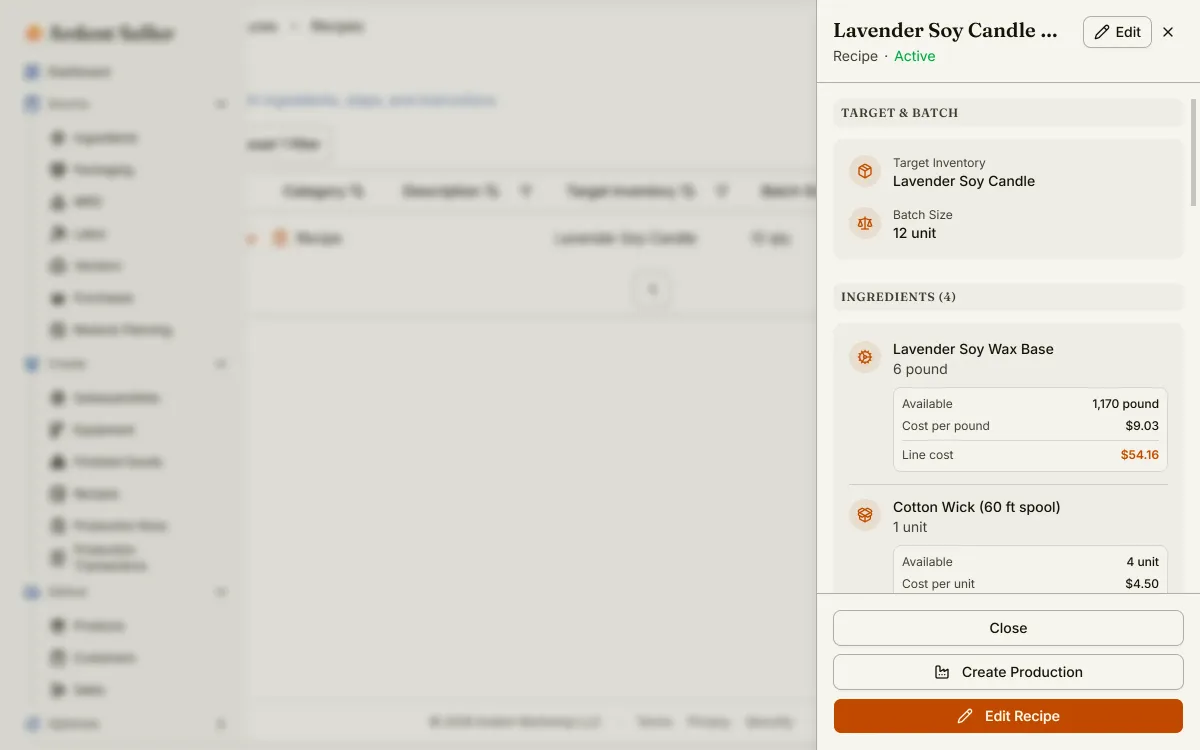
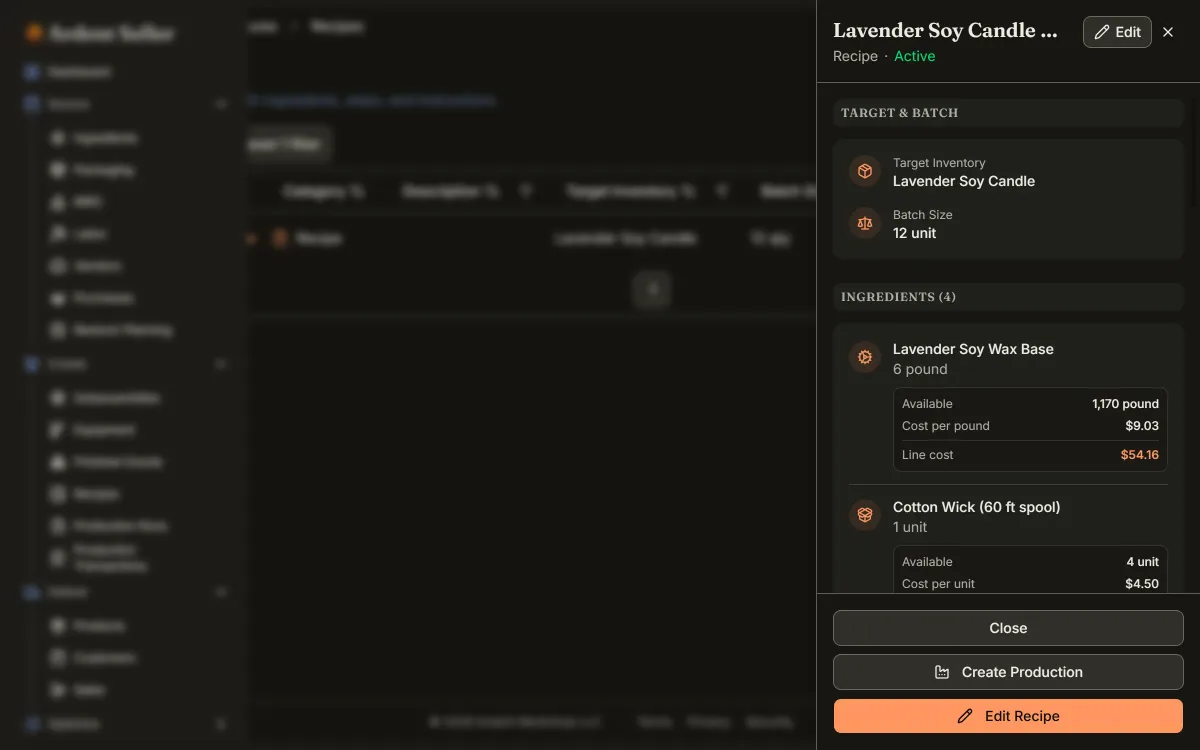
Once a profile is dialed in, treat it as a recipe: the green lot, charge weight, target curve, and drop point. Reproducing that recipe batch after batch is what lets you sell a named coffee that tastes the same in March and June — and it's exactly the kind of production record a tool like Ardent Seller is built to hold (see step 8, on tracking inventory, costs, and taxes).
Step 5: Package and protect freshness
Roasted coffee is perishable and gives off CO2 for days after roasting. Packaging isn't just branding — the bag and valve are what keep your coffee fresh from your roaster to the customer's cup.
Freshly roasted coffee degasses — it releases carbon dioxide for several days. That drives two packaging realities:
- One-way valve bags. Coffee bags use a degassing valve that lets CO2 escape without letting oxygen in. Sealing fresh coffee in a non-valve bag can swell or burst it; leaving it open lets it go stale. Valve bags (with a heat-sealer or zip closure) are the standard.
- Rest before you sell or brew. Most roasters rest beans about 1–3 days (roughly 24–72 hours) after roasting before packing or brewing, so the coffee settles — some specialty espresso is rested longer. Whole bean keeps far longer than pre-ground — selling whole bean (and grinding to order) protects freshness and is the specialty norm.
Common bag sizes are 12 oz (340 g) for retail and 2 lb / 5 lb for wholesale and subscriptions. Label per the FDA rules from step 2, and add a roast date — specialty buyers look for it. Packaging cost (bag + label + valve) is a real per-unit line item: build it into your price in step 6, not as an afterthought.
Step 6: Price for retail and wholesale
Coffee pricing has to absorb three things many new roasters forget: roast loss, packaging, and labor. Skip them and a bag that looks profitable is quietly losing money — especially at wholesale prices.
Start from the true cost of a roasted bag, then set retail and wholesale prices on top of it.
What a 12 oz bag actually costs
- Green coffee, adjusted for roast loss. Green prices vary widely by origin and grade — as of this guide's last update, specialty green was often listed around $8–$12/lb at sellers like Sweet Maria's, but prices move, so check current listings. Using $8/lb as the example: at a 16% roast loss, one pound of green yields about 0.84 lb roasted, so to fill a 12 oz (0.75 lb) roasted bag you need 0.75 ÷ 0.84 ≈ 0.893 lb of green. At $8/lb that's about $7.14 in green — not the $6.00 the unadjusted 0.75 lb weight suggests. Roast loss is the number most beginners miss; substitute your own green cost here.
- Packaging: valve bag + label, roughly $0.30–$0.80 (illustrative — order minimums and bag style move this a lot, so check your actual supplier pricing).
- Labor and roasting overhead: your time roasting, cupping, and packing, plus power and machine wear, amortized per bag. This adds up faster than beginners expect — a small tabletop roaster fills even a modest order only across many back-to-back batches — so track your actual minutes per bag at your machine's batch size and pay yourself a real hourly rate.
As a rough illustration only — not a sourced benchmark — many U.S. specialty micro-roasters list a 12 oz retail bag somewhere in the $14–$22 range; treat that as a starting point and check what comparable roasters in your own market actually charge before setting a price. Wholesale to cafes is typically priced per pound at a meaningful discount to retail (cafes need room to mark it up), which is why wholesale demands tight cost control and volume to be worth it. The two channels have very different math:
- Retail bags — best margin per bag, but you drive every sale and absorb marketing and shipping.
- Wholesale — lower margin per pound, but predictable repeat orders that keep a roaster busy. Build a simple line sheet with wholesale price, case sizes, and lead time.
- Subscriptions — recurring revenue and predictable roasting volume; a strong fit once you have a few reliable coffees.
Run the yield and pricing calculators below on your own green cost, roast loss, and packaging before setting a price — the figures above are illustrative and shift with origin, roast level, and bag size.
Step 7: Choose where to sell
Coffee sells well across a wide range of channels — direct online, at markets, by subscription, and wholesale to cafes. Each trades margin, effort, and predictability differently.
The common starting channels for a new roastery:
- Your own online store (Shopify / Squarespace) — full margin and control, and the natural home for a subscription. You drive every visitor, so it pairs best with local and social traffic. Subscriptions on your own store can be your highest-value channel once you have repeat customers, because the no-commission margin compounds on recurring orders.
- Farmers markets and local events — direct sales, instant feedback, and brand-building with samples. Booth fees and weekend time are the cost; great for finding your first regulars.
- Wholesale to cafes, restaurants, and offices — the volume channel for many roasters. Lower per-pound margin, but predictable repeat orders. Expect to provide samples and sometimes brew training.
- Local grocers and bottle shops — shelf placement with repeat reorders, usually at wholesale or consignment terms.
- Marketplaces (Amazon, Etsy) — reach, but with fees and freshness/shipping-speed challenges for a perishable product. Specialty buyers typically expect fresh coffee, so it works best for roasters who can roast-to-ship within about 2–3 days and keep total roast-to-delivery under roughly 7–10 days (check your carrier's published transit map to see whether ground shipping reaches your customers in time); if your fulfillment can't hit that, defer it. Usually a later, secondary channel. Of these two, Ardent Seller currently syncs Etsy sales automatically (Amazon and other channels are in development), which simplifies reconciliation once your fulfillment is ready.
A common opening combination is a Shopify store plus local farmers markets (online margin plus in-person discovery), then layering wholesale once your roasting is consistent and you can reliably hit volume. Whatever the mix, you'll need to track stock and cost across all of it — step 8, on tracking inventory, costs, and taxes.
Step 8: Track green inventory, costs, and taxes from day one
Coffee creates a specific tracking problem: you buy green by the lot, lose weight in the roast, and sell roasted across multiple bag sizes and channels. Staying on top of cost-per-bag and stock is the operational reality once sales start.
For a couple of coffees a spreadsheet is fine. Past that, the math gets brittle in ways specific to roasting:
- You buy green by the pound but sell roasted by the bag — and roast loss means the conversion isn't one-to-one, so manual cost-per-bag math drifts.
- One green lot becomes multiple roasted SKUs (12 oz, 2 lb, 5 lb; whole vs ground) and a spreadsheet stops tracking which is actually in stock.
- A wholesale order ships and you forget to deduct the green; you over-promise a single-origin that just ran out.
- Green prices change between lots, and your true COGS quietly moves with them.
- Tax time arrives and you can't tell the IRS what the coffee you sold actually cost to produce.
A rough heuristic: once you're past a handful of coffees, selling on more than one channel, or running wholesale accounts, dedicated software starts to pay for itself. Ardent Seller is built for exactly this — track green lots by cost and weight, model each roast as a production batch that converts green to roasted (capturing your roast loss), see true cost per bag across every size, and reconcile retail and wholesale sales. The Tools section below covers the full range from free spreadsheets up.
Keep two tax items separate: sales tax (collection rules vary by channel and state) and income tax (roasting profit goes on Schedule C; quarterly estimated taxes via Form 1040-ES are required once you expect to owe $1,000+ for the year).
The tools section
Tools to consider
A short, honest list — Ardent Seller alongside the other tools most coffee roasting business owners end up using.
Track green coffee lots by cost and weight, model each roast as a production batch that converts green to roasted (capturing roast loss), and see true cost per bag across every size and channel. Build named coffees as products with auto-generated SKUs, and reconcile retail and wholesale sales. Free plan covers a small catalog; paid plans add Etsy sync (more marketplace channels in development) and deeper reporting.
Roast-logging software that records your temperature curve and roast events. The core desktop app is free and open-source; the optional artisan.plus cloud service is a paid subscription. A common free starting point for building repeatable roast profiles.
Widely used commercial roasting software for profile logging, green inventory, and production once you scale into serious wholesale volume. Subscription pricing — see their site for current rates.
Specialty green-coffee seller with small-lot and sample-sized bags, detailed origin and cupping notes, and home-roasting resources. A common first green supplier for new roasters before moving to full-bag importers.
Hosted online store with built-in subscription apps — the natural home for direct retail bags and a coffee subscription. No platform commission on your own store; monthly subscription plus payment processing.
Tracks income and expenses for tax purposes and exports a Schedule C summary at year-end. Pricing changes — see Intuit's pricing page for current rates.
Common mistakes to avoid
The patterns that show up over and over in the first year.
Treating roasting as a hobby, not a food business
The most expensive mistake: roasting in an unlicensed home kitchen, skipping FDA-compliant labels, or assuming cottage food laws cover coffee (they usually don't). Roasting for sale is food manufacturing. Sort out the production space, labeling, and facility registration before your first sale — verify with your state (step 2).
Ignoring roast loss in your pricing
Beans typically lose about 12–20% of green weight in the roast (commonly 15–18% for a medium roast, more for darker), so a pound of green yields only roughly 0.80–0.88 lb roasted. Pricing off green weight instead of roasted weight quietly understates your cost on every bag. Build roast loss into both purchasing and pricing (steps 3 and 6).
Buying too big a roaster too early
A 5 kg+ machine with three-phase power and an afterburner is easy to want before you have the wholesale accounts to justify it. Rent roaster time or start on a ~1 kg machine, prove demand, then scale — used roasters hold value, so upgrading later is low-risk (step 1).
Selling stale or under-rested coffee
Packing coffee straight off the roaster (before it degasses) can swell bags and dull flavor; pre-grinding kills freshness fast. Rest beans 24–72 hours, use one-way valve bags, sell whole bean, and date your bags (step 5).
Chasing wholesale before retail is profitable
Wholesale feels like growth, but its per-pound margin is thin — if your retail bag math is shaky, wholesale loses money faster. Get cost-per-bag right and a profitable retail price first, then pursue wholesale for volume (step 6).
Mixing personal and business money
Open a separate business checking account on day one. Green coffee, bags, and equipment are real deductible costs — at tax time the difference between five minutes and five hours of bookkeeping is whether those expenses sit in their own account (step 2).
Frequently asked questions
The questions new makers ask most often.
Do I need a license to sell roasted coffee?
In most U.S. states, yes — roasting coffee for sale is treated as food manufacturing, so you generally need to produce in a licensed commercial or shared kitchen, label to FDA food rules, and (for most non-retail operations) register your facility with the FDA. You'll also typically need a general business registration and a sales-tax permit. Cottage food laws that allow some home-made foods often exclude roasted coffee. Requirements vary by state, so confirm with your state department of agriculture or health before you sell.
How much does it cost to start a coffee roasting business?
A realistic range is $1,000 to $20,000. At the low end you can rent time at a shared roastery or start on a small home/sample roaster ($200–$1,000) and reinvest. A typical nano-roastery built around a ~1 kg tabletop roaster runs roughly $3,000–$8,000 for the machine, plus green coffee, valve bags, labels, a scale, and a grinder. A dedicated shop roaster (5 kg+) with the power and ventilation it needs pushes well past $10,000. Most roasters start small and scale once wholesale demand is proven.
How long does it take to start selling coffee?
Plan on one to three months. The craft comes fast — a few weeks of practice and cupping gets you to a sellable profile. The calendar is usually set by the business side: securing a legal production space, registering the business and (for most) the food facility, designing compliant labels, and ordering packaging. Renting roaster time and selling at a farmers market can shorten this to weeks; building out a registered space takes longer.
What is roast loss and why does it matter for pricing?
Roast loss (or shrinkage) is the weight green coffee loses during roasting as moisture evaporates and chaff is shed — typically about 12–20% (commonly 15–18% for a medium roast), with lighter roasts losing less and darker roasts more. It matters because you buy green by the pound but sell roasted by the bag, so a pound of green yields only roughly 0.80–0.88 lb of roasted coffee. Pricing off green weight instead of roasted weight understates your true cost on every bag, which is why roast loss has to be built into both your green purchasing and your per-bag price.
Can I roast coffee at home and sell it?
You can roast at home to learn and practice, but selling what you roast is usually a different matter. In many states, coffee sold to the public must be roasted in an inspected commercial or shared kitchen rather than a home kitchen, and cottage food laws often don't cover roasted coffee. Home roasting also produces smoke and chaff and needs real ventilation. Many people start by renting time at a shared roastery or co-roasting space, which provides a compliant facility without the build-out cost. Always verify your state's rules before selling.
Is retail or wholesale better for a new roaster?
They serve different goals. Retail bags — sold through your own store, at markets, or by subscription — carry the best margin per bag, but you drive every sale. Wholesale to cafes and offices has thinner per-pound margins because buyers need room to mark it up, but it delivers predictable repeat volume that keeps a roaster busy. Most roasters get retail pricing profitable first, then add wholesale for volume once their roasting is consistent enough to reliably hit larger orders. A subscription on your own store is often the highest-value channel of all.
How do I keep roasted coffee fresh?
Three things protect freshness: rest, packaging, and grind. Rest beans 24–72 hours after roasting so they can release built-up carbon dioxide (degassing) before you seal the bag. Pack in one-way valve bags, which let carbon dioxide escape without letting oxygen in. And sell whole bean rather than pre-ground, since ground coffee goes stale far faster — grind to order if customers want it. Adding a roast date to your bags signals freshness to specialty buyers and helps you rotate stock.
Free resources
Hand-picked calculators, checklists, and templates that map directly to the steps above.
Enter green weight, roast level, and retail bag size — get roasted weight, bag count, and (with green price + packaging + labor) the cost of goods per bag.
A working Excel workbook for small-batch coffee roasters — roast profile log (charge temp, first-crack time, drop temp, development ratio), SCA-style cupping scores by lot, a 4-component blend calculator, and per-bag costing that picks up the actual measured weight loss from each roast.
Live web version of our Excel pricing calculator. Materials + labor + packaging + platform fees → defensible retail at your target margin, with batch-pricing tiers.
Pick a target hourly rate, enter your materials, hands-on minutes per unit, and platform fees — the calculator returns the minimum price that actually pays you that rate after fees and costs. Maker-business specific, not a "freelance day rate" tool.
A working Excel line sheet for handmade wholesale — buyer-ready front sheet, per-SKU pricing math behind it, and the formulas already wired in.
36 things to set up before — and after — your first sale. Inventory, pricing, and the legal essentials in one place.
A working Excel inventory tracker for makers — raw materials, finished goods, packaging, and a purchase log. Reorder thresholds and a status column do the math; conditional formatting flashes red when you are below the line.
A four-page fillable PDF for tracking suppliers — vendor records, an alternate-supplier scoring sheet, and a one-row-per-vendor master index. Type into it in your PDF reader, or print blank copies for the clipboard.
A free, scoped-for-small-sellers economic-nexus checker. Enter your trailing 12-month sales and transactions per state, and the tool flags every state where you have probably crossed the post-Wayfair economic-nexus threshold — without pushing you into a filing product.
Walk through the nine factors of Treasury Regulation §1.183-2(b) and find out whether your side activity qualifies as a for-profit business or a hobby for federal tax purposes — and where to focus to strengthen the business case.
When a spreadsheet is enough, when it stops working, and how to tell the difference before it costs you.
A working Excel worksheet for sellers reconciling Etsy + Shopify + in-person sales against bank deposits — surfaces fee shortfalls, refund mis-postings, and a per-channel monthly P&L.
A working Excel worksheet for self-employed makers — log income, set filing status, and the four quarterly estimated-tax payments calculate themselves. SE tax (15.3%) plus federal income tax math built in, with a safe-harbor escape hatch on its own tab.
A working Excel expense tracker organized by IRS Schedule C category. Drop-down picker on every row, a Monthly Summary that builds itself, a year-end Schedule C view, and a mileage log with the deduction calculated for you.
Read next
Deeper dives on the topics that come up in the guide.
Green coffee loses 15-20% of its weight during roasting — and that vanishing weight takes your profit margins with it if you are not tracking it. Learn how to manage green bean inventory by origin lot, calculate roast loss per batch, and price your bags based on what they actually cost to produce.
Learn how to calculate the real cost of every product you make — from raw ingredients to labor and overhead — so you can price with confidence and protect your profit margins.
COGS is the single number that quietly decides whether your maker business is profitable, what your taxes look like, and which products are worth keeping in the catalog. Here is what it actually means, what goes in (and what stays out), and how to start tracking it this week — without an accounting degree.
A six-gate decision framework for makers staring at an email from a boutique buyer. Margin cushion, production headroom, retail price firewall, terms creep tolerance, packaging fit, and fulfillment cadence — the six conditions that separate the wholesale yes that builds a business from the wholesale yes that eats a year.
Most handmade sellers think "nexus" is something only big companies worry about. Then they ship their 250th candle to a customer in Pennsylvania and unknowingly cross an economic threshold they have never heard of. This guide defines the terms, dismantles the most common myths, and explains what a small seller should actually do — without the legalese.
Once you're selling, you'll need to track it
Tracking inventory, costs, and taxes across every batch and every channel is the operational reality once sales start. Ardent Seller is purpose-built for this.
Specialty coffee roasters & small-batch roasteries
Ready to start?
Track every batch, recipe, and sale from day one of your coffee roasting business. Free plan, no credit card.