
The studio smells like damp clay and cardboard. It is Tuesday, the kiln has been off since Sunday, and there are eleven mugs on the bench waiting to go into boxes. Somewhere under the table is the roll of bubble wrap that was supposed to last the month, now down to a stub. The tape gun makes that sound.
This is the part of pottery nobody photographs for Instagram: the hour between "sold" and "shipped," where a piece you spent three weeks on gets handed to a conveyor belt that will drop it, tumble it, and stack a forty-pound box of dog food on top of it. Most of them arrive fine. The ones that don't turn into a message on a Saturday morning with a photo of your work in pieces, and a question you have four seconds to answer well.
The short of it: a piece that survives is double-boxed — wrapped, immobilized in an inner box with two inches of cushioning on every face, then suspended in three more inches inside an outer box six inches larger in every direction. A piece that does not survive is a claim, and the claim is decided by evidence you can only collect while you pack. If one already arrived broken, go straight to what to do when a pot arrives broken — the filing clock is probably already running.
That is easier to see through one potter than in the abstract. Lorna throws stoneware — mugs, a few lidded jars, the occasional large vessel she resents shipping. She is a composite, assembled from the ways this goes wrong rather than from any one person. Follow her through a pack and a broken arrival, because the packing and the claim are the same problem viewed from two ends.
Why pottery breaks in transit
It is almost never a dramatic drop. It is the boring stuff: the vibration of a trailer floor for eleven hundred miles, the shock of a chute transfer, the moment a heavier box lands on yours in a cart. Ceramic does not fail gradually. It absorbs energy until it doesn't.
Which means the packing question is not "how much padding," it is "what is the piece touching." Anything rigid that touches the pot becomes a transmission path — a box wall, a second mug, the hard edge of a folded insert. Anything hollow that stays hollow becomes a place for a handle to snap into. The rule Lorna finally internalized after her third breakage: the piece should be suspended, not surrounded.
Carriers say the same thing in their own language. UPS notes that its published box-strength figures "are only guidelines" and that packaged products should be tested to International Safe Transit Association Test Procedure 3A (UPS Packaging Guidelines (opens in new tab)). That is an independent shipping-test standard, and you are not going to run it on a mug. But it tells you what the box is being asked to survive, and it is not a gentle ride.
The packing method, step by step
Seven steps. The first four build the inner package; the last three build the shell that keeps the inner package from ever touching the outside world.
Wrap the piece so nothing hard touches it. FedEx puts a number on this: wrap fragile products individually in "a minimum 3" thickness of air-cellular cushioning material" (FedEx, Packing breakables 101 (opens in new tab)). For a mug that means several full passes of bubble, not one polite lap. Wrap the handle separately first, then wrap the body over it, so the handle is bedded rather than protruding.
Fill the void inside the piece. A hollow form is a drum. Crumpled paper inside a mug, a jar, or a vase dampens the ring and stops the walls flexing. Do not pack it tight enough to wedge — you are damping, not stressing.
Immobilize it in an inner box with two inches on every face. UPS is specific here: "Use at least two inches of appropriate cushioning material to protect internal items from each other and the corners, sides, top and bottom of containers," and, because loose fill settles, "use a minimum of two inches of cushioning around the contents of the box." Two inches on the bottom matters most. Most parcels land on a corner or a base.
Do the rattle test. Close the inner box, tape it, and tip it end over end. If you hear or feel movement, open it and add fill. This takes eight seconds and catches a failure that is easy to miss: a piece cushioned generously on five faces and not at all on the sixth.
Choose an outer box six inches larger in every dimension. This is the two-box method, which UPS recommends for "sharp, fragile goods": for the outer box, "use a box that has a depth, width, and length 6" greater than the inner box."
Suspend the inner box in three inches of cushioning. UPS: "Secure your box with an additional 3" of cushioning material around the inner box to fill the spaces between the inner box and outer box." FedEx gives the same figure — "Double-box fragile items within a larger box and include 3" of cushioning in and around the interior box." Two independent carriers landing on three inches is about as close to an industry standard as parcel packing gets.
Tape an H and label it. Tape the center seam and both edge seams, top and bottom. Then mark the box as fragile — and understand exactly what that marking buys you, which is the subject of a later section and is less than you think.
The pack that costs the least is the one you never redo. For Lorna, a second box and a bag of fill runs roughly $2–$4 on a mug. A remake is your clay, your glaze, a kiln slot, three weeks of calendar, and a customer who now waits twice.
Handles, lids, plates, and anything over twelve inches
The seven steps handle a mug. Four shapes need something extra.
Handles are a common failure point, and they usually go from a lever action rather than an impact — the body moves, the handle stays, the join fails. Bed the handle first so it cannot act as a lever against the wrapping.
Lidded jars should never ship assembled and loose. Either wrap the lid separately and nest it beside the body in the same inner box, or seat it and tape across the seam so it cannot lift and chatter. A lid that bounces a quarter inch a thousand times will chip the lip it rests on.
Plates and shallow bowls ship on edge, not stacked flat. Flat-stacked plates concentrate the whole column's mass on the lowest rim. On edge, with dividers, each piece carries only itself.
Anything over about twelve inches should be treated as a different product. Larger vessels have more mass, longer lever arms, and a much worse ratio of surface area to strength. Lorna's rule is that big work either goes double-boxed with foam-in-place, or goes local pickup, or gets priced with the real packing cost in it — a $9 box-and-fill bill on a $380 vessel is not a rounding error to hide.
What "Fragile" and included insurance actually buy you
Marking a box fragile is a request, not a contract. USPS tells mailers that fragile items "need to be identified on the outside of the package" (USPS packaging tips (opens in new tab)), and that marking does travel with the box — but nothing in it creates coverage, upgrades handling, or shifts liability. What decides whether you get paid is a list published in the Domestic Mail Manual, and two entries on it are aimed directly at work like yours.
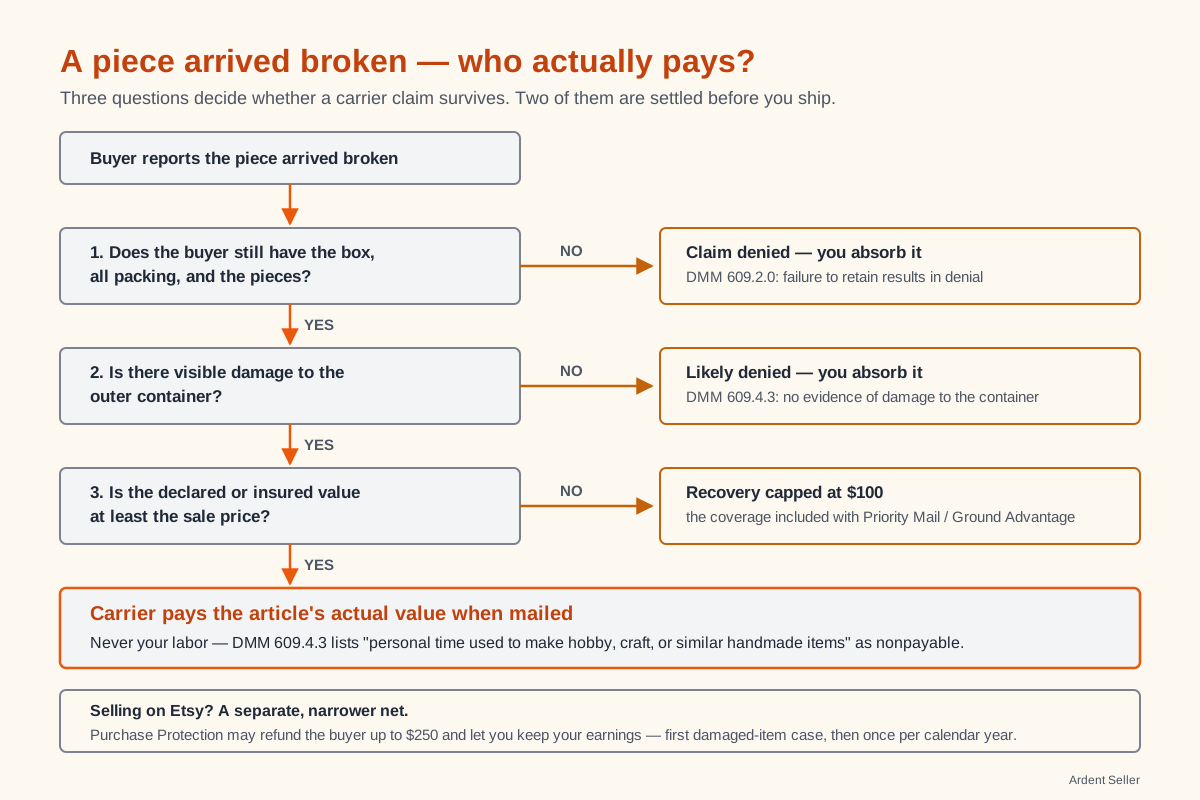
The Postal Service will not pay when the "fragile nature of article prevented its safe carriage in the mail, regardless of packaging," and it will not pay for "damage caused by shock, transportation environment, or x-ray, without evidence of damage to the mailing container" (DMM 609.4.3 (opens in new tab)).
Read that second clause again. If the outer box arrives pristine and the pot inside is in four pieces, the rule as written points at a denial — because there is no evidence the container took the abuse. The undamaged box is not proof of your innocence. It is the carrier's argument that the packing, not the transport, failed.
The same section rules out "any item packaged in such a manner that it could not have reached its destination undamaged in the normal course of the mail." Packing standards are not just a way to avoid breakage. They are the standard your claim gets measured against afterward.
As for coverage: Priority Mail Express and Priority Mail "include up to $100 of insurance in the price," and the shipment must carry a USPS Tracking barcode to qualify for it. Beyond that you can buy up to $5,000, priced on declared value — what you tell USPS the piece is worth — and "starting at $2.80" (USPS, Insurance and Extra Services (opens in new tab)). USPS Ground Advantage also includes $100 (USPS Ground Advantage (opens in new tab)).
So the honest version, in Lorna's numbers: her $46 mug is covered by default, her $380 vessel is covered for about a quarter of itself unless she spends a few dollars more, and neither is covered at all if the box looks fine.
The five minutes at pack time that decide the claim
Every piece of evidence a claim needs is available for free while you are packing, and unavailable forever afterward.
Take four photographs as you go: the wrapped piece in the inner box before you close it, the inner box seated in the outer box with the cushioning visible, the sealed outer box, and the shipping label with the tracking number legible. That sequence is not paranoia — it is close to exactly what UPS asks for on a damage claim: a photo showing the damaged item and how it was packaged inside the box, one photo of the outside of the package showing any damage, and a close-up of the shipping label with the tracking number (UPS, Supporting Documents for Claims (opens in new tab)).
Then keep those photos where the order is. This is the small operational thing that separates a fifteen-minute claim from a two-hour archaeology dig through your camera roll: when the message arrives six weeks later, you want the sale, the price you charged, the tracking number, and the pack photos to be one lookup, not four. In Ardent Seller you can attach files and photos to the record itself, so the proof of value and the proof of packing sit with the order rather than in three different apps. When a piece is genuinely lost to breakage, logging it as a loss also keeps breakage visible as a real cost instead of a vague sense that shipping is expensive.
Lorna's number, once she tracked it for a year, was that breakage cost her more in remakes than in refunds. That is not a number you can act on until you can see it.
What to do when a pot arrives broken
The message comes in with a photo. Here is the order of operations, and the first step is the one people get wrong.
Tell the buyer to keep everything — before you apologize. USPS rules are blunt: the addressee "must retain the mailing container, including any damaged articles, all packaging, and any contents received," must make it available for inspection on request, and "failure to do so will result in denial of the claim" (DMM 609.2.0 (opens in new tab)). UPS sets the same expectation from the other side, and holds a stronger card than photos alone: "During a damage claim, photo documentation will be required and a physical inspection at a UPS-approved location may be needed as well" (UPS, Supporting Documents for Claims (opens in new tab)). The inspection is UPS's call, not the buyer's — which is one more reason the box cannot go out with the recycling.
The instinct is to lead with "I'm so sorry, I'll send a replacement right away." A buyer who hears that sweeps the shards into the trash with the box. Lorna learned this on a $210 order: gracious message on Saturday, trash pickup on Monday, claim denied on Thursday. Lead with the request, then apologize, then fix it — or keep the wording ready in the Customer Service Response Starter so the order survives your own good manners.
Ask for their photos. The broken piece as it sits in the packaging, the packaging itself, and any damage to the outer box. That last one is the evidence the whole claim hangs on.
File inside the window, and know which clock you are on. Two of the three carriers start counting the moment you ship, not when the box arrives — so check which clock applies before you do anything else. A broken piece is a damage claim, and that is the column that governs you; the loss column is for the parcel that never turns up at all, and its longer windows are not yours to use.
Carrier claim deadlines for damage and for loss, and when each clock starts Carrier Damage / missing contents When the clock starts Loss USPS 60 days Date of mailing 15–60 days from mailing (7–60 for Priority Mail Express) FedEx (US) 60 calendar days Shipment date Nine months from shipment date UPS 60 days Scheduled delivery date 60 days from scheduled delivery date Sources: DMM 609.1.4 (opens in new tab), FedEx claims (opens in new tab), UPS, File a Claim (opens in new tab).
A parcel that takes nine days to arrive and a buyer who takes three weeks to open it have already spent half your USPS window, and the postmarked mailing receipt is what proves the date.
Submit proof of value. USPS accepts "a sales receipt, paid invoice or bill of sale, or statement of value from a reputable dealer" (DMM 609.3.2 (opens in new tab)). Your paid Etsy or Shopify order is a paid invoice. It is the strongest single document you have, and it is why the price you actually charged — not what you wish you charged — is the number that gets paid.
Appeal if denied. A customer may appeal a claim decision "within 30 days from the date of the original decision," and if that appeal is denied, submit a further appeal within 30 days for final review (DMM 609.6.2 and 609.6.3 (opens in new tab)). Denials on first pass are common enough that treating one as final leaves money on the table.
What you can actually recover, and what you can't
This is where the arithmetic gets uncomfortable.
USPS pays "the article's actual value when mailed" and no more, and for a used article it applies depreciation based on life expectancy (DMM 609.5.1 and 609.5.2 (opens in new tab)). Fine — a new mug sold at $46 has an actual value of $46, evidenced by the paid invoice.
What it does not pay for is the entry sitting a few lines up the nonpayable list: "personal time used to make hobby, craft, or similar handmade items." Your labor is explicitly excluded. So is the "cost incurred for estimates and appraisals," which means the repair estimate a claim sometimes asks for is on you.
For Lorna's mug that shakes out like this. Clay, glaze, and her share of two firings run about $9.80. Throwing, trimming, handling, glazing, and loading run about 45 minutes of her time. The claim pays the $46 sale price — which does cover her materials and her margin on that sale, because the sale price is the measure. What it never covers is the second 45 minutes she now spends making the replacement, or the kiln slot it occupies, or the three weeks the buyer waits. The claim makes the sale whole. It does not make the day whole. That gap is the real cost of a breakage, and it is the argument for spending four more dollars on the box.
Etsy's Purchase Protection is not shipping insurance
If you sell on Etsy, there is a second, narrower safety net, and it is easy to over-trust.
Etsy may refund a buyer up to $250 — including shipping and taxes collected on the platform — without holding the seller responsible, and in a covered case you keep your earnings. But for damaged items specifically, Etsy supports a seller's first eligible case and once for each calendar year thereafter (Etsy, Purchase Protection Program for Sellers (opens in new tab)). Anything past that, anything over $250, and anything outside the program's shipping requirements comes back to you.
For Lorna the arithmetic is stark: her $46 mug sits comfortably inside the $250 ceiling, but a broken $380 vessel does not — Etsy would cover $250 of it and the remaining $130 is hers. Either one spends her single covered damage case for the year. For most sellers, one covered damage case a year is generous. For a potter, one covered damage case a year is a season. And Etsy revised this program more than once in 2026 — the version quoted here took effect on July 9, 2026 — so read the current policy rather than a summary of it, this one included.
Refund, remake, or partial refund
When a piece breaks, there are only three moves: refund, remake, or partial refund with the buyer keeping the pieces. Refund is fastest and costs you the sale. Remake costs you the labor twice but keeps a customer who wanted that mug. The third one is underused and often the best deal for both sides on a small chip — a buyer who loves the piece frequently prefers $12 back over waiting a month.
What should decide it is not guilt. It is whether the claim is likely to pay: if the outer box was visibly damaged and the buyer still has everything, you are probably recovering the sale price and can afford to be generous. If the box arrived clean, you are almost certainly eating this one, and the generous move needs to be sized accordingly.
Lorna's shipping is boring now. Two boxes, three inches, four photos, one rattle test. She still breaks a piece two or three times a year, because eleven hundred miles of trailer floor eventually finds every weakness. The difference is that a broken piece is now a fifteen-minute process with a known outcome instead of a Saturday that gets away from her.
Pack the next one as if the claim depends on it, because as far as the carrier's rules are concerned, it does. If you want the sale, the price, the tracking number, and the pack photos to live in one place when that message arrives, start a free Ardent Seller account and put them there before you need them.
Related reading
- How to Label Handmade Products — the other half of what goes in the box: which label elements are legally required on a handmade product before it ships.
- Shipping Math for Handmade Sellers — the cost side of the same box: dimensional weight, void fill, and how to calculate what a shipment actually costs you before you offer free shipping on it.
- Kiln Costs and Pricing for Ceramics — the cost-per-firing math behind the $9.80 materials figure above, worked properly for your kiln and your rates.
- Product Liability Insurance for Handmade Sellers — carrier indemnity covers a broken pot in transit; this covers the very different problem of a pot that hurts someone after it arrives.
Free resources
Free companion downloads if you want to put any of this into practice:
- Customer Service Response Starter — ready-made wording for the "it arrived broken" message, so the request to keep the box and packing comes out calm and comes out first.
- Shop Policy Starter — write your shipping-damage and replacement terms into your policies now, instead of inventing them on a Saturday morning with a photo of shards on your screen.
This article is general information about carrier packaging standards and claim procedures, not legal, insurance, or financial advice. Carrier rules, filing windows, indemnity limits, and marketplace protection programs change, and the terms that apply to your shipment are the ones published by that carrier or marketplace on the date you ship. Verify current requirements with USPS, UPS, FedEx, or your marketplace before relying on any figure here, and consult a qualified professional about coverage decisions for high-value work.