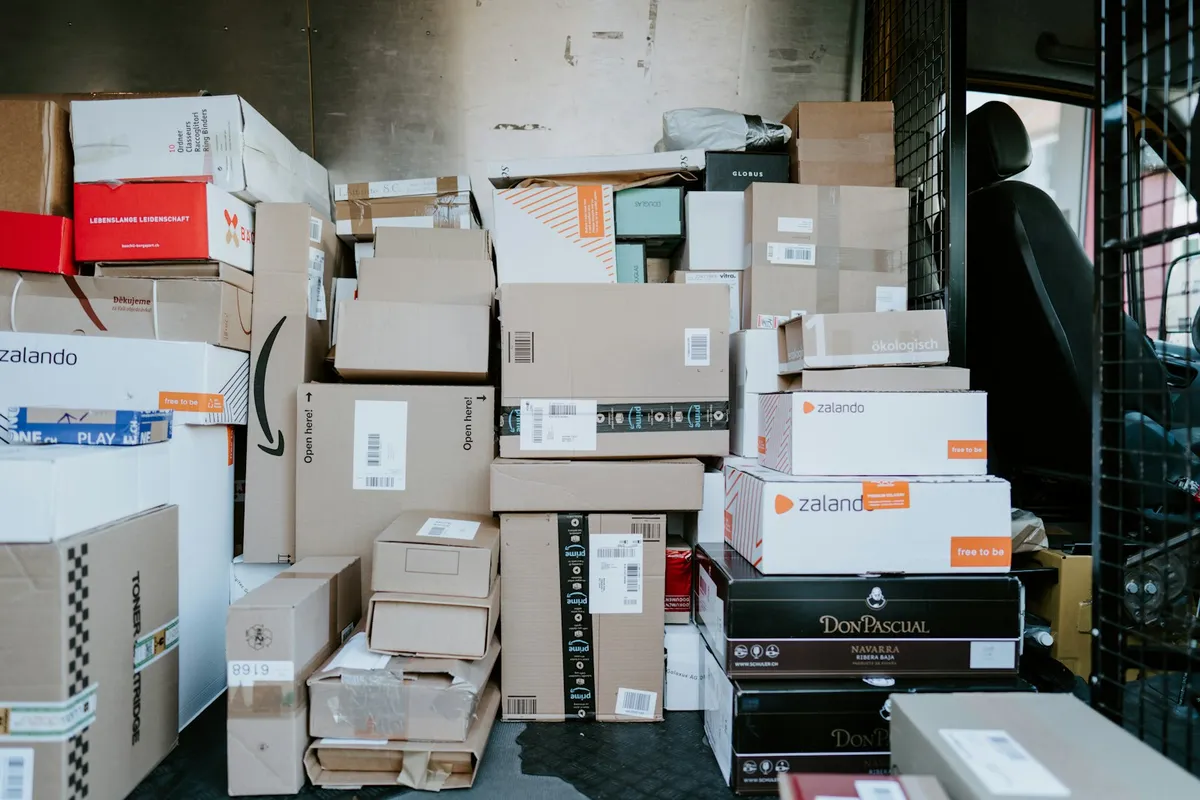
Shipping costs are the only recurring business expense small sellers routinely undercount by something like forty percent and then blame on vibes. The label is the visible part. The box, the fill, the label subscription, the dimensional-weight upcharge, the card fee on the shipping the customer already paid you, the Tuesday-afternoon order that took twice as long to pack because the tape dispenser ate three feet of tape: those are the rest of the iceberg, and they are the part that drills holes in the boat.
Carriers wrote the contract. Platforms translated it badly. Small sellers sign it every day while looking at the wrong number.
The label is not the shipping cost
Ask a seller what it costs to ship a candle and you will hear a number. Almost always it is the postage. Almost never is that number right. The postage is one line on a larger bill, one that runs through packaging suppliers, label software, payment processors, and the clock on the wall.
A shipped package is a small manufacturing project. It has bill-of-materials costs, labor costs, platform fees, and an overhead slice. Pretending the label represents the whole thing is how a "break-even shipping charge" of seven dollars and eighty cents turns into a net loss by the time the accountant is done.
This article is about the other six costs.
The eight things inside a shipped package
Every order you ship carries the same general cost structure. The weights change by category, but the categories do not. Here is the full list, in the order most sellers remember them, which is to say roughly backwards.
| # | Cost component | Typical range per order | Usually forgotten? |
|---|---|---|---|
| 1 | Carrier postage (the label) | $4.00 to $12.00 | No |
| 2 | Dimensional-weight surcharge | $0 to $6.00 | Yes |
| 3 | Outer box or mailer | $0.40 to $2.50 | Partially |
| 4 | Void fill (paper, peanuts, air pillows) | $0.10 to $0.80 | Yes |
| 5 | Tape, labels, tissue, thank-you card | $0.20 to $0.75 | Almost always |
| 6 | Label platform or software fee | $0.05 to $0.30 | Yes |
| 7 | Payment processor fee on the freight charge | 2.9% + $0.30 of the shipping portion (Stripe pricing (opens in new tab)) | Yes |
| 8 | Packing labor | 5 to 15 minutes at your loaded labor rate | Yes |
Add those up for a typical candle in a 6x6x6 box shipping to a Zone 4 destination, and the "shipping cost" a seller quoted to themselves as seven dollars and eighty cents becomes something closer to twelve or thirteen dollars out the door. The customer may have paid six. The seller ate the difference and called it growth.
The next few sections walk through the categories most sellers get wrong.
Dimensional weight: the carriers' favorite trick
Here is the rule: you pay the greater of actual weight or dimensional weight. Dimensional weight is calculated by taking the box's cubic inches and dividing by a divisor, which for most domestic ground services in 2026 is 139 (UPS dimensional weight (opens in new tab)). A box that weighs half a pound but measures 12x12x12 has a dimensional weight of about 12.4 pounds. You pay for thirteen pounds of postage on half a pound of actual product.
Handmade sellers get hit by this constantly because their packaging tends to be oversized for protection. Pottery in a double-walled box, candles in a roomy cushioned mailer, soap packed with generous paper fill. A featherweight product in a protective box pays postage as if it were a brick.
| Box size (inches) | Actual weight (lb) | DIM weight (lb) | Billable weight | Approximate rate (Zone 4) |
|---|---|---|---|---|
| 6 x 6 x 6 | 0.5 | 1.6 | 2 | $8.95 |
| 10 x 8 x 6 | 1.0 | 3.5 | 4 | $11.40 |
| 12 x 12 x 12 | 0.5 | 12.4 | 13 | $22.30 |
| 14 x 10 x 10 | 2.0 | 10.1 | 11 | $19.80 |
| 18 x 12 x 6 | 1.5 | 9.3 | 10 | $18.50 |
Rates are illustrative 2026 retail ground prices rounded for clarity (USPS Ground Advantage retail prices (opens in new tab)). Your actual rate depends on carrier, service level, and any commercial discount.
Two moves cut the DIM surcharge. First, size your boxes to the product rather than to whichever box size you happen to buy in bulk. Second, track package dimensions as an attribute of each product so the math shows up the moment you list it. A product whose DIM weight meaningfully exceeds its actual weight has a structural shipping problem, and no amount of customer promotion will fix it.
Zone pricing: the map nobody showed you
Carrier rates are priced by zone, a rough measure of the distance between the origin ZIP and the destination ZIP, bucketed from Zone 1 (local) through Zone 8 or 9 (the opposite coast, plus Alaska and Hawaii). Rates roughly double between Zone 1 and Zone 8. A seller in Ohio quoting a flat six-dollar shipping rate is eating the difference every time an order ships to Washington State.
| Zone | Rough distance | Illustrative 2 lb ground rate | vs Zone 1 |
|---|---|---|---|
| 1 | Same metro | $7.95 | baseline |
| 2 | About 150 miles | $8.40 | +6% |
| 4 | About 600 miles | $9.80 | +23% |
| 6 | About 1,400 miles | $12.90 | +62% |
| 8 | Coast to coast | $16.50 | +108% |
A flat shipping charge averages these out. That works fine on paper. It does not work fine if your customer mix is geographically lopsided. Sellers on the coasts ship inland on average; sellers in the middle of the country ship to both coasts on average. Whichever direction your customers live, your flat rate is wrong, usually in a way that favors the customer.
Calculated shipping at checkout solves this honestly. Flat rates solve it with marketing. Both are valid; only one of them is math.
The "free shipping" accounting trick
Free shipping is a pricing decision dressed up as a customer benefit. The label still costs what it costs. Somebody pays. When a listing says "free shipping," that somebody is you.
This is not necessarily wrong. Free shipping can materially lift conversion rates — Etsy itself states that "free shipping leads to a higher purchase rate" and prioritizes low-shipping listings in search (Etsy Seller Handbook: Creating Listings That Convert (opens in new tab)). The magnitude varies widely by category, price point, and how competitors in your niche present shipping costs. The question is whether the lift pays for the subsidy.
Consider a $35 candle a seller lists three ways:
| Scenario | Listed price | Shipping charged | Real shipping cost | Net revenue | Conversion assumption |
|---|---|---|---|---|---|
| A — Paid shipping | $35.00 | $8.00 | $11.50 | $31.50 | baseline |
| B — Free shipping (absorbed) | $35.00 | $0 | $11.50 | $23.50 | +20% |
| C — Free shipping (priced in) | $43.00 | $0 | $11.50 | $31.50 | +20% |
Scenario B is the trap. The seller did not price shipping into the product, checked the free-shipping box because competitors did, and handed $8 of margin to the carrier on every order in exchange for a 20% lift in volume. The math works only if the product's contribution margin was extremely high to begin with. For most handmade goods, it is not.
Scenario C is honest. The customer sees one round number. The seller still collects their margin. The only downside is a slightly higher sticker price, which matters less on handmade goods than sellers think.
Rule of thumb: If you offer free shipping, price it into the product first and then announce it. Announcing first and pricing later is how margin leaves the building.
Payment processing on the shipping charge
Here is a small one that adds up fast. When a customer pays $45 for a product plus $8 in shipping, the payment processor takes its cut of all $53. At a typical 2.9% + $0.30, that is $1.84 total, of which roughly $0.23 is the processor's fee on the shipping portion alone.
Twenty-three cents. Trivial on one order. Across a thousand shipments a year, it is $230. Real money, invisible on the P&L unless someone explicitly allocates it. Most sellers book the processor fee as a lump-sum expense and never realize a slice of it is attributable to shipping, not product.
The fix is not to switch processors. The fix is to understand that "cost of shipping" is a slightly bigger number than the invoice from the carrier. Every ancillary fee that moves with the shipping charge belongs in the shipping cost bucket when you are deciding whether to offer free shipping, flat rates, or calculated.
Packaging is inventory, not office supplies
Most sellers treat boxes, mailers, and void fill as a miscellaneous expense. Swipe the card at the supply company, file the receipt under "packaging," move on. This is the single easiest shipping cost to lose track of because the per-unit value is small and the purchase cadence is irregular.
Packaging is inventory. Every box is an SKU. Every spool of tape has a cost per inch. Every tissue sheet is a unit. Treating it that way unlocks a few things at once:
- You can attribute the correct packaging cost to each shipment by product size, not by averaging across all orders
- You can see which packaging SKUs are running out before you are staring at an empty shelf on a shipping day
- You can tell when a bulk packaging deal actually saved money versus when you bought ten thousand of a mailer size you only ship twice a month
- You can roll packaging cost into the true landed cost of every product, which is the number that determines whether the listing is profitable
This is the part where tracking software stops being optional. Treating packaging as inventory means managing it the same way you manage finished products, with quantities, unit costs, reorder points, and consumption tied to the transactions that used them. Ardent Seller tracks packaging alongside raw materials and finished goods, and attributes the exact packaging cost to each sale instead of smearing it across the month as generic overhead.
Packing labor: the cost you paid yourself to forget
A handmade seller who values their time at $20 an hour and packs an order in seven minutes just put $2.33 of labor into that order. On twenty orders, that is $46.60 of labor hidden inside "shipping." Across a year at modest volume, it is three to five thousand dollars of pay that was never expensed, never invoiced, and never priced.
You do not have to allocate packing labor to every individual order to benefit from tracking it. A rough monthly estimate — "we shipped about 80 orders, averaging 8 minutes each, at $20 per hour, for roughly $212 in packing labor" — is enough to put a number on the P&L and to notice when volume rises faster than your packing efficiency does.
If you are the only person packing orders and you are not paying yourself a formal wage, the labor still has a cost. The hour you spent with tape in one hand is an hour you did not spend making product. The bill gets paid in either money or growth.
What a real per-order shipping cost looks like
Here is the candle order from the opening, costed out in full. This is the table most sellers do not run and most accountants do not insist on. It is the one that answers the question "is shipping actually eating my margin."
| Cost line | Amount |
|---|---|
| Carrier postage (Zone 4, 2 lb billable) | $8.95 |
| Box (6 x 6 x 6 corrugated) | $0.70 |
| Void fill (crinkle paper) | $0.25 |
| Tape, label, thank-you card | $0.45 |
| Label platform fee | $0.08 |
| Payment processor fee on $8 shipping charge | $0.23 |
| Packing labor (6 minutes at $20/hr) | $2.00 |
| Total landed shipping cost | $12.66 |
The customer paid $8. The seller paid $12.66. Every order in that bucket leaves a $4.66 hole before the product margin is even touched. Over a year of a few hundred orders, the difference is not a rounding error. It is the line between a profitable Q4 and a confused one.
What to actually track going forward
None of this requires a project. It requires one spreadsheet or one system field per category. The goal is to know, for every order, what it actually cost to ship, not just the label but the whole thing.
- Record package dimensions and weight as attributes on every product
- Track packaging supplies as inventory items with per-unit costs
- Estimate or log packing time at a reasonable hourly rate
- Include the payment processor's share of the shipping charge in your shipping-cost number
- Compare shipping charged to customer versus landed shipping cost, by order, at least quarterly
- Review flat-rate and free-shipping assumptions against your actual zone mix twice a year
Sellers who do this discover, almost always, that one or two products are structurally unshippable at current prices. The DIM weight is too high, the packaging is too protective, or the category is too dense for the rate card. Discovering that is the point. You cannot fix a shipping-margin problem you cannot measure.
The part you are paying for either way
Shipping is going to cost what it costs. The carriers are not negotiating with a home candle maker. The only variables within your control are which boxes you buy, what you charge for shipping, whether you price it into the product, and whether you track the whole cost or just the label. Every one of those variables is within reach of a single afternoon and a willingness to open a spreadsheet.
Start with one month of orders. Cost them out, honestly, in full. If the number surprises you, you are the hundredth seller this week to learn the same lesson. If it does not, you are already ahead of almost everyone else selling handmade online.
Sign up for Ardent Seller to track packaging as inventory, attribute real shipping costs to every transaction, and stop guessing at the number that shows up on the P&L. A business that knows its shipping math is a business that gets to keep the margin it earned.
Related reading
- Best Place to Buy Shipping Labels — Before optimizing any of the lines above, check you are paying the commercial price rather than the retail one: five places to buy a label compared on the same parcel, and why the spread between them is smaller than you would expect.
- Best Shipping Scale for Handmade Sellers — The device that produces the weight all of this math starts from, and the one price cliff below a pound it has to be able to see.
- 2026 Holiday Shipping Deadlines — The seasonal line in this math: USPS's temporary holiday prices from October 4 to January 17, and the ship-by dates that decide which service a December order can still use.
- Wholesale Pricing for Handmade Products — Shipping costs decide whether a wholesale order is profitable — or quietly underwater.
- Farmers Market Mistakes — In-person sales avoid shipping costs but introduce booth-fee and processor math of their own.
- Scaling Your Handmade Business — Shipping costs scale faster than revenue — this is what breaks first when growth accelerates.
Free resources
A few free downloads from the Ardent Workshop library that pair well with this post:
- Product Pricing Calculator (Excel) — Where the shipping math from this post turns into a defensible retail price. Drop your shipping-supplies cost (the part you're absorbing, not the carrier rate the buyer pays) into the calculator with materials, labor, and platform fees — suggested retail comes back with everything netted out.
- Should I Raise My Prices? Decision Tool — A live web tool that runs the +10% / +20% / +30% price-hike math on one product — including the volume drop that comes with each — and tells you which scenario clears the most monthly profit.
- Small Business Tax Deduction Cheat Sheet — A Schedule C walkthrough that covers the postage, packaging, and supplies categories every shipping-heavy seller files inconsistently year over year.
- End-of-Month Closeout Checklist — Seven monthly steps including the per-channel reconciliation that surfaces shipping-margin leakage before another quarter goes by uncorrected.
This article is provided for educational purposes only and does not constitute financial, tax, or business advice. Shipping rates, carrier surcharges, dimensional-weight divisors, and payment processing fees vary by carrier, region, and commercial relationship, and change frequently. Cost examples are illustrative and will vary by your specific circumstances. Consult a qualified accountant or small-business advisor before making financial decisions based on this content.