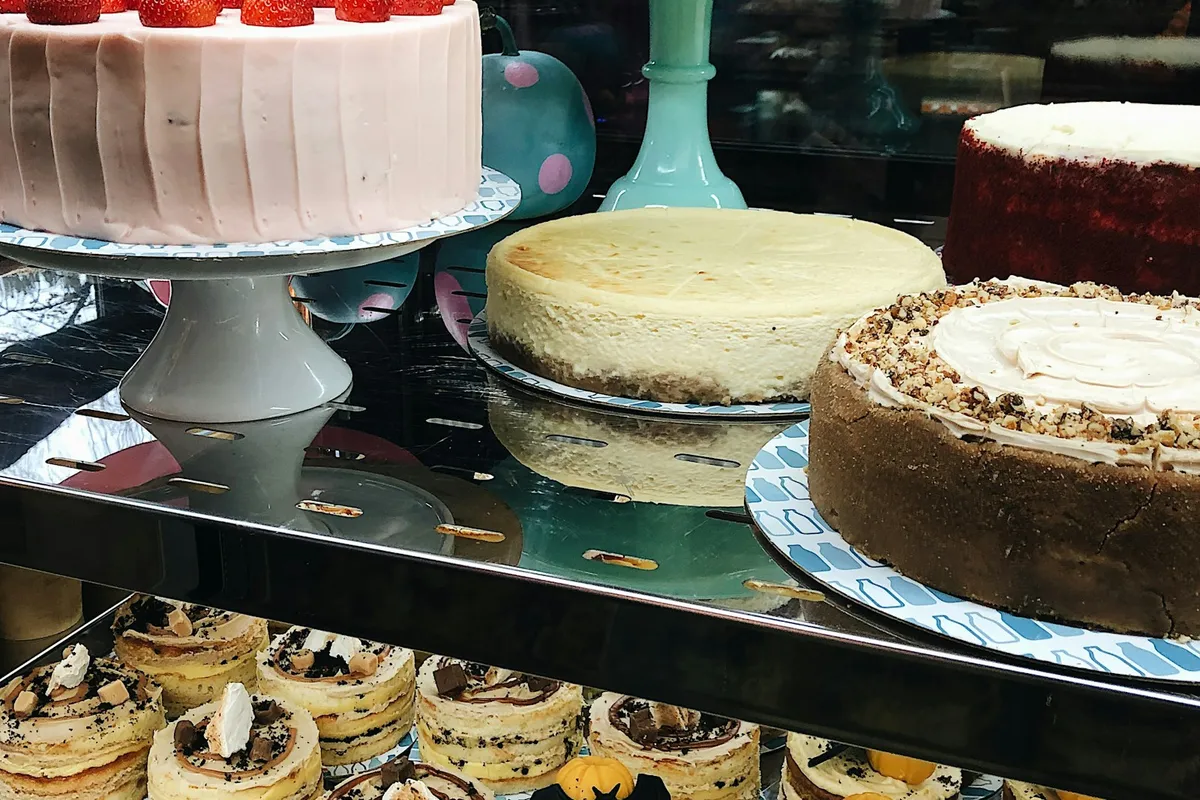
A cafe owner tastes your lemon loaf cake, loves it, and asks what you would charge for a dozen a week. What number do you say? If your answer is "my retail price, minus a bit," you have skipped the two questions that decide whether this order makes you any money, and one that decides whether you can legally take it.
The short answer: to price a cake wholesale for a cafe, first check that your license allows sales through a cafe. Then find your floor, the delivered cost of one cake divided by 1 minus your target margin. Find the cafe's ceiling, its slice price times the slices in the cake, times the share it can spend. If the floor sits above the ceiling, change the volume, the slice price or the cake, or say no.
To see it in practice, follow Nadia, an invented home baker whose numbers are illustrative. Yours will differ, so swap them in as you go.
Step 1: Check that you are allowed to sell to a cafe
Do this first, because it can end the conversation before any math does. A sale to a cafe is a sale through a business, and many cottage food laws treat that very differently from a sale to the person eating the cake.
| State | Can a home baker sell through a cafe? | What the rule says |
|---|---|---|
| Florida | No | A cottage food operation "may not sell, offer for sale, or deliver cottage food products at wholesale" (Fla. Stat. 500.80 (opens in new tab)) |
| Colorado | No | Products "cannot be sold to restaurants or grocery stores" (CDPHE (opens in new tab)) |
| California | With a Class B permit | Class B operations may make indirect sales through a permitted third-party retailer, including retail food facilities where food may be eaten on the premises (CDPH (opens in new tab)) |
| New York | Yes, within the state | Registered home processors may sell wholesale to local "restaurants, cafes, grocery stores, etc." (NY Agriculture and Markets (opens in new tab)) |
These are four examples, and your state's page in the cottage food law hub is the place to start for yours. Then confirm it with the agency that licenses you, because these rules change.
Three follow-up questions are worth asking, because a yes on the table above does not settle them:
- Will the cafe's inspector accept it? The FDA's model Food Code says: "FOOD prepared in a private home may not be used or offered for human consumption in a FOOD ESTABLISHMENT" (Food Code 2026 PDF, section 3-201.11(B) (opens in new tab)). The code is a model that governments choose to adopt, and New York and California plainly allow some home-to-business sales. Still, the cafe has its own permit at stake, so ask the owner to confirm with their inspector before the first order.
- Can the cafe cut your cake? New York requires items (opens in new tab) to be "pre-packaged in the home and properly labeled." A labeled whole loaf that the cafe unwraps and slices is a question to put to the agency, not one to assume your way through. If the answer is no, price individually wrapped and labeled slices instead, adding that packaging and labor to Step 2.
- Is the cake itself allowed? Check your state's list against your actual frosting and filling. Colorado's eligibility questions (opens in new tab) start with whether a product needs refrigeration or hot holding for safety, and New York's list (opens in new tab) says "No homemade buttercream or cream cheese frostings" on cakes.
If your state does not allow the sale at all, one common route is a licensed kitchen, which adds rent to every number below. The shared kitchen rental agreement guide covers what to check before you sign one.
Nadia is registered as a New York home processor and the cafe is in her county. For this example, assume the agency and the cafe's inspector have both said yes to slicing, so she moves on.
Step 2: Find your wholesale price floor
Your floor is the lowest price that covers every cost, pays for your hours and leaves the profit margin you decided on. A wholesale quote often goes wrong here, when the cost in the baker's head stops at ingredients.
Worked example: the lemon loaf cake
Nadia bakes four loaves per batch, and a batch takes 75 minutes of active work. She pays herself $25 an hour. The cafe is a 14-mile round trip, one delivery a week, with 30 minutes of driving and a quick handoff. For mileage she uses the IRS business rate of 76 cents a mile (opens in new tab), which applies from July 1 to December 31, 2026.
| Cost line | How it is worked out | Per loaf |
|---|---|---|
| Ingredients | Her recipe cost | $4.35 |
| Box and label | Her packaging cost | $0.90 |
| Labor | 75 minutes at $25/hour = $31.25, across 4 loaves | $7.81 |
| Overhead | Monthly utilities, registration and insurance ÷ loaves a month | $1.00 |
| Delivery | (14 × $0.76) + (0.5 hour × $25) = $23.14, across 12 loaves | $1.93 |
| Delivered cost | Sum of the lines above | $15.99 |
If you have never worked out an overhead share, Recipe Costing 101 walks through it.
Now add a profit margin, which here means what is left after you have paid yourself for your hours. Nadia wants 25%, so she divides by 0.75 instead of multiplying by 1.25, because margin and markup are different math:
$15.99 ÷ 0.75 = $21.32, which she rounds up to $22 a loaf.
After rounding, $22 leaves her $6.01 a loaf, a margin of about 27%. The wholesale pricing guide uses a 25-40% margin as a rule of thumb, so she is near the low end of it.
The delivery fee guide explains that per-mile and drive-time logic for one-off orders. On a standing order, you can fold it into the price, as Nadia does, or bill it as its own line.
This table goes stale whenever butter does. In Ardent Seller, the box and label can sit on the recipe as lines next to the flour, and labor can be assigned to the recipe's steps. Each completed purchase re-blends that item's average cost and the recipe moves with it, though an average rises more slowly than the latest price. Labor follows your step times and rate. Overhead and delivery are still yours to add.
If you want to test numbers before setting anything up, the free Product Pricing Calculator works in a browser. Choose Cash / direct (no fees), set the target margin to yours, add your per-loaf delivery to the overhead figure, and read Suggested retail as your floor. Ignore Suggested wholesale, which is only half of that and can fall below your cost. At 25%, expect a "Tight margin" verdict that suggests a higher target, and a hint under the margin field that wholesale is typically 50% of retail (keystone). Those are general guidance, not your costs, so use them to recheck your numbers and decide how much cushion you want against ingredient price rises.
Step 3: Find the cafe's ceiling from its slice price
The cafe is doing its own math, and it starts from the slice. Get the slice price from the menu, or ask what they would charge if this is a new item. Count slices the way they would actually cut it. Then ask the owner directly: "On a cake you buy in, what share of its sales can you pay?"
Nadia's loaf cuts into 10 slices. The cafe sells a slice for $4.75, so one loaf brings in $47.50 if every slice sells.
Toast's coffee shop pricing guide (opens in new tab) says ideal beverage and food costs for cafes are "typically 15-25% per item." At 25%, the cafe would want to pay $11.88 a loaf, which is below what the loaf costs Nadia to make and deliver.
Before giving up, notice what that percentage is measuring. A cake that arrives finished includes your labor, so the cafe may accept a higher share on it than on a drink it makes in-house. That is why the owner's own answer matters more than the benchmark.
Then run your price through their numbers:
| Scenario | Cafe's sales from one loaf | $22 as a share of sales | Left for the cafe |
|---|---|---|---|
| All 10 slices sell at $4.75 | $47.50 | 46.3% | $25.50 |
| Only 8 slices sell at $4.75 | $38.00 | 57.9% | $16.00 |
| All 10 slices sell at $5.25 | $52.50 | 41.9% | $30.50 |
The owner says they can pay about a third of sales on a bought-in cake. A third of $47.50 is about $16, so that is the cafe's ceiling and the offer on the table. Nadia's floor is $21.32. At $16 she would earn one cent of profit per loaf, for a dozen loaves every week.
Step 4: Close the gap with the cafe, or walk away
When your floor and their ceiling do not meet, you have four real moves. Discounting and hoping is not one of them.
Change the volume
Delivery is the line that shrinks fastest as the order grows, since the same run is spread over more loaves. To keep the example simple, overhead stays at $1.00 a loaf, though yours may fall a little with volume. Suppose the owner stretches past a third and asks for $19, which is 40% of $47.50, in return for a bigger order.
| Loaves a week | Delivered cost per loaf | Floor at 25% margin | Weekly profit at $22 | Weekly profit at $19 |
|---|---|---|---|---|
| 8 | $16.95 | $22.60 | $40.40 | $16.40 |
| 12 | $15.99 | $21.32 | $72.12 | $36.12 |
| 24 | $15.02 | $20.03 | $167.52 | $95.52 |
The 24-loaf row assumes the cafe can really sell that many. If you fill it with a second cafe instead, it also assumes that stop adds no real mileage or time, so check that against your own route. Notice how little the cost moved: from 8 loaves to 24, it fell by under $2. Even $22 misses the floor at 8 loaves, and at 24 the floor only drops to about $20, so a volume discount has to stay small. The $19 price sits below Nadia's floor at every size. Taking it means choosing a thinner margin, 20.9% at 24 loaves, for six batches and seven and a half hours of baking a week.
Change the slice price
This one is the cafe's call, but you can put it on the table. Moving the slice from $4.75 to $5.25 adds $5 per loaf to the cafe's sales, and it takes your $22 from 46.3% of sales down to 41.9% without costing you anything. A third of $52.50 is only $17.50, though, so a 50-cent rise does not close this gap by itself.
Change the cake
Some cakes are much harder to make work at wholesale. Here is the same math on an 8-inch frosted layer cake that cuts into 12 slices, using a frosting your rules allow:
| Cost line | Per cake |
|---|---|
| Ingredients | $11.00 |
| Box and board | $2.25 |
| Labor (45 minutes at $25/hour) | $18.75 |
| Overhead | $1.50 |
| Delivery | $1.93 |
| Delivered cost | $35.43 |
At a 25% margin, that is $47.24, or $48 after rounding. If the cafe sells slices at $7, the cake brings in $84 and your price is 57.1% of it. A third of $84 is $28, which is $20 short of your price, and on a smaller run the delivery line grows, so the gap widens. The loaf takes less hands-on time per slice in these examples, under 2 minutes against nearly 4, which is the biggest part of its extra room.
If a cafe asks for layer cakes, show them the slice price it takes: your price ÷ (the cafe's share × slices). At the 41.9% a $22 loaf takes at a $5.25 slice, that is $48 ÷ (0.419 × 12) = about $9.55 a slice. At a third, it is $48 ÷ (12 ÷ 3) = $12.
Decline
Run this last comparison before you say yes: what else would those oven hours sell for? If your Saturday custom orders pay better and your calendar is full, wholesale has to beat them or wait. The first wholesale account decision tree covers capacity and retail price conflicts in depth.
Nadia and the owner land at $22 for 12 loaves, with the slice at $5.25. That takes the owner moving twice: a higher slice price and a bigger share, 41.9% instead of about a third, because the loaf arrives finished and needs no baker on staff. The cafe keeps $30.50 a loaf if every slice sells, $1 less than it would have kept at its own $16 offer. Had the owner held at a third, the loaf's slice would have needed to reach $6.60. Short of that, the remaining moves were a different cake or declining.
Step 5: Put the wholesale cake terms in writing
A one-page agreement heads off arguments before they start. The general ground on wholesale minimums and net terms applies, but cake needs these answered too:
- Unsold cake. Is this a firm sale, or can the cafe return leftovers? Returned cake usually has no second buyer. The 8-slice row in Step 3 shows what leftovers do to the cafe's math. A smaller order delivered more often can help, but rework Step 2 first, because a second weekly run doubles the delivery line.
- Order changes. Set a cutoff, such as 48 hours before delivery, after which the order is baked and billed.
- Delivery day and time. State when it arrives and who at the cafe signs for it.
- Payment. Paying on delivery is simplest at first. Each unpaid week is another batch of ingredients you have fronted.
- Labels and allergens. Agree on who gives customers ingredient and allergen information once the cake is cut, and supply it in writing. Your state's label rules still apply to the cake you hand over.
- Slice count. Write down how many slices you are both assuming, because a cafe cutting 8 instead of 10 changes its whole calculation.
- Resale paperwork. Ask for a resale certificate if your state uses one. In California, for example, the seller bears the burden of proof (opens in new tab) that a sale is not at retail unless it timely takes a certificate in good faith.
- Price reviews. Name a date to revisit the price, such as every six months, so raising it is routine rather than a confrontation.
Once the price is agreed, it has to survive weeks of repeat orders. In Ardent Seller, you can put the cafe's agreed price for each cake on a price list and assign it to that customer. Every new sale to them fills in those prices, you can still edit a line, and the invoice shows what you recorded.
The lemon loaf math takes one afternoon. It is much cheaper than finding out in March that a dozen loaves a week has been earning you a cent of profit apiece. Start with the recipe you would actually sell, get its cost right, and bring the slice math with you to the next conversation.
Related reading
- Wholesale Pricing for Handmade Products — The general wholesale method behind this post, including minimums, tiered discounts and net terms.
- Should I Accept a Wholesale Order? — Six gates to run a cafe's offer through before you commit your oven to it.
- How Much to Charge for Cake Delivery — The fee formula and zones for one-off orders, which you can fold into a standing order's price.
- How to Price Custom Cakes — What your retail cakes need to earn, which is the number a wholesale order has to compete with.
Free resources
Two free resources to use before that next conversation with a cafe owner:
- Product Pricing Calculator (Live) — Test your floor against different margins and costs in a browser, with no account.
- Cottage Food Laws by State: The 50-State + DC Quick Reference — A starting point for Step 1 if you want your state's rules alongside its neighbors, before you confirm them with your agency.
This article is provided for educational purposes only and does not constitute legal, regulatory, financial, or tax advice. Costs, pricing examples, cottage food laws, food code adoption and sales tax rules vary by jurisdiction and change frequently. Consult a qualified accountant, your state or local food regulator, or an attorney before making financial or compliance decisions based on this content.