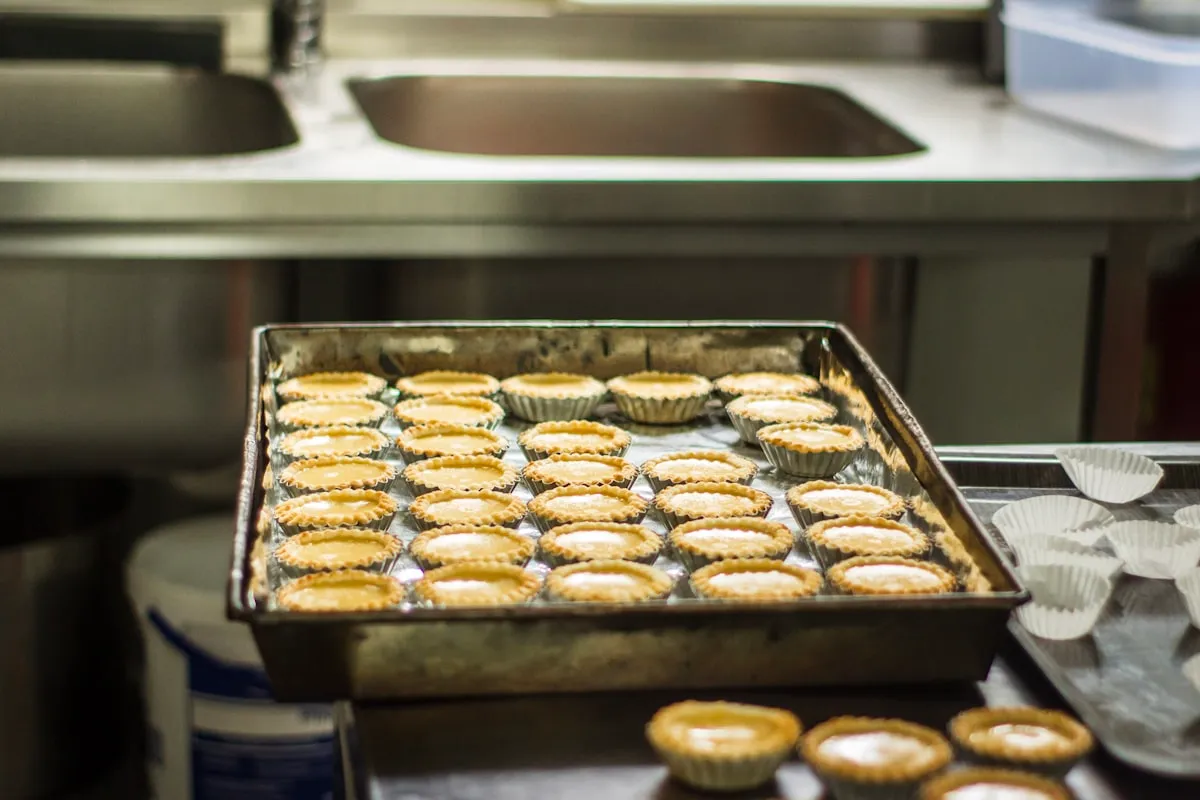
The order is for 800 jars. You read it three times. The buyer wants them in six weeks, and your oven holds twelve at a time.
This is often the moment a food business discovers that its production ceiling was never a business decision — it was an appliance. You can hire help, you can work nights, you can borrow your neighbor's second fridge, and none of it changes the fundamental arithmetic of one home kitchen. What changes it is leaving the house.
There are two doors out. You can rent time in a licensed commercial kitchen and keep making the product yourself, or you can hand the recipe to a co-packer and buy finished cases. They look like two versions of the same step. They are not. One buys you capacity; the other buys you cases, and quietly takes something in return.
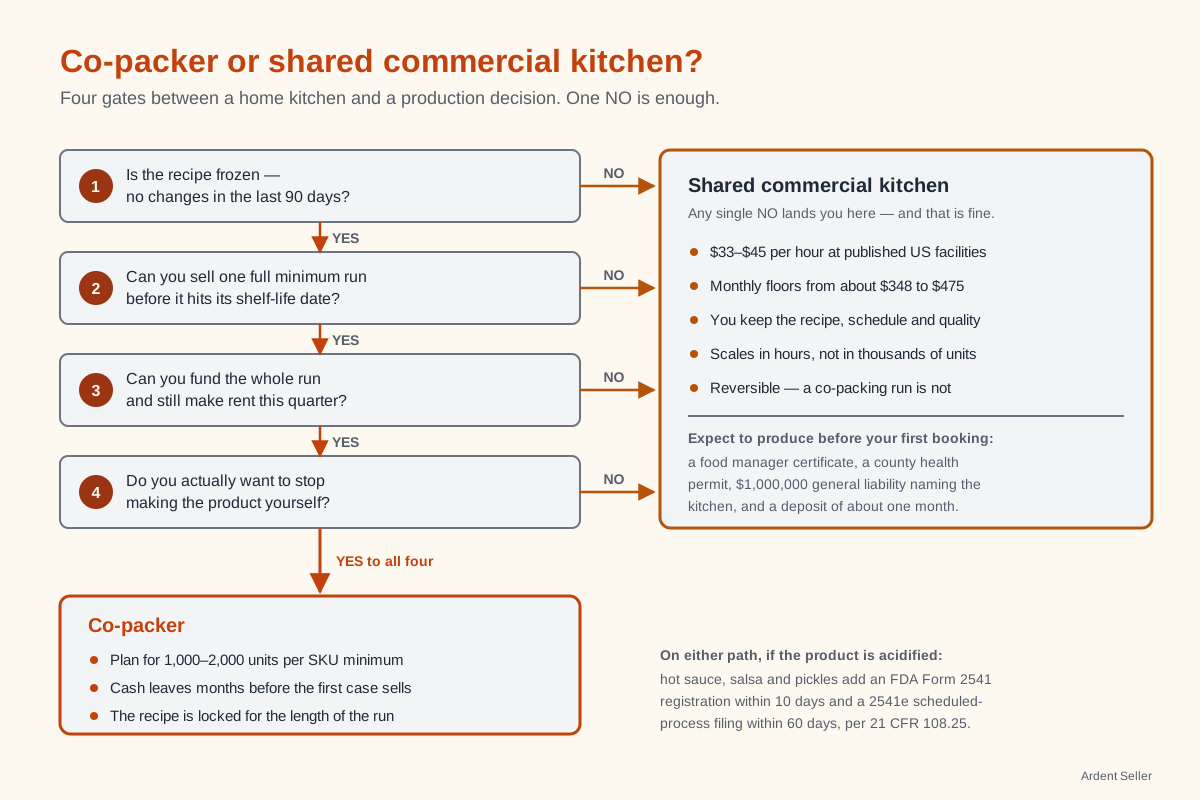
The short version: A shared kitchen rents you licensed capacity by the hour and keeps production in your hands — roughly $33–$45 per hour at facilities that publish rates, with monthly floors from about $348. A co-packer makes the product for you in their own facility and sells you finished cases, typically starting at a 1,000–2,000 unit minimum per SKU. Kitchens scale in hours; co-packers scale in thousands of units. The decision is set almost entirely by four things — whether your recipe is finished, whether you can sell a full run before it expires, whether you can fund that run, and whether you actually want to stop making the thing yourself.
The ceiling you just hit
Cottage food laws are what let you sell from a home kitchen in the first place, and every one of them is written with a lid on it — a revenue cap, a product list, a venue restriction, or all three. The lid is frequently what a seller runs into first, before the oven ever becomes the binding constraint.
What tends to happen is that the ceiling arrives in a form nobody warned you about. It is rarely "you exceeded the cap." It is a wholesale buyer asking for a nutrition facts panel your exemption never required. It is a grocery account that will not stock a product made in an unlicensed kitchen regardless of what state law permits. It is a farmers-market-only restriction meeting an out-of-state shipping request.
If you are not sure how close you are, the Cottage Food Revenue Cap Tracker will tell you in about ten minutes, and it is worth knowing before you sign anything.
What actually changes when you leave the house
The regulatory shift is bigger than the rent, and it catches people. Three things move at once.
You may acquire a facility. Under 21 CFR 1.227, "the private residence of an individual is not a facility" — which is precisely why a home kitchen never had to register with the FDA (21 CFR § 1.227 (opens in new tab)). Rent commercial space and that exclusion no longer applies to what you do there. Registration is also not a one-time errand: 21 CFR 1.230 requires renewal "every other year, during the period beginning on October 1 and ending on December 31 of each even-numbered year" (21 CFR § 1.230 (opens in new tab)). 2026 is an even-numbered year, which puts the next window this coming autumn.
Your labels grow. Cottage food exemptions frequently waive a full nutrition facts panel. Commercial production generally does not. Getting a panel by database analysis is cheap; getting one by laboratory analysis is not. Medallion Labs' published price list for a complete NLEA nutritional screen ran $1,609.00 to $1,724.00 per sample depending on the fiber method, with rush turnaround at double the standard rate (Medallion Labs, price list published 2019 (opens in new tab)) — dated, but directionally right about which decimal place you are in. Database analysis is a legitimate alternative that the FDA accepts, at a fraction of the cost, with the tradeoff that it assumes your ingredients behave like the database's (ReciPal, database vs. lab analysis (opens in new tab)).
Some products acquire a second regulator. If you make hot sauce, salsa, pickles, or anything else acidified, 21 CFR 108.25 requires the commercial processor to register on Form FDA 2541 within 10 days of first engaging in acidified food processing, and to file a scheduled process for each food and container size on Form FDA 2541e no later than 60 days after registration and before packing any new product (21 CFR § 108.25 (opens in new tab)). Separately, 21 CFR § 114.83 (opens in new tab) requires that the scheduled process be established by "a qualified person who has expert knowledge acquired through appropriate training and experience in the acidification and processing of acidified foods" — the role the industry calls a process authority — and § 108.25 requires that everyone working on acidification or pH control be supervised by someone who has completed FDA-approved instruction. This is not optional and it is not fast — and if you need the pH-testing and documentation side of it in detail, that lives in Hot Sauce Compliance rather than here.
There is one piece of good news buried in the FSMA rules. A "very small business" is defined as one "averaging less than $1,000,000, adjusted for inflation, per year, during the 3-year period preceding the applicable calendar year in sales of human food plus the market value of human food manufactured, processed, packed, or held without sale" (21 CFR § 117.3 (opens in new tab)), and a business inside that line qualifies for modified requirements rather than the full preventive-controls program. A maker scaling out of a home kitchen is usually well under that threshold — but the definition counts subsidiaries and affiliates and averages three years, so it is worth running your own numbers rather than assuming.
Option one: renting a shared commercial kitchen
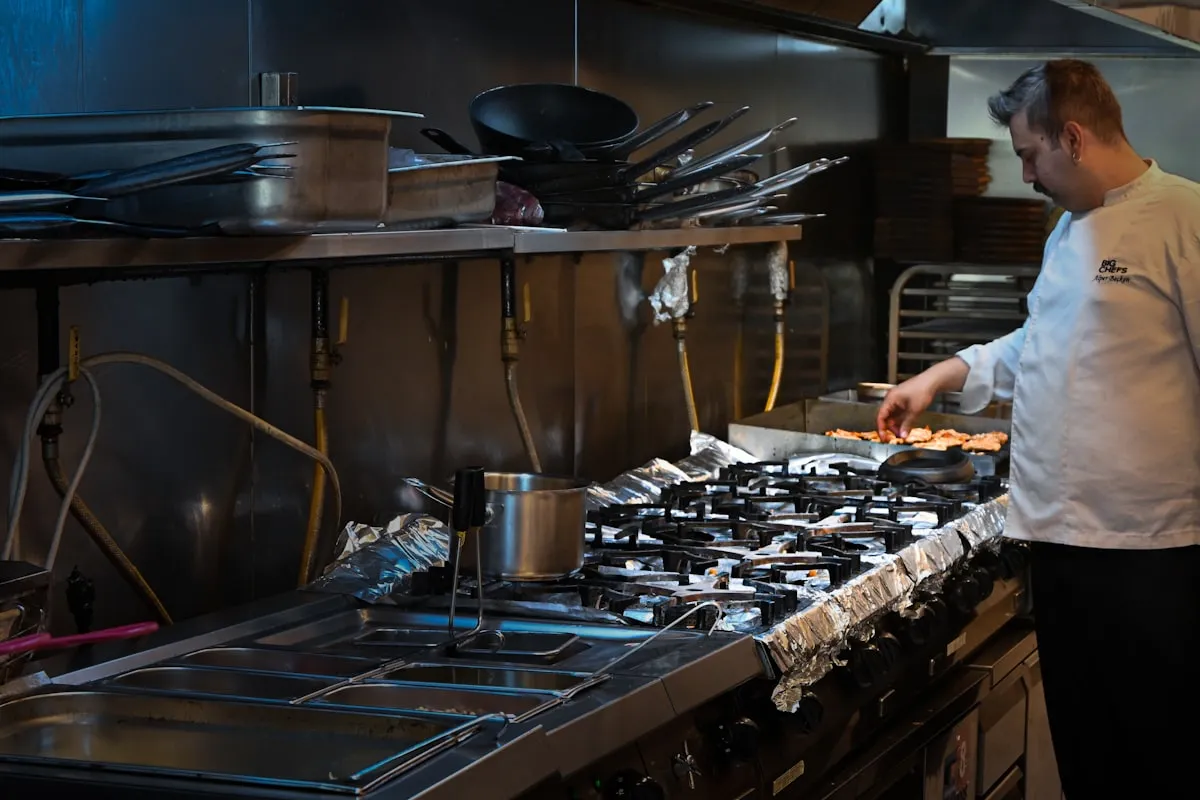
A shared kitchen — commissary, kitchen incubator, shared-use facility, the names are interchangeable — rents you licensed, inspected space with equipment you could not otherwise justify buying. You bring your ingredients, you cook, you clean, you go home.
What it actually costs is more legible than co-packing, because a number of operators publish rates. Two examples, both live at the time of writing:
| Line item | Capital Kitchens (Austin, TX) | Shared Kitchen Rentals (San Diego, CA) |
|---|---|---|
| Hourly rate | $33/hr main kitchen · $29/hr prep-only | $45/hr peak (M–F 8a–6p) · $40/hr non-peak |
| Minimum commitment | 12 hrs/month → $396/mo or $348/mo | Month-to-month, packages from $475/mo for 15 peak hours |
| Storage | Dry, cold, and packaging charges may apply | Dry goods $35/metro shelf or $175/rack · refrigerated $60–$70/shelf or $300–$350/rack · freezer $105–$135/shelf · annex caged $300/cage |
| Deposit | One month's rent | $15 refundable per access fob |
| Insurance | $1,000,000 commercial general liability, kitchen named as additional insured | Not published |
Sources: Capital Kitchens rates (opens in new tab) and getting-started requirements (opens in new tab); Shared Kitchen Rentals rates and reservations (opens in new tab). Rates as published in August 2026 and specific to those facilities — most operators quote privately, so treat these as calibration, not as a national average.
The onboarding list matters as much as the rate. Capital Kitchens publishes its own, and it is a fair model of what to expect anywhere: at least one person holding a Food Manager's Certificate, food handler certificates for other staff, a Food Enterprise Permit issued by the county health department — applied for after you have a kitchen agreement, which is a sequencing trap worth noting — a signed operating agreement and policy handbook, the security deposit, and the certificate of insurance.
Pros: You keep the recipe, the quality, and the schedule. Costs scale in hours, so a bad month costs you a small number instead of a large one. You can change the product between sessions without renegotiating anything.
Cons: You are still the labor. Every jar is still your hands, now with a commute attached. Equipment is shared, which means the 40-quart kettle is occasionally somebody else's 40-quart kettle at the exact hour you needed it.
Best for: Makers whose volume is growing but whose recipe is still moving, whose margins do not yet support a four- or five-figure production run, and who want to stay in control of the craft.
Option two: hiring a co-packer
A co-packer makes your product in their registered facility, to your specification, and hands you finished cases. The economics run the other way from a kitchen: high commitment, low per-unit labor.
The first thing to understand is the shape of the commitment, because it is not gentle. Co-packers price around a minimum order quantity (MOQ) — the smallest run they will schedule for a given product. PartnerSlate, a co-manufacturer matchmaking platform, publishes minimum-run data across its network, and the floors are the part worth sitting with.
| Product category | Published minimum run |
|---|---|
| Any product, floor across all categories | 1,000–2,000 units per SKU |
| Packaged foods, typical range | 1,000–10,000 units |
| Beverages, typical range | 1,000–20,000 units |
| Sauce | 40 gallons |
| Bakery items | 1,000 lbs |
| Jarred nut butter | 10,000 units per SKU |
| Bars | 100,000 bars per SKU, with a 3–4 run annual commitment |
Source: PartnerSlate Academy, production volumes and MOQs (opens in new tab), as published in August 2026. Two caveats worth reading the source for yourself: these are network-wide examples rather than quotes, and the page lists conflicting figures for several categories depending on sub-type. Granola appears both at 2,500 lbs and at 60,000–75,000 lbs. Coffee appears both at 1,000 lbs and, as a plant-based beverage, at 7,500 gallons per SKU. Bars appear both at the 100,000-per-SKU figure above and, as "cookies/bars in overwrap," at 10,000 units per SKU. A 24× spread inside one category is itself the lesson: your MOQ depends on the specific facility and the specific line, not on your product's name.
Read that table next to your current monthly volume, and do the division. At 200 units a month, a 1,000-unit floor is five months of production paid for up front; at 40 units a month, the same floor is two years of it, sitting in a warehouse.
The second thing is the service model, which determines who spends the money.
- Turnkey — "The co-man makes the entire product. They will be in charge of ordering the ingredients and packaging and making the product, and you will be billed for the finished product."
- Tolling — "The brand is in charge of purchasing the ingredients & packaging, and sending it to the co-man. The co-man will manufacture the product, and will charge you for the use of their machines and their labor."
Both quoted from PartnerSlate Academy on turnkey vs. tolling (opens in new tab), as published in August 2026. Tolling usually lands cheaper per unit and keeps your supplier relationships intact; it also makes every late pallet your problem, and a co-packer whose line is idle because your labels are stuck in transit will still want the slot paid for.
Pros: Volume you could not physically produce. Consistency enforced by process controls rather than by how tired you were on Thursday. Your time comes back for selling, which is usually where the constraint actually was.
Cons: Cash out the door months before revenue comes in. A minimum run that locks your recipe — reformulating after 6,000 units means 6,000 units of the old recipe. Less day-to-day control, and a relationship where you are, initially, the smallest account on the floor.
Best for: Makers with a recipe that has stopped changing, a proven sell-through rate, distribution or wholesale accounts already committed, and enough cash to survive a full run sitting in inventory.
The four questions that decide it
Everything above narrows to four questions, in order. They all run the same direction: yes moves you toward a co-packer, and a single no is your answer — stay in the kitchen this year. You need all four.
Is the recipe finished? Not "do you like it" — is it frozen? A co-packer's minimum run turns every remaining tweak into scrap. If you changed anything about the formulation in the last ninety days, or if you are still deciding between two jar sizes, you are not ready for a minimum run. Go to a kitchen. Come back when the recipe stops moving.
Can you sell one full run before it expires? Take the smallest realistic MOQ for your category, divide by your current monthly unit sales, and compare that to your product's shelf life. If the answer is longer than the shelf life, a co-packer is not a scaling decision — it is a spoilage decision. Shelf life is the constraint most likely to be overlooked here, because price is the number everyone checks first.
Can you pay for the run and still make rent? Co-packing is cash-out-first. Ingredients, packaging, the run itself, and often a deposit all land before a single case sells. A shared kitchen at $33/hr for 12 hours is $396; a 5,000-unit run is a different category of number. If financing the run means you cannot cover your own household for a quarter, the answer is the kitchen, this year.
Are you ready to stop being the one who makes it? This is not a soft question and it is not last by accident. Some makers are relieved to stop standing at the kettle. Others discover, about two months into a co-packing relationship, that the part of the business they actually loved is now happening in a building three states away without them. If the honest answer is no — you want to keep making it — that is not a lesser choice, and the kitchen is where you belong. Neither answer is wrong. But knowing which one you are prevents an expensive correction.
What a co-packer will ask you for
If all four came back yes, the next surprise is the intake packet. Co-packers do not accept recipes; they accept specifications. Expect to produce most of the following before anyone quotes you a price:
- A formulation on a weight basis, not a volume basis. "Three cups of chili flake" does not scale. Grams per kilogram of batch does. This is where most home recipes need genuine reconstruction, not just multiplication — a recipe scaling and batch calculator does the arithmetic, but the conversion from cups to mass is yours to do first.
- A spec sheet per ingredient, including supplier, grade, and any allergen or certification claims you intend to make on the label.
- Target shelf life and the data behind it, which for many products means a third-party study you have not commissioned yet.
- Packaging that exists. Not a mock-up — real components, with dimensions, sourced and available at the run quantity.
- A scheduled process, if your product is acidified or low-acid canned. See above; start this early, because the process authority is a separate appointment from the co-packer.
- Your annual volume forecast, which they will use to decide whether you are worth a slot at all.
The reconstruction in item one is the quiet one. Home recipes are written in the units your kitchen uses; commercial formulations are written in percentages of batch weight, and the two versions of "the same" product frequently do not taste identical the first time. Budget for at least one failed pilot run — it is a common outcome and rarely a budgeted one.
The costs nobody puts in the quote
The hourly rate and the per-unit price are the visible numbers. These are the ones that show up later:
- Storage. Finished cases have to live somewhere. San Diego's published rack rates — $175/mo for dry goods, $300–$350/mo refrigerated (Shared Kitchen Rentals (opens in new tab)) — are a useful reminder that a co-packing run does not end when the truck leaves.
- Freight, in both directions. Tolling means shipping ingredients in and cases out. Neither leg is usually quoted with the run.
- The pilot run. Rarely free, frequently repeated.
- Nutrition and shelf-life testing. Per SKU, and again per reformulation.
- Insurance you did not carry before. The $1,000,000 commercial general liability policy a kitchen requires as a condition of entry (Capital Kitchens (opens in new tab)) is a real annual line item.
- The commute. Four hours a week driving to a kitchen is 200 hours a year that used to be production time.
- Your own time on paperwork. Permits, renewals, the biennial FDA registration window, the process filing. None of it is difficult. All of it is hours.
The reason to write these down before you commit is that your cost per unit is about to change in both directions at once. Ingredient costs usually fall — you are buying 50 lb sacks instead of retail bags — while overhead per unit rises. If your pricing was built on home-kitchen numbers, it is now wrong, and the only way to know by how much is to rebuild the bill of materials at the new quantities.
That rebuild is not a spreadsheet task once you are running two locations, two ingredient tiers, and a co-packer's lot numbers alongside your own. Ardent Seller keeps recipes and production runs costed against the actual purchase price of each ingredient lot, so when the 50 lb sack replaces the retail bag, the cost per jar follows automatically instead of waiting for you to notice. It also treats a co-packer's warehouse as a location of its own, which is the difference between knowing you have 4,200 jars and knowing where they are.
Frequently asked questions
Q: Do I need to close my cottage food operation to use a shared kitchen?
Usually no — many makers run both, using the exemption for direct sales and the licensed kitchen for wholesale. But the two operations generally need separate records, separate labels, and sometimes separate permits, and mixing product between them is where people get into trouble. Your state health department is the authority here, not the kitchen.
Q: How do I find a co-packer for my product?
Start with your state's food-industry extension program — many land-grant universities run one, and they know the regional facilities that take small accounts. Matchmaking platforms cover the broader market. Trade associations for your specific category are often faster than a general search, because the co-packer you need is defined by equipment, not geography.
Q: Will a co-packer steal my recipe?
Reputable facilities typically work under confidentiality agreements, and a facility that competes with its own customers is unlikely to keep them — but the agreement is the thing to read, not the assumption. The realistic risk is not theft but lock-in: once your formulation is dialed into one facility's specific equipment, moving to another means re-developing it. Ask early what happens to your specification if the relationship ends.
Q: Can I use a shared kitchen and a co-packer at the same time?
Yes, and it is a common intermediate state — the co-packer handles the one high-volume SKU that sells through wholesale, while the kitchen handles seasonal and small-batch products that would never hit a minimum. It doubles your record-keeping, which is the real cost.
Q: Which one should I try first if I genuinely cannot tell?
The kitchen. It is reversible. A co-packing run is not.
The bottom line
Outgrowing the home kitchen is not one decision. It is a fork, and the two paths lead to genuinely different businesses — one where you are still the maker with more capacity, and one where you are the brand and somebody else is the maker. Both are legitimate. The expensive mistake is walking down the second path because it looked like the more serious version of the first.
Whichever door you take, the numbers underneath it change on day one. Rebuild your costs before you commit, not after the first invoice.
Sources and methodology
- 21 CFR § 1.227 (opens in new tab) — the definition of "facility" and the private-residence exclusion.
- 21 CFR § 1.230 (opens in new tab) — the biennial registration renewal window.
- 21 CFR § 108.25 (opens in new tab) — acidified-food registration on Form FDA 2541, the Form FDA 2541e scheduled-process filing, and operator supervision. The separate requirement that a qualified person establish the scheduled process comes from 21 CFR § 114.83 (opens in new tab), not from § 108.25.
- 21 CFR § 117.3 (opens in new tab) — the FSMA "very small business" definition.
- Capital Kitchens (Austin, TX) (opens in new tab) and its getting-started page (opens in new tab) — hourly rates, monthly minimums, deposit, insurance, and onboarding requirements.
- Shared Kitchen Rentals (San Diego, CA) (opens in new tab) — hourly rates, monthly packages, and storage fees.
- PartnerSlate Academy (opens in new tab) — co-packer minimum run sizes; and its turnkey vs. tolling explainer (opens in new tab) for both quoted service-model definitions.
- Medallion Labs (opens in new tab) — laboratory nutrition-panel pricing, and ReciPal (opens in new tab) as a secondary source on database versus laboratory analysis.
On data freshness: federal regulations are quoted from the current CFR text. The two kitchen rate cards and the PartnerSlate MOQ figures were current in August 2026 and are specific to those facilities and that network — they are here to calibrate expectations, not to substitute for a quote from a facility near you. The Medallion Labs price list is explicitly dated 2019 and is cited only to establish the order of magnitude of laboratory analysis, not a current price.
Related reading
- Scaling Your Handmade Business — the systems that break between 10 orders and 100, which is usually the stretch that pushed you toward this decision in the first place.
- Batch Tracking for Food Sellers — the lot-code spine you will need the day a co-packer's run and your own kitchen batches are both in the field under the same label.
- How to Label Handmade Products — what has to appear on the panel once the cottage food exemption stops covering you.
- Hot Sauce Compliance — the pH-testing and acidified-foods documentation itself, in the detail this post deliberately leaves to it.
Free resources
Free companion downloads if you want to put any of this into practice:
- Recipe Scaling & Batch Calculator — converts a home-kitchen recipe to a weight-based formulation at co-packer batch sizes, which is the first thing an intake packet will ask for.
- Small-Batch Production Planning Playbook — for scheduling kitchen sessions once your production time is metered by the hour and shared with other tenants.
- Hot Sauce pH & Acidified Foods Safety Check — a first pass at whether your product falls under the acidified-foods regime before you pay a process authority to tell you.
This article is provided for educational purposes only and does not constitute legal, regulatory, financial, or food-safety advice. Costs, published rates, co-packer minimums, cottage food laws, FDA registration requirements, and acidified-food regulations vary by jurisdiction, facility, and product, and change frequently. Consult your state agriculture or health department, a qualified process authority or compliance consultant, and a qualified accountant before making financial or compliance decisions based on this content.