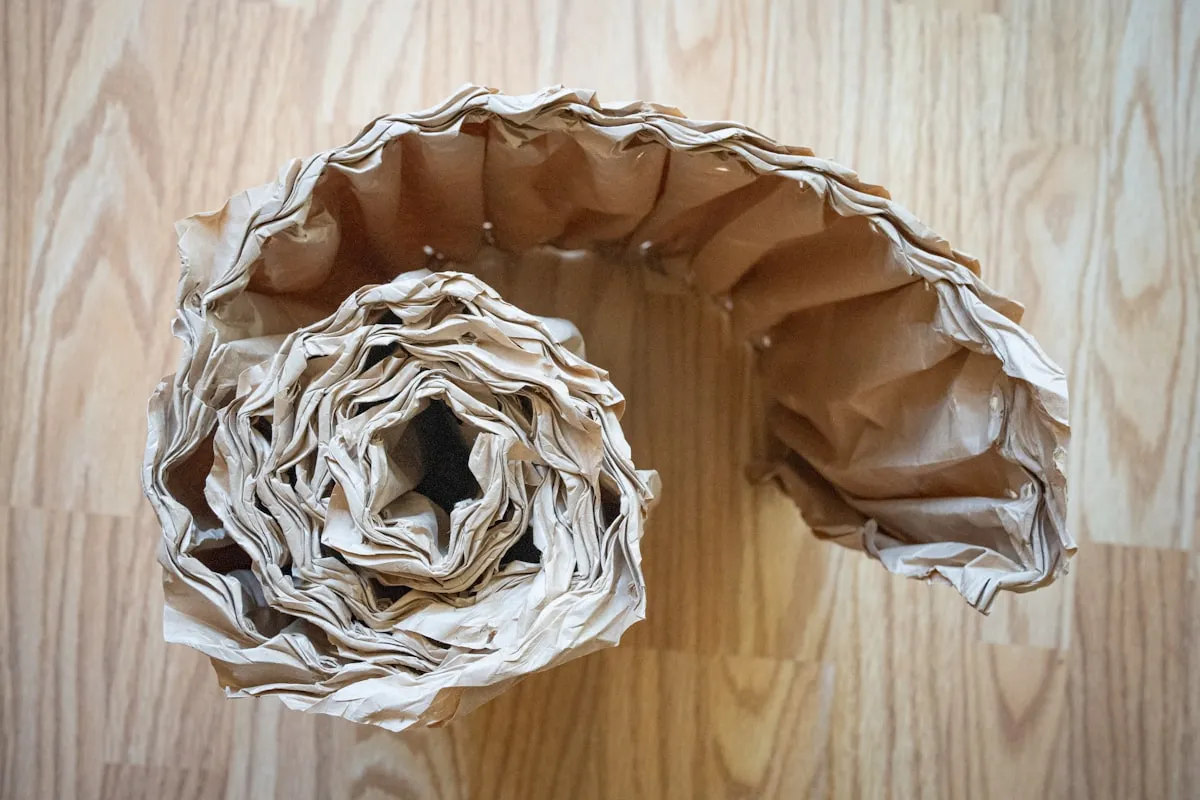
There are two kinds of words on a package. One kind describes a feeling — handmade, small-batch, made with care. Nobody is coming to audit those. The other kind describes a physical outcome that either happens or does not, and printing one of those is closer to printing gluten-free than to printing made with love. It is a claim with a test behind it.
"Compostable" is the second kind. So are "recyclable," "biodegradable," "plastic-free," "non-toxic," and — the one that surprises people most — "eco-friendly."
Jump to a term — or, if you only want wording you can copy, skip to safer wording for the same packaging at the end.
- Eco-friendly, green, sustainable, environmentally friendly
- Biodegradable, degradable, decomposable
- Compostable
- Recyclable
- Recycled content, post-consumer
- Non-toxic
- Free-of, plastic-free, PFAS-free
- Refillable
- Made with renewable materials, bamboo
- Certifications and seals
- Source reduction, "30% less plastic"
Who decides what these words mean
The Federal Trade Commission publishes the Guides for the Use of Environmental Marketing Claims, universally called the Green Guides, at 16 CFR Part 260 (opens in new tab) — that is Part 260 of Title 16 of the Code of Federal Regulations, cited throughout this article by section number as § 260.4, § 260.7 and so on. The operative text is still the version issued at 77 FR 62122 on October 11, 2012. The FTC opened a review of the guides with a request for public comment published December 20, 2022 (opens in new tab), extended the comment period in February 2023 (opens in new tab), and announced a public workshop (opens in new tab) — but as of this writing no revised guides have been issued, so 2012 is what you are working from.
Two features of the guides matter before any individual term does.
First, they are guides, not a rule you can violate directly. As § 260.1(a) puts it, they "do not confer any rights on any person and do not operate to bind the FTC or the public." What they do is describe how the Commission reads Section 5 of the FTC Act, which prohibits deceptive practices — and the same subsection notes the FTC "can take action under the FTC Act if a marketer makes an environmental claim inconsistent with the guides." Treat them as the scoring rubric rather than the law.
Second, the scope is wide enough to include everything you publish. Section 260.1(c) applies the guides to claims made "in labeling, advertising, promotional materials, and all other forms of marketing in any medium, whether asserted directly or by implication, through words, symbols, logos, depictions, product brand names, or any other means." There is no small-seller carve-out and no revenue threshold. Your listing copy, your hang tag, your shop announcement, and the sticker on your mailer are all covered, and so is a logo that implies a claim without stating one.
Two words do most of the work in the sections that follow. A claim is unqualified when it is printed on its own, with no limiting or explanatory phrase attached — "Compostable" alone is unqualified; "Compostable in commercial facilities only" is qualified. To substantiate a claim is to hold concrete evidence that backs up exactly what it says: a lab test, a certificate, a supplier spec sheet. Not a reasonable belief, and not the supplier's word over the phone. A document.
The two questions behind every term below. Can you substantiate the specific thing a reasonable buyer would understand you to be saying? And is it clear what the claim applies to — the product, the packaging, or both? Section 260.3(b) requires that distinction unless context makes it obvious, and its own example is a plastic package containing a new shower curtain, labeled "recyclable" — deceptive when you cannot tell which item is meant and either the package or the curtain, beyond minor incidental components, turns out not to be recyclable.
The words, one at a time
Eco-friendly, green, sustainable, environmentally friendly
These are what the guides call general environmental benefit claims, and § 260.4 is blunt about them: "marketers should not make unqualified general environmental benefit claims." The reasoning is that such a claim implies far-reaching benefits and possibly no negative impact at all, and almost nobody can substantiate every reasonable reading.
The guides go out of their way to make the point with an example a maker will recognize. Example 1 under § 260.4 says the brand name "Eco-friendly" is itself deceptive — and then shows the fix: "Eco-friendly: made with recycled materials" is acceptable if the qualifying phrase is clear and prominent, the recycled-content claim is true for the whole item, and the recycled material genuinely makes the product better overall.
So the word is not banned. It is a headline that requires a subtitle.
Biodegradable, degradable, decomposable
The riskiest word on your shelf. Section 260.8 covers degradable, biodegradable, oxo-degradable, oxo-biodegradable, and photodegradable claims together, and requires evidence that "the entire item will completely break down and return to nature ... within a reasonably short period of time after customary disposal."
Then it puts a number on it. Unqualified claims are deceptive for items entering the solid waste stream that do not completely decompose within one year, and the guides say plainly that "unqualified degradable claims for items that are customarily disposed in landfills, incinerators, and recycling facilities are deceptive because these locations do not present conditions in which complete decomposition will occur within one year." Customary disposal for a padded mailer is a landfill. That is usually the end of the analysis.
The guides' own trash-bag example is the trap in miniature: the marketer had soil burial tests showing decomposition with water and oxygen, and the claim was still deceptive, because consumers do not bury trash bags in soil.
Compostable
Section 260.7 asks for competent and reliable scientific evidence that all the materials break down into usable compost "in a safe and timely manner," meaning roughly the same time as the material composted alongside it, in an appropriate facility or in a home compost pile.
Two qualification triggers follow, and small sellers hit both. You should qualify if the item cannot be composted safely or in a timely manner in a home pile — Example 3 says the disclosure should be that the package "is not suitable for home composting." And under § 260.7(d) you should qualify if municipal or institutional composting facilities "are not available to a substantial majority of consumers or communities where the item is sold." Selling nationally on a marketplace makes "where the item is sold" the whole country.
The flip side is genuinely useful: Example 1 says an unqualified claim on a coffee filter that truly composts at home is fine, and that in that case "the extent of local municipal or institutional composting facilities is irrelevant." Home-compostable is the version of this claim that survives national shipping.
Recyclable
Section 260.12 contains the most quotable threshold in the entire part. When facilities are available to a substantial majority of consumers or communities where the item is sold, you may make an unqualified claim — and the guides define the phrase for you: "The term 'substantial majority,' as used in this context, means at least 60 percent."
Below 60 percent, you qualify, and the guides scale the wording to the gap. Slightly under the line, "This product [package] may not be recyclable in your area" is offered as an example. Available to only a few consumers, and they ask for stronger language.
The provision that catches handmade packaging most often is § 260.12(d): an item made from recyclable material that "because of its shape, size, or some other attribute, is not accepted in recycling programs, should not be marketed as recyclable." Small kraft mailers with plastic-lined interiors, hang tags with a film laminate, thin poly sleeves, tiny lids — the material is nominally recyclable and the object is not. Same subsection: if any component significantly limits recyclability, the whole claim is deceptive.
Recycled content, post-consumer
Under § 260.13, an unqualified claim requires that the entire product or package, excluding minor incidental components, be made from recycled material. Anything partial gets qualified with the amount or percentage by weight.
The pre-consumer versus post-consumer distinction is optional — but the moment you state it, you own it. If you say "80% post-consumer," you need substantiation for that specific number, and pre-consumer material only counts if you can show it would otherwise have entered the waste stream. Manufacturing offcuts that were always going to be re-fed into the same line do not qualify.
Non-toxic
Short section, wide reach. Section 260.10 says a non-toxic claim "likely conveys that a product, package, or service is non-toxic both for humans and for the environment generally," so you need evidence on both counts or a clear and prominent qualification. The example is a cleaning product marketed as "essentially non-toxic" that harms the environment while being safe for people: still deceptive.
Hedging adverbs do not rescue the claim. "Essentially" and "practically" are in the example precisely because they did not help.
Free-of, plastic-free, PFAS-free
Section 260.9 permits these claims and then names two ways a truthful one can still deceive. It is deceptive if the item "contains or uses substances that pose the same or similar environmental risks as the substance that is not present" — swapping one problem material for an equivalent one and advertising the absence of the first. And it is deceptive if "the substance has not been associated with the product category," which is the mechanism behind every "gluten-free water" joke you have ever seen. A wooden button advertised as PFAS-free is that joke with your brand on it.
Trace amounts get a narrow allowance under § 260.9(c) — roughly, background contamination levels that were not intentionally added and do not cause material harm.
Refillable
Section 260.14 is the most concrete rule in the part: do not make an unqualified refillable claim "unless the marketer provides the means for refilling the package." Either you run a collection-and-refill system, or you sell a refill product the customer can buy. A jar that could be refilled is not a refillable jar. The guides' example of a container labeled "refillable three times" by a manufacturer with no collection program is squarely deceptive.
If you sell refills only sometimes, or only at markets, that is a limitation the claim has to carry.
Made with renewable materials, bamboo
Section 260.16 exists because consumers read more into this phrase than marketers intend. Its Example 1 says an unqualified "made with renewable materials" claim on flooring likely conveys that the product is also recycled, recyclable, and biodegradable — and is deceptive without substantiation for all of it. The suggested fix names the material and explains the renewability: "Our flooring is made from 100 percent bamboo, which grows at the same rate, or faster, than we use it."
Bamboo deserves its own warning. In April 2022 the FTC sought civil penalties of $2.5 million from Kohl's and $3 million from Walmart for marketing rayon textiles as "bamboo" and pairing them with eco claims, when converting bamboo into rayon "requires the use of toxic chemicals and results in hazardous pollutants" (FTC press release, April 8, 2022 (opens in new tab)). If you sell bamboo-labeled fabric, drawstring pouches, or bags, the fiber content question comes before the green claim.
Certifications and seals
Section 260.6 says two things worth pinning up. Third-party certification "does not eliminate a marketer's obligation to ensure that it has substantiation for all claims reasonably communicated by the certification." And using a certifier's name, logo, or seal may be an endorsement, which pulls in the Endorsement Guides at 16 CFR Part 255 (opens in new tab) — including the material-connection disclosure rules.
A seal your supplier earned belongs on your packaging only if you are entitled to display it. Reusing a mailer manufacturer's certification mark on your own hang tag is a different act from buying their certified mailer.
Source reduction, "30% less plastic"
Section 260.17 wants to know: less than what? A claim that disposal generates "10% less waste" could mean less than your last version or less than a competitor, and the guides say you need substantiation for both readings unless you clarify which comparison you mean. The Guides' own fixed version is "10% less waste than our previous product" — name the baseline, swapping in whatever you actually make.
What "clear and prominent" actually requires
Every qualification above only works if a buyer sees it. Section 260.3(a) sets the standard: qualifications and disclosures "should be clear, prominent, and understandable," using "plain language and sufficiently large type," placed "in close proximity to the qualified claim," and without "inconsistent statements or using distracting elements that could undercut or contradict the disclosure."
Translated to the surfaces makers actually use:
- A qualification in the last line of a 900-word listing description is not in close proximity to a chasing-arrows symbol on the photo.
- A hang tag that says "Compostable" in 14pt and "at commercial facilities only" in 5pt gray is a contradiction problem, not a font problem.
- A shop banner reading "Sustainable Studio" while the FAQ tab explains the nuance is exactly the "net impression" case § 260.1(d) says the FTC will judge you on.
Where state law goes further
Section 260.1(b) states that the guides "do not preempt federal, state, or local laws," and that compliance with those laws "will not necessarily preclude Commission law enforcement action under the FTC Act." Both directions of that sentence bite. California is the state most likely to reach a maker shipping nationwide, because you are selling into it the moment you accept the order.
Two provisions of the California Public Resources Code do most of the work:
Section 42357 (opens in new tab) makes it unlawful to sell a product in the state labeled "compostable" or "home compostable" unless it meets the applicable ASTM standard specification, and adds that a product "shall not be labeled with the term 'home compostable' unless the manufacturer of that product holds OK compost HOME certification with regard to that product."
Note who has to hold that certification: the manufacturer. Buying an uncertified mailer and printing the word yourself does not create the certification.
Subdivision (b)(1) is a separate rule with a separate trigger: it bars selling a product labeled "biodegradable," "degradable," or "decomposable," or that "in any way implies that the product will break down, fragment, biodegrade, or decompose in a landfill or other environment."
Section 42355.51 (opens in new tab) reaches the recycling symbol itself. It provides that displaying "a chasing arrows symbol, a chasing arrows symbol surrounding a resin identification code, or any other symbol or statement indicating the product or packaging is recyclable" is deemed deceptive unless the item is considered recyclable in the state under the statute's criteria and "is of a material type and form that routinely becomes feedstock used in the production of new products or packaging."
The phrase material type and form is the same idea as the FTC's shape-and-size rule, written into a statute. A kraft mailer is a recyclable material; a laminated kraft mailer in a size no sorting line captures is not a recyclable form.
The practical upshot for a small shop: the chasing-arrows graphic is not decoration, and the safest packaging vocabulary is descriptive rather than aspirational.
Keeping the proof attached to the packaging
Every claim above resolves to a document somebody else gave you. The recycled-content percentage is on the mailer manufacturer's spec sheet. The compostability certification is a certificate with a number and an expiry. The fiber content is on the textile supplier's declaration. Substantiation is not something you generate — it is something you filed, or did not.
The failure mode is boring and extremely common. You switch mailer suppliers in October because the first one is out of stock, the new box arrives, the claim on your hang tag stays the same, and the spec sheet that justified it belongs to a product you no longer buy. Nothing announces the change. The words on the tag simply stop being true.
The fix is to treat packaging as inventory rather than as overhead. Each mailer, box, tag, and sticker gets its own item record, with the supplier attached, the certification number and expiry stored on the record, and the supplier's PDF filed against it. In Ardent Seller packaging materials are inventory items like any other, so the vendor, the documents, and the purchase history live on the same record — which means the question "what am I allowed to say about the mailer I am shipping in today?" has one place to be answered instead of an email search. Do the same for the claim itself: write the exact approved sentence on the item record, so the person printing tags copies a sentence rather than remembering one.
Safer wording for the same packaging
None of this requires you to stop talking about packaging. It requires you to describe the material instead of promising the outcome — which, conveniently, is what buyers who care about packaging actually want to read.
| Instead of | Write | Why it holds up |
|---|---|---|
| Eco-friendly packaging | Shipped in a 100% post-consumer recycled kraft mailer | A specific recycled-content claim backed by a supplier spec sheet (§ 260.13) |
| Biodegradable mailer | Paper mailer, no plastic lining or film window | Describes composition instead of a decomposition outcome (§ 260.8) |
| Recyclable | Recyclable where paper mailers are accepted — check your local program | A qualified claim for an item under the 60% threshold (§ 260.12) |
| Compostable | Home compostable: kraft paper and starch-based tape, no labels to remove | Meets the home-compost standard the guides treat as the strong version (§ 260.7) |
| Plastic-free shop | Paper tape, paper tissue, cardboard mailers; shipping labels are still synthetic | Accurate, and avoids a free-of claim contradicted by a component (§ 260.9) |
| Sustainable materials | Bamboo viscose drawstring bag (bamboo processed into viscose rayon) | Names the material and its processing rather than implying a bundle of benefits (§ 260.16) |
That right-hand column is longer than the left. That is the trade: three more words on a hang tag in exchange for claims you can defend with a document.
Consider a potter who sells mugs and has been putting an "Eco-Friendly Packaging" sticker with a chasing-arrows symbol on every box. That one sticker makes three claims at once — a general environmental benefit claim, a recyclability claim, and a symbol claim that reaches into California. Suppose the kraft box is genuinely 100% recycled. The sticker never says so. Replacing it with a rubber stamp reading "100% recycled box · paper tape · no plastic fill" costs about nine dollars and turns one unsupportable claim into three supportable ones.
Pick the claim you make most often, find the document that proves it, and file it where the packaging lives. If the document does not exist, you have learned something more useful than a compliance rule: you have learned what you are actually shipping in.
Start free with Ardent Seller and give your packaging materials real item records — supplier, certification, cost, and the exact wording you are cleared to print.
Related reading
- How to Label Handmade Products — the other half of the label: what identity, content, and contact information has to appear before you get to the green claims.
- Best Food-Safe Packaging Suppliers for Small-Batch Makers — before the claim goes on the packaging, somebody has to sell you the packaging: which suppliers publish real minimums at 250 units, and what food-contact compliance they will put in writing.
- Best Label Printer for Handmade Sellers — if a claim changes, so does the tag; what it costs to reprint hang tags and stickers in small runs.
- Handmade Shop Policies Template — the shipping and returns wording that sits alongside your packaging copy, torn down clause by clause.
Free resources
Free companion downloads if you want to put any of this into practice:
- Vendor and Supplier Contact Organizer — one row per packaging supplier, so the spec sheet and certification behind each claim has an owner and a contact when a substitution lands.
- Legal Documents Checklist — the wider paperwork picture your substantiation files sit inside.
This article is provided for educational purposes only and does not constitute legal, regulatory, or advertising-compliance advice. Environmental marketing standards, labeling requirements, and state packaging laws vary by jurisdiction and product, and change frequently. The FTC Green Guides describe the Commission's views rather than a rule you can violate directly, and state statutes may impose stricter requirements. Consult a qualified compliance consultant or an attorney before making labeling or advertising decisions.