The quantity box on an Etsy listing isn't an inventory count. It's easy to treat it as one, and Etsy's own help pages explain why it isn't.
Etsy's article on fees and listing multiple quantities (opens in new tab) gives two instructions next to each other. First: "It's a good idea to list the true quantity of the number of items you have in stock." Then: "If you're selling made-to-order items, make sure you only list the number of items you can feasibly create during your production time." So the same field means stock on hand for one seller and production capacity for another. It is also a fee schedule, as callout 1 below shows. That's a lot to ask of a single number.
Behind that box, an Etsy listing records a quantity, a SKU and a price for each version of the item. It keeps no count of the materials you make it from, the components several variations share, the batch an item came from, or what it cost you, so neither the listing nor Etsy Stats can show your profit. This post takes one Etsy listing apart, field by field, to show where each of those gaps sits. If you resell finished goods, most of the gaps won't matter. If you make what you sell, they're where your stock and your margins stop matching what Etsy shows you.
The listing, field by field
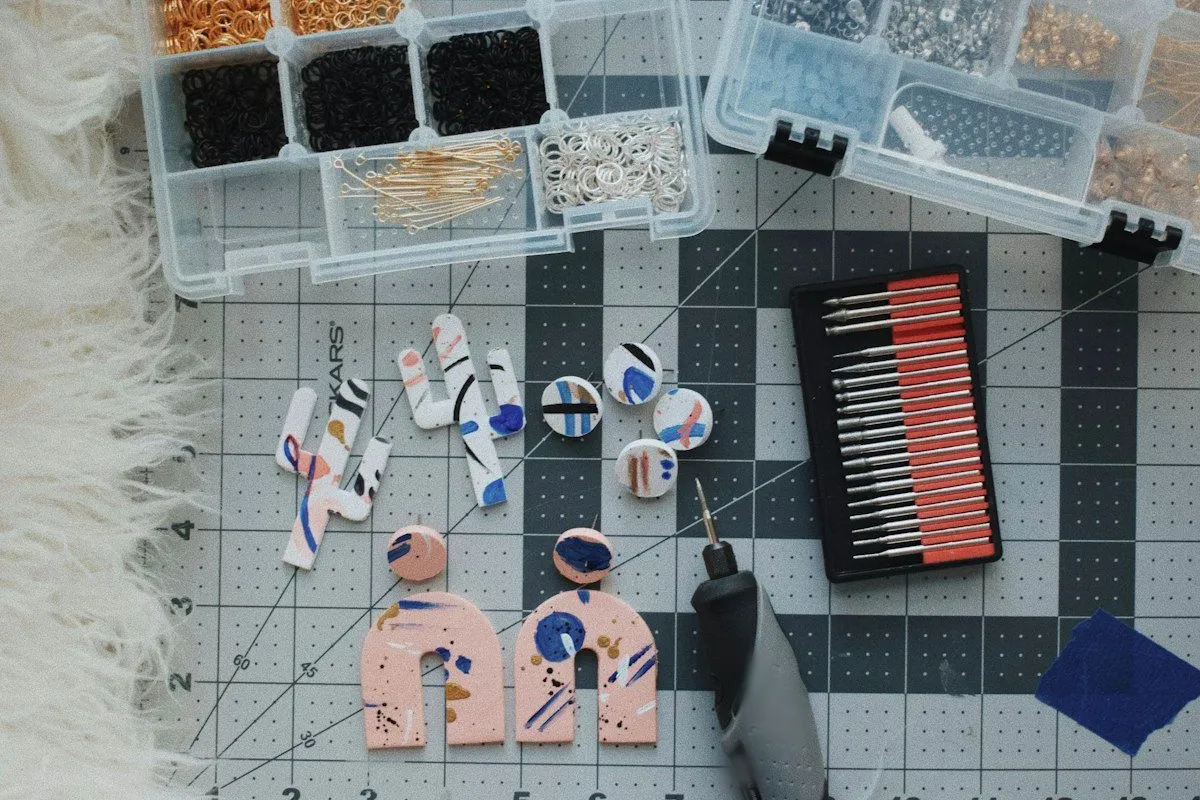
Meet Juno, an illustrative composite rather than a real seller. She makes polymer clay earrings at a desk by the window and sells them on Etsy and at a monthly makers' market. Here is her best seller written out as the fields and stats Etsy holds for it. This is a hand-written summary, not a screenshot, and each callout links to its section below:
| Field | What the listing says | Callout |
|---|---|---|
| Listing | Speckled Arch Earrings | |
| Price | $28.00 | |
| Quantity | 14 | (1) Quantity |
| SKU | ARCH-SPK | (2) SKU |
| Variations | Color: Terracotta, Sage or Oat. Hook: Gold-plated or Titanium | (3) Variations |
| Materials | Polymer clay | (4) Materials |
| Processing | Ready to ship | (5) Processing |
| Listing stats | Views, favorites, orders, revenue | (6) Stats |
Every line is accurate. Etsy will sell exactly 14 pairs and no more. What the record can't tell Juno is that she has clay for nine more pairs of Sage, titanium hooks for four, and that her cost per pair went up in August. Each numbered callout below covers what the field does, where it stops, and what fills the gap.
(1) Quantity: a promise to buyers, not a count of stock
What it does. Each sale takes from the listed quantity. Etsy's variations help page (opens in new tab) notes that an option set to zero shows on the listing as Sold out. That's all Etsy needs the number for: stopping a buyer from purchasing what you can't send.
Where it stops. The number counts finished pairs. Juno's two blocks of Sage clay, her bag of titanium hooks and her jump rings aren't on any listing, so Etsy has no idea they exist. The quantity can say 14 while she has materials for only four more titanium pairs, and nothing on Etsy will warn her.
The quantity also drives fees. When a listing with more than one in stock sells, Etsy's Fees & Payments Policy (opens in new tab) says it "will be automatically renewed at $0.20 after each of the items sells." Its help page works the example: list ten bowls, sell all ten, and you pay $0.20 up front plus another $1.80. Those fees are fine, but the number that sets them is the same one Juno is supposed to keep honest by hand.
What fills it. A count of materials, kept apart from the count of finished goods, that goes down when you make something, not when you sell it. Ardent Seller stores each product's recipe (clay by weight, two hooks, two jump rings) and deducts those materials when a batch is logged. The Etsy connection then sends the finished count to the listing. That way the number in the quantity box comes from what's actually on the shelf.
(2) SKU: a label that Etsy stores and does nothing with
What it does. Etsy's SKU help page (opens in new tab) says SKUs "are a way for you to keep track of your inventory and quickly identify what you have in stock." You type one into the Inventory and pricing section and Etsy keeps it.
Where it stops. That's the end of it. Etsy's own developer reference shows how small the record behind a listing is. A listing's inventory resource (opens in new tab) holds products, and each product carries a SKU, its property values (Terracotta, Titanium) and its offerings. An offering has a price, a quantity, whether it's enabled, and which processing profile it uses. There is no field for what the item cost, where it's stored, or when it was made. The SKU is a good name for a thing Etsy knows very little about.
What fills it. Treat the SKU as the join between two systems. Etsy holds the listing, and something else holds the cost, the recipe and the history behind the same code. The free SKU Naming & Barcode System Starter Kit is worth working through before you connect anything, because a SKU scheme you invent in a hurry is one you'll be renaming later.
(3) Variations: six quantities, one bag of hooks
What it does. Etsy handles variations well. You can vary on up to three attributes, and turn on separate price, quantity, processing profile and SKU for each option. Etsy's variations help page (opens in new tab) says you can set unique "prices, SKUs, and quantities for up to 400 option combinations." Juno's three colors and two hook types make six combinations, each with its own count.
Where it stops. Look at what those six counts share. All three titanium versions draw from the same bag of titanium hooks. All three gold-plated versions draw from the same gold findings. Etsy keeps six separate quantities and doesn't know that four of them depend on two shared bags. When the titanium hooks run out, three combinations become impossible to make at once, and Etsy will keep selling all three until each quantity reaches zero.
This is the classic shared-component problem, and it gets worse with every option you add. A candle maker with eight scents in two jar sizes has 16 counts drawing on one wax supply and two jar stocks.
What fills it. A recipe for each variation that names its components, so the one shared component sets a limit on every variation that uses it. In Ardent Seller, a variant can have its own recipe that draws on the same material records as its siblings, and the What Can I Make Right Now? report shows how many units each recipe can still make from current stock and which ingredient runs out first. For Juno, that ingredient is the titanium hooks.
(4) Materials: a claim to buyers, not a supply list
What it does. The field looks like the answer to callout 1, and it isn't. Etsy's attributes help page (opens in new tab) says "Materials identify substances or components used to make an item." It adds: "By selecting a Material or Material feature, you are making a claim that it accurately describes your item." Etsy also says it "does not verify or assume any responsibility for the accuracy of attributes selected by sellers."
Where it stops. The Materials attribute is buyer-facing description, and it comes with a responsibility attached. Etsy's page tells sellers to keep records that support whatever they select. It holds no quantity, no supplier and no cost. "Polymer clay" on the listing tells a shopper what the earrings are made of, and it tells Juno nothing about how much clay is left.
What fills it. A real supply list, with quantities, units and the price paid. As a side benefit, the purchase records behind it can serve as the supporting records Etsy's page asks you to keep. If a listing says "Titanium," a dated supplier invoice for titanium hooks backs it up.
(5) Processing: Etsy knows when it ships, not when it was made
What it does. A listing's processing profile marks it ready to ship or made to order, with a processing time, and the variations page lets you vary the profile by option. In Etsy's API reference (opens in new tab), each offering points to a processing profile, and the profile's readiness state is either ready_to_ship or made_to_order.
Where it stops. Etsy has no event for "Juno made 12 pairs on Tuesday." A batch, the clay it used, and which pairs came out of it are invisible to the listing. For earrings, that's mostly a costing problem. For anything a customer eats, puts on their skin or gives to a pet, it's a traceability problem: if a batch goes wrong, a record that says only "14 available" can't tell you which buyers to contact.
What fills it. A production record. In Ardent Seller, logging a production run deducts the recipe's materials, adds the finished units and stamps a lot number on them. A sale can then be traced back to the batch it came from, which is the setup batch tracking for food sellers walks through.
(6) Stats: revenue in, profit nowhere
What it does. Etsy reports well on the selling side. Etsy Stats (opens in new tab) shows visits, orders, conversion rate and revenue for the shop, and views, favorites, orders and revenue for each listing.
Where it stops. That page doesn't mention cost, margin or profit anywhere, and since the inventory record has no cost field (callout 2), Etsy has nothing to work profit out from. Juno can see that Speckled Arch earned the most revenue in September. She can't see that the titanium version earns her noticeably less per pair than the gold-plated one, because the titanium hooks cost more and the price is the same.
What fills it. A cost per item built from its recipe and priced at what you actually paid, then set against each sale with Etsy's fees taken off. If you want to check one product by hand first, the free Etsy Fee & True-Profit Calculator does the arithmetic for a single listing, and it makes the size of the gap obvious quickly.
Etsy's inventory limitations, side by side
Here are the six callouts in one place:
| Callout | What Etsy records | What a maker also needs |
|---|---|---|
| (1) Quantity | Finished units, or production capacity for made-to-order | Materials on hand, deducted when a batch is made |
| (2) SKU | A code, stored but not used for anything | Cost, recipe and history attached to the same code |
| (3) Variations | A separate quantity for each combination | Shared components that cap every combination using them |
| (4) Materials | A buyer-facing claim about what the item is made of | A supply list with quantities, units and prices paid |
| (5) Processing | Ready to ship or made to order | A dated batch with a lot number |
| (6) Stats | Visits, orders, conversion rate, revenue | Cost per item and profit per sale |
When Etsy alone is enough
Etsy's tools are fine for plenty of shops, and it's worth saying who can stop reading here:
- One-of-a-kind sellers. A vintage reseller or a painter selling originals has a quantity of one on every listing, and the item is the inventory. There's nothing to deduct.
- Resellers of finished goods. If you buy finished items and list them, Etsy's quantities and SKUs track what you have. You still need cost somewhere for your taxes, but a spreadsheet will do.
- Small, single-material makers who sell only on Etsy. If one input makes everything and you never sell anywhere else, a weekly count and an honest quantity box can carry you a long way.
The gaps become expensive in three situations. Materials get shared across products or variations, so one empty bag stops several listings at once. Material prices move, so last spring's cost per item is now wrong. And the same stock sells somewhere else too. A market sale doesn't lower an Etsy quantity on its own, which is the problem the guide to syncing inventory between Square and Etsy is about.
How a materials layer sits behind Etsy
The fix isn't to leave Etsy. Etsy keeps the listing, the checkout and the buyer. A materials layer sits behind it and keeps everything the listing can't. This is how the Ardent Seller Etsy connection splits the work, as described in its sync guide:
- Orders arrive as sales. Etsy orders import as sales every 15 minutes, with shipping, coupons and currency, and they lower stock like any other sale.
- Fees are recorded per sale, worked out from Etsy's published fee schedule and filed under Schedule C categories. That makes callout 6's profit figure something you can actually read.
- Quantities flow back only when you say so. Newly linked listings start on Manual only, which leaves your Etsy quantities alone until you click Push now or turn on auto push. With auto push on, Etsy gets your on-hand count minus a safety buffer you choose, and the listing can be deactivated automatically when stock hits zero.
- The listing itself stays yours. SKUs flow one way, from Etsy into Ardent Seller. Prices and listing details never push automatically during sync.
- A daily check compares the two. Each day, the connection compares what it expects each linked listing's quantity to be against Etsy's and logs any difference with a reason.
The Etsy connection is included on every plan, including Free.
The field to check tonight
Open your best-selling Etsy listing and look at its quantity. Then go to the shelf and count the materials for that product, not the finished pieces. If the two numbers tell different stories, the quantity box has been answering a question you weren't asking.
Etsy will keep selling what the box says you have. If you make what's in the box, connect your Etsy shop to Ardent Seller and keep the materials, batches and real costs in a record built for them.
Related reading
- Shopify Inventory Limitations for Makers — the same teardown for a Shopify store, for when Etsy isn't your only storefront.
- How to Sync Inventory Between Square and Etsy — keeping one stock count when market sales and Etsy orders draw from the same shelf.
- Best Inventory App for Etsy Sellers — once you've decided Etsy alone isn't enough, five tools compared on what an Etsy maker actually needs.
- Etsy Sellers FAQ: Fees, Inventory, and Bookkeeping — the fee, reconciliation and 1099-K questions that sit beside the inventory ones here.
- Recipe Costing 101 — how to build the cost per item that Etsy has no field for.
Free resources
Two free downloads for an Etsy shop that's outgrowing its quantity box:
- Etsy Seller's Inventory & Fee Survival Guide — covers the listing-side and fee-side habits that keep Etsy's numbers honest while you decide whether you need more.
- Etsy Fee & True-Profit Calculator — the profit figure from callout 6, worked out one listing at a time.
This article is provided for educational purposes only and does not constitute financial, tax, or business advice. Examples are illustrative and will vary with your products, costs and fees. Consult a qualified accountant or small-business advisor before making financial decisions based on this content. Etsy is a trademark of Etsy, Inc.; Ardent Seller uses the Etsy API but is not endorsed or certified by Etsy, Inc. Etsy features and fees described here reflect Etsy's help pages, fee policy and developer reference as of October 2026.