How much weight do your beans lose between the bag and the bar — and how much of what's left can you legally call "chocolate"?
The brown substance coming out of your melanger has been governed by federal regulation since the 1940s, when the FDA first codified the standards of identity for cacao products under the Federal Food, Drug, and Cosmetic Act of 1938. The yield from your roaster has been documented by every cocoa importer in North America. The cost of running your tempering machine is recoverable from your last electricity bill. None of these are mysteries. They are just questions most makers do not think to ask until a wholesale buyer turns over a bar and asks, "Wait — what does '70%' mean here, exactly?"
The 22 questions below cover the ones bean-to-bar makers tend to ask in the first three years of running a small operation. Sourcing comes first, then the batch math from green beans to finished bars, then the equipment that does the work, then the FDA rules that govern what ends up on the label, then the pricing and wholesale conversation that decides whether the business can keep running. Where an answer rests on a federal regulation or a manufacturer specification, the source is linked. Where it does not, what follows is what tends to happen in a small shop running 5 to 50 kilograms of bean a week.
What's a fair price for cacao beans right now, and why does it vary so much?
Specialty cacao prices have very little to do with the commodity cocoa price you see on a Bloomberg ticker, and you are not going to pay the New York futures price for anything that is worth turning into a bar.
The International Cocoa Organization (opens in new tab) publishes a daily commodity price that lives in a different universe from what specialty importers charge. Commodity cocoa has been unusually volatile — futures pushed above $10,000 per metric ton through 2024 because of West African crop failures, then settled in the $7,000–8,000 range. For a craft maker buying through specialty importers like Uncommon Cacao (opens in new tab), Meridian Cacao, Cacao Hunters, or Atlantic Cocoa, you will typically pay $9–18 per kilogram for fermented, dried, sortable beans, sometimes higher for estate-specific or heirloom lots.
What you are paying for, above the commodity number, is fermentation discipline, drying control, traceability, smallholder premiums, and the importer's logistics and risk. A bag of generic West African cocoa is, in practical terms, a different product from a fully-fermented Heirloom Cacao Preservation Fund-certified Pure Nacional from Ecuador, even though both are technically "cocoa beans." We come back to what this means for your pricing in question 21.
What's the difference between "direct trade," "fair trade," and just buying from an importer?
These three phrases describe different relationships, not different qualities of bean.
Fair trade refers to a third-party certification — most commonly through Fair Trade USA (opens in new tab) or Fairtrade International (opens in new tab) — that audits the supply chain against social and economic standards, including a minimum farmer price and a community premium. The certification has overhead, which is one reason it is more common in commodity supply chains than in craft.
Direct trade is not a certified term. It describes a relationship where the maker (or the importer acting on the maker's behalf) deals with a specific cooperative or estate, knows the price paid to the farmer, and often visits the origin. There is no universal audit, which is why some makers use the phrase carefully.
Buying from an importer is the default and not a lesser path. Specialty importers like Uncommon Cacao publish transparency reports (opens in new tab) that show the farmgate price for every lot they sell. For a small maker who cannot reasonably travel to origin, an importer with documented sourcing is closer to direct trade than to commodity.
What tends to happen: makers describe their sourcing in the language they have actually earned. If you have not visited origin, "single estate, sourced through [importer name], farmgate price published" reads more honestly than "direct trade."
How do I track origin lots when one batch blends beans from two farms?
This is where most small chocolate operations leave money — and recall safety — on the floor.
Every shipment you receive should be assigned a lot number tied to the importer, origin, farm or cooperative, harvest year, and the date you received it. When you build a recipe that blends two origins (which is common with milk chocolate and complex dark recipes), the batch record should reference both lot numbers, with the gram weight of each. When you mold the finished bars, every mold should be tied back to the batch record, and the batch number printed or impressed on the bar packaging.
The practical reason this matters is recall and trade. The same lot of beans that produces a bar you sell to a boutique on Tuesday may show up in a wholesale order on Friday and a custom corporate gift on the following Monday. If the importer issues a quality notice, you need to trace which finished products contain which lot — and you need to do it in minutes, not days.
A simple recipe-and-batch system handles this without ceremony. Ardent Seller's recipe and production-run tracking was built for exactly this — every batch captures the ingredient lots, the finished weight, and the audit trail, and any finished bar can be traced back through its batch to the original cacao lot in a single query. See also our companion guide on lot tracking for food sellers.
Can I call my chocolate "single origin" if the beans came from multiple farms in the same country?
The honest answer is: by industry convention, yes, but you should disclose the level of specificity.
There is no FDA standard of identity for "single origin." The phrase has been adopted from coffee, where it carries similar ambiguity. In the craft chocolate world, a workable hierarchy looks like this: single farm or single estate is the most specific (one named farm or estate), single cooperative is one named cooperative aggregating multiple farms, single region is multiple farms or cooperatives within a defined growing region, and single country is multiple sources within one country. All four are commonly called "single origin," and the term is not legally protected — but a buyer who pays a premium for "single origin" expects to know which level you mean.
What tends to happen: small makers either state the precise origin on the bar ("Cooperativa Norandino, Piura, Peru") or describe the level in the marketing copy ("a single-cooperative bar from northern Peru"). A bar that quietly blends beans from three importers across two countries and calls itself "single origin" is the version that catches up with you.
What does "criollo, forastero, trinitario" actually mean for my finished bar?
It means much less than the older chocolate literature suggests, and modern genetic work has complicated the story considerably.
The traditional taxonomy divided cacao into three groups: criollo (the fragile, low-yielding heirloom variety associated with Mesoamerica), forastero (the high-yielding, hardier varieties from the Amazon basin and West Africa), and trinitario (a Caribbean hybrid). The taxonomy persists in marketing copy because it is romantic, but genetic studies published since 2008 — including work led by Juan Carlos Motamayor at USDA-ARS — have identified ten genetic clusters (opens in new tab) within cacao, and the old three-group model maps onto them only loosely.
The flavor implications are weaker than the marketing suggests, too. Fermentation quality and drying discipline have larger effects on cup characteristics than genetic variety does. A well-fermented Forastero from Tanzania can be more interesting than a poorly-fermented Criollo from Venezuela.
What tends to happen: makers who used to say "criollo" on the bar are increasingly saying "fully-fermented heirloom" or naming the specific accession (the genetic identifier of the planting stock) when they have it. The romantic taxonomy still moves bars at retail, but a buyer who knows the territory will notice if you lean on it.
How much weight do beans lose from delivery to finished chocolate?
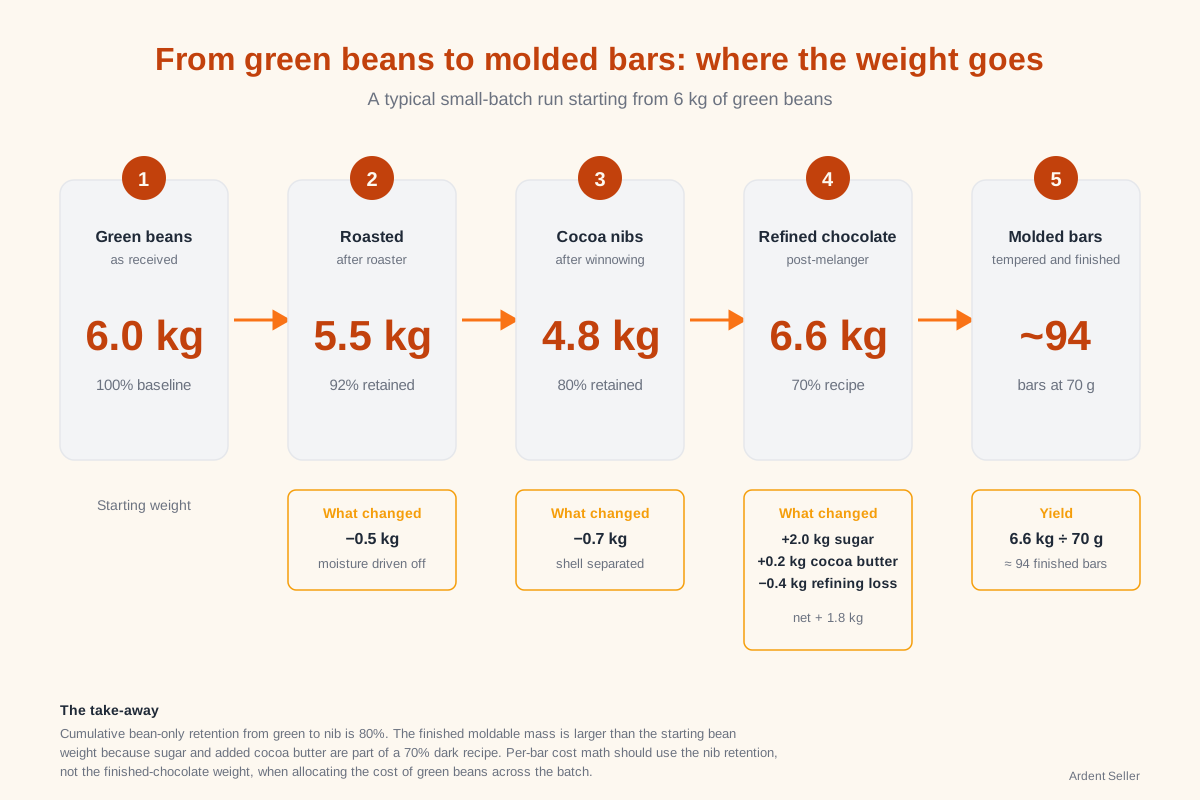
Cumulative loss from green beans to molded bars typically runs 18–25%, and the math is worth understanding before you cost a single bar.
Roasting drives off 5–8% of the weight as moisture. Winnowing — separating the nibs from the shell — removes another 12–16%, depending on the bean variety and how aggressively your winnower runs. Small additional losses occur in refining (typically 1–2% as the volatile aromatics leave during conching), in tempering rejects (chocolate that seizes or scorches), and in mold release (the residue left in molds, tempering bowls, and on tools).
A worked example. A 6 kg charge of green beans into the roaster typically yields 5.5 kg of roasted beans, then 4.8 kg of nibs after winnowing. If you are making a 70% dark recipe, you would add roughly 2 kg of sugar to the 4.8 kg of cocoa mass to produce 6.8 kg of finished chocolate. If the recipe also calls for added cocoa butter (which most do, to improve flow), add another 200 grams or so. Net of small losses through refining and tempering, you finish with roughly 6.6 kg of moldable chocolate from a 6 kg roast — enough for about 94 bars at 70 grams each.
What's a normal winnowing loss, and what should I do with the shells?
A well-tuned cracker-and-winnower setup removes 12–16% of the post-roast bean weight as shell. The variation depends on the bean (some varieties have thicker shells), how aggressively you crack, and whether you run the winnower at a velocity that retains tiny nib fragments along with the shells.
What tends to happen with first-year makers: the winnower is run too aggressively, throwing 2–3% of usable nib into the shell stream. Over a year of production, that is not a trivial loss. The fix is to slow the airflow until you see the shell stream clean, then back off slightly.
The shells themselves are not waste. Cocoa shells (also called cocoa husks) brew into a cocoa tea (opens in new tab) with a chocolate aroma and almost no caffeine, can be sold in bulk to landscape supply stores as garden mulch (the theobromine makes it mildly toxic to dogs, so it must be labeled), or composted. A few craft makers package and retail the shell as tea, which can recover $2–4 per finished bar's worth of shell weight if the brand and channel support it.
How long does a melanger take to refine a batch, and what does it cost in electricity?
The standard 5 kg stone melanger — a Premier Wonder Grinder or a Spectra 11 — refines a 5 kg batch in roughly 48–72 hours of continuous running, depending on the bean, the sugar particle size, and how smooth you want the finished mass.
The electricity cost is small. A 5 kg melanger draws about 150 watts (verify against your specific machine's nameplate). At a US average residential rate of roughly $0.16 per kilowatt-hour, 60 hours of running costs about $1.44. Divide across 70 finished bars and the electricity component of refining is roughly $0.02 per bar.
The cost that actually shows up at the end of the year is not the electricity. It is the depreciation on the machine (covered in question 12), the labor required to monitor it (most makers check temperature and consistency every few hours), and the opportunity cost of the bench space the machine occupies. The electricity is a rounding error.
How do I account for tempering failures and re-melting in my cost-per-bar?
Tempering failures are not a fringe event in a small operation — they are a line item. A first-year maker might lose 8–12% of finished mass to bad temper, scorched batches, or molds with bloom that have to be re-melted and re-tempered. By year three, that number tends to fall to 2–4% as technique improves.
The accounting move is simple: build the loss rate into the recipe yield. If your finished-chocolate batch is 6.6 kg and your typical loss-to-rework is 5%, your effective yield for cost-per-bar purposes is 6.27 kg, not 6.6 kg. That changes the per-bar cost by roughly 5% — which on a $9 retail bar is about $0.45 of margin you would otherwise have given away.
The harder cost is the time. A re-temper takes 30–45 minutes of focused work, and if the rework happens on the same day as the original batch, the labor is duplicated. Most makers eventually decide that the labor reduction from tempering reliably is worth the cost of a machine, which is the subject of question 11.
What's the right batch size for a one-person bean-to-bar shop?
The honest answer is whatever your roaster's drum size and your melanger's capacity will support — the equipment usually picks the batch size, not the maker.
A standard small-batch operation runs a 5 kg melanger and a roaster sized to charge 5–8 kg of green beans. That defines a batch as roughly 6–7 kg of finished chocolate, or roughly 90–100 bars at 70 grams each. Larger operations move to 12 kg or 25 kg refiners, which require a bigger roaster, more bench space, more cocoa butter on hand, and a meaningful step up in capital.
What tends to happen: makers who plan to be larger by year three undersize the equipment in year one and then run the small melanger four times a week, with the labor cost that implies. Makers who size up too early carry a depreciation expense that the production schedule cannot fill. The middle path that works for most one-person shops is a 5 kg melanger paired with a roaster that can charge 6 kg, a workspace that can hold three or four production days a week, and a clear trigger (typically the second wholesale account, or the second farmers' market booth) for upgrading.
Do I really need a tempering machine, or can I temper by hand?
You do not need one, and many small makers never buy one.
Hand-tempering by seeding — adding finely chopped tempered chocolate to a melted mass at the right working temperature — is reliable, requires no equipment beyond a thermometer and a heatproof bowl, and scales naturally to about 5 kg of chocolate. Tabling, the marble-slab method, works at a similar scale and is what most pastry kitchens use. The chocolate tempering tool is a free reference for the temperature ramps for dark, milk, white, and ruby chocolate, cross-referenced against Callebaut and Valrhona's published curves.
A continuous tempering machine — typically priced from $2,000 (small Selmi or Mol d'Art melt-and-hold units) to $15,000+ (Selmi One, FBM Aura) — becomes worthwhile when you are producing more than roughly 5–10 kg of finished chocolate per week, when you need to hold tempered chocolate at working temperature for extended periods (which is common in production runs that include molding, dipping, and inclusions), or when consistency across batches starts to matter to a wholesale buyer who will not tolerate a bar with the first signs of bloom.
What tends to happen: makers buy the machine in year two, after the third Saturday in a row that started at 6 a.m. so they could hand-temper enough chocolate for the day's molding.
How do I depreciate a melanger, roaster, or tempering machine for taxes?
In the United States, equipment used in a chocolate business is depreciable as five-year MACRS property under IRS Publication 946 — the same class that covers most food-production equipment.
The practical paths are three. Section 179 allows you to deduct the full purchase price of qualifying equipment in the year you place it in service, up to a generous annual cap (over USD 1 million in 2026, well above anything a small chocolate shop will trigger). Bonus depreciation under Section 168(k) allows a partial accelerated deduction in the first year, with the percentage phased down on a schedule that has changed several times under recent tax law. Straight-line MACRS spreads the deduction over five years using the half-year convention.
Which path is best for a given maker depends on the business's income picture in the year of purchase. A first-year shop with little revenue may not have enough taxable income to absorb a full Section 179 deduction and may be better off with straight-line. A profitable third-year shop with a major equipment purchase typically takes Section 179.
For a deeper walk-through of the math and the decision logic, see our equipment depreciation guide for small makers.
What's the realistic cost-per-bar of running a 5-kg melanger setup?
The equipment-amortization cost — separate from the cacao, sugar, packaging, and labor — typically rolls up to $0.40–0.80 per finished 70-gram bar in a one-person shop running consistently.
A realistic stack for a small operation: a 5 kg melanger at roughly $1,000, a small roaster at $3,000–8,000, a winnower at $600–2,000, a tempering machine at $2,500 (if and when you buy one), molds and small tools at $500–1,000, and a refrigerated cooling cabinet at $800–1,500. Call it $10,000–15,000 of equipment for an operation that can produce 4,000–6,000 bars a year. Amortized over five years (the depreciation life), that is roughly $2,000–3,000 per year of equipment cost, spread across 4,000–6,000 bars — $0.33–0.75 per bar.
This is the cost that disappears from most cost-per-bar spreadsheets. Materials and labor are obvious; the depreciation on the machine that touched the chocolate often is not. The fix is to capture it as a fixed monthly overhead and allocate it to each batch.
How do I avoid sugar bloom and fat bloom on finished bars in shipping?
The two blooms have different causes and different fixes.
Fat bloom — the gray streaks or whitish haze that appears on dark chocolate — is caused by unstable cocoa-butter crystal forms, usually the result of a tempering that did not reach the stable Form V crystal structure, or a finished bar that was exposed to temperatures high enough to melt the surface and re-crystallize incorrectly. The fix is upstream: temper correctly, and ship in insulated mailers when the destination forecast or origin city temperature is above roughly 75°F.
Sugar bloom is caused by moisture. A bar exposed to humidity (or condensation from being moved between a cold and warm environment) develops a layer of dissolved sugar on the surface, which then re-crystallizes as the moisture evaporates. The fix is storage discipline: bars in their finished packaging, kept at stable temperature and humidity, never in a refrigerator unless they are double-bagged and brought to room temperature inside the bag.
What tends to happen with first-year makers shipping in summer: a customer in Phoenix gets a bar that left a 70°F workshop, sat in a 110°F mailbox for six hours, and arrived with a faint white film. The customer thinks it has gone bad. The fix is insulated mailers and gel packs from May through September, priced into the shipping line of the order and disclosed at checkout.
What does the FDA actually require on a chocolate bar label?
Six things, all governed by 21 CFR Parts 101 and 163 (opens in new tab) and several adjacent regulations.
A statement of identity — the common or usual name of the food. If the product meets a standard of identity in 21 CFR 163 (milk chocolate, sweet chocolate, semisweet or bittersweet chocolate, white chocolate, etc.), that name must be used. If it does not meet a standard, a descriptive name like "chocolate flavored" applies.
A net quantity of contents in both US customary (ounces) and metric (grams) units, on the principal display panel.
An ingredient list in descending order by weight, using the common names of ingredients (sugar, not sucrose; cocoa butter, not theobroma cacao).
A major-allergen contains statement covering the nine FDA-defined major allergens — milk, eggs, fish, crustacean shellfish, tree nuts, peanuts, wheat, soybeans, and sesame (added January 2023 under the FASTER Act). For a milk chocolate bar, "Contains: Milk" is the typical wording. Tree-nut and soy disclosures are common in this category.
The name and address of the manufacturer, packer, or distributor.
A Nutrition Facts panel unless an exemption applies. Small-business exemptions under 21 CFR 101.9(j)(1) (opens in new tab) exist for very small operations, but the thresholds are low and the exemption must be applied for.
Country of origin labeling applies if the product is imported. Cacao percentage and origin claims are optional but, if used, must be truthful and not misleading under FDA misbranding rules.
What's the legal difference between "milk chocolate," "dark chocolate," and "chocolate flavored"?
21 CFR 163 (opens in new tab) defines the compositional minimums for the standardized names. "Dark chocolate," critically, is not one of them.
Milk chocolate (21 CFR 163.130) requires at least 10% chocolate liquor and at least 12% milk solids. Sweet chocolate (21 CFR 163.123) requires at least 15% chocolate liquor. Semisweet chocolate and bittersweet chocolate are commonly understood to require at least 35% chocolate liquor, although the FDA regulation defines these as the same product as sweet chocolate with a higher minimum chocolate liquor content traditionally observed in trade. White chocolate (21 CFR 163.124, as expanded in 2002) requires at least 20% cocoa butter, no more than 55% sweetener, at least 14% milk solids, and at least 3.5% milkfat.
"Dark chocolate" appears nowhere in 21 CFR 163. It is a common-usage term that, in the trade, usually means a chocolate with no milk solids and at least 50% cacao content. Most craft makers labeling a 70% dark bar are formally selling a "semisweet chocolate" or "bittersweet chocolate" under the standards of identity, with "dark chocolate" used as a descriptive subtitle.
A product that fails to meet any of the standard minimums cannot be labeled with the standard name. The fallback labels are "chocolate flavored," "chocolaty," or a descriptive term like "compound coating" (for products that use vegetable fat in place of cocoa butter). The distinction matters: "chocolate flavored" signals to a buyer that the product does not meet the FDA chocolate standard, and to an inspector that you understand the rule.
Does the cacao percentage on the label have to match the actual recipe?
Yes, and the math is not negotiable.
The cacao percentage is the combined weight of all cacao-derived ingredients in the finished product — chocolate liquor (cocoa mass) plus added cocoa butter plus cocoa powder — divided by the total weight, expressed as a percentage. A bar that contains 700 grams of nib-derived cocoa mass plus 100 grams of added cocoa butter in a 1,000-gram batch is an 80% bar, not a 70% bar.
The FDA's misbranding rules under 21 CFR 101 (opens in new tab) prohibit false or misleading information on a label. A bar labeled "70%" that audits to 62% is misbranded, full stop. The FDA's enforcement priorities for small makers do not typically include random audits of cacao percentage claims, but a wholesale buyer auditing for accuracy — or a state agriculture inspector following up on a consumer complaint — can put you in an uncomfortable position quickly.
What tends to happen: the percentage drifts when a maker changes the recipe (a bit more cocoa butter to improve flow, a small adjustment to the sugar to balance acidity) and forgets to recalculate the label. A recipe-and-batch system that captures the exact gram weights per batch — and the cacao-derived subset — closes this loop automatically.
What allergen statements are mandatory, and what about "may contain"?
The nine major food allergens under FALCPA (2004) and the FASTER Act (2021) are milk, eggs, fish, crustacean shellfish, tree nuts, peanuts, wheat, soybeans, and sesame. Any of these that appear in your formula must be declared either by inclusion in the ingredient list using their common name, or in a separate "Contains:" statement, or both. FDA's labeling guidance for major food allergens (opens in new tab) is the authoritative source.
Milk and soy lecithin are the two that almost every chocolate maker has to address. Tree nuts (almonds, hazelnuts, pecans) and peanuts come up in inclusions. Sesame became a major allergen on January 1, 2023, which means any bar with sesame seeds, tahini, or sesame oil must now declare it.
"May contain" statements — sometimes called precautionary allergen labeling — are not required by FDA, are not regulated for content, and have no defined standard for what constitutes a real risk of cross-contact. They are voluntary. A small maker who shares a kitchen with peanut-containing products is on stronger ground including "May contain peanuts" than omitting it, but the legal protection a "may contain" statement offers is limited. The better protection is dedicated equipment and documented cleaning procedures for allergen-containing batches.
Can I sell my chocolate under cottage food law, or do I need a licensed kitchen?
It depends on your state, and for most bean-to-bar makers the answer is "you need a licensed kitchen."
State cottage food laws — which we cover in detail in our Texas, California, Florida, New York, Pennsylvania, and Ohio cottage food guides — vary substantially in what they allow. Many states explicitly exclude chocolate that requires tempering or molding, on the reasoning that the production process needs equipment and temperature control beyond a home kitchen. Some states allow chocolate-dipped items (a strawberry dipped in melted chocolate) but not bean-to-bar production. A few states permit small-scale chocolate work with restrictions.
The practical path for most bean-to-bar makers is a commercial kitchen rental, a shared-use commissary, or a dedicated home-based food processing license under state agriculture or health-department rules. The cost is real — $300–600 per month for a kitchen rental is typical — but so is the path it opens to wholesale and to interstate sales, which most cottage food laws restrict heavily.
The free Cottage Food Laws by State reference is the fastest way to check your state before you call the inspector.
Why is craft chocolate so much more expensive than mass-market, and how do I explain it to a customer?
A $2 grocery bar and a $10 craft bar are, in cost-structure terms, different products that happen to share a category.
The mass-market 100-gram bar is built around commodity cocoa at roughly $3–5 per kilogram, soy lecithin as the emulsifier (a few cents of ingredient cost), large-scale production that amortizes equipment over millions of bars per year, and a supply chain whose markup model is volume. The craft 70-gram bar is built around specialty cacao at $9–18 per kilogram (sometimes much higher), no lecithin (replaced by added cocoa butter at roughly $18–25 per kilogram), production in batches measured in single-digit kilograms, and labor that earns a meaningful wage.
A short explanation that works at a farmers' market booth: "The cacao in this bar costs about four times what the cacao in a grocery bar costs, and we use cocoa butter instead of soy lecithin. The mass-market price is what you pay when most of the costs of making chocolate have been moved upstream and onto someone you cannot see. The price on this bar is what those costs look like when you can."
That conversation lands better than a defense of the price tag. A customer who tries the bar and likes it does not need to be persuaded a second time. A customer who finds the price uncomfortable is usually responding to an unfamiliar category, not to a misjudgment of value.
What's a typical wholesale margin for craft chocolate, and what's a sustainable retail price for a 70-gram bar?
The conventional craft-chocolate wholesale margin is keystone — a 50% retailer markup, meaning the retailer pays the maker roughly half of the eventual retail price. A bar that retails for $10 wholesales at roughly $5. Some retailers in chocolate work on a higher markup (55–60%), particularly specialty grocers and gift shops with high overhead; some specialty cacao retailers work on a slimmer markup if the maker is well-known or the product moves quickly.
A sustainable retail price for a 70-gram craft dark bar in 2026 is broadly $8–14, with origin-driven, small-batch, single-cooperative bars often higher. Below $7, the math typically does not support the cost of specialty cacao, paid labor, and equipment depreciation. Above $15, the market becomes thin unless the brand and provenance carry the price (the territory of Marou, Original Beans, To'ak, and other premium makers).
A worked example. A 70-gram bar with $0.85 of cacao (about 50 grams of cocoa mass at $12/kg + 8 grams of cocoa butter at $22/kg + 12 grams of sugar), $0.20 of packaging, $0.60 of allocated equipment and overhead, and $0.80 of labor totals $2.45 of cost. A 50% wholesale margin requires a wholesale price of roughly $4.90 and a retail price of roughly $9.80. A maker selling direct at farmers' markets can capture more, but the per-hour cost of staffing the booth has to be priced in.
This is why our recipe-and-batch costing was built to flow ingredient and labor cost through to a per-bar number that updates automatically when the cacao price moves — which it will, every quarter.
How do I price a custom-formula bar for a wholesale account that wants 200 of them?
The instinct that wrecks the math is treating the 200-bar custom order as a discount opportunity. It is the opposite. A custom-formula run carries every fixed cost a stock bar carries — the same setup, the same cleaning between batches, the same labeling work, the same tempering session — and adds a recipe-development cost that gets amortized over fewer units.
The structure that holds up is two-line pricing: a recipe-development fee (a one-time charge that covers your time formulating, test-batching, and tasting) plus a unit price for the production run that reflects the actual cost-per-bar of the run, not the discounted volume price of a standing wholesale account.
A worked structure for a 200-bar custom run: recipe-development fee of $150–400, depending on the complexity of the formula (a custom inclusion like cardamom or freeze-dried raspberry takes longer to dial in than a percentage change), plus a per-bar wholesale price that may actually be slightly higher than the standing wholesale price for a 200-unit run, because the run is smaller and the per-bar fixed cost is higher. A 1,000-bar order gets a different price; a 50-bar order should not exist unless you are using it to win a customer.
What tends to happen: makers quote their standard wholesale price on a 200-bar custom order, lose money on the run, and then quietly raise prices on the next quote. The cleaner path is to charge what the work costs the first time.
A clear pricing system — recipe-by-recipe, with the labor and equipment allocations visible per batch — makes the custom-quote conversation a matter of arithmetic, not negotiation. A wholesale buyer who sees the math accepts it more readily than one who feels they are negotiating against a feeling.
The questions above are the ones makers tend to surface in the first three years. The ones that come later — opening a second production room, hiring the first employee, managing a wholesale book of 30 accounts, deciding whether to ship to Europe — sit on top of the foundation these answer. Get the bean math, the equipment math, the label law, and the per-bar pricing right, and the next questions are about scale, not survival.
For makers building the recipe-and-batch system that holds all of this together, Ardent Seller was designed to let a small chocolate operation track cacao lots, refining batches, tempering sessions, and finished-bar inventory with the rigor a wholesale buyer or an FDA inspector expects — without the spreadsheet sprawl that most makers eventually outgrow. Start a free account when the spreadsheet stops keeping up.
Related reading
- Bean-to-Bar Chocolate Costing: What a Bar Really Costs to Make — The full per-bar cost teardown behind these answers, from the shell you throw away to the labor that dwarfs the cacao five to one.
- Coffee Roasting: Green Bean Inventory, Roast Loss, and the True Cost-per-Bag — The closest niche analog to bean-to-bar, with the same green-weight-to-finished-weight math and origin-tracking discipline.
- Lot Tracking for Food Sellers: A Step-by-Step Batch System — The traceability spine that turns a cacao lot, a refining batch, and a finished bar into a single recallable line.
- Recipe Costing 101 for Maker Businesses — The five cost categories underneath every per-bar number above, with a worked example.
Free resources
Free companion downloads if you want to put any of this into practice:
- Chocolate Tempering Tool — The temperature ramps for dark, milk, white, and ruby chocolate referenced in question 11, cross-checked against Callebaut, Valrhona, and ThermoWorks guidelines.
- Cottage Food Laws by State — The 50-state quick reference for question 19, including which states do and do not allow chocolate under their cottage food rule.
- Recipe Scaling & Batch Calculator — The batch math from questions 6 through 10, in a spreadsheet you can adapt to your specific roaster and melanger.
This article is provided for educational purposes only and does not constitute legal, regulatory, financial, or tax advice. FDA Standards of Identity (21 CFR 163), allergen-labeling rules (FALCPA, FASTER Act), cottage food laws, depreciation rules, and pricing examples vary by jurisdiction and change over time. Consult a qualified accountant, food regulatory consultant, or attorney before making compliance, financial, or labeling decisions based on this content. The 21 CFR text current at time of writing should always be verified against the current eCFR (opens in new tab) before relying on any specific regulatory citation.