
Type "grants for small handmade businesses" into a search bar and you will get results. That is precisely the problem. The results are numerous, confident, and mostly wrong, and the agency at the center of them contradicts the entire premise in nine words on its own website: "SBA does not provide grants for starting and expanding a business" (U.S. Small Business Administration (opens in new tab)).
That sentence is not buried. It is on the SBA's grants page, near the top, in plain type. And yet an entire cottage industry of listicles, newsletters, and paid "grant databases" exists downstream of people who never read it.
So let's do this the other way around. Instead of starting with the money you hope exists, start with what the primary sources — the SBA, Grants.gov, the CDFI Fund, the Federal Reserve — actually document. It is a shorter list than the search results suggest. It is also a real one, and for a maker who needs four thousand dollars rather than four hundred thousand, it is more useful than any grant roundup you will find.
The short version: Federal grants are not going to fund your materials — they go to organizations and to research. What actually lends to a one-person handmade business, cheapest capital first: your own retained revenue, customer pre-orders, a 0%-interest Kiva U.S. (opens in new tab) loan, an SBA microloan through a nonprofit intermediary, a CDFI, and bank or credit union credit last. The amounts and rates for each are in the third section down, under "You need $4,000, not $400,000." Before you accept any of it, run the turn test: not whether you can afford the payment, but whether your sales pace clears the inventory the money buys inside the loan's term.
The grant you are searching for probably is not a grant
Start with what federal grant money is for, because the answer explains why so little of it reaches a candle maker.
The SBA's own accounting of its grant programs covers nonprofits and resource partners that deliver counseling and training, scientific research and development through the SBIR and STTR programs, manufacturing training and technical assistance, state entities helping small businesses export, veteran entrepreneurship training, and microenterprise development programs. Notice what all of those have in common: the money goes to an organization that then serves businesses, or to research. It does not go to a business to buy wax.
Grants.gov is even more direct. Its eligibility page states that "Most of the funding opportunities on Grants.gov are for organizations, not individuals," and, under a heading titled Personal Financial Assistance, that "Although there are many funding opportunities on Grants.gov, few are available to individuals, and none provide personal financial assistance" (Grants.gov (opens in new tab)).
There is a genuine exception, and it is worth stating precisely because it is the seed of the confusion. Grants.gov does list "Small Businesses" as an eligible applicant category: "Small business grants may be awarded to companies meeting the size standards established by the U.S. Small Business Administration (SBA) for most industries in the economy." That is true. It is also almost entirely the SBIR and STTR research programs — federal agencies buying research and development they want done. If your business develops a novel manufacturing process, that door is open. If your business makes soap, it is a door into a room you have no reason to enter.
What this does not rule out: private and local grants are a separate universe with separate rules. Corporate foundations, city and county economic-development offices, arts councils, and regional business-plan competitions all fund small awards, and some of them genuinely fit makers. They are just not federal, not large, and not findable through a national database. Your SBA District Office and local Small Business Development Center track the ones in your area, and both are free to talk to (SBA local assistance (opens in new tab)).
The practical upshot: keep grant-hunting to a couple of hours a month aimed at local and private programs, and stop treating it as your funding plan. It is a lottery ticket with a good expected value only because it costs nothing but time.
Every free-money offer is a scam until it proves otherwise
The moment a topic has high desperation and low information, it attracts fraud. Grants qualify on both counts, and the Federal Trade Commission's guidance on this is unusually blunt for a government agency: "Offers of free money from government grants are scams" (FTC, Government Grant Scams (opens in new tab)).
Four specifics from that page are worth committing to memory, because they kill nearly every variant on contact:
- The government does not initiate. "The government won't get in touch out of the blue about grants. It won't call, text, reach out through social media, or email you." If the first move came from them, the answer is no. That single rule disposes of the DM offering a "small business relief grant," the Instagram account impersonating a maker who "got approved," and the call from a spoofed number.
- Nobody charges you to find grants, or to receive one. "Don't pay for a list of government grants — and don't pay any up-front fees. The only place to find a list of all available federal grants is at grants.gov. And that list is free." A processing fee, a "release fee," or a paid database is the tell. So is the payment method: the FTC notes no government agency will ever ask you to pay by gift card, cash reload card, wire transfer, or cryptocurrency — "Not for a grant, and not ever."
- Official-sounding is not official. Scammers invent agencies. The FTC's example is the "Federal Grants Administration," which does not exist. Before you believe an agency name, search for it on a
.govdomain rather than in the message that named it. - Qualifying is the bait. The FTC describes the pattern precisely: scammers ask for personal information "to see if you 'qualify' for the grant (you will)" — then ask for bank details or fees. Instant approval is a symptom, not a result.
If you have already paid someone, the FTC's advice is speed: contact the gift card, money transfer, or crypto company, tell them it was fraudulent, and ask them to reverse it. Report it at ReportFraud.ftc.gov (opens in new tab).
Private grant competitions that charge a small entry fee are a different animal from a government grant scam, and some are legitimate. But treat the fee as the price of a raffle ticket, read who has actually won in past cycles, and never pay a fee to an entity claiming to represent a government program.
You need $4,000, not $400,000 — and that changes the entire list
Here is where most funding advice goes wrong for makers: it was written for a business several times larger than yours.
The Federal Reserve's Small Business Credit Survey separates employer firms from nonemployer firms — those with no paid employees except the owner. The 2026 Chartbook on Nonemployer Firms, drawn from the 2025 survey, names its manufacturing examples explicitly: "makers of handcrafted leather items, artisanal baked goods, handmade jewelry." That is not an analogy. The Fed is describing you.
What it found about how those firms handle money is the honest baseline for this whole conversation. Among nonemployer firms that reported financial challenges in the prior twelve months, 64% said they used the owner's personal funds to deal with them, against 54% of employer firms. About half of nonemployer firms carried no debt at all at the time of the survey, and 31% said they did not regularly use external financing (2026 Chartbook on Nonemployer Firms (opens in new tab), Federal Reserve Banks). One caveat the report states about itself: the SBCS is a convenience sample rather than a random one, so read it as a strong signal about how small firms behave, not as a census.
Read those numbers together and the picture is clear. The default funding source for a business like yours is you — and the realistic question is not "how do I raise capital" but "which of the four or five small-dollar doors is worth knocking on, and in what order."
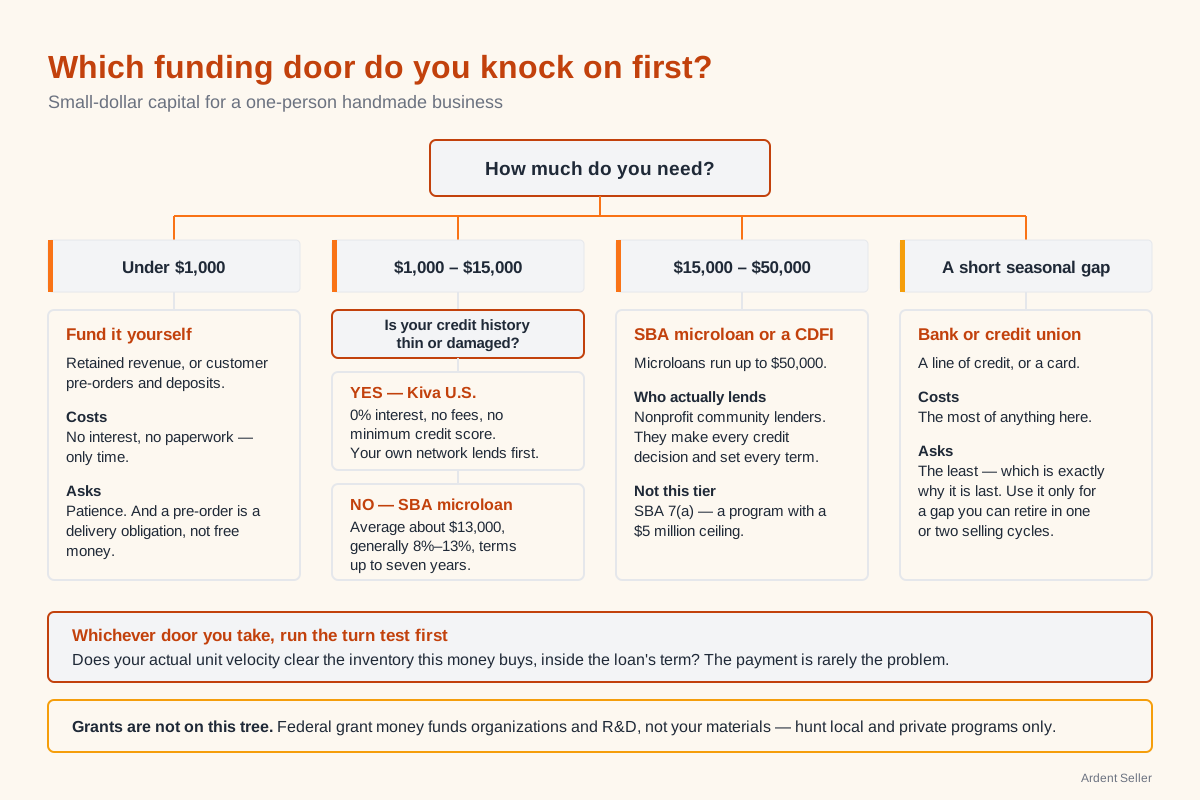
Here are the doors, cheapest money first.
Your own revenue, deliberately routed. The tradeoff nobody frames as a tradeoff: it costs no interest and no paperwork, but it is slow and it silently taxes your household. Right when your growth constraint is materials rather than time, and you can wait a season. Wrong when a dated opportunity — a confirmed wholesale order, a booked market season — will pass while you save.
Pre-orders and deposits from customers. Costs you nothing in interest and validates demand before you spend. Asks of you a delivery obligation you must be able to meet, which is a real liability, not free money. Right when you have an audience and a defined product run. Wrong when your production timeline is uncertain, because a missed pre-order is worse than an unmade sale.
A 0% community loan. Kiva U.S. (opens in new tab) makes crowdfunded loans "between $1,000-$15,000" at "no-interest, no-fee, and no-collateral," and states plainly that it has no minimum credit score requirement. What it asks instead is social capital: during a private fundraising period you must ask a small number of friends, family, clients, or business partners to lend to you first, and you need a PayPal account to receive and repay. Repayment starts exactly one month after you receive the funds and typically runs 12 to 36 months. Right when your credit history is thin or damaged and you have a community willing to vouch. Wrong when you are unwilling to ask your own network, because that ask is the underwriting.
An SBA microloan. This is the SBA program that actually fits a maker, and it looks nothing like the 7(a) loans that dominate SBA coverage, where "the maximum loan amount for a 7(a) loan is $5 million" (SBA (opens in new tab)). Microloans run up to $50,000, but the SBA notes "The average microloan is about $13,000," with a maximum repayment term of seven years and rates "generally, between 8%-13%" (SBA (opens in new tab)). Proceeds can cover working capital, inventory, supplies, furniture, fixtures, machinery, and equipment — and cannot be used to pay existing debts or buy real estate. Right when you need four to fifteen thousand dollars for inventory or equipment and want a lender whose day job is small, unglamorous loans. Wrong when you need money this week — expect training requirements and a real underwriting process.
One mechanic to know before you apply: the SBA does not lend to you directly. It funds "specially designated intermediary lenders, which are nonprofit community-based organizations with experience in lending as well as management and technical assistance," and those lenders "make all credit decisions and set all terms." Find one through the SBA's list of microlenders (opens in new tab).
A CDFI. A Community Development Financial Institution is, per the U.S. Treasury's CDFI Fund, a certified organization providing "financial services in low-income communities and to people who lack access to financing." They "include regulated institutions such as community development banks and credit unions, and non-regulated institutions like loan and venture capital funds," and there are certified CDFIs "in all 50 states, the District of Columbia, Guam, and Puerto Rico" (CDFI Fund (opens in new tab)). Many SBA microlenders are themselves CDFIs, so this door often opens into the same room. Right when a conventional bank has already declined you or will not consider a loan this small. Wrong as a shortcut — certification signals mission, not looser standards.
A bank or credit union line of credit, and credit cards. Costs the most and asks the least, which is exactly why it is last. Right for genuinely short gaps — a fair-booth fee in March that a May market pays back. Wrong for anything you cannot retire in one or two selling cycles, because a revolving balance on materials becomes a permanent tax on every unit you sell afterward.
| Source | Typical size | What it costs | What it asks of you |
|---|---|---|---|
| Retained revenue | Whatever you keep | Time | Patience, and household slack |
| Pre-orders / deposits | Order-sized | Nothing in cash | A delivery obligation |
| Kiva U.S. | $1,000–$15,000 | 0% interest, no fees | Your network lends first; PayPal account |
| SBA microloan | Up to $50,000 (avg ≈ $13,000) | Generally 8%–13% | Underwriting; often training |
| CDFI loan | Varies by institution | Set by the lender | A mission fit and real financials |
| Bank / credit union credit | Varies | Highest of the list | Credit history; sometimes collateral |
Before you borrow: the payment is almost never the problem
Most borrowing advice stops at "can you afford the payment." For a maker buying materials, that is the wrong test, and it is wrong in a way that quietly costs people money.
Work an example. Say you take a $5,000 microloan at 11% over three years to buy candle-making supplies in bulk. The monthly payment is about $164 — $163.69, to be exact — and you will pay roughly $892 in interest across the term. If your candles sell for $26 with $9.50 of materials and packaging in each one, every candle contributes $16.50. Ten extra candles a month brings in $165 against that $163.69 payment — it clears, barely. On the payment test, this loan looks manageable.
Now look at what the $5,000 actually bought: at $9.50 a unit, about 526 candles' worth of materials. Selling ten a month, that inventory takes roughly 52 months to convert. The loan matures in 36.
| Question | Number | Verdict |
|---|---|---|
| Monthly payment | ≈ $164 | Covered by 10 extra sales/month |
| Interest over the term | ≈ $892 | Acceptable for a growth purchase |
| Units the loan buys | ≈ 526 | — |
| Months to sell at 10/month | ≈ 52 | Outlives the 36-month loan |
| Sales pace needed to clear it in term | ≈ 15/month | The actual hurdle |
Clearing this loan inside its own term would take selling about 15 candles a month, not 10 — roughly 50% faster than the pace that made the payment look manageable. At 10 a month you would spend sixteen months paying for wax you had already melted, poured, and shelved, financing it out of other products' margins the whole time. The loan did not fail the affordability test. It failed the turn test, and nothing on the payment schedule would have told you.
So the question to ask before signing is not "can I make the payment." It is: does my actual, historical unit velocity clear the inventory this loan buys, inside the loan's term? That requires two numbers most makers estimate rather than know — a true per-unit cost that includes packaging and waste, and a real sell-through rate per product rather than a whole-shop average. This is the least glamorous reason to keep inventory and unit costs in something that computes them for you: when a lender or a loan offer is in front of you, the answer needs to already exist.
If the turn test fails, the fix is usually not a smaller loan. It is a smaller order — buy the quantity your demand can absorb in the term, even when the bulk price per unit is worse. A 12% materials discount is a bad trade for eighteen months of dead stock.
The four numbers a lender will ask for, and where they come from
Nonprofit microlenders and CDFIs are more forgiving than banks about credit scores. They are not more forgiving about not knowing your own business. The application will ask for four things, and makers routinely stall out here — not because the answers are bad, but because they do not exist yet.
Twelve months of revenue, by month. Not a total. Lenders want the shape, because a maker's shape is seasonal and they are sizing a payment against your worst quarter, not your best. If you sell across a market booth, an online shop, and wholesale, they want it combined — which is far easier to produce if you close each month as it ends rather than at the end of the year, and the End-of-Month Closeout Checklist is a one-page version of that habit.
Gross margin, or something that stands in for it. What is left after materials and direct costs, before your booth fees and your time. If you cannot produce this, you cannot answer the turn question above either — it is the same number doing double duty.
What the money buys, itemized. "Inventory" is not an answer. "$3,200 of wax and vessels at the case price, $900 for a second melter, $900 of packaging" is. Kiva makes this explicit in its application guidance (opens in new tab), asking that itemized loan spend be specific and consistent with the story you told. Every lender wants it; Kiva just says so out loud.
Current inventory value. What you are already holding, at cost. This is the number that most often embarrasses an applicant, because the honest answer is sometimes "more than I am asking to borrow" — which is itself the answer to whether you should borrow at all.
None of these require accounting software. They require records that were kept as the year happened rather than reconstructed the week of the application. That is the whole argument for tracking purchases, production, and sales in one place as you go: Ardent Seller exists to make month-by-month revenue, per-unit cost, and inventory-at-cost things you can read off a screen rather than rebuild from a shoebox. A lender meeting is a bad time to discover you have been guessing.
What to do this week
The honest summary of the primary sources is that there is no pot of free money waiting for a handmade business, and there is a modest, real, boring lending infrastructure built for exactly your size that most makers never contact.
So:
- Demote the grant search. Keep it as a hobby pointed at local and private programs only, and stop treating it as the plan.
- Spend one hour on two numbers. Pull your last twelve months of revenue into monthly buckets, and calculate a true per-unit cost on your two best sellers.
- Look up the SBA-approved microlenders in your state. Read what they actually fund. Many publish their criteria, and a fifteen-minute call will tell you more than a week of searching.
- Run the turn test before accepting any offer. The loan that sinks a small maker is almost never the one with the scary interest rate. It is the affordable one that bought four years of inventory.
Ready to get the numbers a lender will ask for out of your head and onto a screen? Start free with Ardent Seller and track materials, production, and sales in one place — so the answers exist before you need them.
Related reading
- What Banks Want in a Loan Application — Once you have picked a lender, this is what banks want in a small business loan application: the tax-transcript check, the coverage ratio and the personal guarantee that decide it before anyone reads your plan.
- True Hourly Wage for a Handmade Business — Before you borrow against future sales, find out what an hour of your production time is currently earning you.
- Should I Quit My Day Job for My Handmade Business? — The income-replacement question that sits directly upstream of any borrowing decision.
- Cash Flow for Seasonal Sellers — How to survive the slow months, which is usually the real problem a loan is being asked to solve.
- Recipe Costing 101 — Where the true per-unit cost in the turn test comes from.
Free resources
Free companion downloads if you want to put any of this into practice:
- Product Pricing Calculator — Produces the true per-unit cost and margin the turn test runs on, with a batch tab that shows exactly what buying 50 instead of 10 does to your per-unit economics.
- End-of-Month Closeout Checklist — Run it monthly and the twelve-month revenue history a lender asks for builds itself, instead of being reconstructed the week of the application.
This article is provided for educational purposes only and does not constitute financial, tax, or business advice. Loan terms, interest rates, program eligibility, and the cost and margin figures used in the worked examples are illustrative and will vary by lender and by your specific circumstances. Consult a qualified accountant or small-business advisor before making borrowing decisions based on this content.