The right to sell a chocolate chip cookie you baked at home to your neighbor in Wisconsin does not come from a statute. It comes from a May 31, 2017 order of the Lafayette County Circuit Court in Kivirist v. DATCP (Case No. 2016CV6), which enjoined the Wisconsin Department of Agriculture, Trade and Consumer Protection from enforcing food licensing requirements against home bakers selling non-potentially-hazardous baked goods directly to consumers. The right to sell a jar of home-pickled cucumbers comes from Wis. Stat. § 97.29(2)(b)2. (opens in new tab), enacted by 2009 Wisconsin Act 101 (opens in new tab) — the "Pickle Bill" — which requires such sales to stay under $5,000 a year and restricts them to farmers' markets and community or social events. There is no comparable right to sell a hand-dipped truffle, a bar of fudge, a bag of roasted coffee beans, or a box of dried pasta you made at home without a license — and since November 19, 2024, when the Wisconsin Court of Appeals reversed the Lafayette County Circuit Court's December 28, 2022 order in Wisconsin Cottage Food Association v. DATCP (2024 WI App 69, Appeal No. 2023AP367), that has been settled, even though some third-party cottage food law summaries have not caught up to the reversal.
Three rights, two parallel frameworks, one regulatory agency, and a reversal most readers are downstream of without knowing it. This guide walks through what the law actually is right now.
The short version
What Wisconsin's cottage food framework actually looks like as of September 2026: Wisconsin operates two completely separate home-food legal frameworks with no statutory bridge between them. Baked goods are governed by Kivirist v. DATCP (Lafayette County Circuit Court, May 31, 2017) — no cap, no permit, no fee, no kitchen inspection, no registration, no food handler certificate, no annual renewal, direct-to-consumer only. Home-canned acidified foods (pH ≤ 4.6) are governed by Wis. Stat. § 97.29(2)(b)2. (opens in new tab), the Pickle Bill — under $5,000 a year, sold only at a farmers' market or a community or social event in Wisconsin (DATCP guidance also lists flea markets), and not from home, online, on consignment, or alongside licensed foods. Most other homemade foods — chocolates, candies, fudge, dried pasta, roasted coffee, freeze-dried items, dipped chocolates, marshmallows, cocoa bombs, rice cereal treats — require a license unless a separate statutory exemption applies (popped popcorn has one, under Wis. Stat. § 97.30(2)(b)1.d.). The December 28, 2022 Lafayette County Circuit Court order in Wisconsin Cottage Food Association v. DATCP (the "Cottage Foods II" case) briefly extended Kivirist to non-baked shelf-stable foods. The Wisconsin Court of Appeals reversed that order on November 19, 2024 (2024 WI App 69, Appeal No. 2023AP367 (opens in new tab)), and the Wisconsin Supreme Court denied review. Sales channels for baked goods: direct to consumer only — no wholesale or retail placement; DATCP guidance does not address online ordering, so in-person sale or pickup in Wisconsin is the conservative reading. Sales channels for Pickle Bill products: farmers' markets and community or social events (plus flea markets per DATCP). Label requirements: packaged baked goods still fall under Wisconsin's misbranding law (Wis. Stat. §§ 97.03, 97.10), which calls for the maker's name and place of business, net quantity, ingredients, and allergens — but no disclaimer; Pickle Bill products need the preparer's name and address, the canning date, an ingredient list with allergens, and the verbatim statement "This product was made in a private home not subject to state licensing or inspection.", plus a point-of-sale sign reading "These canned goods are homemade and not subject to state inspection." 2025–2026 legislation: Senate Bill 739 / Assembly Bill 748, authored by Senator Eric Wimberger (R-Oconto) and others, would have replaced both frameworks with a registered, $40,000-capped program. Both bills failed to pass on March 23, 2026.
What changed on November 19, 2024 — and why your favorite cottage food law site probably hasn't caught up
The Kivirist ruling in 2017 was narrow on its face. The complaint, brought by three Wisconsin home bakers (Lisa Kivirist, Kriss Marion, and Dela Ends) with representation from the Institute for Justice (opens in new tab), challenged DATCP's enforcement of the retail-food-establishment license requirement against home bakers of non-potentially-hazardous baked goods. Applying rational basis review, the circuit court held that as applied to those bakers, the licensing requirement violated substantive due process because it was not related to public health and safety, and violated equal protection because home bakers were treated differently from producers of other exempted products that are also shelf-stable, made outside a commercial kitchen, and sold directly to consumers. The original order covered the named plaintiffs; later orders in September and October 2017 extended it to others commercially selling nonhazardous, shelf-stable baked goods, where "the bakers are of 'good character'" and the "hygiene" of their kitchens is not in question (as summarized by the Wisconsin Legislative Council). DATCP did not appeal. The remedy was an injunction against DATCP enforcement, not a statutory amendment — the licensing statutes were untouched. The court told DATCP it could not enforce them against this category of producer; it did not strike them down.
A second lawsuit, Wisconsin Cottage Food Association v. DATCP (Lafayette County Case No. 2021CV13), asked the courts to extend the Kivirist logic to unbaked but still not potentially hazardous homemade foods — the Court of Appeals opinion lists fudges, candies, energy bars, roasted coffee beans, and dried soup mixes, and the Legislative Council cites chocolates and rice cereal treats. The Lafayette County Circuit Court ruled for the plaintiffs on December 28, 2022. The Wisconsin Court of Appeals put the order on hold on May 30, 2023 pending appeal. The Court of Appeals issued its decision in Wisconsin Cottage Food Association v. DATCP, 2024 WI App 69, Appeal No. 2023AP367 (opens in new tab) on November 19, 2024, reversing the circuit court, holding the licensing laws constitutional as applied to unbaked goods, and directing judgment for DATCP. The plaintiffs petitioned the Wisconsin Supreme Court, which denied review, leaving the reversal as the controlling authority. Because the Kivirist decision itself was never appealed, it remains good law.
The structural takeaway: only the original 2017 Kivirist category — non-potentially-hazardous baked goods — is protected by the court orders. Unbaked homemade foods need a license unless a statute exempts them.
This matters editorially because most third-party cottage food law summaries on the web carry one of three different snapshots of Wisconsin law:
| Source as of May 2026 | What it shows | What it misses |
|---|---|---|
| Forrager (last updated August 2023) | Lists baked goods as uncapped and allowed; notes "in May 2023, the ban on non-baked goods was temporarily reimposed" | Does not reflect the November 19, 2024 Court of Appeals reversal that made the May 2023 stay permanent |
| PickYourOwn | Lists baked goods plus a broad shelf-stable category | Carries the pre-November-2024 categories without flagging that they are no longer legal |
| Stand Scout 2026 Guide | Lists "no cap for baked goods" and lists categories that are not actually authorized | Reads as if the December 2022 expansion is still in effect |
| Wisconsin Cottage Food Association (the plaintiffs themselves) | Their own background page (opens in new tab) explicitly notes the May 2023 stay and says "for-profit sales of most homemade, shelf-stable food products are once again prohibited in Wisconsin — at least for now" | Does not reflect that the November 19, 2024 reversal moved the May 2023 stay from "pending appeal" to "decided against us" |
| DATCP's own home baker guidance | Reflects the current legal landscape (opens in new tab) — the court orders apply only to "baked goods" that are "not potentially hazardous," generally exposed to dry heat above 140°F in a closed chamber such as an oven; items dried in a dehydrator are not baked goods | This is the authoritative source. Read it first. |
If you are reading this guide and the producer you are advising is currently selling chocolate-covered pretzels, hand-dipped chocolates, fudge, roasted coffee beans, or dried pasta from home in Wisconsin without a license, the lawful answer right now is to stop. The 2022 Circuit Court order that briefly authorized those categories is no longer in effect, and the 2025–2026 bill that would have created a statutory path for them failed to pass in March 2026.
The two parallel frameworks, side by side
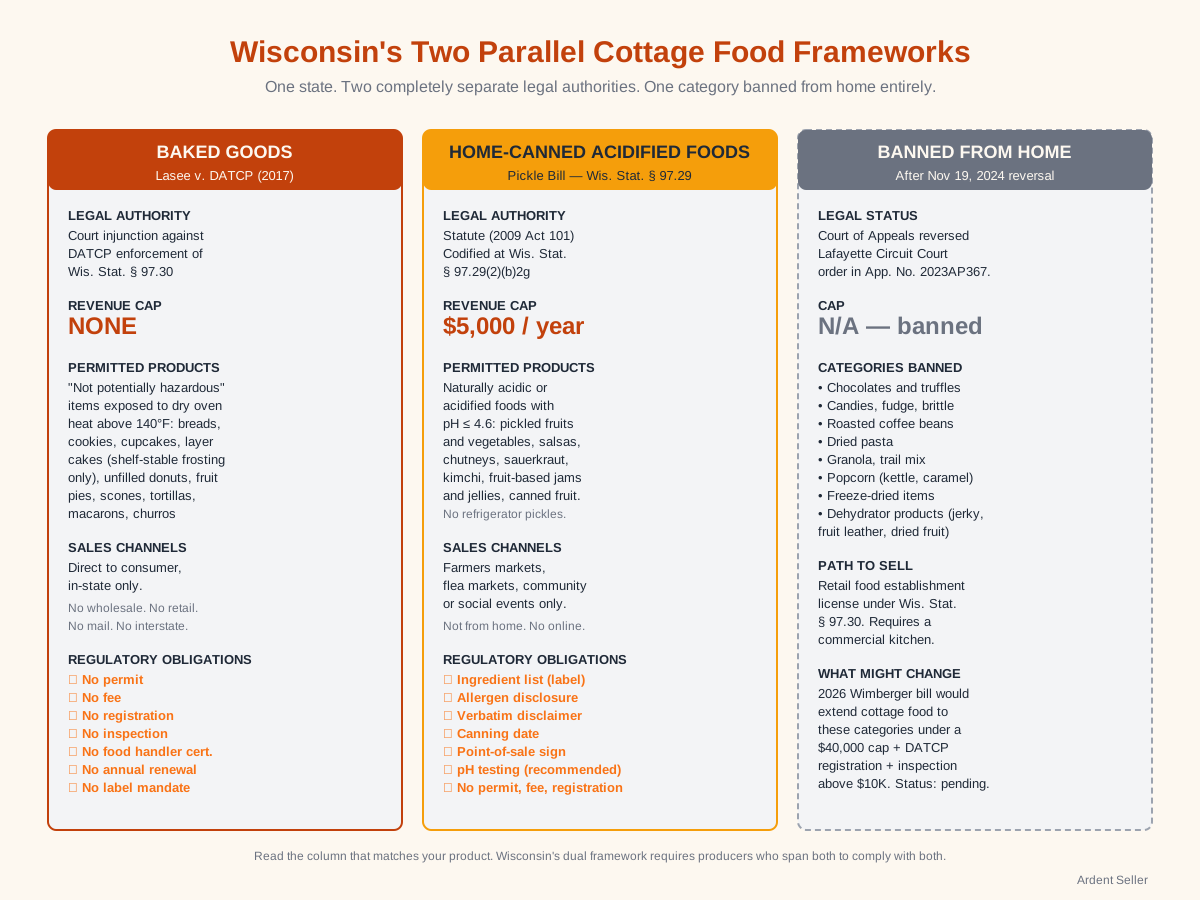
In Wisconsin, two completely separate home-food legal regimes coexist with different authorizations, different caps, different sales channels, and different label requirements. The dual structure traces directly to the way the rights were created: the Pickle Bill is a 2009 statutory enactment of the legislature, while the baked-goods carve-out is a 2017 court injunction against DATCP enforcement of a statute the legislature has not amended. They do not interact, do not stack, and do not refer to each other in the underlying authority.
| Dimension | Baked Goods (Kivirist framework) | Home-Canned Acidified Foods (Pickle Bill) |
|---|---|---|
| Legal authority | Kivirist v. DATCP, Lafayette County Circuit Court Case No. 2016CV6, May 31, 2017 (court injunction against enforcement of food licensing laws) | Wis. Stat. § 97.29(2)(b)2., enacted by 2009 Wisconsin Act 101 (statute) |
| Revenue cap | None | Less than $5,000 per year |
| Permitted products | "Not potentially hazardous" baked goods, generally exposed to dry heat above 140°F in a closed chamber such as an oven | Pickles or other processed vegetables or fruits with equilibrium pH ≤ 4.6, canned at home — per DATCP, pickled fruits and vegetables (not refrigerator pickles), salsas, chutneys, sauerkraut, kimchi, fruit-based jams and jellies, canned fruits |
| Excluded products | Anything with cream filling, custard, perishable frosting, fresh-meat filling; dehydrator products (not baked goods per DATCP); chocolate-coated baked goods are ambiguous | Anything with pH > 4.6; fish, meat, pickled eggs, lemon curd, pesto, dressings |
| Sales channels | Direct to consumer only | Statute: a community or social event or a farmers' market in Wisconsin. DATCP guidance also lists flea markets. |
| Online ordering | Not addressed by DATCP — the conservative reading is in-person sale or pickup | Not permitted (DATCP) |
| Consignment, or sale alongside licensed foods | Not addressed | Not permitted (DATCP) |
| Out-of-state shipping | Not authorized | Not authorized |
| Wholesale to retailers | Not authorized | Not authorized |
| Kitchen inspection | None | None |
| Registration with DATCP | None | None |
| Food handler certificate | Not required | Not required |
| Permit / fee | None | None |
| Annual renewal | None | None |
| Label requirement | Packaged goods: misbranding law (Wis. Stat. §§ 97.03, 97.10, applying 21 U.S.C. 343) — name and place of business, net quantity, ingredient list, major food allergens. No disclaimer required. | Mandatory under § 97.29(2)(b)2.e.: preparer's name and address, canning date, ingredients in descending order of prominence with the common name of any ingredient from milk, eggs, fish, crustacean shellfish, tree nuts, wheat, peanuts, or soybeans (DATCP guidance adds sesame), and the verbatim statement "This product was made in a private home not subject to state licensing or inspection." |
| Point-of-sale sign | None | Mandatory: "These canned goods are homemade and not subject to state inspection." |
| pH testing | Not applicable | Recommended for acidified products (not strictly required by statute but heavily emphasized in DATCP guidance) |
| Recordkeeping | None | DATCP guidance recommends recipe, batch amount, canning date, sale location, receipts, and pH results — not formally mandated |
| Liability insurance | Not required | Not required |
| What ends the protection | A statutory amendment by the legislature, a successful constitutional challenge to Kivirist, or DATCP withdrawing its acquiescence to the injunction | Reaching $5,000 in annual sales (moves you out of the exemption), or selling through an unauthorized channel |
The dual framework is a quirk of how Wisconsin law evolved rather than a deliberate policy design. A baker producing only shortbread and a producer making only pickled cucumbers might both believe they are operating "under the Wisconsin cottage food law" and be operating under two completely different legal authorities, with two completely different obligations, two completely different sales-channel restrictions, and two completely different exposure profiles if something goes wrong. The same producer doing both — Maya in Madison selling shortbread cookies at the Dane County Farmers Market on Saturdays and selling jars of her grandmother's pickled green tomatoes at the same booth — is straddling both frameworks simultaneously and needs to comply with both sets of rules for the products that fall on each side of the line.
What still needs a license, and the gray-area categories
The November 19, 2024 Court of Appeals reversal confirmed a line between baked and unbaked homemade foods. DATCP's working description: baked goods are generally exposed to dry heat, transferred via air, at a temperature above 140°F, in a closed chamber such as an oven — some items made in a waffle maker or Dutch oven count, and items dried in a dehydrator do not. If the finished product meets that description and is not potentially hazardous, it falls inside the Kivirist framework. If it was produced by a different process — boiling sugar (candy), melting chocolate (truffles, dipped chocolates, fudge), extruding pasta, freeze-drying, or dehydrating — it does not, unless a separate statute exempts it.
Needs a license — no court order or statutory exemption covers it:
- Chocolate-covered fruit, pretzels, or other chocolate-dipped items
- Hand-dipped chocolates and truffles
- Fudge of any variety
- Hard candies, caramels, brittle, toffee
- Marshmallows and marshmallow-based treats
- Cocoa bombs
- Rice cereal treats and other no-bake confections
- Energy bars and trail mix
- Roasted coffee beans and coffee blends
- Dried pasta and dried soup mixes
- Freeze-dried items (candies, fruit, etc.)
- Dehydrator-produced items (jerky, dried fruit, dried herbs as a product, fruit leather) — DATCP says items dried in a dehydrator are not baked goods
- Nut butters
- Spices and spice blends
- Tea blends
- Cut produce
- Tomato sauce
- Garlic-in-oil
Typically inside Kivirist (oven-baked, not potentially hazardous, no cap):
- Breads, rolls, biscuits, muffins, scones, sweet breads
- Cookies, brownies, bars
- Cupcakes and layer cakes with shelf-stable frosting
- Pies with shelf-stable fillings (fruit pies — not custard, not cream, not unbaked dairy)
Permitted under the Pickle Bill (home-canned acidified foods, under $5,000 a year):
- Pickled fruits and vegetables with verified pH ≤ 4.6 (not refrigerator pickles)
- Salsas and chutneys with verified pH ≤ 4.6
- Sauerkraut and kimchi
- Fruit-based jams and jellies (high natural fruit acid)
- Canned cherries, peaches, applesauce, and other naturally acidic fruits
Genuinely ambiguous categories — proceed only after talking to DATCP:
- A baked good with a chocolate component (chocolate chips, chocolate drizzle, chocolate ganache) where the chocolate is a minority of the finished weight is a common case. A chocolate-coated baked good where the coating is a significant share of the weight (like a chocolate-enrobed brownie) is less clear.
- Fried or griddle-cooked items — fried donuts, churros, tortillas — do not fit DATCP's dry-heat, closed-chamber description of baked goods. Confirm with DATCP before selling them under the court orders.
- Oven-baked granola and oven-roasted nuts — the status is unconfirmed. They are produced with dry oven heat, but they are not traditional baked goods, and DATCP guidance does not address them. (One plaintiff in the second lawsuit was dismissed after the parties stipulated she could sell her homemade granola, which does not settle the question for everyone.)
- Popcorn has its own statutory exemption: a retail food establishment "where popcorn is popped" does not need a retail food establishment license if it is not required to obtain one to sell or process any other food (Wis. Stat. § 97.30(2)(b)1.d.). Coated varieties such as caramel corn raise confectionery questions — check with DATCP.
- Honey is outside both frameworks: a place used by a beekeeper solely for extracting honey or producing and selling raw honey is not a food processing plant (Wis. Stat. § 97.29(1)(h)8.), and a retail establishment primarily selling honey, cider, maple syrup, or fresh produce that the operator produced is exempt from the retail license if it does no other food processing (§ 97.30(2)(b)1.b.).
- Maple syrup has a separate exemption for a place used solely to produce and package maple syrup or concentrated sap for direct sale when sales do not exceed $5,000 in any 12-month period (§ 97.29(1)(h)12.).
- Eggs from your own flock are governed by Wis. Stat. § 97.28 (flocks of 150 birds or fewer, sold at the farm, a Wisconsin farmers' market, or on an egg sales route, with specific carton labeling and 41°F storage), not by either cottage food framework.
If a product is not on the lists above and you have not received explicit confirmation from DATCP that it falls under the Kivirist orders or a statutory exemption, default to assuming it requires a license (a retail food establishment license under Wis. Stat. § 97.30 or a food processing plant license under § 97.29).
What happened to the 2025–2026 cottage food bill
In December 2025, Senate Bill 739 (opens in new tab), authored by Senators Wimberger (R-Oconto) and Feyen, and its companion, Assembly Bill 748 (opens in new tab), authored by Representative Swearingen and others, were introduced to replace the dual framework with one statutory program. Per the Legislative Reference Bureau's analysis, the bill would have exempted home-prepared nonpotentially hazardous foods from licensing alongside the canned-pickled-foods exemption, and both exemptions would have required:
- Registration with DATCP, with the registration number on every label
- Sales directly to consumers at the producer's business address, by delivery, or at a community or social event or farmers' market in Wisconsin
- A label with the registration number, preparation date, the statement "This product was made in a private home," and an ingredient list with major food allergens
- Liability insurance
- Total annual gross sales under $40,000
- Under $10,000 in sales: a point-of-sale sign stating "These food products are homemade and not subject to state inspection."
- From $10,000 to under $40,000: at least one person holding a DATCP certificate of food protection practices, plus a DATCP home inspection (to be set by rule) for producers of nonpotentially hazardous foods
Public hearings were held in January 2026. Coverage by Wisconsin Public Radio (opens in new tab) and the Wisconsin Examiner (opens in new tab) framed it as a "food fight" between home bakers, who objected to capping a currently uncapped baked-goods right, and industry groups. As one home baker told the Wisconsin State Farmer (opens in new tab), a $40,000 cap "makes business efforts hardly worth it." Opponents compared it with Minnesota's roughly $78,000 Tier 2 limit and Iowa's uncapped shelf-stable tier.
Both bills failed to pass on March 23, 2026, pursuant to Senate Joint Resolution 1, according to the legislature's bill histories. Nothing changed: the Kivirist orders and the Pickle Bill are still the law. Any new attempt would have to start over in the legislative session that begins in January 2027.
For producers, the practical advice is: operate under the current Kivirist and Pickle Bill frameworks as they exist today, and watch for new bills in 2027 — a future bill modeled on SB 739 would add registration, insurance, and a cap to a baked-goods right that currently has none.
How Ardent Seller helps with the Wisconsin label
Ardent Seller assembles this label, and it handles Wisconsin's two frameworks separately. For Kivirist baked goods — where the court orders lifted licensing but Wisconsin's misbranding law still applies to packaged food — the generator builds a label with the maker's name and place of business, net quantity, the ingredient statement in descending order by weight, and the "Contains:" allergen line, and never prints a disclaimer the law does not require. For Pickle Bill canned goods, it renders the verbatim Wis. Stat. § 97.29(2)(b)2. statement, the ingredient and allergen lines, the canning date, and the preparer's name and address, plus a reminder for the point-of-sale sign the market booth needs but the package label can't carry. For both, the checklist blocks printing while a required element is missing. Output is a PDF sheet (Avery 5163, 4″×6″, or full page) or a direct print.
Generate your Wisconsin cottage food label with Ardent Seller free — the label generator is included on every plan, including the free tier.
Comparison to neighboring states
Wisconsin sits on the restrictive end of the Upper Midwest cottage food spectrum for product categories — and on the permissive end for paperwork (under Kivirist). The dual structure makes apples-to-apples comparison difficult, so the table below shows each state's framework on the dimensions Wisconsin producers most commonly ask about.
| State | Cap | Baked goods | Chocolates / candies / fudge | Acidified foods | Online | Wholesale | Interstate | Inspection | Registration |
|---|---|---|---|---|---|---|---|---|---|
| Wisconsin (current) | None for baked goods; under $5,000 for Pickle Bill products | Yes (no cap, Kivirist) | No | Yes (under $5K, pH ≤ 4.6) | Not addressed (baked); No (Pickle Bill) | No | No | No | No |
| Minnesota | ~$7,665 (Tier 1, 2025) / ~$78,000 (Tier 2) | Yes | Yes | Yes (pH ≤ 4.6, both tiers) | Yes (in-state delivery) | No | No | No | Yes (Tier 2) |
| Iowa | No cap (shelf-stable tier) | Yes | Check Iowa rules | No | Yes | No | No | No | No (shelf-stable tier) |
| Michigan | $50,000 standard + $75,000 for items priced $250+ per unit | Yes | Yes | No | Yes (Michigan addresses) | No | No | No | No |
| Illinois | No cap | Yes | Yes | Yes (approved recipe or food safety plan) | Yes (in-state) | No | No | No | Yes (local health department; CFPM credential) |
The structural distinction Wisconsin most needs to internalize: Minnesota, Michigan, and Illinois all permit candies and fudge at the cottage tier. Wisconsin does not, the November 19, 2024 reversal foreclosed the court route, and the 2025–2026 legislative route failed in March 2026.
What this means for an Ardent Seller customer in Wisconsin
A Wisconsin home baker operating under Kivirist has a very light paperwork regime — no permit, no fee, no registration, no inspection, no food handler certificate. But the absence of paperwork is not the absence of recordkeeping discipline. The producer-side discipline that pays off in Wisconsin is the same discipline that pays off in every cottage food state:
- Lot tracking for every batch, even though no agency will ask to see it. The single most common cause of a contained product-quality incident becoming a full-blown reputation problem is the inability to identify which customers received which batch. A lightweight batch number and a customer record per market day is sufficient. (Batch tracking for food sellers walks through the minimum-viable lot-tracking spine.)
- Recipe costing at the gram level. Wisconsin's Kivirist framework does not cap revenue, which means a serious operator can grow the business meaningfully — and the operators who grow most cleanly are the ones who know their margin per unit and per batch before they price for the next farmers market. (Recipe costing 101 covers the cost layers.)
- Inventory tracking for ingredients with shelf-life considerations. Even a no-permit kitchen is responsible for what it ships; a flour lot recall from a supplier is the same recall regardless of whether the state inspected your kitchen.
- Sales-channel discipline: the Kivirist protection covers direct-to-consumer sales only. A wholesale account placed by an enthusiastic boutique is a one-step path out of the protection. An out-of-state mail order is the same. Knowing which orders are inside the protection and which are not, and turning down the ones that are not, is part of running a Wisconsin cottage food business.
Ardent Seller is built around these four disciplines — multi-tenant inventory, batch and lot tracking, gram-level recipe costing, and per-channel sales records — for makers who don't have a regulator forcing them to be organized but want to be organized anyway. The free trial is the place to start; the features page walks through what's included; the pricing page shows the plan tiers.
Related reading
- Massachusetts Cottage Food Law Guide — Another no-statewide-statute framework where the rule that applies to you depends on which town's board of health you file with, instead of a single court ruling against a single state agency.
- Minnesota Cottage Food Law Guide — Wisconsin's most-cited neighbor in the cap-comparison debate, with the structurally unique Tier 1 / Tier 2 framework Wisconsin producers contrast their own no-cap regime against.
- Batch Tracking for Food Sellers — The minimum-viable batch and lot-tracking spine that pays off even under a no-paperwork framework like Kivirist.
Free resources
A few free downloads from the Ardent Workshop library that pair well with this post:
- Cottage Food Laws by State: The 50-State + DC Quick Reference — The downloadable PDF this state guide is part of, covering Wisconsin and the other 49 states plus DC at a glance.
- Cottage Food Revenue Cap Tracker — An interactive tracker that helps Pickle Bill producers monitor progress against the $5,000 limit.
- Monthly Inventory Count Sheet — A printable count sheet for keeping ingredient inventory honest in a kitchen that no one is going to inspect.
This article is provided for educational purposes only and does not constitute legal, regulatory, food-safety, or health advice. Cottage food laws, court rulings, and legislative proposals in Wisconsin are evolving — future court decisions and legislative sessions may produce material changes. Consult the Wisconsin Department of Agriculture, Trade and Consumer Protection (opens in new tab), a qualified Wisconsin food-safety attorney, or your local UW-Extension food safety specialist before making compliance or commercial decisions based on this content.