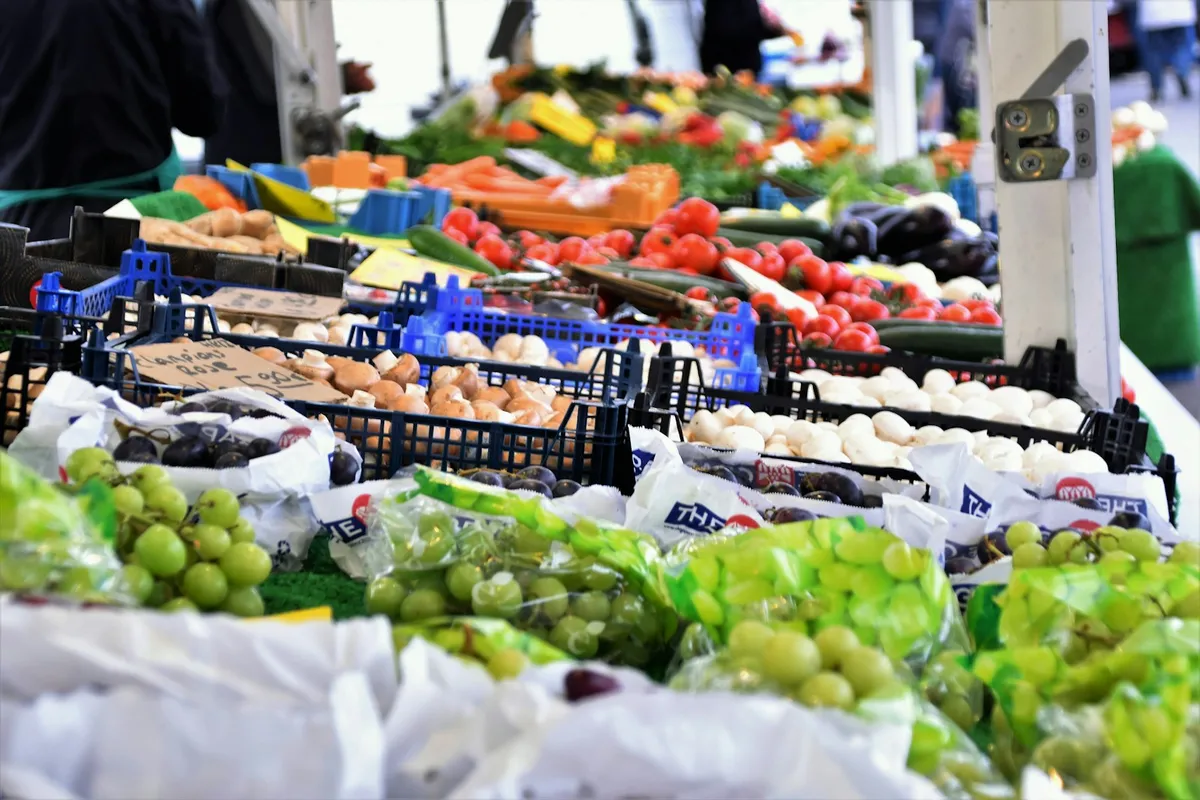
Every farmer knows the December harvest depends on what went in the ground in May. Farmers market vendors know it too — they just forget on a slow Tuesday in spring, when the booth feels quiet and Black Friday feels like ten years away.
It isn't ten years away. It's 28 weeks. The vendors who clear out in December — the ones who close November with full tills and December with empty shelves — are doing quiet, almost-invisible work right now, in May, when nobody is thinking about it. The vendors who scramble in October are already a half-step behind, and that gap doesn't close. It widens every week, until December arrives and one booth is selling everything they make while the booth across the aisle is selling everything they panic-produced.
This is the month-by-month plan to be the first booth.
Why May is the unglamorous month that decides Q4
The mistake is treating Q4 as a season that starts on Black Friday. By Black Friday it's too late to do most of the things that matter — too late to negotiate better packaging pricing, too late to apply to the better holiday markets, too late to test a new gift bundle, too late to hire the helper who would have made all of it possible.
What you can do in November is execute. What you can do in May is decide what gets executed.
Take Lena, a composite of every farmers market vendor heading into their second or third holiday season. She runs a small-batch preserves and shortbread booth at her town's Saturday market. Last December, her sales were strong — but she ended the season exhausted, with two full kitchen days of unsold cranberry-orange marmalade staring at her on January 2nd, and a vague sense that she'd left money on the table somewhere. She just couldn't tell where.
The leak wasn't December. The leak was every month from May through October, when she made dozens of small decisions on instinct that should have been made on a plan. The plan below is what last May should have looked like.
The eight-month playbook
Each month has a theme, a checklist, and a finish line. Print this out. Tape it inside your kitchen cabinet. Cross items off as you go. The fact that you can see them all at once is the point — Q4 isn't one quarter, it's eight months of small commitments compounding into a calm, profitable holiday season.
Month 1 — May: Materials lock-in
This is the month for boring, behind-the-scenes work. Suppliers, packaging vendors, and producers of any imported component (jars, lids, ribbon, gift boxes, custom labels) get slammed in September. Their lead times stretch, their prices climb, and "back-ordered until January" enters your vocabulary at exactly the wrong time.
Your May checklist:
- Pull last year's Q4 numbers. Total sales by SKU, costs by SKU, units made vs. units sold. If you don't have this data, write down what you remember while it's still in your head — it's better than nothing, and you'll be glad you started this discipline now.
- Identify your hero products. Three to five SKUs that earn the majority of your December revenue. Everything in this plan is about protecting their supply chain.
- Email your top three suppliers. Confirm they can hit your projected Q4 volume. Ask about price changes. Ask about lead times. Lock in any 2026 pricing they'll quote.
- Place the long-lead orders. Anything that ships from overseas, anything custom-printed, anything you almost ran out of last year — order now. The 12% you save by buying in May vs. September is real money.
- Open a "Q4 Plan" document. This will be your one source of truth from now until New Year's. Add this checklist. Add notes from supplier conversations. Add ideas as they come up.
By end of May: You know what your hero products are, you've talked to the people who supply them, and you've placed the orders that have the longest lead times.
Month 2 — June: Capacity audit
You're going to be tempted, somewhere around August, to commit to more markets and more SKUs than you can actually produce. June is for the math that prevents that.
Your June checklist:
- Calculate your honest weekly production ceiling. Not your max — your max-without-burnout. How many jars, bars, batches, or units can you make in a normal week without working past 9 p.m.? Halve that for the weeks when life happens.
- Project your Q4 demand. Take last year's peak weekly sales and add 15-25% if you're growing. That's your demand line. Compare it to your capacity line.
- Identify the bottleneck. It's almost never raw materials. Usually it's your time, your kitchen, or one specific piece of equipment. Name it.
- Decide: scale up or scale down expectations. If demand exceeds capacity, you have three options: hire help, drop low-margin SKUs, or cap your market commitments. Pick one before July. (Here's a decision framework for hiring your first helper if that's the path.)
- Schedule a "capacity test" week. Pick one week in late June. Produce at peak rate. See what breaks. Better to find out now.
By end of June: You know exactly how much you can make per week, you've matched it against demand, and you have a written decision about how to close the gap.
Month 3 — July: Pricing and product review
July is when summer markets are busy and the temptation is to coast. Don't. The window to test new pricing and new products is now, not in October when the stakes are five times higher.
Your July checklist:
- Run the cost math on every SKU. Materials, packaging, labor, overhead. If you haven't done this since last year, do it now — input prices have moved. (The recipe costing primer walks through the categories.)
- Set your Q4 pricing. Test it at July markets. If a price increase is coming, give your customers two months to absorb it before peak season — don't surprise them in November.
- Design your gift bundles now. Three SKUs in a wrapped box always sells better in December than three loose SKUs side by side. Prototype them in July. Photograph them. Price them.
- Cut your bottom 20%. The slow seller you've been carrying since March will be a slow seller in December too. The shelf space, production time, and table real estate it occupies are needed elsewhere. Drop it.
- Apply to holiday markets. Most juried holiday markets and craft fairs have application deadlines in July or August. Get yours in early. (Here's a guide to juried craft show applications.)
By end of July: Q4 prices are set, gift bundles are designed and tested, and your holiday market applications are in.
Month 4 — August: Booth, brand, and Q4 calendar
August is the month for the work you keep meaning to get to but never do — the photography, the signage, the marketing inventory you'll need in November.
Your August checklist:
- Lock your Q4 market schedule. List every market, holiday fair, pop-up, and pickup date through January 2nd on one calendar. This is your production target.
- Refresh your booth visuals. Holiday-specific signage, gift-bundle display, "Order for Christmas Pickup by [date]" sign. Don't make these in November.
- Photograph everything. Hero products, gift bundles, lifestyle shots with seasonal styling. You'll need these for emails, social, and any online ordering you accept.
- Build your customer outreach list. If you've collected emails or numbers, segment them: VIP customers, recent buyers, lapsed customers. You'll need each list for different campaigns in October and November.
- Plan one new product or one new market. Q4 is not the time to launch three new things. It is a fine time to launch one. Pick it now.
By end of August: Your Q4 calendar exists, your booth visuals are designed, and your customer list is segmented and ready.
Month 5 — September: The production sprint begins
This is when the unglamorous work pays off. Suppliers are scrambling to keep up with demand, prices are climbing, and you are placidly receiving the orders you placed in May.
Your September checklist:
- Begin building inventory for November and December markets. Anything that holds — jams, shelf-stable goods, hard candles, soaps, packaged dry goods — gets produced ahead. Track every batch.
- Set up batch tracking discipline. Every batch labeled, dated, and costed. If something goes wrong in December (a recall, a complaint, a mismatched lot), you'll need this.
- Stocktake at the end of the month. Real numbers, not estimates. (Here's a 30-minute stocktake guide if you've never done one cleanly.) This is the baseline you'll measure everything else against.
- Order any remaining packaging. Gift bags, ribbon, holiday labels, shipping supplies if you ship. Last call before lead times stretch.
- Send the September "we're ready" email. A short note to your list: "Holiday gift bundles are here. Pre-orders open. Pickup dates below." Test the messaging now while stakes are low.
By end of September: Inventory is building, batch tracking is in place, and you've made first contact with your holiday customer list.
Month 6 — October: The buffer
October is the buffer month — the place where everything that went wrong in September gets caught and fixed before November arrives.
Your October checklist:
- Run your final pricing audit. Costs may have shifted between July and October. Adjust prices on any SKU where the margin slipped below your floor.
- Test every system you'll lean on in November. Square reader charged? Backup payment method? Inventory data syncing? Email automation working? Find the broken thing now.
- Triple-check labeling compliance. Every new SKU. Every new gift bundle. Every cottage-food-required disclosure. Compliance violations in November are expensive — they pull you off the booth at exactly the wrong time.
- Plan your week-by-week production schedule for November and December. What gets made which week, by whom, in what quantity. Tape it inside the kitchen cabinet next to this checklist.
- Start your customer marketing push. Email the VIP list first (early access to gift bundles), then recent buyers, then lapsed customers. Different message for each.
By end of October: Your systems are tested, your November-December production schedule is written, and your marketing engine is warming up.
Month 7 — November: Execution mode
By November, planning is over. Either the work was done or it wasn't. The vendors who did the work in May through October are now mostly executing — running production, working markets, refilling shelves. The vendors who didn't are improvising under pressure, and you can see it in their booths.
Your November checklist:
- Track per-event profitability, not just revenue. Booth fee, mileage, supplies used, samples given away, hours worked. Revenue alone hides which markets are actually paying you.
- Monitor inventory daily. Stockouts cost you future sales (a customer who arrived to find empty shelves doesn't always come back). Re-up production weekly based on actual sales velocity, not projections.
- Capture customer data at every market. Email signup, QR code, business card. The customers you meet at a November market are your December and January customers — but only if you can reach them.
- Watch your hero products. They drive the cash flow. If a hero is selling 30% faster than projection, decide by mid-November whether to produce more or coast on the demand.
- Take five minutes after each market to reconcile. What sold, what came back, what spoiled, what went into the donation pile. Don't let this data live only in your head.
By end of November: You're hitting your production targets, you have real per-market data on what's working, and your customer list has grown.
Month 8 — December: Ride it out, capture, and learn
December is half execution and half record-keeping for next year. Don't let the chaos eat the second half.
Your December checklist:
- Decide the push-vs-coast question by mid-December. If demand is exceeding production, do you push harder, raise prices, or sell through and stop taking orders? Don't let this decide itself.
- Plan for the January slump. Income drops sharply post-holiday for most market vendors. Have a January marketing plan ready before December 23rd, even if it's three bullet points. (Cash flow strategy for seasonal sellers is worth a read in early December.)
- Final inventory count between Christmas and New Year. What sold, what didn't, what spoiled, what carried over. This becomes your starting point for next May.
- Write the post-Q4 retrospective in the first week of January. What worked, what broke, what you'd change. Three pages, hand-written, while it's still fresh. This is the most valuable document you'll write all year.
- Capture every customer who bought in December. They are your highest-value list for the entire year. Email them in January with a thank-you and a "what's next" preview.
By end of December: You've protected your margins through peak, you have a written record of what actually happened, and you have a January plan that prevents the cliff.
Why this compounds
None of these checklists is hard on its own. The hard part is doing them in May, when the work feels optional. By September, when peak is closing in, the May work is non-negotiable — but by then it's also too late to start.
The vendors who run this calendar two or three years in a row stop describing Q4 as "stressful." They describe it as "busy." There's a difference. Stress is what you feel when you're discovering problems in real time. Busy is what you feel when you're executing a plan you wrote six months ago.
The compound effect goes both directions. Every year you skip the May work, you make the next December a little harder. Every year you do the May work, you make the next December a little easier — and the year after that, easier still. The vendors at the booth across the aisle who seem to never panic during peak season aren't smarter than you are. They just started in May.
If you want a system that helps you actually track all of this — per-market profitability, batch-level inventory across multiple selling locations, costs by SKU, weekly production targets — that's exactly what Ardent Seller is built for. Most market vendors outgrow spreadsheets somewhere around their second Q4. You can keep the calendar above on paper if you want; the data behind it eventually needs a home that isn't a stack of receipts in a shoebox.
Print the checklists. Tape them up. Start with May. Black Friday is 28 weeks away — and the vendors who'll have the calmest, most profitable December are the ones who'll spend this week doing supplier emails and pulling last year's numbers, while everyone else is enjoying the spring market and not thinking about December at all.
Sign up for Ardent Seller if you're ready to track this season the way it deserves. Or just bookmark this post and come back to it the first of every month.
Related reading
- Farmers Market Mistakes — The ten silent profit leaks the calendar above is designed to plug, with the math behind each one. Read this before you start your May checklist.
- Shelf Life, Spoilage, and Shrinkage — Q4 amplifies every spoilage problem you have in summer. The framework here turns the November and December overproduction question into a number instead of a guess.
- Multi-Location Inventory Tracking — By peak season, most market vendors are running three or four selling channels at once (Saturday market, holiday craft fair, online store, wholesale). This is how you keep the data straight when the booth is moving every weekend.
Free resources
A few free downloads from the Ardent Workshop library that pair well with this post:
- Craft Show Prep and Profit Tracker — Print one per market. Break-even math before you load the truck, an in-show tracking grid for revenue-by-hour, and a post-show reconciliation that calculates true per-event profit after booth fee, mileage, and unsold perishables. The tool that makes Month 7's per-event tracking actually happen.
- Small-Batch Production Planning Playbook — A weekly production calendar template plus the capacity-and-bottleneck audit you'll need in June. Pairs directly with Month 2.
- Vendor & Supplier Contact Organizer — A printable contact sheet for every supplier, packaging vendor, and producer in your supply chain. Fill it in May, lean on it in September.
- Year-End Inventory Reset Checklist — The capstone for Month 8. After the last December market, run a full stocktake across booth stock, studio inventory, and any consignment-held units; identify the unsold seasonal SKUs that need a write-off or a Q1 sample-out plan; and run the Schedule C Part III math so the Line 41 ending inventory number that flows to your CPA is defensible. Pairs with the monthly Craft Show Prep tracker as the once-a-year deeper pass.
This article is provided for educational purposes only and does not constitute financial, tax, or business advice. Cost structures, pricing examples, and timeline figures are illustrative and will vary by your specific circumstances. Consult a qualified accountant or small-business advisor before making financial decisions based on this content.