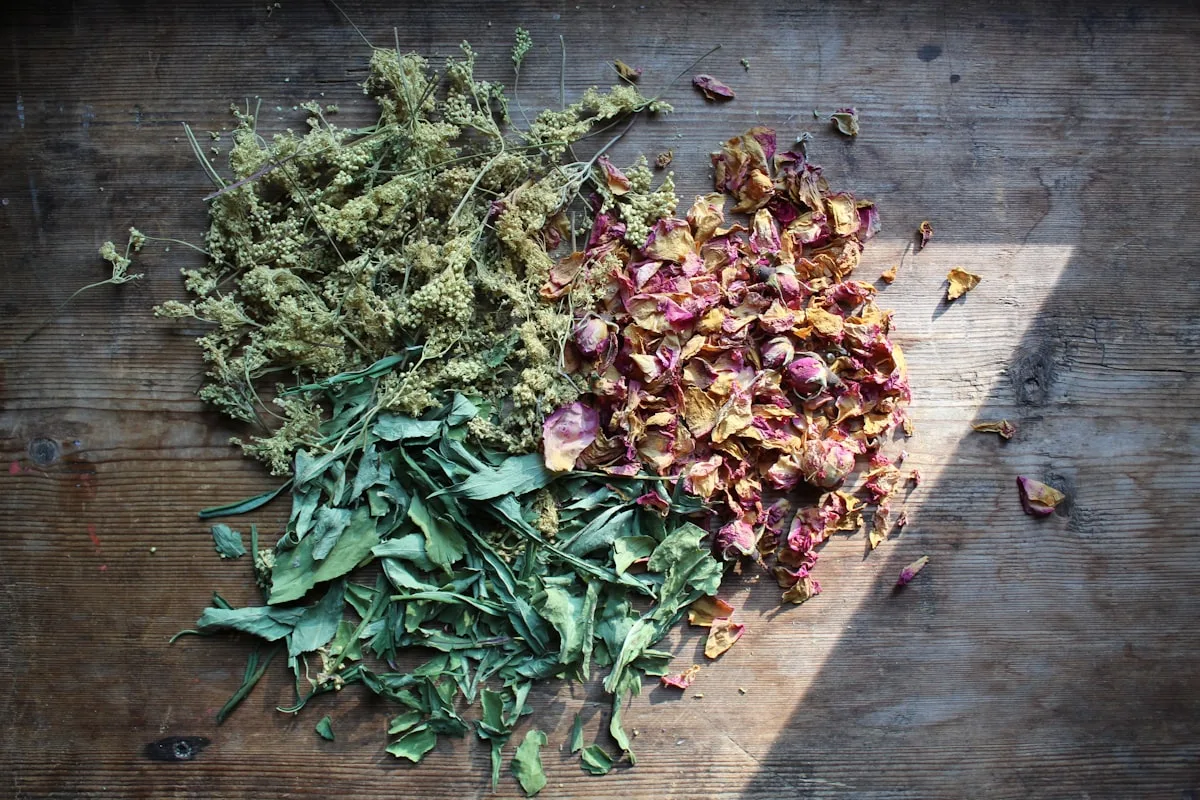
Blending tea is often described as a kind of cooking, but it behaves more like tuning an instrument. A cook can improvise and call the result a happy accident. A blender is chasing the same note every single time — pulling a consistent cup out of leaves that never taste quite the same twice, harvest to harvest, garden to garden. The whole craft is the pursuit of sameness, which is a strange thing to build a business on until you realize that sameness is exactly what a customer is paying for.
That pursuit is old. The home blenders selling 50-gram pouches at Saturday markets today are the far end of a story that runs through empires, monopolies, and railway platforms. It's worth knowing that story, partly because it's a good one, and partly because it explains why the same small skill has mattered for two hundred years — and still does.
The blend was always the secret
For most of tea's commercial history, the blend was the proprietary part. Anyone could buy leaf; the value lived in what you did with it. Merchants combined teas from different gardens and seasons to hit a house flavor a customer could return to, and they guarded those formulas the way a distiller guards a mash bill.
Consider the most famous blend of all. Earl Grey — black tea scented with oil from the rind of the bergamot orange — is named after Charles Grey, the second Earl Grey, who served as British Prime Minister from 1830 to 1834. The romantic origin story, in which a grateful Chinese diplomat gifts Lord Grey the recipe to suit the water at his estate, is almost certainly a later marketing flourish rather than documented history; the earliest known reference to tea flavored with bergamot actually predates his premiership, appearing around 1824, and seems to have been a way to make mediocre tea taste better (Earl Grey tea, Wikipedia (opens in new tab)).
That detail is the important one. Bergamot wasn't added because someone loved bergamot. It was added to fix something — to lift a dull leaf, to cover an off note, to make an inconsistent supply taste consistent. Blending began as a problem-solving craft, not a luxury one.
The oldest reason to blend: to make a variable, imperfect supply taste the same in every cup. Flavor was the visible product. Consistency was the actual one.
When a blend became a brand
The leap from a merchant's private recipe to a product with a name on it is where tea blending became a business the way we'd recognize it now.
English Breakfast — that full-bodied blend of black teas from Assam, Ceylon, and Kenya built to stand up to milk — has a contested birth, which is fitting for a blend. One account credits a New York tea merchant named Richard Davies in 1843, who started with a base of Congou and rounded it out with a little Pekoe and Pouchong. In Britain, its popularity is often traced to Queen Victoria tasting a blend by that name at Balmoral in 1892 (English breakfast tea, Wikipedia (opens in new tab)). Two countries, two stories, one blend — and both versions turn on a specific person reproducing a specific formula reliably enough that other people wanted it by name.
Once a blend had a name, it needed a standard. A customer who bought "English Breakfast" in March and again in September expected the same cup, even though the underlying leaf had changed gardens and seasons in between. Meeting that expectation is a records problem as much as a taste problem. The blender had to know exactly what went into the last batch to have any hope of matching it with the next.
What branding really demanded: not a better blend, but a repeatable one. The name was a promise, and the recipe was how you kept it.
The people's blends
Not every blend came down from an aristocrat's table. Some of the most enduring ones came up from the street.
Masala chai is the clearest example. Spiced milk-and-tea drinks have deep roots in India, but the everyday masala chai now sold on nearly every corner took its modern shape during the British colonial period, when tea-industry bodies (originally funded by a tea tax) ran a sweeping campaign to build a domestic tea habit: free cups and demonstrations at railway platforms, enamel placards in markets and at festivals, and afternoon tea breaks pushed in factories and offices (The Print, on how the tea trade made India a nation of tea drinkers (opens in new tab)). Vendors, working with thin margins, stretched a small amount of expensive leaf with milk, sugar, ginger, and cardamom. The spice wasn't only flavor; it was economics. Regional preferences hardened into recipes, and those recipes became a craft passed hand to hand rather than sold under a label.
It's a useful counterweight to the Earl Grey story. Blending was never purely a luxury pursuit for people with estates and mandarins. It was also a working person's improvisation — a way to make a little go further and taste like something worth returning to. The home blender weighing chamomile and dried orange peel on a kitchen scale is standing in both traditions at once: the merchant's discipline and the street vendor's resourcefulness.
The craft comes home
For most of the twentieth century, blending consolidated into large companies with tasting rooms and warehouses. What's changed in the last couple of decades is that the craft has come back down to the individual — and, increasingly, to the home kitchen.
The market underneath that shift is not small. On any given day, more than 159 million Americans drink tea, and it can be found in almost 80% of U.S. households — figures the U.S. Census Bureau (opens in new tab)'s January 2024 feature drew from the Tea Association of the USA (opens in new tab)'s 2022 fact sheet. Most of that is commodity product, but the appetite for something distinctive — a single-origin oolong, a house tisane, a small-batch breakfast blend — is exactly the gap a small maker can fill.
The law has quietly made room for it, too. As of 2026, dried tea and herbal blends are among the most commonly permitted products under U.S. cottage food laws, because a properly dried blend has no moisture to support bacterial growth. California explicitly lists dried tea and roasted coffee among allowed cottage foods (CDPH Approved Cottage Food List (opens in new tab)), and Colorado permits dried tea and herb blends, which its state extension service considers safe only when they're dried thoroughly — under-dried blends can grow mold (Food Smart Colorado, Colorado State University Extension (opens in new tab)). Many other states with similar frameworks do the same. That combination — real demand and a legal on-ramp — is why a folding table at a farmers market can now hold a dozen blends that would once have required a company behind them.
Why tea is a natural cottage product: it's shelf-stable, it's forgiving to store, and — done right — it's low-risk. What it isn't is forgiving of sloppiness in the recipe. The whole value is consistency, and consistency is a discipline.
What every blender has always needed
Two hundred years of this history rhyme on a single point. The merchant guarding a formula, the brand keeping a name honest across seasons, the chai vendor holding a recipe steady on a busy platform, the home blender filling tins for a Sunday market — all of them are solving the same problem. Buy a variable raw material by weight. Combine it to a fixed ratio. Reproduce that ratio exactly, batch after batch, as the underlying leaf shifts underneath you. And keep enough of a record that when a blend drifts, you can find out why.
That last part is where many small blenders quietly struggle. It's easy to nail a blend once — a scoop of this, a pinch of that, a cup that makes friends ask where you bought it. It's much harder to make that same cup a year later, at ten times the volume, after you've switched suppliers twice and can't quite remember whether the winter batch had a little more cinnamon. What tends to happen is that the blend slowly becomes a different blend, and nobody notices until a regular says it "tastes off."
This is the unglamorous backbone of a tea business, and it's the part software is genuinely good at. In Ardent Seller, a blend lives as a scalable recipe — fixed ratios by weight, so a sample batch and a wholesale run cost out and taste out the same.
From there, the repackaging math takes care of itself. When you buy base teas and botanicals by the kilo, the system converts bulk leaf into pouch, tin, and sachet counts. The packaging you'd otherwise forget — the pouch, the label, the hang tag — folds into the true cost of every unit automatically.
Lot codes and best-by dates ride along on each component, so when a new harvest changes a blend, you can trace which lot did it. It is, in plain terms, the merchant's old discipline — know exactly what went into the last batch — made routine instead of heroic.
The history of tea blending is often told as a history of flavors. It's really a history of people learning to reproduce a flavor on purpose. That's the craft. It always has been. The tools have finally caught up to the kitchen table.
If you're blending tea and starting to sell it, the flavor is the fun part — and the part you already have handled. Give the same care to the recipe and the records, and you'll still be making that first great cup years from now. Start free with Ardent Seller and keep every blend exactly where you left it.
Related reading
- Herbal Product Shelf Life: Tracking Teas and Tinctures — The freshness-and-lot-tracking companion to this post, for anyone selling dried botanicals that won't taste right forever.
- Loose-Leaf Tea Blend Cost Per Ounce — The consistency this post traces back two centuries starts with a recipe in grams; this is the same recipe worked through to a cost per ounce and a price per pouch.
- Recipe Costing 101 for Makers — How to turn a blend ratio into a true per-pouch cost, including the packaging most makers forget to count.
- SKU Design for Small Sellers — When one blend becomes a dozen blends across three pouch sizes, this is how you keep the catalog from swallowing you.
Free resources
A few free downloads from the Ardent Workshop library that pair well with this post:
- Recipe Scaling & Batch Calculator — Scale a signature blend from a 200-gram test batch to a wholesale run without the ratios drifting.
- Cottage Food Laws by State — Check whether your state allows packaged dried tea and what the label needs to say before you sell your first tin.
This article is provided for educational purposes only and does not constitute legal, regulatory, food-safety, or health advice. Cottage food laws, labeling requirements, and food-safety rules for dried teas and herbal blends vary by jurisdiction and product, and change frequently. Consult your state agriculture or health department, a qualified compliance consultant, or an attorney before making compliance or safety decisions.