
North Carolina does not have a cottage food law. Like Pennsylvania and New York, it routes home food producers through an agency program instead of a cottage food statute.
This is not a story about North Carolina being behind the times. North Carolina is not behind. North Carolina has, quietly and without ever using the words "cottage food," built a regulatory system for home-produced food that is — measured against the cottage food laws of every adjacent state and most non-adjacent ones — more permissive on revenue and more permissive on sales venues, with a product list that only Tennessee's Food Freedom Act beats among NC's neighbors. It is also more demanding on one thing: the kitchen has to be inspected before you sell the first cookie, and the inspector treats your home like a regulated food facility under federal GMP rules. There is also a pet provision that rules out a large share of would-be applicants.
This guide is the longer version. The history that explains why North Carolina never wrote a cottage food statute. The Home Processor Inspection Exemption that took the place of one. What the inspection actually checks. What you can make. What you cannot make. The acidified-foods pathway and what it really costs. The pet rule, deconstructed. Where a NC home processor can legally sell — and why that list is longer than you would expect from a state with "no cottage food law" (and the one channel the guidance does not address). How the framework stacks up against the four neighbors. And what to do this week if you want to start.
The short version: North Carolina does not have a formal cottage food law. It administers the Home Processor Inspection Exemption through the NCDA&CS Food and Drug Protection Division (opens in new tab) under the authority of Chapter 106, Article 12 of the NC General Statutes (opens in new tab) (the NC Food, Drug, and Cosmetic Act), implemented in line with federal 21 CFR 117 Subpart B (opens in new tab) (Good Manufacturing Practices), 21 CFR 114 (opens in new tab) (Acidified Foods), and 21 CFR 101 (opens in new tab) (Food Labeling). NCDA&CS lists no application or inspection fee and no annual fee. No revenue cap. Sales channels in the guidance include direct to consumer, farmers markets, delivery, special events, shipping by postal or parcel services, and wholesale to retail stores, restaurants, and distributors — a venue list broader than the cottage food law of every adjacent state. The guidance does not address shipping across state lines; federal law and the destination state's rules would govern, so confirm with NCDA&CS first. Acidified foods (hot sauce, pickles, salsa, BBQ sauce) are permitted but can require an Acidified Food Course, product testing and a Process Authority Letter, pH control, and FDA registration and process filing under 21 CFR 108 — a meaningful compliance burden. No pets in the home, ever. Labels follow federal 21 CFR 101 — name, physical address, ingredients, allergens, net weight — with no NC-specific disclaimer. Homes on a private well must submit coliform and E. coli results dated within one year of the application. Expect eight to twelve weeks before an inspector contacts you.
Why doesn't North Carolina have a cottage food law?
Because it never needed to write one.
The standard story of cottage food legalization runs like this: a state has a retail food code that requires all commercial food sales to go through inspected commercial kitchens; home bakers want a carve-out; advocacy groups (the Institute for Justice, the Cottage Food Coalition, state-level home baker associations) push a bill; the legislature passes a statute that creates an exemption category — non-potentially-hazardous foods, a revenue cap, an allowed-foods list, a label disclaimer; the home bakers start selling cookies. This is how Texas, California, Florida, Pennsylvania, Ohio, New York, Michigan, Minnesota, Illinois, Georgia, New Jersey, and forty-odd other states got their cottage food laws.
North Carolina ran a different play, decades earlier. Under the NC Food, Drug, and Cosmetic Act (opens in new tab) — Chapter 106, Article 12 of the General Statutes — the NCDA&CS Food and Drug Protection Division has long-standing rulemaking and inspection authority over food sold in North Carolina. Rather than treating home kitchens as categorically illegal (the New Jersey approach for forty years) or carving out a statutory exemption for non-potentially-hazardous foods (the standard cottage food approach), the Division built a program that treats a home kitchen as a small food-manufacturing facility, applies federal Good Manufacturing Practice standards to it, and inspects it before it begins production.
Because home bakers could already sell legally through the inspection program, the cottage food advocacy wave of the 2010s never produced a North Carolina cottage food statute. Legislators have proposed changing the program rather than replacing it: House Bill 833 (2025), the "FRESH Act," would have directed NCDA&CS to expand the Home Processor Program to refrigerated and frozen foods and to bakery products with cream or cream cheese fillings. It was referred to committee in April 2025 and has not advanced.
The structural consequence is that North Carolina is governed by a program rather than a statute. The NCDA&CS program guidance — published on the Department's Home Processor page (opens in new tab) and elaborated through the program application and inspection process — is the operative ruleset. There is no NC General Statute that says "home processors may sell non-potentially-hazardous foods up to $X per year." There is no statutory disclaimer to put on the label. There is no statutory venue restriction. The program is what it is because the Department says so, and it is subject to administrative change.
This is the trade-off. Statutory cottage food laws are slower to change (good) but also slower to expand (bad). The NC program is faster to evolve when the Department decides to evolve it (the acidified-foods pathway is the most-discussed example) but rests entirely on the Department's continued willingness to administer it.
What is the Home Processor Inspection Exemption, then?
The name is doing a lot of work, so worth unpacking word by word.
Home. The applicant's residence. NCDA&CS guidance is explicit: a kitchen in a separate location from the home kitchen (a garage or basement kitchen) or in a separate building on the property does not qualify and is treated as a commercial business. The kitchen must be a kitchen inside the home where the applicant lives. This excludes a meaningful category of would-be operators — the small farm owner with a separate canning shed, the artisan baker with a dedicated outbuilding — who, if they want to sell, must use a fully commercial food-facility framework rather than the Home Processor exemption.
Processor. A producer who manufactures food. The applicant is regulated as a manufacturer under NCDA&CS rules — not as a "cottage food operator" or a "home baker," and the distinction is structurally important. As a manufacturer, the applicant is subject to the same federal Good Manufacturing Practices that apply to a commercial food plant — scaled to a home kitchen and applied with regulatory judgment, but the underlying framework is industrial food manufacturing law, not retail food law.
Inspection. Pre-operational. The applicant submits an application with a business plan, a water bill or well-water test results, an example label, and any required testing or course certificates; NCDA&CS says that within eight to twelve weeks of receiving the application (sometimes longer, especially around the holidays) a Food Regulatory Specialist contacts the applicant to schedule a home inspection; inspectors may require pH or water-activity testing before the visit. After the inspection, the inspector provides a copy of the inspection report and a "Notice of Inspection" showing the home has been inspected. There is no permit document, no license certificate, no plastic card with a number on it — just the Notice. Major violations found at inspection can disqualify an applicant. The lack of a permit document is part of what makes outsiders describe NC as "not having a cottage food law" — there is no permit because the program is structured as an inspection-based exemption, not a licensure framework.
Exemption. From what, exactly? From the standard commercial food-facility licensing requirement that would otherwise apply to any food sold in NC. The framework is: all food sold in NC is regulated by NCDA&CS; commercial food facilities require a license and ongoing inspection; the Home Processor Inspection Exemption exempts a home producer from the commercial licensure regime by substituting a pre-operational inspection and ongoing federal-GMP compliance. It is an exemption from commercial licensure, not an exemption from regulation.
The shorthand most NC home producers use for the whole apparatus is just "the home processor program" or "getting your inspection." The Department's own page uses the formal name. Both refer to the same thing.
What is the revenue cap?
Zero. Or rather, no cap.
This is a major structural difference between the NC program and many other states' cottage food laws. Many formal cottage food laws cap annual gross revenue: Michigan at $50,000 (standard) plus a separate $75,000 tier for high-priced items, California at $88,878 for Class A and $177,756 for Class B in 2026, Texas at $150,000, Florida at $250,000, and so on. Others — Georgia, Tennessee, Ohio, and Illinois among them — have no cap. Where a cap exists, it is what keeps the exemption "small" and what triggers the transition to commercial licensure when the operator outgrows it.
The NC Home Processor Inspection Exemption has no cap because it is not a cottage food law. It is a manufacturer-level inspection-based exemption that applies the same federal GMP framework whether the producer is making $5,000 of jam a year or $500,000. The compliance burden scales with production volume in the ordinary way (more product means more batches means more record-keeping) but the legal framework does not change.
In practice, NC home processors who scale meaningfully eventually transition to a fully licensed commercial food facility for operational reasons — they outgrow the home kitchen, they need commercial equipment the home cannot accommodate, they need to hire help and the home-kitchen GMP framework does not contemplate multi-operator workflow, or they hit local zoning ceilings on home-based commerce. The transition is driven by operations, not by a statutory revenue ceiling.
For producers in the $5,000 to $100,000 revenue range — which is most home processors most of the time — the no-cap framework is a meaningful structural advantage. A NC home processor doing $90,000 a year of jam is operating under the same rules as a NC home processor doing $20,000, and does not have to spend mental energy on a cap-proximity calculation that a Texas or California cottage food operator at the same revenue level does.
How much does it actually cost to get started?
The state-level dollar costs are unusually low — but the time and friction costs are real.
| Item | Cost | Notes |
|---|---|---|
| Application for Home Processor Inspection | No fee listed | NCDA&CS publishes no application fee. |
| Pre-operational home kitchen inspection | No fee listed | Conducted by an NCDA&CS Food Regulatory Specialist. |
| Annual fee / renewal | None listed | NCDA&CS publishes no annual fee or renewal cycle for the Notice of Inspection. Violations found after inspection can lead to further action. |
| State food handler training | $0 | Not required at the state level. Some local jurisdictions or specific venues may require ServSafe-equivalent training separately. |
| Private well water testing | Varies by lab | Required only if the home uses a private well. Coliform bacteria and E. coli results from a certified testing agency, dated within one year of the application; store-bought test kits are not accepted. NCDA&CS recommends the local health department. Homes on municipal water submit a recent water bill instead. |
| Acidified Food Course (one-time, if required) | ~$200–$500 (third-party estimate) | NCDA&CS says acidified-food applicants may be required to take the course and submit a Certificate of Completion; contact NC State University for course details. |
| Product testing and Process Authority Letter (if required) | ~$150 per product (third-party estimate) | Acidified foods, dressings and sauces, homemade cream cheese frostings, "moist" breads and cakes, and some pies may need pH or water-activity testing. The testing laboratory provides the Process Authority Letter submitted with the application. |
| FDA registration and process filing (acidified foods) | Filing requirement | 21 CFR 108.25: register on Form FDA 2541 within 10 days of first processing acidified foods, and file scheduled-process information within 60 days of registration and before packing any new product. |
| Local zoning, business license, sales-tax registration | Varies | NCDA&CS requires you to check with your local planning or zoning department (and your HOA or landlord) before applying. Sales-tax registration applies to any business with sales. |
For a producer making non-acidified baked goods (cookies, brownies, bread, scones), the state-level out-of-pocket to be operational is essentially zero plus any well-water testing fee. For a producer making a single hot sauce, the course, testing, and federal filing add several hundred dollars and several extra steps on top of the eight-to-twelve-week wait for an inspector.
The cost framework is on a different axis than the cost framework of a typical cottage food state. Texas requires no permit but does require an accredited food handler course. Pennsylvania's Limited Food Establishment registration is $35 a year and includes a home kitchen inspection. New Jersey's cottage food permit is $100 biennially with ANSI food protection manager certification. NC lists no fee and requires a pre-operational inspection. The structural trade-off is the pre-operational inspection itself — which the cottage food laws of every adjacent state explicitly do not require.
What does the kitchen inspection actually check?
The inspection is conducted against federal 21 CFR 117 Subpart B Good Manufacturing Practices, applied at the scale of a home kitchen with regulatory judgment about what is reasonable. The inspector is looking for the same conditions that any food-manufacturing facility must meet, scaled down.
Cleanliness and sanitation. Surfaces are smooth, non-porous, and cleanable. Counters are not damaged, scratched, or porous in a way that traps food residue. Floors are sealed and cleanable. The kitchen is not visibly dirty.
Pest control. No evidence of pests — no droppings, no chewed packaging, no live pests. Screens on windows that open. Doors that seal. The inspector will check pantries, under sinks, and in storage areas.
Water supply. Municipal water is verified by a recent water bill. Private wells require coliform and E. coli results from a certified testing agency dated within one year of the application, attached to the application. Kitchen and bathroom sinks need adequate hot and cold running water. Under GMP rules the kitchen sink may be used only for food preparation — handwashing must happen at a separate sink or the bathroom sink.
Equipment. Standard household equipment and appliances are acceptable and can be used for both personal and commercial use. Refrigerators and freezers need thermometers. The kitchen should be free of decorative materials that collect dust.
Light fixtures. Overhead lights in the kitchen and any food-storage area must be shielded or shatter-resistant. This is a common reason for a first inspection to require corrective action.
Storage. Raw materials, packaging, and finished product are stored off the floor and away from cleaning chemicals. Personal household items (medications, cosmetics, non-food chemicals) are stored separately from food items.
Animals. No pets in the home. This is the most-discussed provision, addressed in a dedicated section below.
Waste disposal and exterior. Waste is carried away by sewer or septic system. Inspectors may also walk around the outside of the house to check that the foundation is intact and will not let pests in.
The inspector does not require the home to be commercial in feel — most inspections happen in ordinary single-family kitchens that look like ordinary kitchens. What the inspector is looking for is the absence of contamination risk. The inspector also points out any possible violations of the N.C. Food, Drug and Cosmetic Act — and NCDA&CS warns that major violations found during the inspection may disqualify an applicant, so fix light shields, damaged surfaces, and storage problems before the visit.
What can a NC home processor actually make?
The allowed-foods framework is narrower than most third-party summary sites describe but broader than most state cottage food laws.
Baked goods that do not require refrigeration for shelf stability. Breads, rolls, biscuits, muffins, scones, cookies, brownies, bars, cakes with shelf-stable frostings, pastries without cream or custard fillings, and similar yeasted, chemically-leavened, or unleavened items. Anything that needs refrigeration is out. Bakery products with cream or cream cheese fillings and cheesecakes are excluded. Homemade cream cheese frostings are not automatically excluded, but they require lab testing to determine whether they can be produced in a home kitchen, and "moist" breads, cakes, and some pies may also need pH or water-activity testing.
Candies and confections. Hard candy, fudge (recipe-dependent — some fudges are too high in moisture to be shelf-stable), brittle, toffee, taffy, caramels, marshmallows, chocolate-coated nuts and fruits. Freeze-dried candies have become a meaningful product category and are explicitly allowed.
Jams, jellies, preserves, marmalades, fruit butters. Products with an FDA standard of identity, such as apple jelly, need no further evaluation; products without one, such as apple butter, must be evaluated first.
Dry mixes and dry products. Dry baking mixes, dry rubs, dry seasoning blends, dry herb and spice blends, dry tea, instant-coffee-style products, and shelf-stable dry goods generally. Granola, granola bars, popcorn (plain or seasoned), and roasted coffee beans are all in the category.
Acidified foods. Pickles, BBQ sauce, hot sauce, salsa, mustard, fermented vegetables — permitted under a separate compliance layer described in the next section.
Some shelf-stable liquids. NCDA&CS lists some liquids such as iced tea, coffee, and lemonade. The Department evaluates these on a recipe-by-recipe basis. Bottled water and bottled juice (which fall under separate federal rules) are excluded.
Sauces and condiments. Some sauces (NCDA&CS gives balsamic dressing as an example) — each must first be evaluated to confirm it is shelf-stable, often through pH or water-activity testing.
The framework is more permissive than most state cottage food laws on dry products (dry mixes, dry rubs, dry tea, dry herbs are all uncontroversially in) and on acidified foods (pickles and hot sauce are excluded outright in Georgia and South Carolina, and capped at $9,000 a year in Virginia). It is more restrictive than some on baked goods with cream cheese frostings, which require lab testing before approval.
What cannot a NC home processor make?
The categorical exclusions are the same as the federal-GMP categories that all home processors are excluded from regardless of state — with one or two regulator-discretion variations.
Refrigerated or frozen products. Anything that requires refrigeration or freezing, including bakery products with cream or cream cheese fillings, cheesecakes, custard pies, eclair fillings, and refrigerated trifles. (Cream cheese frostings are a testing question, not an automatic exclusion — see above.)
Dairy products. Fluid milk, cheeses, yogurts, butters, ice creams, fluid cultured dairy products — all separately regulated under dairy-specific frameworks and excluded from the Home Processor exemption.
Meat and poultry products. Federally regulated under USDA Food Safety and Inspection Service jurisdiction. Jerky, smoked meats, cured meats, sausages, and any meat-containing finished product are excluded from the NC home-processor program.
Seafood. Federally regulated under separate FDA rules. Excluded.
Low-acid canned foods. Anything pressure-canned at pH above 4.6 — green beans, corn, soups, stews, broths, low-acid sauces. Categorically excluded; production requires a separate full commercial-canning regime.
Cottage cheese and home-made fluid milk products. Subject to NC dairy law, excluded from the home-processor program.
Bottled water and bottled juice. Federally regulated separately.
Infant formulas, medical foods, dietary supplements. Separately regulated by FDA; outside the home-processor framework.
Foods requiring time-temperature control for safety (TCS foods). Anything that, by formulation and water activity, requires refrigerated holding to prevent pathogen growth. This is the broad federal category that picks up most of the exclusions above and a few others (e.g., garlic in oil at room temperature, raw vegetable mixes in oil).
The exclusions are not unique to NC. Every cottage food state, with minor variations, excludes the same set of categories. What is unique to NC is the manufacturer-level GMP framing of the exclusions — the rationale for excluding a cream-filled pastry under NC home-processor rules is the same federal-GMP rationale that excludes it from any commercial food-manufacturing facility that does not have the right HACCP plan. The exclusions are not soft; they are the same exclusions that apply to a regulated commercial food plant.
Can I sell hot sauce, salsa, or pickles in North Carolina?
Yes — and the acidified-foods pathway is where NC's program departs most sharply from its neighbors, though not always in the direction you would expect.
Under 21 CFR Part 114 (opens in new tab), which the NC Home Processor program incorporates, "acidified foods" means low-acid foods (foods that on their own would have a pH above 4.6) to which acid or acid foods have been added to achieve a final equilibrium pH of 4.6 or below. Pickles, hot sauce, salsa, BBQ sauce, mustard, fermented vegetables, and many similar products fall into the category. Foods that are naturally high-acid (jams, jellies, vinegars, most fruit preserves) are not "acidified" in the regulatory sense and follow the standard non-PHF pathway.
NCDA&CS asks anyone planning pickles or other acidified foods to call its office at (984) 236-4820 first. To produce acidified foods under the NC Home Processor program, the operator should expect to:
Complete an Acidified Food Course if required. NCDA&CS says applicants planning acidified foods may be required to take an Acidified Food Course and must then submit a Certificate of Completion with the application. Better Process Control School is the standard offering; NCDA&CS directs questions about the course to NC State University at 919-513-2090. Third-party estimates put the course fee at $200 to $500.
Have the product tested and obtain a Process Authority Letter. Acidified foods may require pH or water-activity testing. Once testing is complete, the laboratory provides a Process Authority Letter, and a copy must be submitted with the application. A new recipe generally needs its own review. Testing is available through NC State University Extension or certified commercial labs; third-party estimates put it at about $150 per product.
Register with the FDA and file your process. NCDA&CS lists 21 CFR 108 among the regulations for acidified foods. Under 21 CFR 108.25, a processor must register with the FDA on Form FDA 2541 within 10 days of first processing acidified foods, and must file scheduled-process information within 60 days of registration and before packing any new product. The rule also requires that the people handling acidification and pH control work under the supervision of someone who has completed an FDA-approved school.
Control pH and keep records. 21 CFR Part 114 requires acidified foods to be processed to an equilibrium pH of 4.6 or below and requires processing and production records, including pH measurements.
Pass the standard home-processor kitchen inspection.
The framework is meaningfully more demanding than the non-acidified pathway. Every applicant waits for the same NCDA&CS inspection queue — eight to twelve weeks before a Food Regulatory Specialist makes contact — and the course, testing, and FDA filing add time and cost on top.
What makes NC unusual is the combination the framework supports. Georgia and South Carolina categorically exclude acidified foods from their cottage food laws, so a Georgia hot-sauce maker who wants to be legal has to lease commercial kitchen time or build out a commercial facility. Virginia allows acidified vegetables at pH 4.6 or lower, but only up to $9,000 a year. Tennessee's Food Freedom Act is the most permissive of the four on the product itself — acidified and low-acid canned foods, no Process Authority letter — but only for sales within Tennessee. NC is the only one of the five that pairs a home-kitchen acidified route with no revenue ceiling and sales to retail stores, restaurants, and distributors. A NC hot-sauce maker can operate from a home kitchen, with substantial front-end compliance work but no commercial-kitchen lease.
Where can I actually sell — and how does that compare to other states?
This is the section where the NC framework's structural advantages become most visible.
NCDA&CS guidance describes the following sales channels (its label rules spell out when each needs an affixed label):
- Direct to consumer on demand — orders picked up from your home, products delivered to consumers, and deliveries to special events such as weddings and birthday parties.
- Farmers markets and similar venues — handed to the customer from behind the counter, or packaged for self-service with a full label.
- Shipping by postal or parcel services — NCDA&CS requires an affixed label on products shipped through services such as USPS or FedEx.
- Wholesale to retail stores — for resale to consumers, with a full label.
- Wholesale to restaurants — with a full label.
- Wholesale to distributors — with a full label.
One channel the guidance does not address is shipping across state lines. Interstate sales would be governed by federal food law and by the destination state's rules, so confirm with NCDA&CS before shipping out of state.
Compare against the typical state cottage food law:
| Channel | NC Home Processor | Typical state cottage food law |
|---|---|---|
| Direct to consumer | ✓ | ✓ |
| Farmers markets | ✓ | ✓ |
| Online with in-state pickup/delivery | ✓ | ✓ (most states) |
| Shipping within the state | ✓ (label required) | Mixed (TX and WI exclude; NJ, PA, FL permit) |
| Interstate shipping | Not addressed — confirm with NCDA&CS | Excluded in most cottage food laws (FL, ND, OK, and PA permit) |
| Retail store placement | ✓ | Excluded in most cottage food laws (CA Class B, GA after 2025, and a few others permit) |
| Restaurant wholesale | ✓ | Excluded in most cottage food laws |
| Wholesale to distributors | ✓ | Excluded in most cottage food laws |
Third-party summary sites disagree on whether NC home processors may ship out of state — Forrager, for one, lists interstate sales as prohibited — and the NCDA&CS Home Processor guidance does not address the question. A state inspection does not by itself authorize interstate sales: food shipped across state lines falls under federal food law, and the destination state's own rules apply too. Operators who want to ship out of state should confirm with NCDA&CS before doing so.
The wholesale and retail channels are the structurally important ones. For a producer who wants to sell jam to local grocery stores, a hot sauce to a restaurant supply distributor, or granola to a coffee shop, the NC framework is one of a minority of home-kitchen frameworks that permit the work without first transitioning to a fully licensed commercial food facility.
What goes on a North Carolina home processor label?
This is where the absence of a cottage food statute is most visible. Most states with a formal cottage food law require a home-kitchen disclaimer on the label — "Made in a home kitchen and not subject to state inspection" or some statutory equivalent. North Carolina has no such requirement, because there is no cottage food statute to mandate one.
What NC requires instead is a label built on the federal packaged-food framework in 21 CFR Part 101 (opens in new tab). NCDA&CS asks for one example label with the application, for review.
Required on every labeled product:
- The common or usual name of the product. "Chocolate chip cookies." "Honey-fig jam." "Roasted garlic hot sauce."
- The name and address of the manufacturer. The home processor's business name (which may be the producer's personal name or a registered trade name) and the physical address. NCDA&CS notes that a website address cannot be substituted. NC does not provide an address-privacy mechanism — unlike Georgia (optional GDA identification number), California (city and ZIP code), or Texas (city, state, and ZIP code, or a DSHS registration number) — and the residential address goes on the label.
- The net quantity in ounces or pounds with the gram equivalent, or in fluid ounces with the milliliter equivalent.
- A complete ingredient statement in descending order of predominance by weight. Sub-ingredients of any compound ingredient (a premade frosting mix, a purchased spice blend) must be parenthesized into the main statement.
- Allergens, listed in the ingredient statement or in a "Contains" statement immediately after it — milk, egg, tree nuts (naming the specific nut), wheat, soy, peanuts, sesame, fish (naming the species), and shellfish, the nine major allergens recognized under FALCPA and the FASTER Act of 2021.
Not required unless triggered:
- Nutrition Facts panel. Not required unless the producer makes a nutrient-content claim ("low fat," "high fiber," "sugar-free") or a health claim. Triggered by claim, not by sales volume.
- State-specific disclaimer. None. This is the absence-of-a-cottage-food-statute consequence — no "Made in a home kitchen" language, no permit number, no state regulatory phrase.
- Country of origin labeling. Required if the product or specific ingredients are imported, but generally not triggered for domestically-sourced cottage-food-style products.
When a label is required — and when it is not. NCDA&CS requires an affixed label on products packaged for self-service sale (including at farmers markets, flea markets, and curb markets), products sold to retail stores, distributors, or restaurants, and products shipped through services such as USPS or FedEx. The exemption is for custom or on-demand sales directly to the consumer — orders picked up from your home, deliveries to the consumer or to special events, products served on demand from a secure bulk container or display case, and farmers-market sales where you hand the product to the customer from behind the counter. Ingredient information must still be available on request.
How Ardent Seller helps with the North Carolina label
Ardent Seller assembles this label. Pick a finished product, choose North Carolina, and the cottage food label generator pulls together the common product name, the manufacturer's name and address, the ingredient statement in descending order by weight with sub-ingredients in parentheses, the federal "Contains:" allergen line, and the net weight. Because North Carolina has no cottage food statute and no state-specific home-kitchen disclaimer, the generator correctly leaves one off rather than printing wording the state does not ask for, and builds a standard federal 21 CFR Part 101 label instead. A validation checklist shows every element the federal rule requires and blocks printing while any of them is missing. Output is a PDF sheet (Avery 5163, 4″×6″, or full page) or a direct print.
Generate your North Carolina cottage food label with Ardent Seller free — the label generator is included on every plan, including the free tier.
The pet rule — what does it actually mean?
This rule deserves direct treatment because third-party summaries often understate how broadly it applies.
The rule: no pets in the home, at any time.
Not "no pets in the kitchen while cooking." Not "the dog goes in the backyard during production." Not "the cat is in a separate room with the door closed." No pets in the home, at any time — including overnight when the kitchen is not in active use.
The basis is federal 21 CFR 117 Subpart B Good Manufacturing Practices. NCDA&CS asks every applicant: "Do you have a pet that comes into your home at any time (even if only at night)?" If so, the Department says, "you cannot manufacture foods from your home kitchen as this practice is a violation of the Good Manufacturing Practices," because a home processor is viewed as a food manufacturing facility. The inspection guidance adds that indoor pets are considered pests and are not permitted under the program, and the application form asks the same question.
For pet owners considering the program, the practical advice is to rule the pet rule in or out before spending money on anything else. Producers who keep their pets typically pivot to a shared-use commercial kitchen, where pet ownership is not an issue; NCDA&CS links to a list of NC shared-use and business incubator kitchens from its Home Processor page.
How does North Carolina compare to its neighbors?
The four adjacent states — Georgia, South Carolina, Tennessee, Virginia — all have formal cottage food frameworks of one kind or another. The comparison table below shows the major structural dimensions.
| Dimension | North Carolina | Georgia (after HB 398, 2025) | South Carolina | Tennessee | Virginia |
|---|---|---|---|---|---|
| Statute or program | Home Processor program (no statute) | OCGA Article 19, Chapter 26-2 | SC Code §44-1-143 | T.C.A. §53-1-118 (Food Freedom Act) | VA Code §3.2-5130 |
| Revenue cap | None | None | None | None | None |
| Permit / inspection | Application + pre-operational inspection (no fee listed) | No license/registration; no inspection | No permit or registration; no inspection | No permit; no inspection | No permit; no inspection |
| Food handler training | None at the state level | None | None | None | None |
| Acidified foods | Permitted (course if required + testing + Process Authority Letter + FDA registration and process filing) | Excluded | Excluded | Permitted (no process authority letter required) | Acidified vegetables only; $9K/yr sub-cap |
| Retail store wholesale | Permitted | Permitted (new under HB 398) | Permitted (store must post signage) | Permitted (non-TCS only) | Excluded |
| Restaurant wholesale | Permitted | Permitted (new under HB 398) | Packaged resale only; serving/ingredient use needs an SCDA variance | Third-party resale permitted (non-TCS); statute doesn't address ingredient use — confirm with TDA | Excluded |
| In-state mail order | Permitted (label required) | Permitted | Permitted | Permitted | Permitted (since HB 402, July 1, 2026) |
| Interstate shipping | Not addressed — confirm with NCDA&CS | Excluded | Excluded | Excluded | Excluded |
| Pet rule | No pets in home | None | None | None | None |
Three observations come out of the table.
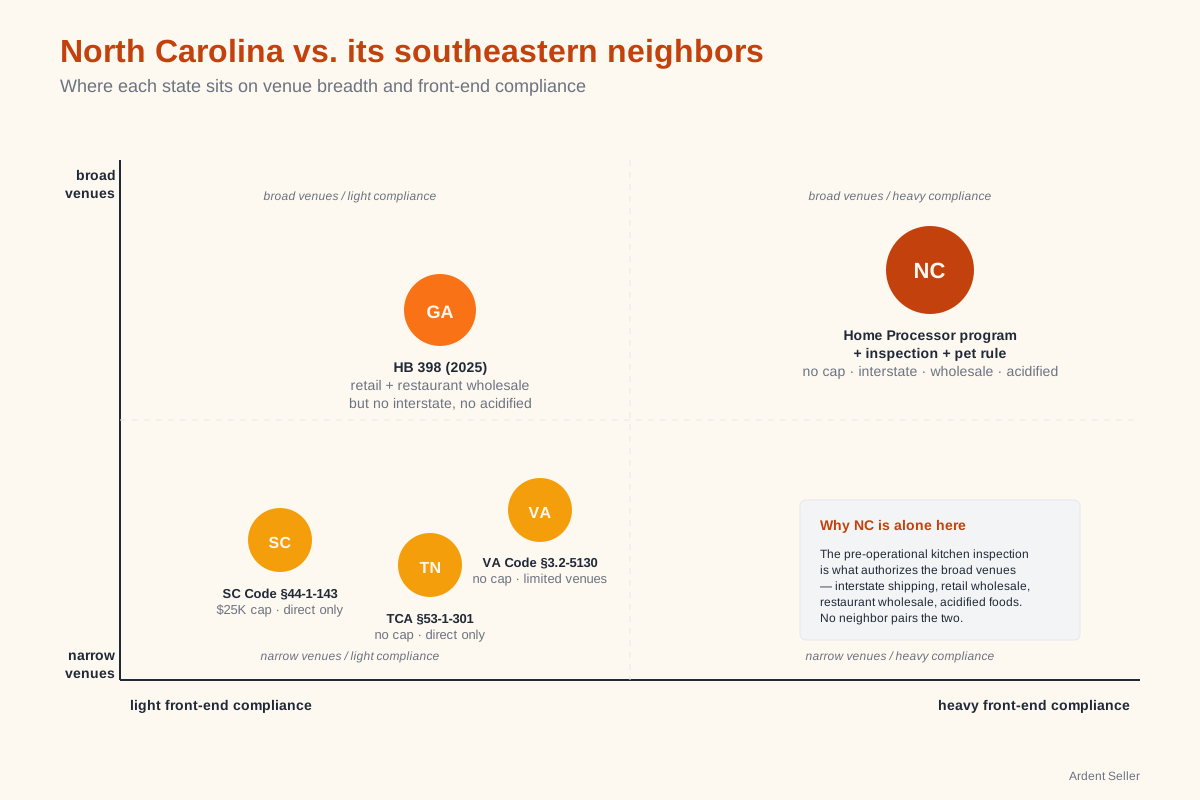
First, NC has the broadest venue list in the southeast — by a meaningful margin. Georgia, after HB 398 in 2025, picked up retail-store wholesale and restaurant wholesale, putting it closer to NC than it was before. South Carolina permits retail and grocery placement and in-state mail order, though restaurants can only resell it packaged unless they obtain a variance. Tennessee's Food Freedom Act permits wholesale to retail stores and packaged resale through restaurants for shelf-stable items. Virginia, since HB 402 (2026), allows in-state sales online, by phone, and by mail, but still excludes resale and wholesale. None of the four neighbors allows sales outside the state, and NC's guidance does not address it. For a producer whose business model depends on distributors or restaurant accounts across the full product range, NC's framework is the broadest of the five.
Second, three of these five states have an acidified-foods route — but NC is the only one that pairs it with wholesale and no ceiling. Georgia and South Carolina exclude hot sauce, salsa, pickles, and BBQ sauce from their cottage food frameworks outright; a maker in either has to lease commercial kitchen time or build a commercial facility. Virginia allows acidified vegetables at pH 4.6 or lower, but caps them at $9,000 in gross sales a year and bars resale. Tennessee is the most permissive of the group on the product itself: its Food Freedom Act allows acidified foods — and even low-acid canned foods — with no Process Authority letter, where NC can require an Acidified Food Course, product testing, a Process Authority Letter, and FDA registration and process filing under 21 CFR 108. What NC offers that none of the other four do is the combination: no revenue ceiling plus sales to retail stores, restaurants, and distributors.
Third, NC is the only southeastern state with the pre-operational kitchen inspection and the pet rule. Both are absent from the formal cottage food laws of every neighbor. NCDA&CS requires the inspection of anyone selling food made in a home kitchen, whether to consumers, retail stores, or restaurants. Producers who do not want the inspection (or who cannot meet the pet rule) face a different cost-benefit calculation against the neighbors than producers who can.
The net effect is that NC is among the broadest home-food regimes in the southeast on revenue and wholesale venues — and the most demanding of the five on the inspection and the pet rule. Whether the trade is worth it depends entirely on what the producer plans to make and where they plan to sell.
What to do this week
If you have never sold home-produced food in NC before, start with the NCDA&CS Home Processor program page (opens in new tab). Read the program description and the application form. If your kitchen is in your home (not a garage, basement, or separate building), you have no pets in the home, and your intended product is on the allowed list, check with your local planning or zoning department (and your HOA or landlord) — NCDA&CS requires that step — then assemble the application: a business plan listing your products, ingredients and suppliers, storage, production flow, transport, and sales locations; a water bill or well-water test results; and an example label. NCDA&CS lists no application or inspection fee. Plan on eight to twelve weeks before a Food Regulatory Specialist contacts you to schedule the inspection.
If your product is acidified — pickles, hot sauce, salsa, BBQ sauce, mustard, fermented vegetables — call NCDA&CS at (984) 236-4820 before you apply, and budget extra time for an Acidified Food Course if one is required, product testing and the Process Authority Letter, and FDA registration and process filing under 21 CFR 108.
If you have pets, decide whether the pet rule is a deal-breaker before paying any other costs. The rule covers any pet that comes into the home at any time, and there is no quiet workaround. The alternative path for pet owners is a shared-use commercial kitchen, where the pet rule does not apply.
If you plan to scale beyond what the home kitchen can support — multi-operator workflow, equipment that does not fit a residential kitchen, production volume that exceeds residential utility capacity — the next step is a fully licensed commercial food facility under standard NCDA&CS commercial-licensure rules. The Home Processor program is excellent for small-to-meaningful scale; it has structural ceilings on operational scale that are independent of any revenue cap.
If you sell across multiple channels, the no-cap framework removes the cap-tracking burden that cottage food operators in cap-imposing states have to manage — but you still need clear per-channel revenue and cost tracking for tax purposes and for understanding which channels actually make money. Inventory and revenue software built for makers — including Ardent Seller's cottage food and bakery tracking — handles cross-channel revenue and lot-level inventory in a way that supports the breadth of venues the NC framework allows (direct, farmers markets, delivery, wholesale, retail). For producers on simpler workflows, a single-tab revenue ledger or even a careful spreadsheet is sufficient at the volumes most NC home processors operate at.
If you are watching for regulatory changes, the two surfaces to monitor are the NCDA&CS Food and Drug Protection Division updates (opens in new tab) and the NC General Assembly bill search (opens in new tab) for any introduced legislation that would change the program or create a statutory cottage food framework alongside it. House Bill 833 (2025), which would have expanded the program to refrigerated and frozen products and cream-filled bakery items, has not moved since it was referred to committee in April 2025.
Related reading
- Pennsylvania Cottage Food Law Guide — the deepest read on the Mid-Atlantic peer state that, like NC, has no traditional cottage food exemption and routes home producers through an inspected program — Pennsylvania's $35-a-year Limited Food Establishment registration.
- Georgia Cottage Food Law Guide — the closest southeastern peer after HB 398 (2025) brought GA closer to NC on retail and restaurant wholesale, while keeping the acidified-foods exclusion NC does not have.
- Cottage Baker Glossary — the 32-term vocabulary every home producer should know, organized by the four "rooms" of the business (kitchen, regulator, books, platform).
Free resources
A few free downloads from the Ardent Workshop library that pair well with this post:
- Cottage Food Laws by State: The 50-State + DC Quick Reference — the PDF this blog series feeds. Includes the updated North Carolina entry and the comparison framework against forty-nine other states and DC.
- Cottage Food Revenue Cap Tracker — the interactive tool that calculates remaining cap headroom under any state's rule. For NC producers, the no-cap framework means the tracker is primarily useful for the channel-mix breakdown and the "what if I move?" comparison against neighboring states.
- Home Bakers Order & Delivery Tracker — the workbook that walks each custom order through ingredients, decoration time, delivery cost, and per-order margin. Especially relevant for NC producers selling across the broader venue mix the Home Processor program authorizes.
Sources & methodology
North Carolina program guidance and statute:
- NCDA&CS — Food and Drug Protection Division, Home Processor program page (opens in new tab) — the authoritative source for current program guidance, application process, allowed foods, pet rule, water testing, labeling, inspection criteria, and acidified-foods requirements. Updated by the Department.
- Application for Home Processor Inspection (opens in new tab) — the program application form, including the label requirements, the well-water test requirement, and the cream cheese frosting testing note.
- House Bill 833 (2025), the FRESH Act (opens in new tab) — the proposed expansion of the Home Processor Program to refrigerated and frozen products; referred to committee in April 2025.
- NC Food, Drug, and Cosmetic Act — Chapter 106, Article 12 of the NC General Statutes (opens in new tab) — the statutory authority under which NCDA&CS administers food regulation.
- NC State Extension — Food Safety for Processors, Home Processing Focus (opens in new tab) — the academic-extension companion to the Department program, useful for the practical detail on acidified-foods compliance.
Federal framework that NC incorporates by reference:
- 21 CFR 117 Subpart B — Current Good Manufacturing Practice (opens in new tab) — the federal GMP framework that the home-processor inspection is conducted against.
- 21 CFR 114 — Acidified Foods (opens in new tab) — the federal acidified-foods rule that governs the hot sauce / pickle / salsa pathway.
- 21 CFR 108.25 — Acidified foods registration and process filing (opens in new tab) — the FDA registration (Form FDA 2541) and scheduled-process filing requirements NCDA&CS lists for acidified foods.
- 21 CFR 101 — Food Labeling (opens in new tab) — the federal labeling framework that NC home processors operate under, in the absence of any NC-specific cottage food label disclaimer.
- FASTER Act of 2021 (opens in new tab) — added sesame as the ninth major food allergen requiring disclosure under FALCPA.
Adjacent state references:
- Georgia Cottage Food framework — OCGA Article 19, Chapter 26-2 (opens in new tab) — the post-HB-398 (2025) Georgia framework that is now the closest southeastern peer to NC.
- South Carolina Home-Based Food Production Law — SC Code §44-1-143 (opens in new tab) — the South Carolina framework: no cap, no permit or registration, retail and grocery placement permitted, in-state delivery only.
- Tennessee Food Freedom Act — T.C.A. §53-1-118 (opens in new tab) — the Tennessee framework: no cap, no permit, acidified and low-acid canned foods permitted, in-state wholesale allowed, no interstate shipping.
- Virginia Home Food Processing exemption — VA Code §3.2-5130 (opens in new tab) — the Virginia framework: no general cap, a $9,000 acidified-vegetables sub-cap, and in-state sales in person, online, by phone, or by mail since HB 402 (2026), but no resale.
Third-party state-law summary references:
- Forrager — North Carolina cottage food law database entry (opens in new tab) — the most-cited third-party summary. Useful as a cross-reference; note that Forrager lists interstate sales as prohibited for NC home processors, a question the NCDA&CS guidance itself does not address.
- Cottage CMS — North Carolina state laws (opens in new tab) — secondary summary; useful as a cross-check but several entries reflect older program guidance.
Note on data freshness: This guide reflects NCDA&CS Home Processor program guidance as published in September 2026. The program is not codified in a specific statutory section but in Department guidance, which can be updated by the Department without legislative action. Operators should verify current program requirements directly against the NCDA&CS Home Processor page before relying on any specific provision. Third-party state-law summary websites — including Forrager, Cottage CMS, PickYourOwn, and others — were consulted as cross-references; where they conflict with current NCDA&CS guidance, the agency guidance controls. Multiple third-party sources continue to describe NC as having "no cottage food law" without explaining the Home Processor program that replaces it; that characterization is technically accurate but materially misleading without the program context.
This article is provided for educational purposes only and does not constitute legal, regulatory, food-safety, or tax advice. North Carolina home processor program guidance, the federal Good Manufacturing Practices framework that it incorporates, the acidified-foods compliance pathway, the labeling requirements, the kitchen inspection standards, the pet rule, the venue and interstate-shipping rules, and the federal jurisdictional framework that applies on top all vary by jurisdiction and product and may change with new agency guidance, federal rulemaking, or state legislative action. Consult the North Carolina Department of Agriculture and Consumer Services, your municipal zoning office, a qualified food regulatory consultant, or an attorney before making compliance, financial, or production decisions based on this content.