If you've ever sold a jar of jam for $8, felt good about it because the fruit only cost you a couple of dollars, and then had a quiet, nagging feeling that the math didn't quite add up — this is for you. You're not bad at numbers. You're just missing a few columns.
The short version: A jam batch log tracks seven things per batch — a batch ID, fruit, sugar and set ingredients, packaging, energy, yield (the jars that actually sealed and sold), and your hands-on time. Add up the costs, then divide the fully-loaded total by the jars you can actually sell (not the jars you filled). Many makers price off fruit and jar alone, which leaves out labor and the jars that never earn anything — so the honest cost often lands meaningfully higher, sometimes two to three times the "fruit plus jar" number, depending on your labor rate and batch size.
Here's a pattern that's common for preserves makers in their first year or two: you price off the cost of the fruit, maybe add a little for the jar, and call it good. The batch comes out beautiful. The customers come back.
And somehow, at the end of the season, there's less money in the account than the sales totals say there should be. The gap isn't a mystery. It's living in the jars you gave away, the batch that cooked down further than you expected, and the two and a half hours you spent on your feet that never showed up in any cost calculation.
A batch log fixes that. Not a fancy one — a handful of columns you fill in while the canner is still cooling. This post walks you through exactly what to track, why each column matters, and what the finished log tells you. By the end you'll have a true cost per jar, and you'll probably never price a batch the old way again.
Why the fruit-and-jar number lies to you
The reason the simple math feels right is that it's not wrong — it's just incomplete. Fruit and a jar genuinely are your two most visible costs. They're the ones you paid for at the register this week, so they're the ones your brain reaches for.
But a finished jar of jam carries four costs that hide:
- The set ingredients — sugar, pectin, lemon juice or citric acid, spices. Individually cheap, collectively not nothing, and easy to forget because you buy them in bulk on a different shopping trip.
- The cook-down. Twelve pounds of fruit does not become twelve pounds of jam. Depending on the recipe and how long it simmers, a sizable share of the starting weight — often somewhere between a quarter and half — cooks off as water, so your yield is always lower than your inputs suggest. The only number you can really trust is the one your own batch produces, which is exactly why the log records it.
- The jars that never sell. The failed seal you ate yourself. The two you handed out as samples at the market. The one you gave your neighbor who watches the dog. Every one of those is a fully-costed jar producing zero revenue.
- Your time. Two hours of prep, cooking, filling, wiping rims, and labeling is real labor. If you wouldn't work two hours for free at someone else's stove, it belongs in the cost.
None of these are exotic. They're just invisible without a place to write them down. So let's build that place.
The seven columns of a batch log
You can keep this on paper taped inside a cabinet, in a notebook, or in a spreadsheet — the format matters far less than the habit of filling it in every single batch. Here's what each column captures and why.
1. Batch ID and date
A simple code — SR-2026-06 for the sixth strawberry-rhubarb batch of 2026, say — plus the date you made it. This is the spine of everything. If a customer ever asks "which batch was this?" or you need to trace a recall, the ID is what connects the jar in their pantry to the day you made it. It's also how you'll compare this batch to the same recipe three months from now.
If you only do one thing this week: start numbering your batches. Even with no other column filled in, a batch number on every lid is the foundation that lot tracking, shelf-life dating, and cost history all build on.
2. Fruit and produce
Weight and cost of every fruit and vegetable that went in. Strawberries, rhubarb, the lemon you zested. Write the actual price you paid this batch, because fruit prices swing hard with the season — the strawberries that cost $2.50 a pound in June will cost you double in November, and a single fixed number in your head will quietly mislead you for half the year.
This is usually your largest single cost, so it's worth getting right.
Sidebar — foraged, gifted, or homegrown fruit: If you picked the blackberries yourself or your neighbor handed you a bucket of plums, what's the cost? You have two defensible answers. Enter $0 if you want your log to reflect cash actually spent — clean and honest for bookkeeping. Or enter the market price you'd otherwise have paid, if you want the log to tell you whether the product is viable when the free fruit runs out. Pick one approach and stay consistent. The trap is valuing it at market in a good year, building your price around that, then losing the foraging spot and discovering the recipe never actually penciled out.
3. Sugar, pectin, and the set
Sugar, pectin, lemon juice or citric acid, and any spices or flavorings. These are cheap per batch but they're the costs makers skip most often, and they add up across a season. Buy in bulk, then divide down to what this batch actually used. A box of pectin used across two batches is half a box of cost here, not a whole one.
4. Packaging, per jar
Jars, lids, bands, and labels. The lid (the flat) is single-use and should always be counted. Bands get reused, so amortize them — if a band survives ten uses, it's a fraction of its purchase price per jar. Labels count too, including the ink and the sheet they printed on if you do them at home.
Packaging is the cost that scales jar-for-jar, so track it per jar and multiply by your yield.
5. Energy and overhead
This is the one people resist, and it's fine to keep it light. A long stovetop reduction and a water-bath canner running for fifteen minutes use real propane or electricity. You don't need a sub-meter — a small flat estimate per batch (roughly $1 to $3 as a starting point for a typical home stovetop-and-canner session, depending on your fuel type and local utility rates) is enough to stop pretending it's free. If you bought a dedicated canner or a second burner, amortize that across the batches it'll serve, too.
6. Yield — and the gap below it
Here's where the log earns its keep. Record two numbers, not one:
- Jars filled — how many sealed jars came out of the batch.
- Jars sellable — filled jars minus failed seals, minus samples, minus gifts, minus the one you opened to check the set.
The difference between those two is the single most expensive thing many preserves makers never measure. You'll cost the batch correctly only if you divide by sellable jars, because the lost jars don't stop costing money just because they don't earn any.
7. Hands-on time
Total active minutes — hulling, chopping, cooking, filling, processing, wiping, labeling, cleanup. Not the hours the jam sat cooling; the minutes you were actually working. Multiply by a rate you'd accept for your time. If $20 an hour feels right, use it. The number will probably surprise you, and that surprise is the point.
A real batch, fully torn down
Numbers make this concrete. Here's a single strawberry-rhubarb batch run through all seven columns. Every figure below is illustrative — your fruit prices, labor rate, and yield will differ — but the structure is exactly what you'd write down. The number in the first column of the table maps to the seven log columns from the section above.
Batch SR-2026-06 — Strawberry-Rhubarb Jam
| # | Line item | Detail | Cost |
|---|---|---|---|
| (1) | Batch ID / date | SR-2026-06 · made June 21 | — |
| (2) | Fruit & produce | 8 lb strawberries @ $2.50 + 3 lb rhubarb @ $3.00 | $29.00 |
| (3) | Sugar & set | 6 lb sugar @ $0.70, pectin, lemon juice | $8.60 |
| (4) | Packaging | 14 jars × (jar $0.90 + lid $0.22 + band $0.05 + label $0.18) | $18.90 |
| (5) | Energy & overhead | Stovetop reduction + canner + amortized equipment | $3.50 |
| (6) | Yield | 14 jars filled → 1 failed seal, 2 market samples → 11 sellable | — |
| (7) | Hands-on time | 2.5 hours @ $20/hr | $50.00 |
What the callouts mean:
- (2) Fruit is your biggest cash cost — $29.00, nearly half the materials. In November those same strawberries could push this line past $45 and quietly erase your margin if your price never moved.
- (3) The set ingredients look trivial at $8.60 until you notice they're bigger than your energy and nearly half your packaging. Cheap is not the same as free.
- (4) Packaging scales with jars filled, not jars sold — you paid for 14 jars and lids even though 3 of them will never ring up at a register.
- (5) Energy and overhead looks small at $3.50, but it's a real line — across forty batches in a season that's $140 you'd otherwise never account for.
- (6) The yield gap is the whole story. You filled 14. You can sell 11. Those 3 jars carry full cost and zero revenue.
- (7) Labor is the hidden giant — $50 for one batch, the single largest line item on the sheet, and more than the fruit and packaging put together.
Now the two numbers that matter:
- Materials only, per filled jar: ($29.00 + $8.60 + $18.90 + $3.50) ÷ 14 = $4.29. This is roughly the number many makers carry in their heads, and at an $8 price it looks like a healthy markup.
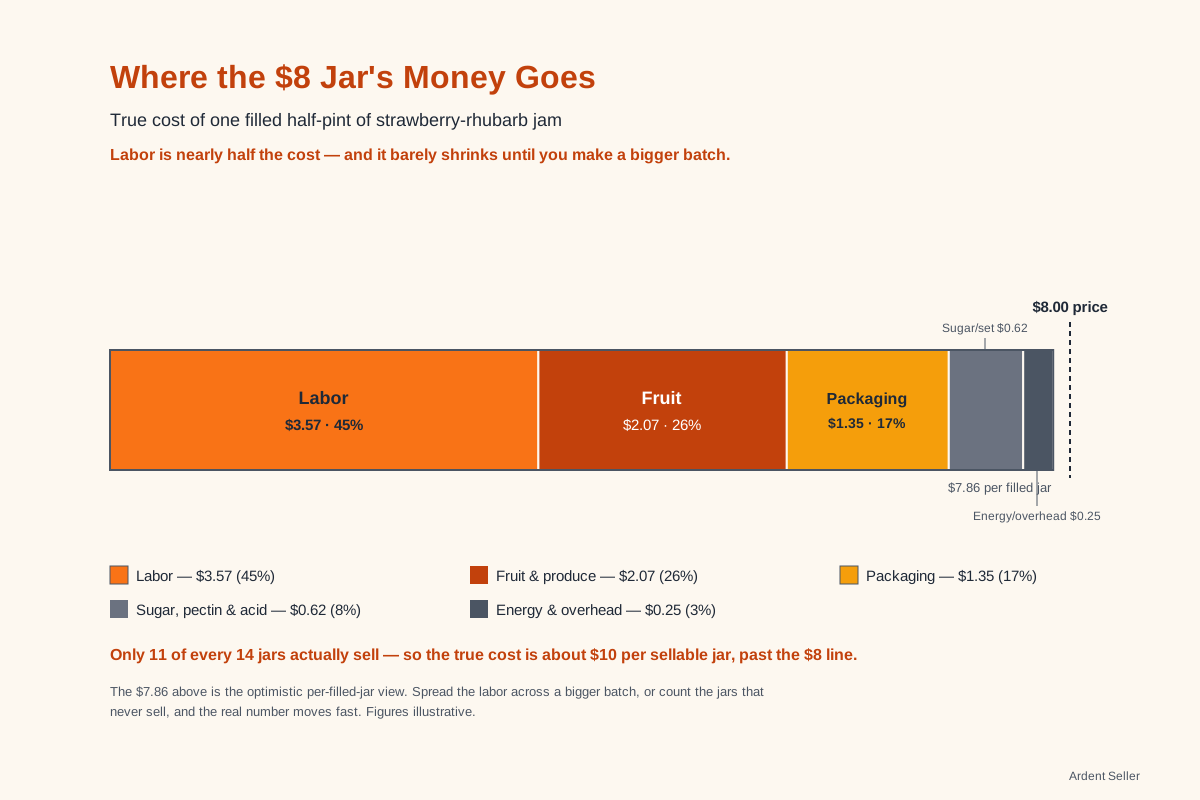
- Fully loaded, per sellable jar: Add the $50.00 of labor to the $60.00 of materials and overhead for a fully-loaded batch total of $110.00, then divide by the 11 sellable jars: about $10.00 per jar ($5.45 in materials and overhead plus $4.55 in labor).
At $8 a jar, the first number says you're winning. The second says every jar you sell loses money once your own time is counted. Same batch. Same jam. The only difference is which columns you were honest about.
What the log tells you to do next
A scary number isn't a verdict — it's a set of levers. The log doesn't just show you the problem; it shows you which lever moves the most.
Batch bigger. That $50 of labor is the dominant cost, and it barely changes whether you make 14 jars or 40. Spread across 40 jars, the same two and a half hours of work falls from $3.57 a jar to $1.25. In a small, labor-heavy batch like this one, batch size is often a bigger lever than price — the same fixed labor spread over more jars drops the per-jar cost fast. If you can double or triple your batch size without sacrificing the set, do that before you touch anything else.
Cut the yield gap. Three lost jars out of fourteen is a 21% leak. Tighten your seals to reduce failures, set a deliberate sample budget (one jar per market, not "however many I feel like"), and log gift jars so at least you can see what generosity costs. You don't have to stop giving jam away — you just have to stop pretending it's free.
Then, and only then, look at price. Once your batch size and yield are tight, if the number still says $10 a jar to make, an $8 price isn't brave minimalism — it's a slow leak. A jar that costs $4 fully-loaded at scale can thrive at $8. A jar that costs $10 cannot.
Rule of thumb: Price off your fully-loaded cost per sellable jar at your realistic batch size — never off the cost of the fruit alone. The fruit is the most visible cost and the least complete one.
When a spreadsheet stops keeping up
For your first dozen batches, a notebook or a single spreadsheet tab is genuinely the right tool. Don't let anyone talk you out of paper while paper is working.
The trouble arrives later, around the time you're running three recipes across a season, buying fruit at prices that change every few weeks, and trying to remember whether the apricot batches from August actually made money. That's when a flat spreadsheet starts fighting you — recosting every batch by hand as ingredient prices move, hunting for which lot a customer's jar came from, reconciling jars-filled against jars-sold against jars-given-away.
That's the point where a system built for batch production starts to pay for itself. Ardent Seller keeps a recipe's cost current as your ingredient prices change, tracks each batch as a lot you can trace from fruit to finished jar, and tells you the real cost per unit without you rebuilding the math every time. It's built for exactly this kind of small-batch, ingredient-driven work — the same way it serves jam and preserves makers and other cottage food producers. When the log in your head outgrows the notebook, that's the natural next step.
Sidebar — when your jam crosses a regulatory line: Most plain fruit jams and jellies are shelf-stable, high-acid foods that fit comfortably inside cottage food rules. But two things can move you into stricter territory. First, revenue caps — cottage food is regulated state by state, and many states cap annual sales, so a good season can sneak you toward the ceiling without warning. Your state agriculture or health department sets and enforces that cap; our cottage food laws by state reference is a quick place to look yours up. Second, low-sugar, low-acid, or savory products — a pepper jelly, a low-sugar preserve, or a fruit-and-vegetable blend can fall under FDA acidified-foods rules (21 CFR 114) (opens in new tab), which require pH verification and a different process entirely. When in doubt, confirm with your state before you scale a new recipe.
The habit, not the template
The columns above aren't sacred. Add one for the market you sold at, drop the overhead line if it's making you avoid the log entirely, color-code by recipe if that's what gets you to fill it in. The format is yours.
What's not optional is the habit: every batch, while the jars are still warm, write down what went in and what came out. Do that for one season and you'll stop guessing. You'll know which recipes carry their weight, which ones only survive on cheap summer fruit, and exactly what to charge so that the number in your account at the end of the year finally matches the number your sales said it should be.
Start with your next batch. Number it, weigh the fruit, count the jars that actually sell, and run the two divisions. The first honest cost-per-jar you calculate is usually the most valuable number you'll write down all year.
Related reading
- Batch Tracking for Food Sellers — turn the Batch ID column into a real lot-tracking spine, so a recall is a 14-jar problem instead of a whole-season one.
- Shelf Life, Spoilage, and Shrinkage — extends the yield-gap idea from one batch to your whole stock, where unsold and expired jars quietly eat the year's margin.
- Recipe Costing 101 — the foundational five-cost-category primer that sits underneath every column of the log above.
Free resources
Free companion resources if you want to put any of this into practice:
- Small-Batch Production Planning Playbook — extends the batch log into a full production plan, so you can size batches deliberately instead of discovering the labor cost after the fact.
- Recipe Scaling & Batch Calculator — does the "batch bigger" math for you, scaling a recipe up cleanly while keeping the set ratios intact.
- Cottage Food Revenue Cap Tracker — keeps a running total against your state's cap so a strong jam season doesn't quietly cross a line you didn't know was there.
This article is provided for educational purposes only and does not constitute legal, regulatory, financial, or tax advice. Costs, pricing examples, and cottage food and acidified-food requirements vary by jurisdiction, product, and recipe, and change frequently. Consult a qualified accountant or small-business advisor, and your state agriculture or health department, before making financial or compliance decisions based on this content.