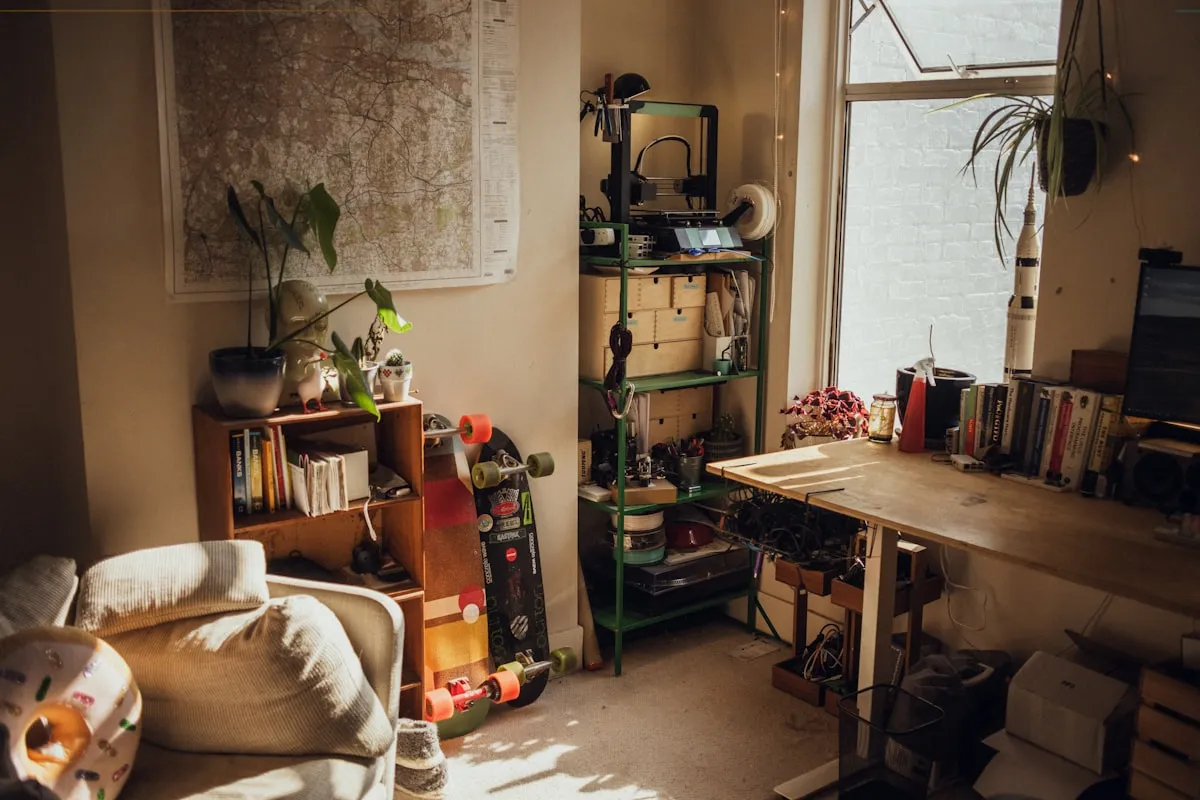
What is the most valuable square footage in your house — the bench you work at, or the closet you never think about?
Most makers answer that question wrong, and the reason is that the home office deduction has a picture attached to it. The picture is a room with a door, a desk, a filing cabinet, and no toys on the floor. Very few people making candles in a spare bedroom or turning bowls in a detached garage believe they have that room, so they never run the numbers.
The home office deduction does not require a dedicated room. It requires a specific, measurable area used regularly and exclusively for the business, in a home that is your principal place of business — and the two rules makers most often qualify under each waive exactly one of those requirements: a storage exception waives exclusive use for inventory and product samples, and a separate-structure rule waives the principal-place test for a detached studio, workshop, garage, or barn. Regular use is never waived, and the separate structure still has to be exclusive. Of the four studios below, two qualify through one of those two workarounds; the other two qualify only after measuring a smaller area than the maker assumed.
Four studio layouts follow. Each is built around a composite character — not a real person or customer — assembled from arrangements that show up often in maker households. None of them is the room in the picture. All four end up with a deduction anyway, and not one of them claims the deduction they originally thought applied.
The two tests everything hinges on
The IRS states the requirements in one short pair. You must "regularly use part of your home exclusively for conducting business," and you must "show that you use your home as your principal place of business" (IRS, Home office deduction (opens in new tab)).
Both halves get misread. Regular use is not a threshold of hours; Publication 587 defines it against its opposite — "incidental or occasional business use is not regular use." Exclusive use is the strict one: "you must use a specific area of your home only for your trade or business." Publication 587's own example is an attorney whose family also uses the den for recreation. The den fails, and it fails completely, not partially (IRS Publication 587 (opens in new tab)).
That is the narrow part, and it is where most makers stop reading. Keep going, because Publication 587 then hands out three doors — two of them genuine ways around the tests above, and one a clarification of what counts as "a space":
- The exclusive use test has written exceptions. "You do not have to meet the exclusive use test if either of the following applies. You use the part of your home in question for the storage of inventory or product samples... You use the part of your home in question as a daycare facility" (IRS Publication 587 (opens in new tab)).
- The area does not have to be a room. "The space does not need to be marked off by a permanent partition" (IRS Publication 587 (opens in new tab)).
- A separate structure skips the principal-place question entirely. "You can deduct expenses for a separate free-standing structure, such as a studio, workshop, garage, or barn, if you use it exclusively and regularly for your business" (IRS Publication 587 (opens in new tab)).
Hold those three. They do all the work in the cases below.
Case 1: The dining table and the fabric closet
Priya sews children's clothing and sells it online. She cuts and sews at the dining table three evenings a week, then clears everything into bins before dinner. Bolts of cotton knit, interfacing, zippers, and about forty finished garments waiting on orders live in a hall closet — two and a half feet deep, six feet wide, nothing in it that is not for the business.
She had assumed the table was her claim and the closet was furniture. It is exactly the reverse.
The table fails exclusive use, and no amount of clearing it changes that; the family eats there. The closet clears every condition of the inventory storage exception, which IRS Publication 587 (opens in new tab) lists as five requirements:
- You sell products at wholesale or retail as your trade or business.
- You keep the inventory or product samples in your home for use in that business.
- Your home is the only fixed location of the business.
- You use the storage space on a regular basis.
- The space is "a separately identifiable space suitable for storage."
Priya's closet meets all five. Fifteen square feet, at the simplified method's $5, is a $75 deduction. That is not life-changing, and pretending otherwise would be the same overselling that made her distrust the topic in the first place. It is worth noticing for a different reason: it is the deduction she was told she did not qualify for at all, and it costs her one tape-measure reading a year to claim.
Case 2: The spare room with a guest bed in it
Marcus makes cold-process soap in an eleven-by-twelve spare bedroom. Batch table along one wall, curing shelves along the next, a folding packing station in the corner. Also in the room: a daybed his mother-in-law sleeps in twice a year, and the family's holiday decorations in the closet.
The instinct is to claim 132 square feet and hope nobody asks. The room as a whole is not used only for the business, so the room as a whole fails. But the room is not the unit of measurement — the space is, and no partition is required. Marcus measures the L that holds the batch table, the curing shelves, and the packing station: roughly seven by nine, call it 63 square feet, in which nothing personal happens.
Under the simplified method that is 63 × $5 = $315. Under actual expenses, 63 square feet of an 1,850-square-foot house is about 3.4% of mortgage interest, insurance, utilities, and repairs, plus depreciation on that fraction of the house.
The honest framing is that the second number is usually bigger and always more work, and that "bigger" comes with a tail (see below on selling the house). The move that matters here is not the method. It is that he stopped trying to claim 132 square feet — a claim that would have been wrong in a way an examiner can see from the doorway — and claimed 63 that hold up.
Case 3: The detached garage that is not the principal place of business
Dana builds furniture in a detached two-car garage, 24 by 20, with its own subpanel, its own dust collection, and no car in it since 2023. Her sales happen at three regional shows and through a gallery downtown. She assumed the shop was disqualified because the selling — the part that feels like the business — happens somewhere else.
The separate-structure rule does not ask that question. A free-standing structure qualifies on exclusive and regular business use alone; the principal-place-of-business test is not part of it. Whether her customers ever set foot in the shop is irrelevant.
Dana is also the case where the simplified method starts to lose. Its allowable square footage is capped: the area is "limited to 300 square feet," at $5, for a maximum of $1,500 (IRS, Simplified option (opens in new tab)). Her shop is 480 square feet, so 180 of them are simply outside the method.
Against that, the actual expense method treats costs that benefit only the shop as direct expenses — Form 8829 "and the Worksheet To Figure the Deduction for Business Use of Your Home have separate columns for direct and indirect expenses" (IRS Publication 587 (opens in new tab)). The shop's own electric bill, the insurance rider on the structure, and the roof repair on that roof are not fractions of a household total. Once a maker has a separate structure with real direct costs, the $1,500 ceiling tends to stop being convenient and start being the reason she is leaving money on the table.
Case 4: The desk that does two jobs
Tom cuts and stitches leather goods on weekends. His bench sits in a finished basement room of about 165 square feet — the same room as the desk where he answers email for his day job at a logistics company three evenings a week.
The bench is fine. The desk is not, and not because of anything about the day job's deductibility — it is the plain reading of only for your trade or business. His employer's work is not his trade or business, so a desk that hosts both is a desk that hosts something other than the leather business.
The fix is a tape measure and a small amount of stubbornness: the bench, the hide rack, and the shelf of finished stock are a separately identifiable space; the desk is not in it. That comes to roughly 40 square feet, or a $200 deduction under the simplified method. Forty square feet claimed cleanly beats the whole 165 claimed loosely, and it is one of the few tax questions where the conservative answer is also the easy one.
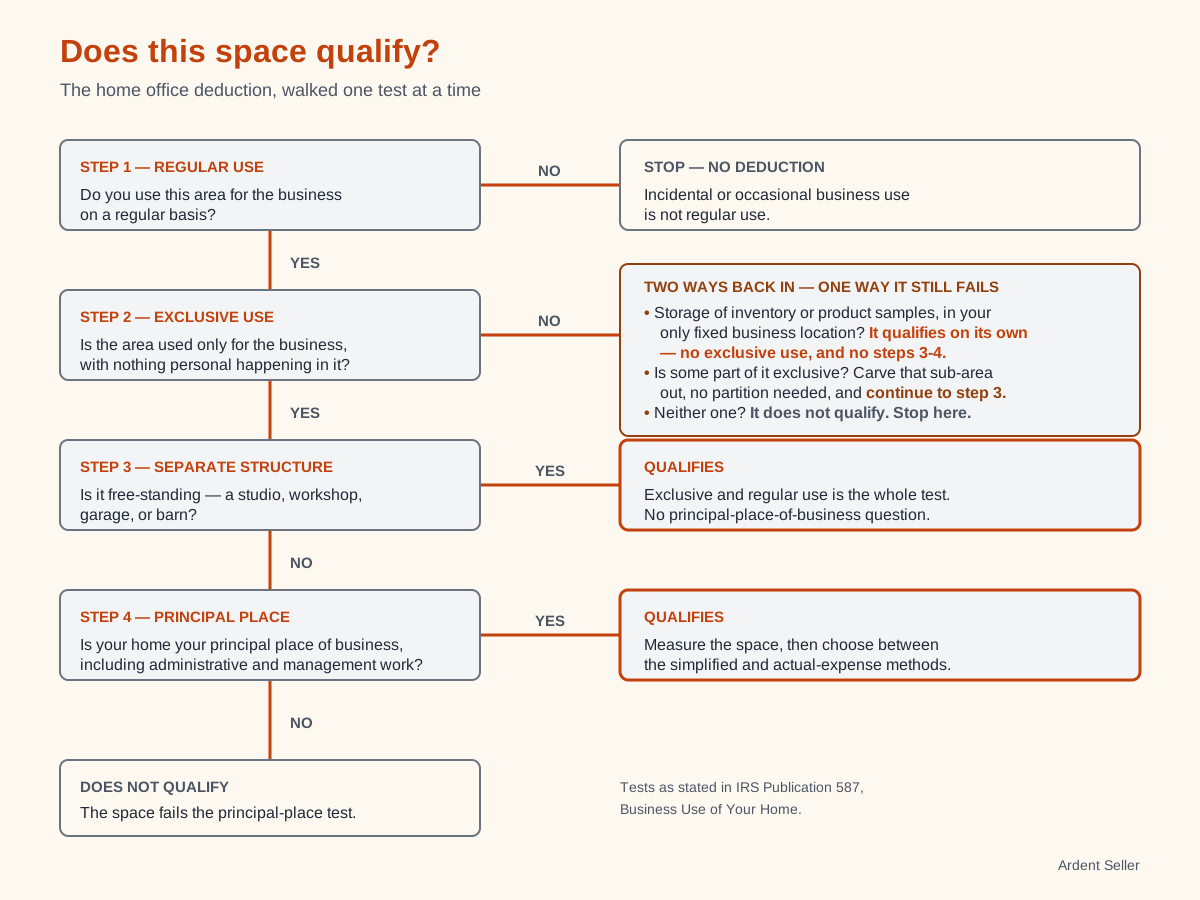
Does your space qualify? Walk it in four steps
None of these makers had the room in the picture, and all four still ended up with something to claim. What made the difference was never the size or the polish of the space — it was whether a specific, measurable area had exactly one use. Marcus and Tom were claiming too much, and had to shrink the claim to a sub-area that holds up. Dana had written her shop off entirely and was owed more than she thought. Priya had the right instinct and the wrong address — she was claiming a table that never qualified while dismissing the closet that did.
Walk your own house in this order:
- Regular use — do you use this area for the business regularly? Occasional use is not enough; incidental use is not regular use. If no, stop here — there is no deduction for that space. If yes, go to step 2.
- Exclusive use — is the area used only for the business? If yes, measure it and go to step 3. If no, there are two ways back in — and one way it still fails:
- If the space is storage for inventory or product samples, it can qualify without exclusive use — but only if it meets all five conditions listed in Case 1 above, including that your home is the only fixed location of the business and that you sell at wholesale or retail. If it clears all five, you are done qualifying: the storage exception stands on its own, so measure the space and skip to choosing a method.
- If some part of the space is used only for the business, carve that sub-area out and measure it instead — no permanent partition is required — then go to step 3.
- If neither is true — the space is not qualifying storage, and no part of it is exclusive — it does not qualify. Stop here.
- Separate structure — is it free-standing? A studio, workshop, garage, or barn that is not attached to the house qualifies on exclusive and regular business use alone. If yes, you are done qualifying — skip step 4 and go measure. If no, go to step 4.
- Principal place of business — is the house itself where the business is run? This includes the administrative test: you use the space exclusively and regularly for administrative or management activities, and you have no other fixed location where you conduct substantial administrative or management activities (IRS Publication 587 (opens in new tab)). If that is true, the space qualifies and you move on to choosing a method. If it is not, the space does not qualify.
Then, and only then, pick a method
The qualification question and the method question are separate, and mixing them is how makers end up believing they need receipts before they know whether they have a deduction at all.
The simplified method multiplies $5 by the allowable square footage, capped at 300 square feet and therefore at $1,500. In exchange for that ceiling, the IRS's own side-by-side comparison gives you four things (IRS, Simplified option (opens in new tab)):
- Home-related itemized deductions are "claimed in full on Schedule A" instead of being apportioned between Schedule A and your business schedule.
- There is "no depreciation deduction."
- There is "no recapture of depreciation upon sale of home."
- Any amount above the gross income limit "may not be carried over."
The actual expense method runs on Form 8829 — "if you used your home for business and you are filing Schedule C (Form 1040), you will use either Form 8829 or the Simplified Method Worksheet in your Instructions for Schedule C" (IRS Publication 587 (opens in new tab)). You compute a business percentage (business area ÷ total area, or rooms ÷ rooms if they are similar in size), split expenses into direct and indirect, take depreciation, and carry any amount disallowed by the gross income limit forward to a later year in which you use the same method. Renters are not excluded: "if you rent the home you occupy and meet the requirements for business use of the home, you can deduct part of the rent you pay" (IRS Publication 587 (opens in new tab)).
Two limits apply either way, and both are worth knowing before you choose.
The deduction cannot create a loss. It "is limited to an amount equal to the gross income derived from the qualified business use of the home reduced by the business deductions that are unrelated to the use of your home" (IRS Publication 587 (opens in new tab)). A first-year maker with $900 of sales does not get a $1,500 deduction, whichever method they pick.
Depreciation has a tail. IRS Publication 523 (opens in new tab) is direct about it: on the sale of your home "you can't exclude the portion of gain equal to any section 1250(b)(3) depreciation adjustments allowed or allowable after May 6, 1997." Allowable is the word doing the damage — the adjustment can follow depreciation you were entitled to and did not claim. This is the single best reason to raise the method choice with a preparer rather than settling it alone.
You are not locked in forever. You may elect either method for any taxable year; you simply cannot change methods for a year after you have filed it.
What you actually need to have written down
Three numbers carry the whole thing: the square footage of the qualifying space, the total square footage of your home, and — only if you go the actual-expense route — the year's home costs split into direct and indirect.
There is one more requirement, and it ambushes people because it is not about the house at all. The gross income limit is computed from the business's own income and its non-home deductions, so you cannot finish the home office worksheet without a real profit-and-loss for the business. Makers who track costs in a shoebox discover this in April, at which point the honest options are to reconstruct a year or to leave the deduction unclaimed.
If you would rather keep it off-screen, the Schedule C Tax Expense Tracker has a per-row business-use percentage built into the expense log, which is the correct shape for home costs that are only fractionally deductible. If you would rather it be a byproduct of work you are already doing, this is what Ardent Seller is for: every purchase, fee, and sale is tagged to a Schedule C line as you record it, so the gross-income figure the home office worksheet demands is a report you pull rather than a year you rebuild.
Whichever you choose, do the measuring this week rather than in April. A tape measure and five minutes settles the qualification question permanently, and the answer tends to be yes in a place you were not looking — a closet, an L-shaped corner, a garage with no car in it.
Start tracking your business costs free and give your preparer numbers instead of a shoebox.
Related reading
- Hobby vs. Business Taxes — the home office deduction assumes you are running a trade or business; this is the post that settles whether the IRS would agree.
- Equipment Depreciation for Makers — the kiln, mixer, or table saw inside that qualifying space depreciates on its own rules, separate from the building.
- Best Bookkeeping Apps for Handmade Sellers — if the gross income limit is the part that stopped you, this is where the profit-and-loss comes from.
Free resources
Free companion downloads if you want to put any of this into practice:
- Small Business Tax Deduction Cheat Sheet — walks every Schedule C line with maker-specific examples, including where the home office figure lands once you have measured it.
- Schedule C Tax Expense Tracker — the expense log with a per-row business-use percentage, which is exactly how partially deductible home costs need to be recorded.
- Hobby vs Business: IRS 9-Factor Test — the prerequisite question, since none of this applies to an activity the IRS would classify as a hobby.
This article is provided for educational purposes only and does not constitute legal, tax, or accounting advice. Deduction rules, square-footage tests, and depreciation and recapture requirements are set by federal law, are applied to the specific facts of your home and business, and change over time. Consult a qualified CPA, tax preparer, or attorney before making decisions that affect your business.