Two versions of the same Alabama statute, one amendment apart.
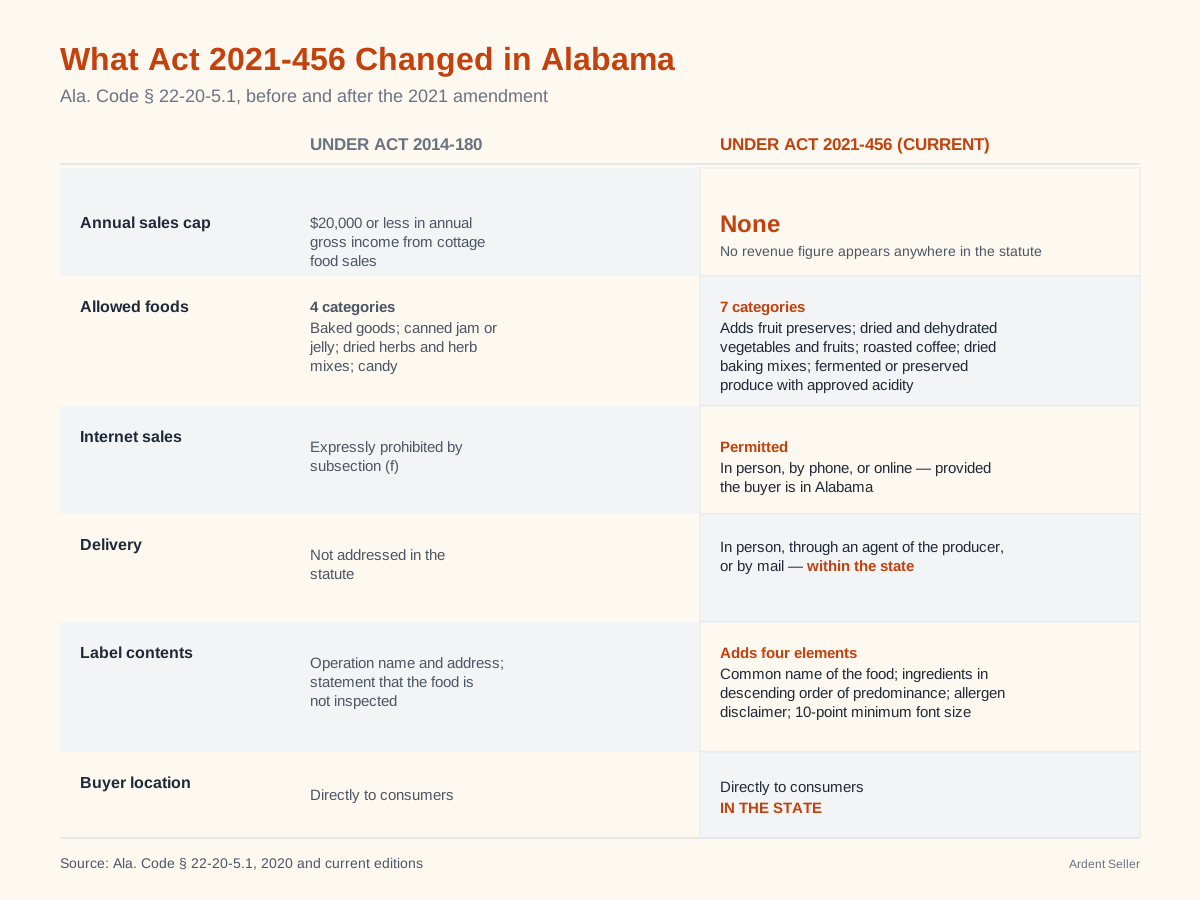
The 2020 edition of Ala. Code § 22-20-5.1 (opens in new tab) defined a cottage food production operation as a person who "produces a baked good, a canned jam or jelly, a dried herb or herb mix, or a candy for sale," who "has an annual gross income of twenty thousand dollars ($20,000) or less" from those sales. Subsection (f) was one sentence long: "A cottage food production operation may not sell baked goods, jams and jellies, candies, or dried herbs and herb mixes over the Internet."
The current edition (opens in new tab) has no income figure anywhere in it. The food list has grown to seven categories. Subsection (f) is gone entirely, replaced by language permitting sales "whether in-person, by phone, or online." The credit line at the bottom of the section tells you why: (Act 2014-180, p. 524, §§1, 2; Act 2021-456, §1.)
Here is where Alabama stands today under Ala. Code § 22-20-5.1 (opens in new tab): no sales cap, no permit, no kitchen inspection. You may sell seven categories of non-potentially-hazardous food — but only to consumers physically in Alabama, and only with a compliant label and a current food safety certificate. Ordinary business obligations sit on top of that.
One amendment, and a great deal of what is written about Alabama cottage food on the internet has not caught up. This guide works from the statute and from the Alabama Department of Public Health's cottage food page (opens in new tab), which was last updated July 9, 2026 — and it flags the places where the two are saying slightly different things.
If you have been selling since before 2021, the four misreadings below are the ones that cost people money.
What the statute actually says now
Strip § 22-20-5.1 to its load-bearing parts and you get a short list.
- A cottage food is a non-potentially hazardous food prepared in a person's home that does not require time or temperature control for safety, and that does not include meat, poultry, or fish.
- A cottage food production operation is a person working out of their home who produces cottage food for sale, sells it only directly to consumers — in person, by phone, or online — in the state, and delivers it directly to consumers in the state, whether in person, through an agent of the producer, or by mail.
- A home is a primary residence with a kitchen and appliances designed for common residential use.
Then three sentences that do a lot of work for you:
A cottage food production operation is not a food service establishment and is not required to have a food service permit issued by the county health department. […] Neither the State Department of Public Health nor a county health department may regulate the production of food at a cottage food production operation except as provided by this section.
And one that puts obligations back on you: subsection (e) requires you to label everything you sell and to complete a food safety course approved by the department, and to maintain that certification.
That is the whole regulatory apparatus under this statute. No permit. No inspection. No cap. Two duties — label it, and be trained — plus a boundary line at the state border. (Ordinary business rules still apply on top: a county license, sales tax, and local zoning. Those come later, under what else Alabama expects of you.)
A note on dates, because a skeptical reader deserves one. Third-party summaries assign the 2021 amendment at least three different effective dates and at least two different act numbers. None could be confirmed against the Alabama Legislature's own records — its bill-history pages refused every retrieval attempt. A Jefferson County reference packet (opens in new tab) dates the amendment to August 1, 2021, but that annotation appears alongside the introduced bill text rather than an enrolled-act certification, so it is offered here as a lead rather than a fact. What is verifiable, because it is printed in the code itself, is the credit line: Act 2021-456 amended this section. That is the citation standing behind every reference to "the 2021 amendment" below, and no effective date is asserted anywhere else in this guide.
Four Alabama makers, four wrong assumptions
The four producers below are composites — invented to illustrate four specific and very common misreadings, not real people, and none of the figures attached to them are drawn from a real business. Each one did the responsible thing and looked the law up. Each one landed on a summary that was accurate in 2019.
Dana turned down orders to stay under a cap that no longer exists
Dana makes pepper jelly and fig preserves in Cullman County. She read that Alabama cottage food operators were limited to $20,000 a year in gross sales, so she built her whole year around that number: she stopped taking wholesale-curious inquiries in October, declined a standing order from a gift-basket assembler, and quietly capped her holiday production.
The belief: Alabama caps cottage food sales at $20,000 in annual gross income.
What the statute says: Nothing. There is no revenue figure in the current § 22-20-5.1 at all. The $20,000 ceiling lived in the 2014 version's definition of a cottage food production operation, at subsection (a)(2)(b), and the 2021 amendment removed it. ADPH's own FAQ answer (opens in new tab) on what changed puts it flatly: "the limit for annual income under the law has been removed."
This is the most consequential of the four errors, because it is the only one where the outdated information costs money rather than creating risk. Dana turned down real revenue to comply with a rule that had already been repealed.
Marcus shipped to Georgia because a summary said "and shipping"
Marcus blends and jars spice rubs in Huntsville. He found a state-by-state roundup explaining that Alabama's 2021 reform "allows online sales and shipping," built a checkout on his site, and started filling orders — including several to customers in Georgia and Tennessee, which, given that Huntsville sits twenty-odd miles from the Tennessee line, arrived faster than some of his in-state orders.
The belief: The 2021 amendment authorized online sales, therefore it authorized shipping to wherever the order comes from.
What the statute says: The amendment authorized online sales to consumers in the state, and it says so twice. Subsection (a)(2)(b) permits sales "whether in-person, by phone, or online, in the state." Subsection (a)(2)(c) permits delivery "directly to consumers in the state, whether in person, through an agent of the producer, or by mail." ADPH's cottage food FAQ (opens in new tab) restates it without ambiguity: a producer may sell online "as long as the receiving person is in Alabama."
The phrase "in the state" is doing enormous work in a sentence most people skim, and it is attached to both halves of the transaction — the sale and the delivery. Watch how easily it falls out of a paraphrase. "Alabama now allows online sales and shipping" is a true sentence with a fatal omission, and it is the version that has propagated. Marcus's website was compliant right up until the shipping label said Chattanooga.
If you want to sell across state lines, the cottage food statute is not the vehicle. That is a commercial food processing conversation, and it starts with ADPH's Manufactured Food Processing program (opens in new tab) — which has its own permitting, plan review, and good-manufacturing-practice requirements — rather than with this section.
Tomeka bought a pH meter and tested her own salsa
Tomeka makes salsa and quick pickles in Mobile. She noticed that fermented and preserved vegetables appear on the allowed list, saw the words "acidity level allowed by the department," bought a calibrated pH meter, tested a batch at 3.9, wrote the reading in a notebook, and considered the matter handled.
The belief: The rule is a pH threshold, so meeting the threshold — and being able to prove you measured it — is compliance.
What ADPH says: The verification has to come from someone else. Asked directly whether a producer can provide their own pH results using a meter they purchased, ADPH's cottage food FAQ (opens in new tab) answers: "No. Fermented or preserved vegetables or fruit must undergo a pH verification from a processing authority or the Alabama Cooperative Extension Service." Only after that verification is approved does ADPH recommend the producer run their own routine pH tests.
Tomeka had the sequence backwards, and it is an easy sequence to get backwards, because her instinct — measure the thing, record the measurement — is the right instinct everywhere else in food safety. Here the state is asking for an independent qualification of the recipe, not a log of your own readings. Her notebook becomes useful the day after the processing authority signs off, not before.
The same structure applies to freeze-dried products: ADPH's cottage food FAQ (opens in new tab) requires a water activity verification before those can be sold. If you have been eyeing a freeze dryer for fruit or vegetable snacks, budget for the verification alongside the machine.
Ray left bags of roasted coffee at a shop on consignment
Ray roasts coffee in Birmingham. Roasted coffee is explicitly on the 2021 list, which it was not before, so he assumed the expansion had loosened things generally. A neighborhood coffee shop offered to put his 12-ounce bags on the counter and split the proceeds. The end buyer would still be an individual person, which sounded like "directly to consumers" to him.
The belief: "Direct to consumer" describes who eventually buys the product.
What it actually describes: who buys it from you. ADPH's cottage food FAQ (opens in new tab) addresses consignment in one word — asked whether a producer can have products sold in a retail store on consignment, the answer is "No. A cottage food producer may only sell their products directly to consumers." And the restriction runs in the other direction too: "Permitted food establishments are not allowed to sell food items produced in a private home." The coffee shop's own permit is the obstacle. Ray's arrangement puts his neighbor at risk, not just himself.
There is a real distinction hiding here that is worth getting right, because it is more permissive than most people assume. ADPH's cottage food FAQ (opens in new tab) says a cottage food producer may sell "from any venue, such as a mobile food unit, van, cart, tent, booth, or storefront that is not permitted by the Health Department," so long as the products are made in the producer's home and sold directly to the consumer. A tent at a festival is fine. A booth you rent is fine. Your own storefront, unpermitted, is fine. What you cannot do is route the sale through a permitted establishment or hand the transaction to a retailer.
How to spot outdated Alabama cottage food advice
Line the four errors up and they are the same error. Every one of them is a statement that was true under Act 2014-180, repeated on a page bearing a recent date, with nothing on the page to signal which era it describes.
That is a predictable failure mode for state-law content. The pages get built once, get a light refresh, and the refresh updates the year in the title without re-reading the statute. It is not usually malice; it is that nobody diffed the code. But the practical effect for you is that a plausible, professional-looking summary is roughly as likely to be describing a repealed statute as the current one, and it will not tell you which.
Two tells will sort most of them in about fifteen seconds:
The $20,000 tell. If the page mentions a $20,000 cap, an annual gross sales limit, or advises you to "track your revenue against the cap," it is describing pre-2021 Alabama. Stop reading it. Not because that one fact is wrong, but because the page has demonstrated it was not written from the current text, and you have no way to know which of its other facts came from the same vintage.
The "ships anywhere" tell. If the page says the 2021 change permitted online sales without attaching "in the state," treat every jurisdictional claim on it as unverified. This one is subtler than the cap, because the sentence is half right, and half-right sentences survive editing passes that catch outright falsehoods.
When a page passes both tells, it is probably fine. When you need certainty rather than probability, the statute is three screens long on Justia (opens in new tab) and the ADPH page prints its own last-updated date at the bottom, which is more than most sources will give you. If you are comparing Alabama against another state you might sell into someday, the Cottage Food Laws by State quick reference covers all fifty plus DC in one document — though the same rule applies to it as to anything else: check it against the state's own agency before you act on it.
What you can actually sell
The statute's list has seven categories:
- Cakes, breads, Danish pastries, donuts, pastries, and pies
- Jam, jellies, and fruit preserves
- Candy
- Dried and dehydrated herbs, herb mixes, vegetables, or fruits
- Roasted coffee
- Dried baking mixes
- Fermented or preserved vegetables or fruit that do not result in the production of alcohol and that have an acidity level allowed by the department
Every one of those sits inside the overarching definition, which is the part that actually decides close cases. The statute's own words are the test: the food must be non-potentially hazardous, must not "require time or temperature control for safety to limit pathogenic microorganism growth or toxin formation," and must not include meat, poultry, or fish. That sentence, not the seven-item list, is what a borderline product gets measured against.
Which means the exclusions follow from the definition rather than from a separate list:
Anything with meat in it. ADPH's cottage food FAQ (opens in new tab) is asked directly about beef jerky and about a baked good containing meat, like pigs in a blanket, and answers no to both. Meat, poultry, and fish are named exclusions in the statute, and they do not become permissible by being baked into something else.
Baked goods that need refrigeration. Cheesecakes and custard pies are the canonical examples — the Alabama Cooperative Extension System's rules summary (opens in new tab) lists both, along with garlic-in-oil mixtures, milk products, and kombucha. A cake is on the allowed list; a cake that has to live in a refrigerator is not, because the governing test is temperature control, not the category name.
Acidified and fermented products, until verified. On the list, but gated behind the processing-authority step from Tomeka's case above. The statute permits these only at "an acidity level allowed by the department," and ADPH's cottage food FAQ (opens in new tab) requires the pH to be verified by a processing authority or the Extension System rather than by your own readings.
Freeze-dried products, until verified. Same structure, water activity instead of pH.
One genuinely useful edge case, since Alabama has a specific answer where most states do not: ADPH's cottage food FAQ (opens in new tab) says non-potentially hazardous items containing less than 3% alcohol may be sold under the cottage food law, naming the Alabama Lane Cake as the example. Above 3%, it directs you to the Alabama Beverage Control Board. If you make a bourbon-glazed anything, that threshold is worth knowing before you scale the recipe.
What has to be on the label
Six elements, all of them in at least 10-point font:
- The common or usual name of the food
- The name of the cottage food operation
- The home or P.O. Box address of the operation
- A list of the ingredients in descending order of predominance
- A statement that the food is not inspected by the health department
- A disclaimer that the food may contain allergens
Four of those six did not exist before 2021. The 2014 statute required only the name and address of the operation and the not-inspected statement — no common name, no ingredient list, no allergen disclaimer, and no font floor. If you have been operating since before the amendment and never revisited your label template, it is almost certainly short by four elements. This is the quietest of the outdated-information problems, because nothing about a 2019 label looks wrong.
Three details worth pinning down:
The allergen disclaimer is not optional. Subsection (e) says the label "shall include a disclaimer that the food may contain allergens." That is a separate item from the ingredient list, and it applies to every cottage food label — including products with no major allergens. Federal allergen labeling can separately require the major allergens to be declared, in the ingredient list or a "Contains:" statement, but that declaration does not replace the disclaimer the statute names on its own. Print both.
The P.O. Box option is in the statute. Subsection (e) says "the name, home or P.O. Box address of the cottage food production operation." If you have been reluctant to start because printing your home address on every jar felt like too much exposure — a reasonable hesitation, and one that comes up constantly among people selling from a residence — a P.O. Box satisfies it.
A QR code will not substitute. ADPH's cottage food FAQ (opens in new tab) was asked whether a scannable QR code can stand in for contact information or the ingredient list, and said no, restating the full requirement in the answer. The information has to be on the label, in print, at 10 points or larger.
Descending order of predominance means by weight, heaviest first. For a spice blend that is 40% paprika, 25% salt, 20% garlic powder, and 15% cayenne, that is the order, and it will not match the order you wrote them in your recipe.
The county step is a review, not a permit
Here is where the statute and the practical process diverge slightly, and it is worth understanding the seam.
The statute says you need no permit and bars the health department from regulating your production except as the section provides. ADPH's page (opens in new tab) nonetheless lists, as a requirement of being a cottage food operation, that you complete and submit a Cottage Food Review Form (opens in new tab) to your local county health department. The form itself (revision 6/7/24) asks for your name, business name, physical and mailing addresses, phone, email, and the products you produce, plus three attachments: a copy of your label, a copy of your current food safety course certification, and pH or water activity verification from a processing authority where applicable. It closes with a signature under this line:
I understand that under these provisions, foods can only be produced in my primary home kitchen for direct sales to the final consumer within the state of Alabama.
Counties then run their own process on top of it. The Jefferson County Department of Health's procedure (opens in new tab), dated March 2024, describes staff reviewing the documents, signing the form, assigning the registration an identifying number, entering it into a database, and notifying the registrant in writing with a letter and a copy of the signed form. On renewal — triggered by your food safety certificate expiring — you submit an updated certificate with a new form and an example label, and keep the same identifying number.
So: not a permit, not an inspection, but not nothing either. The distinction that matters is what is being examined. ADPH's cottage food FAQ (opens in new tab) is explicit that the county "will only review the food safety course certificate and the product labels." Nobody is coming to look at your kitchen. Your dog can stay.
Two practical notes. Fees vary by county — ADPH's cottage food FAQ (opens in new tab) declines to name a figure and tells you to ask locally, which is a fair signal that the range is real. And the county can give you something you will want later: asked whether a producer needs anything from the health department to get a business license, ADPH says the county health department "can provide the cottage food producer with a written confirmation that the food safety course certificate and product labels have been reviewed." Ask for that confirmation while you are there rather than making a second trip.
The food safety course
You must complete a course approved by the department and keep the certification current. ADPH's cottage food FAQ (opens in new tab) accepts the Alabama Cooperative Extension System's course, which was built specifically for cottage food operations, and any course from an ANSI-accredited food safety program.
The Extension course (opens in new tab) currently runs a $25 enrollment fee and the resulting certification is good for three years. It is offered self-paced online, live over Zoom, in person at county Extension offices, and in Spanish. The curriculum covers what can be sold and where, label requirements, analytical testing requirements, basic food safety for home production, and water bath canning for acid and acidified foods.
Twenty-five dollars and three years is, by the standards of food-business compliance, close to free. The thing to actually diarize is the expiration. ADPH's cottage food FAQ (opens in new tab) confirms you must retake a course when the certificate expires, the county form has a dedicated field for "Date of Expiration for Food Safety Course," and Jefferson County's renewal process is triggered by exactly that date. Put it in a calendar with a ninety-day warning the week you pass, because in three years you will not remember.
Where you can sell
The statute draws one line — direct to a consumer, in Alabama — and almost everything else follows from it.
| Channel | Permitted? | Basis |
|---|---|---|
| In person, direct to the buyer | Yes | § 22-20-5.1(a)(2)(b) |
| By phone | Yes | § 22-20-5.1(a)(2)(b) |
| Online, buyer in Alabama | Yes | § 22-20-5.1(a)(2)(b); ADPH |
| Online, buyer outside Alabama | No | "in the state" |
| Mail delivery within Alabama | Yes | § 22-20-5.1(a)(2)(c) |
| Delivery by an agent within Alabama | Yes | § 22-20-5.1(a)(2)(c) |
| Shipping outside Alabama | No | "in the state" |
| Tent, booth, cart, van, or unpermitted storefront | Yes | ADPH |
| Retail store, on consignment | No | ADPH |
| Restaurants and permitted establishments | No | ADPH |
| Permitted mobile food units | No | ADPH |
| Advertising on social media | Yes | ADPH — "does not prohibit advertising" |
Sources for the table: Ala. Code § 22-20-5.1 (opens in new tab) and ADPH's cottage food FAQ (opens in new tab).
Farmers markets deserve their own sentence, because ADPH deliberately does not answer for them. Asked whether a cottage food producer can sell at a farmers market, ADPH's cottage food FAQ (opens in new tab) points out that state-sanctioned farmers markets fall under the jurisdiction of the Farmers Market Authority within the Alabama Department of Agriculture and Industries, and recommends consulting that authority directly. In other words: the cottage food statute does not prohibit you, but the market has its own rulebook and its own regulator. Ask the market manager before you pay for the booth, not after.
There is also a narrower, older exemption in ADPH's food establishment rules that is separate from § 22-20-5.1. Ala. Admin. Code r. 420-3-22-.01(4)(a)14(i) (opens in new tab) excludes from the definition of a food establishment a private home kitchen that prepares only food that is not time/temperature controlled for safety for sale at a charitable, religious, civic, or not-for-profit organization's food sale, or at a state sanctioned farmer's market — provided "the consumer is informed by a clearly visible label, tag, or placard at the sales or service location that the food is prepared in a kitchen that is not inspected by a regulatory agency." The same rule says this exclusion does not allow the sale of low-acid foods in hermetically sealed containers, such as home-canned vegetables. If you sell under the cottage food statute, follow its label rules; if you are relying on this narrower exemption instead, confirm with your county health department which one applies to your sales.
What else Alabama expects of you
Cottage food compliance is not business compliance, and the health department will not mention the rest of it.
A business privilege license. The Alabama Department of Revenue states that a privilege license is required of "every person, firm, company or corporation engaged in any business, vocation, occupation or profession" covered by state law, and that the state and county licenses are issued by the county Probate Judge or License Commissioner (opens in new tab) where the business is located. Municipal licenses are handled separately by city governments. This is the step the health department's written confirmation is useful for.
Sales tax on what you sell. Alabama's state sales and use tax rate on food dropped from 3% to 2% on September 1, 2025, under Act 2025-305, per the Department of Revenue's notice (opens in new tab). "Food" for this purpose takes the SNAP definition at 7 U.S.C. § 2011. City and county rates on food are set separately and stack on top, so your actual collected rate depends on where you are — check the Department of Revenue's rate lookup for your locality rather than assuming 2% is the whole number.
Local zoning. Nothing in § 22-20-5.1 preempts your municipality's rules about operating a business out of a residence. A home occupation permit, or a restriction on customer traffic to your address, is a city-level question and a real one if you were planning porch pickups.
Recordkeeping: what Alabama doesn't require, but you'll want anyway
Alabama asks you to keep almost nothing. There is no production log requirement in the statute, no batch record, no sales reporting. The county wants a form, a label, and a certificate.
That is a genuine freedom and also a trap, and the trap has a specific shape now that the cap is gone. Under the old law, $20,000 was a natural ceiling on how complicated the business could get. Without it, an Alabama cottage food operation can grow to whatever the maker can physically produce — and the recordkeeping that a $12,000-a-year jam business can carry in its head does not survive contact with a $60,000-a-year one.
Three things start to hurt in the same order for almost everyone:
Cost drift. Sugar moves, jars move, the case price at the restaurant supply changes between trips. If your pepper jelly was priced off a spreadsheet you built two seasons ago, your margin today is a rumor. This is the failure that costs the most and announces itself the least.
Traceability. No Alabama regulation requires you to know which batch a jar came from. But if a customer emails you in November about a jar bought in August, the useful version of that conversation requires knowing what went into that batch, when, and where else it went. The state's silence on the point is not an argument against doing it.
Label accuracy at scale. Ingredients in descending order of predominance is easy to get right on one product and easy to get wrong on the eleventh, particularly after you reformulate and the third ingredient becomes the second.
This is the part where a system that already knows your recipes earns its keep. Ardent Seller tracks ingredient costs as you buy them, so the cost of a batch updates when your supplier's price does rather than when you remember to check; it holds recipes with quantities, which is the same data the descending-order-of-predominance rule needs; and it keeps production runs tied to the ingredient lots that went into them. None of that is required by Alabama law. All of it is what you would have to reconstruct from receipts and memory the one time it matters.
What to do this week
If you are starting from zero, the whole sequence is short:
- Confirm your product is on the list — and, more importantly, that it is non-potentially hazardous and shelf-stable. If it involves meat or needs a refrigerator, stop here; this is not your statute.
- If it is acidified, fermented, or freeze-dried, start the verification now. Contact a processing authority or the Alabama Cooperative Extension System. This is the long pole in the schedule and the one that cannot be compressed.
- Register for the Extension course (opens in new tab). $25, three years, available self-paced. Do this in the same sitting you decide to start.
- Build the label with all six elements at 10 points or larger. Common name, operation name, home or P.O. Box address, ingredients in descending order by weight, the not-inspected statement, and the allergen disclaimer.
- Complete the Cottage Food Review Form (opens in new tab) and take it to your county health department with your label and your certificate. Ask what the fee is when you call, and ask for the written confirmation before you leave.
- Get the business privilege license (opens in new tab) from your county Probate Judge or License Commissioner, and check your city's rules about home-based businesses.
- Diary the certificate expiration three years out, minus ninety days.
And if you have been selling since before 2021: pull your label template out and count the elements. Then check whether you have been managing your year around a number that stopped existing five years ago.
Alabama's cottage food rules are unusually light-touch — no cap, no inspection, no permit, and a food list that reaches well past baked goods. (If you want to see how that compares state by state, the 50-state quick reference lays them side by side.) The thing standing between most Alabama makers and that reality is not the law. It is a search result written in 2019 with this year's date on it.
Ready to put the numbers behind the jars? Start free with Ardent Seller and get your recipes, costs, and batches in one place before the volume makes it hard.
Related reading
- How to Label Handmade Products — which of the six federal labeling regimes governs your product, for when a cottage food label is not the only label you owe.
- Cottage Food Industry Statistics — how large the home-based food sector actually is, and what happened in the states that removed their revenue caps before Alabama did.
- South Carolina Cottage Food Law — a neighboring state that also has no permit and no cap, with a very different prohibited-foods list.
- Recipe Costing 101 — the costing method that keeps a no-cap cottage food business from outgrowing its own pricing.
Free resources
Free companion downloads if you want to take any of this off-screen:
- Cottage Food Laws by State: The 50-State + DC Quick Reference — the one-page-per-state comparison for checking Alabama against anywhere you might expand, and for seeing how unusual the in-state delivery rule really is.
- Craft Seller Startup Checklist — covers the business privilege license, sales tax registration, and local zoning steps that the health department will never mention to you.
This article is provided for educational purposes only and does not constitute legal, regulatory, food-safety, or health advice. Cottage food laws, labeling requirements, pH and water activity verification protocols, licensing rules, and sales tax rates vary by jurisdiction and product, and change frequently. Consult the Alabama Department of Public Health, your county health department, or a qualified attorney before making compliance or safety decisions.