In 2012, South Carolina's cottage food law let you sell candy and baked goods, and only face to face. If you wanted to take an order over the internet, you couldn't. If a shop owner offered you shelf space, you had to say no.
Today, under the same section of code, you can make almost any shelf-stable food in your family kitchen, take orders online, mail the box anywhere in the state, and sell to a grocery store — with no permit, no registration, no inspection, and no ceiling on what you earn. It is one of the lightest-touch home food frameworks in the country.
And yet the most common way to break it hasn't changed in fourteen years: you make something that isn't on the list. South Carolina is a barbecue state with a mustard sauce of its own invention, and barbecue sauce is not legal to sell from your kitchen. Neither is a jar of pickles, a pepper jelly, or a boiled peanut.
There is no gatekeeper here to catch that for you. Nobody reviews your recipe, nobody looks at your label, and nobody visits your kitchen. That is the trade South Carolina made — freedom on the front end, responsibility on yours. This guide walks the questions in the order they actually come up.
The short version: South Carolina's Home-based Food Production Law is S.C. Code § 44-1-143 (opens in new tab), enacted in 2012 and substantially rewritten by 2022 Act 208 (S.506) (opens in new tab), effective May 23, 2022. No permit, no license, no registration, no inspection, no revenue cap. Since July 1, 2024, the program is administered by the South Carolina Department of Agriculture, not the former DHEC. You may sell direct to consumers (including online and mail order, delivered only within South Carolina) and to retail stores including grocery stores. Only non-potentially hazardous foods qualify — acidified products like barbecue sauce, hot sauce, salsa, and pickles are excluded, as are cheesecake, pumpkin pie, cold brew, pet treats, aluminum canned goods, and charcuterie boards. Labels need your name and address (or an SCDA ID number), the product name, ingredients by weight, allergens, and a verbatim all-caps disclosure. No out-of-state shipping. One unresolved wrinkle: a second section, S.C. Code § 46-57-20, added by 2023 Act No. 60, repeats the pre-2022 text, so confirm retail sales and label wording with SCDA.
Does South Carolina actually have a cottage food law?
Yes, though nobody in state government calls it that. The statute is S.C. Code § 44-1-143 (opens in new tab), titled "Requirements for home-based food production operations," and the working nickname in the community is the Cottage Law.
It has been amended twice since it passed. 2018 Act 231 (H.5063) (opens in new tab) removed a reference to a Department of Agriculture inspection exemption that had stopped serving a purpose. Then 2022 Act 208 (opens in new tab), which started life as Senate Bill 506, did the real work: it widened the allowed category from "candy and baked goods that are not potentially hazardous foods" to all non-potentially hazardous foods, authorized online and mail-order sales, and opened retail stores as a sales channel. That amendment took effect on May 23, 2022, and it is the version SCDA's guidance applies today.
There is one complication worth knowing about. 2023 Act No. 60 (opens in new tab) — the law that moved food safety programs from DHEC to SCDA — also added a new S.C. Code § 46-57-20 (opens in new tab), effective July 1, 2024. That section reproduces the pre-2022 version of the law: it covers only "candy and baked goods," limits sales to "directly to a person for his own use and not for resale," bars wholesale, and requires a label statement beginning "NOT FOR RESALE." Act 60 did not repeal § 44-1-143, so the official code now prints both sections. SCDA's July 2025 guidance cites and applies § 44-1-143, and this guide follows that guidance. Because the two sections conflict, confirm with SCDA at homebasedfoods@scda.sc.gov before relying on retail-store sales, online or mail-order sales, foods other than candy and baked goods, or the label wording.
The single most useful document for a South Carolina producer is the SCDA Home-based Food Production Law Guidance (opens in new tab) — currently July 2025, version 1.4. It runs 48 pages, includes the full text of the law, an itemized allowed and not-allowed list, a label guide, and the ID number application form. Download it once and keep it. Everything below is drawn from it and from the statute itself.
Do I need a permit, a license, or a registration?
No — none of the three, and no inspection either.
Subsection (F) of the statute is unusually blunt about it: a home-based food production operation "is not a retail food establishment and is not subject to regulation by the department pursuant to Regulation 61-25." The Department of Agriculture says the same thing in its own words on its food safety transfer page (opens in new tab): "SCDA does not issue permits, licenses, certificates, or registrations of HBFP operators."
There is no state-mandated food handler certification either. ServSafe and similar courses are genuinely worth taking, and some markets require them as a condition of a booth, but the state does not.
The one optional piece of paperwork is the SCDA identification number. It exists for a single purpose: subsection (D)(1) requires your name and address on the label, and the ID number lets you substitute a number for your home address so you aren't printing where you live on every jar going out the door. It is free and voluntary. The application is Appendix F of the guidance document, form CPD #2108, returned by email to homebasedfoods@scda.sc.gov or by mail to SCDA Retail Food Safety & Compliance, 350 Ballard Court, West Columbia, SC 29172.
Two things this exemption does not cover. A South Carolina Business License is a taxation matter handled through the Department of Revenue and is unrelated to food regulation. And subsection (I) provides that the law "appl[ies] in the absence of a local ordinance to the contrary" — so a county or municipal rule, or an HOA covenant, can still constrain you even though the state does not.
Is there a revenue cap? (And what is the $1,500 number?)
There is no cap. You can sell $2,000 or $200,000 of cookies a year under the same framework.
The $1,500 figure you have probably seen quoted is real, but it is a floor, not a ceiling, and it works in the opposite direction from what almost everyone assumes. Subsection (G) of S.C. Code § 44-1-143 (opens in new tab) reads:
The provisions of this section do not apply to an operation with net earnings of less than fifteen hundred dollars annually but that would otherwise meet the definition of a home-based food operation provided in subsection (A)(1).
Read that carefully. Below $1,500 in net earnings you are not inside the law with lighter rules — you are outside the section entirely. The SCDA guidance (opens in new tab) explains what that costs you:
This allows those operations that otherwise fit the definition of a Home-based Food Production, but do not have sales more than $1500 a year, to not have to meet the labeling or other provisions of the law & may produce and sell the same items. However, they may not sell at retail locations. The producer must be physically present and sell directly to the end consumer.
So the very smallest sellers give up the grocery-store channel and the ability to ship, in exchange for skipping the label. If you are anywhere near the line, or planning to cross it, just follow the full requirements from day one. Labeling correctly costs you a template and some sticker paper; rebuilding your packaging mid-season because a shop said yes costs considerably more.
Who regulates this now — DHEC or the Department of Agriculture?
The Department of Agriculture, as of July 1, 2024.
Act 60, which began as S.399 (opens in new tab), dissolved the Department of Health and Environmental Control and moved its retail food program — the Home-based Food Production Law included — along with milk inspection, the milk and dairy lab, and certain manufactured food responsibilities to SCDA. The rest of DHEC was split between the new Department of Public Health (opens in new tab) and the Department of Environmental Services (opens in new tab).
This is worth more than a footnote, because a great deal of what you will find online has not caught up. Summaries still tell readers to obtain a "DHEC ID number," still list DHEC as the place to send a restaurant variance request, and still point to a phone number at an agency that no longer exists. Even the statutory text refers only to "the department," and the 2022 bill title names DHEC because that was the department at the time.
The practical translation for 2026: identification numbers come from homebasedfoods@scda.sc.gov, restaurant variance requests go to food-variances@scda.sc.gov, well-water and septic questions go to the Department of Environmental Services, and general questions about the guidance document go to the Clemson-run helpline at sccottagefood@clemson.edu.
What can I sell?
Anything on the non-potentially hazardous list — meaning food that doesn't need time or temperature control to stay safe. You'll also see these called non-TCS foods, for "time/temperature control for safety." Since the 2022 amendment this is a broad category, and the guidance document's Chapter 4 itemizes it. The main families:
- Baked goods — cookies, crackers, cakes and cupcakes, decorated and wedding cakes, quick breads, yeast breads, bagels, pretzels, focaccia without vegetables, scones, sourdough loaves, funnel cakes, cheese breads and biscuits
- Candy and confections — hard candy, fudge, truffles, tempered and molded chocolate, ganache, hot cocoa bombs, candy and caramel apples, cotton candy, chocolate-covered strawberries
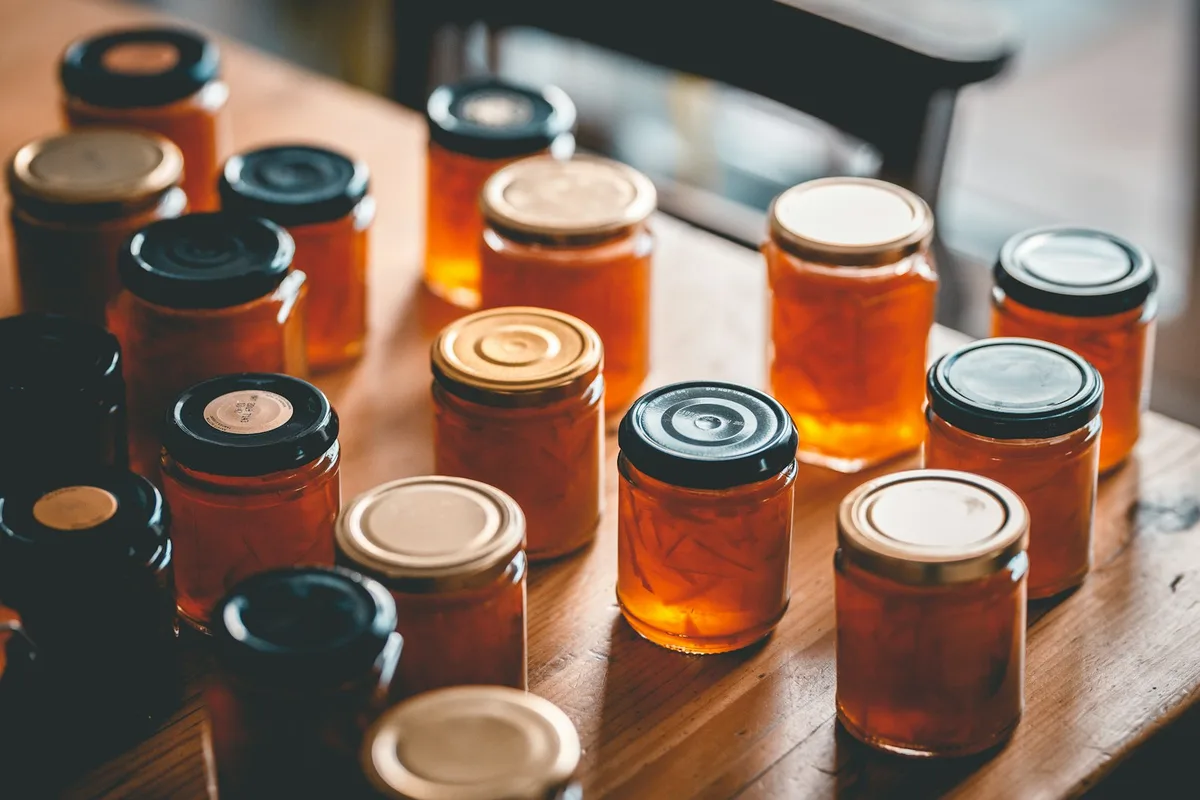
- Jams, jellies, preserves, and high-acid fruit curds made to a science-based recipe, plus home-canned high-acid fruits
- Dried and dehydrated goods — herbs, spices, teas, fruits, vegetables, freeze-dried products, home-roasted coffee beans whole or ground
- Granola, trail mix, chips, candied and roasted nuts
- Icings and frostings — buttercream, royal icing made with meringue powder or pasteurized whites, Swiss and Italian meringue with pasteurized whites
- Honey, including creamed and infused
- Pies with high-acid fruit fillings, and pecan pie
- Infused and flavored vinegars, fruit syrups, extracts, edible cookie dough made with commercially heat-treated flour, and dry baking mixes
What can't I sell?
This is the section to read twice, because it is where South Carolina's generosity stops and where new sellers most often find out they've been operating outside the law.
Acidified and canned savory products — excluded across the board
- Barbecue sauce, hot sauce, and salsa
- Pickles, relish, chow chow, and chutney
- Pepper jelly and mustard
- Acidic dressings and vinaigrettes
- Fermented foods
- Fig preserves
- Low-sugar and no-sugar-added jams
If you want to bottle a sauce in South Carolina, the path runs through a commercial kitchen and a retail food establishment permit or wholesale registration — not through this law.
Refrigeration-dependent baked goods — excluded
- Cheesecake
- Pumpkin and sweet potato cake and pie
- Cream, custard, and meringue pies
- Anything with a cream filling
Fresh produce inside a product — heavily restricted
- Cut melons and cut tomatoes are named as potentially hazardous in the statute itself
- Quick breads made with fresh, frozen, or canned fruits or vegetables are excluded, and muffins may not contain added fresh or frozen fruits or vegetables that are whole, chopped, or grated (commercially prepared or home-canned high-sugar fruits are allowed)
- Focaccia is allowed only without vegetables on or in it
The SCDA guidance (opens in new tab) explains why: a cookie's low water activity keeps a fruit purée safe, but the same purée in a muffin creates pockets of free water that will support bacterial growth.
Everything else on the excluded list
- Meat, poultry, and seafood in any form, including rendered lard and dried meats
- Dairy and frozen — ice cream, raw milk, butter
- Beverages — bottled drinks, juices, cold brew coffee, kombucha, kefir
- Sourdough starter sold on its own — sourdough bread itself is fine
- Boiled peanuts
- Prepared meals and repackaged foods
- CBD and Delta-8 products
- Pet treats — they fall under the South Carolina Commercial Feed Act, not this law
- Aluminum canned goods and charcuterie boards — these two are excluded by name in the statute's own definition, which is unusual and tells you they were a live argument in 2022
If you want to make something that isn't on either list, the guidance is explicit that the judgment call is yours: "it is your responsibility to read the law and determine whether that food item meets the intention of the law and can be produced in a home kitchen." Recipes cannot be submitted to the state for a TCS determination — the guidance says any recipe requiring testing also requires a retail food establishment permit.
Where am I allowed to sell?
Subsection (E) of S.C. Code § 44-1-143 (opens in new tab) gives you two channels, and the July 2025 SCDA guidance (opens in new tab) restates them as:
- Direct to the consumer, including online and mail order, delivered only in South Carolina.
- Retail stores, including grocery stores.
Farmers markets, craft fairs, and pop-ups
These all sit inside channel one — they're direct-to-consumer sales, which is why the guidance never lists them separately.
- Venues set their own rules on top of the law. SCDA's guidance says plainly that "sales venues including markets, events, and other retail establishments may set their own vendor policies and limits."
- A market that requires ServSafe certification or product liability insurance is entirely within its rights.
Retail and grocery stores
This is the genuinely unusual channel. Most cottage food states stop at direct-to-consumer. South Carolina goes further and deems home-based food "to be from an approved source, as required of a retail food establishment pursuant to Regulation 61-25" — the legal move that lets a permitted store stock your jam without jeopardizing its own permit.
- The obligation lands on the store, not on you: it "must post clearly visible signage indicating that home-based food products are not subject to commercial food regulations."
Restaurants
- A restaurant can sell your product packaged and labeled, exactly as a grocery store would.
- It cannot serve your product or use it as an ingredient without an operational variance approved by SCDA.
- Obtaining that variance is "the responsibility of the restaurant, not the food vendor." If a chef wants your shortbread crumbled over a dessert, the request goes from the restaurant to food-variances@scda.sc.gov, and the consumer advisory has to carry the same disclosure sentence your label does.
Mobile units and on-site service
Two more constraints from the guidance's FAQ appendix:
- Food sold from a mobile unit must have been fully prepared and packaged at home — no icing cupcakes in the truck.
- You cannot slice or plate on site: "foods prepared in a home kitchen must be packaged. You cannot serve on napkins or add toppings on site without a permit as a retail food establishment."
Can I ship out of state?
No. This is the hard edge of an otherwise permissive law, and it catches people the moment an Instagram post travels.
The SCDA guidance FAQ (opens in new tab) puts it plainly: "SC 44-1-143 (Cottage Law) is only applicable to sales intrastate. You can sell online for delivery to South Carolina addresses. Products that cross state lines are subject to FDA regulations."
There is one narrow exception, in the same answer: "If a customer comes to SC to make a purchase and takes the product across the state line, that is out of the control of the seller, thus allowed." A visitor buying at a Charleston market and driving home to Georgia is fine. Accepting that same person's online order next month and mailing it is not.
If interstate shipping is central to your plan, the honest answer is that this law is not your path, and you should be looking at a commercial kitchen and a wholesale registration instead of trying to make the exemption stretch.
What has to be on the label?
Four elements, from subsection (D):
- The name and address of the operation — or your SCDA identification number in place of the address.
- The standard name of the product.
- The ingredients, in descending order of predominance by weight.
- This exact sentence, in all capital letters, in a color that clearly contrasts with the background:
PROCESSED AND PREPARED BY A HOME-BASED FOOD PRODUCTION OPERATION THAT IS NOT SUBJECT TO SOUTH CAROLINA'S FOOD SAFETY REGULATIONS.
On top of the statute, federal rules apply. Allergen labeling under FALCPA and the FASTER Act (opens in new tab) covers the nine major allergens — wheat, soy, milk, egg, finfish, crustacean shellfish, peanuts, tree nuts, and sesame — with the specific species named for tree nuts, finfish, and shellfish (walnuts, not "tree nuts"). Net contents go in the lower third of the front panel in both customary and metric units. A Nutrition Facts panel is not required, though some producers add one for marketing. No health claims are permitted.
One detail to check against anything else you read: the 2022 amendment deleted "NOT FOR RESALE" from the § 44-1-143 statement, and SCDA's label guide shows the statement without it. The complication is S.C. Code § 46-57-20 (opens in new tab), added in 2023, which still prints the older statement beginning "NOT FOR RESALE" (see the note above). If you want certainty about which wording SCDA expects on your label, ask SCDA directly.
The state never inspects my kitchen. So what do I owe?
More than most people realize. No inspection does not mean no requirements — it means the requirements are enforced only if something goes wrong.
Physical requirements — subsection (C)
Walk your own kitchen against this list:
- Department-approved water supply
- Separate storage for ingredients used in food for sale
- Properly functioning refrigeration
- A sink with adequate hot water for cleaning and sanitizing utensils and equipment
- Adequate storage for utensils and equipment
- Hand washing facilities separate from the utensil sink
- A sanitary, working toilet
- No evidence of insect or rodent activity
- Department-approved sewage disposal
Behavioral rules — subsection (B)
- Supervise anyone else working in the kitchen
- Keep pets out of the kitchen during production and packaging, and away from ingredients and finished product
- No household activities in the kitchen while you're making food for sale
- Keep anyone with a communicable disease, an infected wound, or an acute respiratory infection out of the process
- Make sure everyone handling the food knows and follows safe food handling practices
If your water comes from a private well, the guidance defines "department approved water source" as either a public system or a private well tested at least annually for Total Coliform Bacteria by a lab certified for public drinking water testing in South Carolina. Sample bottles come from the Department of Environmental Services (opens in new tab).
And one thing the law explicitly does not give you: protection. The guidance answers the question directly — "SC Law 44-1-143 provides no liability protection for cottage food producers." Product liability insurance is your own decision, and it's common for markets, festivals, and wholesale accounts to ask for proof of coverage as a condition of selling — the guidance notes separately that "sales venues including markets, events, and other retail establishments may set their own vendor policies and limits."
What records should I keep when no one is asking for them?
This is the part that separates producers who stay compliant from producers who merely haven't been caught yet.
Because South Carolina inspects nothing on the front end, your records are your compliance file. If a customer complains through the SCDA complaint system (opens in new tab), or a retailer asks what went into lot 2026-114, or you need to pull a single batch off three shelves without pulling everything, the only thing standing between you and a guess is what you wrote down.
Four things are worth tracking from your first batch:
- Batch and lot records — production date, recipe version, and quantity made, so a problem can be scoped to one batch instead of a season.
- Ingredient traceability — supplier, purchase date, and lot code for each ingredient, especially anything with an allergen. When a supplier issues a recall, this is the only way to know whether it reached your kitchen.
- Label version history — which label went on which batch. This is what saves you when a requirement changes, as it did in 2022.
- Where each batch went — direct sales, which market, which store. Retail placement makes this non-optional in practice.
Spreadsheets handle this at first and stop handling it around the point where a second retail account appears. Ardent Seller was built for this kind of tracking — recipes with costed ingredients, batch and lot records that link finished product back to the specific supplier lots that went into it, and a transaction history that shows where each batch ended up. If your operation is heading toward grocery shelves, having that spine in place before the first purchase order beats reconstructing it afterward.
What should I do this week?
If you're starting from zero, in this order:
- Download the SCDA guidance document (opens in new tab) and read Chapters 4 and 5 — allowed and not allowed. Confirm your product is on the right list before you do anything else.
- Request an SCDA ID number if you don't want your home address on every label. Email the Appendix F form to homebasedfoods@scda.sc.gov.
- Build your label from the four required elements plus allergens, and set the disclosure statement in all caps against a contrasting background. Appendix E of the guidance has a worked example.
- Check your local ordinances — subsection (I) means county, municipal, and HOA rules survive the state exemption. Start with your county or city business licensing office; the SC Small Business Development Centers (opens in new tab) (the SCDA guidance lists 803-777-0749) are the referral the guidance itself points to for zoning, permitting, and licensing questions.
- Test your well if you're not on public water, and put the annual retest on your calendar. Sample bottles come from the Department of Environmental Services (opens in new tab).
- Price liability insurance. The law gives you none, and markets and wholesale accounts commonly ask for proof of coverage as a condition of selling. Get quotes from a business insurance agent before you commit to a booth fee — the Craft Seller Startup Checklist covers this alongside the other pre-first-sale essentials.
- Start your batch log with batch one, not batch two hundred — the batch tracking guide walks through what to record and why lot codes matter.
South Carolina has done something genuinely rare: it decided to trust home producers and then got out of the way. The work that trust leaves on your side of the table is a legible product list, an accurate label, and records good enough to answer a question you haven't been asked yet. That is a fair trade, and it is entirely within reach in an afternoon.
Ready to put the batch tracking behind your kitchen on something sturdier than a spreadsheet? Start a free Ardent Seller account and set up your first recipe, ingredient lots, and batch records before your next production day.
Related reading
- North Carolina Cottage Food Law — the neighbor with no cottage food statute at all, an inspection-based program instead, and an acidified-foods pathway if South Carolina's hot sauce ban is what's blocking you. (Tennessee permits acidified foods outright, with no pathway to complete — worth knowing if you're weighing where to base production.)
- Georgia Cottage Food Law — how the other bordering state handles caps, venues, and its 2025 wholesale expansion, useful if you sell at markets on both sides of the Savannah River.
- Batch Tracking for Food Sellers — how to build the lot-tracking system that turns a recall into a one-batch problem instead of a whole-season problem.
Free resources
Two free downloads from the Ardent Workshop library if you want to work through this off-screen:
- Cottage Food Laws by State — the side-by-side reference for every state's caps, venues, and label rules, useful the moment you consider selling across a state line or moving.
- Craft Seller Startup Checklist — the business-side steps that sit alongside the food-safety ones: licensing, insurance, recordkeeping, and pricing before your first sale.
This article is provided for educational purposes only and does not constitute legal, regulatory, food-safety, or health advice. Cottage food laws, allowed-food lists, labeling requirements, and agency jurisdiction vary by state and change frequently — South Carolina's own oversight moved between agencies in 2024. Consult the South Carolina Department of Agriculture, your local health or licensing authority, or an attorney before making compliance decisions.