
More than one-third of consumers who sign up for a subscription service cancel in less than three months, and over half cancel within six. That finding comes from McKinsey research (opens in new tab) surveying more than 5,000 US consumers — fielded in November 2017 and published in February 2018, so treat it as a durable shape rather than a current rate.
The shape is what matters. A subscription box does not usually fail slowly over a year. It fails inside the first quarter, and it fails in a way that most operators misdiagnose, because four genuinely different things all show up in the dashboard as the same word: canceled.
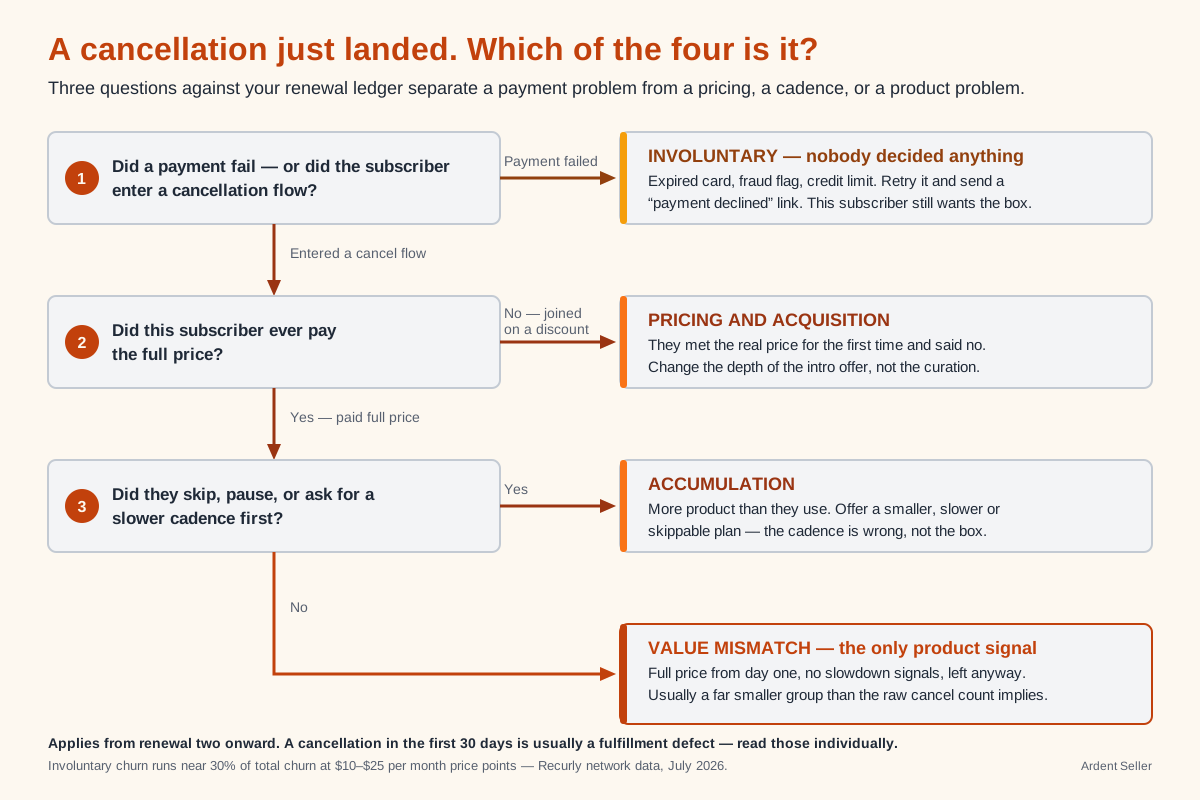
Those four things arrive on different dates, leave different traces, and call for four different responses. This post names them involuntary, pricing and acquisition, accumulation, and value mismatch, and uses those four names throughout. Only the last is a verdict on whether your box is any good — and it is rarely the biggest group.
What follows walks one cohort — a group of subscribers who all joined in the same month, followed forward together — through its first three renewals, then reproduces the ledger so you can run the same read on your own. Throughout, the example is a hypothetical $24-a-month tea and botanicals box with 40 such subscribers. The numbers are illustrative; the method is the point.
Month one: the month that tells you nothing
The first renewal is the one operators watch most closely and learn least from.
Almost everyone renews. In the example cohort, 37 of 40 do. That number feels like validation, and it is not, because month one is measuring a decision the subscriber already made — they signed up three or four weeks ago, the first box arrived, and nothing has yet happened that would make them reconsider. Enthusiasm has not had time to decay and the card has not had time to expire.
What month one can tell you is whether anything went badly wrong in fulfillment. A cancel in the first 30 days usually traces to something concrete: the box arrived broken, it arrived three weeks late, or the subscriber expected a different quantity. That is a small enough number to handle by hand. Email all of them — not with a win-back offer, with a question. At this cohort size the qualitative answer is worth more than the percentage point, and it is the last month where you can plausibly reach everyone who left.
These departures also sit outside the four-cause model entirely, which is the second reason month one teaches you little. A broken box is a fulfillment defect, not a signal about price, cadence, or curation — so do not run first-30-day cancellations through the diagnosis below. It starts at renewal two.
The month-one trap: A high first-renewal rate gets read as product-market fit. It is closer to a measure of how recently you charged people. Resist drawing conclusions until renewal two.
Month two: the cliff, and the two cancels hiding inside it
The second renewal is where subscription boxes actually break. In the example cohort, 37 subscribers get charged and 27 renew — a single month that removes a quarter of everyone still standing.
The reason it concentrates here is structural. If you launched with a welcome discount, a first-box-free offer, or a launch price, the second renewal is the first time most of that cohort meets the real number. Recurly, describing its own network data for this category, attributes the higher voluntary churn in ecommerce subscriptions to exactly this: "Lower price points and impulse-driven signup patterns contribute to higher voluntary churn in this category." (opens in new tab)
So the eight voluntary cancellations at renewal two — voluntary meaning the subscriber actively chose to cancel, as opposed to a card simply failing, which is covered further down — are not one group. They are two, and they mean opposite things:
- Subscribers who joined on the discount and left at the first full charge — the pricing and acquisition cause. They are telling you about your offer and your price, not about your tea. You acquired a price-sensitive cohort and then charged them a different price. That is an acquisition design problem, and it is fixable — usually by making the introductory offer shallower, or by disclosing the ongoing price far more loudly at signup.
- Subscribers who paid full price from day one and left anyway — candidates for the value mismatch cause. These are the only people in the month who can give you a clean signal about the product, and one more check in month three narrows them further. There are almost always far fewer of them than the headline number implies.
In the example cohort, six of the eight came in on the launch discount and two did not. An operator reading "eight cancellations, 22% of the base" reasonably concludes the box is not good enough and starts redesigning the curation. An operator reading "two full-price subscribers left" concludes something much narrower and much more useful.
This is the single highest-value split available to you, it requires no new tooling, and most box operators never make it — because the cancellation report and the signup source live in two different systems and nobody joins them up.
Rule of thumb: Before you change anything about the product, filter your month-two cancellations to people who never received a discount. That is your product signal. Everything else is a pricing and acquisition signal wearing the same label.
Month three: the accumulation cancel
The third renewal has a different character. In the example cohort it is gentler — four voluntary departures out of 27 — and the reason people give, when they give one, is not that the box was bad. It is that they have too much of it.
This is the accumulation cause — the failure mode specific to physical subscriptions — and McKinsey names it directly among its cancellation drivers (opens in new tab) alongside product quality and perceived value: inflexible order volumes. The subscriber liked box one, liked box two, and now has a cupboard containing more loose-leaf tea than a person drinks in a season. Nothing is wrong with the product. The cadence is wrong for how the product gets used.
Accumulation churn has a tell. It is usually preceded by a skip, a pause, or a support message asking whether the plan can go every other month — signals that arrive before the cancellation and are routinely ignored because they are not cancellations. It also correlates hard with product type: consumables at a sane consumption rate churn slowly here; durable goods, or consumables shipped faster than anyone uses them, churn quickly.
The fix is almost never a better box. It is a smaller or slower one — a genuine every-other-month tier, a half-size option, or a real skip button that does not require emailing you. Every one of those converts a cancellation into a lower-revenue subscriber, which is a straightforwardly better outcome than zero.
The cancels that were never cancels
The fourth cause — involuntary churn — is the one that does not belong on this timeline at all, because it does not cluster in any month. It just happens, steadily, to a fixed percentage of your base forever.
A payment fails. The card expired, the bank flagged the charge, the credit limit was hit, or the stored billing credentials never re-synced with the card network. Nobody decided anything. Recurly's list of the root causes of involuntary churn is unglamorous and entirely mechanical: expired card details, outdated billing credentials, bank-level fraud flags, credit limits and insufficient funds, and higher decline rates on some alternative payment methods (opens in new tab).
It is not a rounding error. In Recurly's July 2026 network data (opens in new tab), subscribers in the $10–$25 per month band — the band most handmade boxes sit in or just above — show 4.29 points of total churn, of which 1.30 points are involuntary. That is roughly 30% of all churn at box price points, and the same source shows involuntary churn falling sharply as price per customer rises, which means cheap boxes carry the worst of it.
Two consequences follow, and they are the practical heart of this post.
First, if your own cancellation report shows involuntary churn at or near zero, the most likely explanation is not that your subscribers have unusually good cards. It is that failed payments are being recorded as ordinary cancellations, and roughly a third of your churn is currently invisible and misattributed to your product.
Second, this is the only one of the four causes where the subscriber still wants the box. They are not won back; they are simply retried. A retry schedule and an email that says "your card was declined, here is a link" recovers a meaningful share of them, and it is the cheapest retention work available to any box operator — no product change, no discount, no curation rethink.
Day 90: reading your own ledger
Here is the cohort as it appears in a renewal ledger. Every number in the middle three columns is a departure that most reporting would collapse into the single word canceled.
| Billing date | Charged | Renewed | Canceled in flow | Payment declined, not recovered | Active after |
|---|---|---|---|---|---|
| Renewal 1 | 40 | 37 | 2 (note 1) | 1 (note 4) | 37 |
| Renewal 2 | 37 | 27 | 8 (note 2) | 2 (note 4) | 27 |
| Renewal 3 | 27 | 22 | 4 (note 3) | 1 (note 4) | 22 |
| Day 90 total | — | — | 14 | 4 | 22 (note 5) |
What each note means:
- Two early departures — read them individually, not statistically, as month one describes. These sit outside the four-cause model; they are usually fulfillment defects.
- Eight departures, but two different causes. Split this row by whether the subscriber joined on a discount. In this cohort six did and two did not: the six are pricing and acquisition, the two are candidates for value mismatch.
- Four departures with a different fingerprint. Check whether any of these four had previously skipped, paused, or asked about a slower cadence. If they had, this is accumulation, and the answer is a smaller plan rather than a better box.
- Declines are not decisions. These rows — one, two and one across the three renewals — never entered a cancellation flow and never chose anything. This is involuntary churn. If your billing system files it under the same heading as note 2, you cannot tell a payment operations problem from a product problem. Four of the 18 departures here, or 22% of all churn, were involuntary; Recurly's July 2026 network data (opens in new tab) at this price band would put the expected share nearer 30%, so a ledger showing close to zero is almost certainly a recording failure rather than a good result.
- 22 of 40 still active at day 90 — a 55% three-month retention rate. That is in the neighborhood McKinsey's shape predicts, which makes it unremarkable rather than alarming. The number worth acting on is not this one; it is the split inside the 18 who left.
Note that the three middle columns above are a summary of the cohort, not the whole record. To reproduce this you need a per-subscriber sheet with three columns the summary does not show: how they left (cancel flow or payment decline), whether they ever paid full price, and whether they skipped, paused, or asked for a slower cadence first. Those three facts, and only those three, are what separate the four causes.
If you want to turn a measured churn rate into lifetime value and break-even subscriber count, the Subscription Box CAC, LTV & Break-Even Calculator takes the rate as an input and does the rest.
Keeping a ledger like this by hand stops scaling somewhere around the third cohort. Ardent Seller tracks each customer with a first-purchase date and cohort, so retention can be read by month of joining rather than as one blended number that averages your best month into your worst — the cohort half of the ledger. The decline and discount flags are yours to record alongside it.
Why the benchmark you were about to look up won't settle it
The natural next move after reading a retention curve is to search for the number it should have been. That search is less useful than it looks, and it is worth understanding why before you act on anything it returns.
Recurly publishes benchmarks drawn from its own network, which is a genuine primary dataset rather than a repackaged one. Its churn benchmarks page (opens in new tab), using July 2026 network data, gives ecommerce a total of 4.25%, and states plainly: "For subscription boxes and direct-to-consumer: Ecommerce on the Recurly network showed a 4.25% median annual churn rate."
The same page sets its guidance bands in those same units — "below 2% annual churn is strong performance", "2% to 4% annual churn is the range where most well-run subscription businesses operate" — and elsewhere notes that "a 2% monthly churn rate translates to roughly 22% annual churn".
Read literally, that would mean a typical direct-to-consumer subscription loses about 4% of its subscribers per year. That cannot be reconciled with more than a third of subscribers canceling within three months, which is what the McKinsey consumer survey documents. Both sources are reputable; they are not measuring the same thing, and the published labels do not make the difference legible from outside.
Two things follow. The first is that figures further downstream deserve more suspicion, not less. Search for a monthly churn benchmark for your own category and you will be offered tidy per-category ranges, confidently stated and mutually inconsistent, on marketing blogs that name no dataset behind them. Check any one of them for a retrievable source before you plan against it. Repetition is not sourcing.
The second is more constructive. Ratios survive this ambiguity even when levels do not. Whether Recurly's (opens in new tab) 4.29 and 1.30 for the $10–$25 band are monthly or annual, involuntary churn is about 30% of the total either way — because both figures are in the same units, whatever those units are. That is why this post leans on that source for the share of churn that is mechanical, and leans on your own ledger for the level.
Which is the actual conclusion. There is no benchmark that will tell you whether your box is good. There is a 40-row spreadsheet that will tell you whether the people leaving it ever paid you full price — and that question is answerable this week.
Take one cohort. Follow it through three renewals. Record the three facts — how each person left, whether they ever paid full price, and whether they slowed down first. Then fix the largest group, which will very likely not be the one you assumed. Start tracking subscribers by cohort and the retention curve is drawn for you; the three flags are a column you keep beside it.
Related reading
- Should You Launch a Handmade Subscription Box? — The decision that comes before this one: whether a subscription box makes money at all, and the four numbers — contribution margin, churn, CAC payback, break-even subscribers — to run before box one ships.
- How to Get Repeat Customers for a Handmade Business — The same diagnosis run without a renewal date to read: when the only clock is the one the product's own use-up window sets, and how to tell a real lapse from the buyers who were never on a clock at all.
- Patreon for a Handmade Business — The recurring-revenue model with no per-box fulfillment obligation, and therefore none of the accumulation churn described above.
- Shipping Math for Handmade Sellers — Shipping is the line that most often eats a box's contribution margin, which decides how much churn the business can absorb before it stops working.
Free resources
Free companion downloads if you want to put any of this into practice:
- Subscription Box CAC, LTV & Break-Even Calculator — Feed it the churn rate your ledger produced and it returns average subscriber lifetime, LTV, CAC payback, and the subscriber count you break even at.
- Maker's Email Template Starter — Includes the abandoned-cart and order-status emails worth adapting into the two messages this post asks for: the failed-payment retry note and the month-one "what happened?" question.
This article is provided for educational purposes only and does not constitute financial, tax, or business advice. Cost structures, pricing examples, churn figures, and margin figures are illustrative and will vary by your specific circumstances. Consult a qualified accountant or small-business advisor before making financial decisions based on this content.