
Recurring revenue is the most seductive phrase in small business. Sell the thing once, the logic goes, and then get paid for it every month forever. What if the phrase that sounds like financial freedom is also the one that hides the most math?
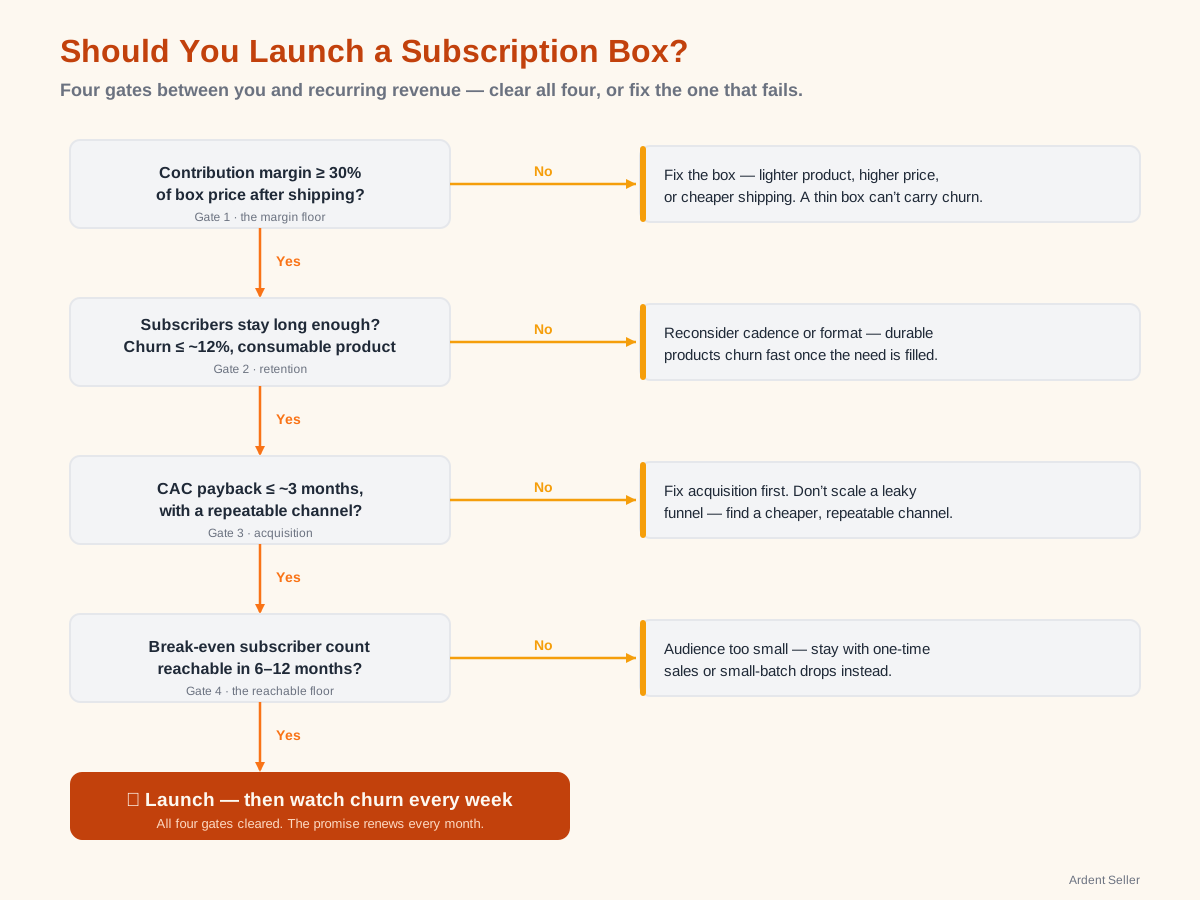
The short version: A subscription box lives or dies on four numbers — contribution margin per box, monthly churn, CAC payback, and break-even subscriber count. Run all four before you ship box one. A light, consumable, high-margin box for a devoted niche usually works. A heavy, durable, thin-margin box usually doesn't, no matter how beautiful it is.
A subscription box is not a product you sell. It is a promise you fund every month — a promise to source, make, pack, and ship something new, to a moving target of subscribers who can leave at any time, while you spend money to replace the ones who do. That can be a genuinely great business. It can also be a treadmill that looks like growth on the subscriber count and feels like drowning in the bank account.
The difference between those two outcomes comes down to four numbers. Not your product. Not your branding. Not how much your existing customers say they'd "totally subscribe." Four numbers. This post walks all four, then runs three composite makers through them to three different verdicts — one clear yes, one clear no, one not-yet, compared side by side near the end.
First: a subscription box is a retention business wearing a product costume
Here's the mindset shift that has to happen before any of the math makes sense.
When you sell a candle, the transaction ends when the candle ships. You made it, you sold it, you're done. When you sell a candle subscription, you've signed up for an obligation: next month, and the month after, and the month after that, you owe this person a box — and the moment the box gets boring, late, or not-quite-worth-it, they cancel, and the lifetime value you were counting on evaporates.
So a subscription box is really two businesses bolted together. A fulfillment business (make and ship a box every month, on time, at a cost you can predict) and an acquisition-and-retention business (keep buying new subscribers faster than the old ones leak away). Makers often come to a subscription with strong fulfillment instincts and far less practice on the acquisition-and-retention side — and the second business is the one that surprises them. The four numbers below force you to think about both.
The four numbers
Number 1: Contribution margin per box
Contribution margin is what's left from the box price after the variable cost of fulfilling one box — everything that only happens because that box went out the door. For a subscription box that means:
- Product cost — the materials and labor in whatever goes inside.
- Packaging — the mailer box, tissue, filler, insert card, tape, label.
- Shipping — the postage you actually pay, not the postage you wish you paid.
- Payment processing — typically around 2.9% + $0.30 per charge on most standard processors (e.g., Stripe (opens in new tab)); it recurs every month, so confirm your own rate.
Box price minus those four lines is your contribution margin. It is the single most important number in the whole model, because it's the only money that exists to cover everything else: your fixed costs, your acquisition spend, and eventually your profit.
Rule of thumb: Aim for contribution margin of at least 30% of the box price after shipping. The logic: on a $30 box, 30% leaves about $9 to absorb a $20-ish acquisition cost and still chip in toward fixed costs before the subscriber churns. Below that, churn and acquisition have almost no room to breathe.
Shipping is the assassin here. A maker pricing a box will lovingly cost the product to the gram and then wave a hand at "shipping's like, what, eight bucks?" For a heavy or fragile product — candles, ceramics, glass jars of anything — real shipping with protective packaging can run $10 to $14 a box and eat the margin alive. A light, flat, durable product ships for a third of that.
Number 2: Monthly churn
Churn is the percentage of subscribers who cancel each month. It is the number makers most underestimate, because in month one nobody has churned yet and the chart only points up.
Churn matters because it sets your average subscriber lifetime — roughly 1 divided by your monthly churn rate, expressed in months. The arithmetic is unforgiving — here is what three illustrative churn rates do to subscriber lifetime:
- 8% monthly churn → average subscriber stays about 12.5 months
- 12% monthly churn → about 8.3 months
- 15% monthly churn → about 6.7 months
Hard category-wide benchmarks for handmade boxes are scarce, and the published subscription-churn data that does exist skews toward larger digital businesses — where monthly churn tends to run in the low-to-mid single digits, around 6–7% even for direct-to-consumer subscriptions (Recurly's churn research (opens in new tab)). Small physical boxes tend to churn faster than that, because shipping friction and durable-goods fatigue work against them. Rather than anchor on someone else's number, model your own and watch it weekly. What drives your number is mostly the product. A consumable people genuinely re-buy — tea, coffee, soap, snacks, craft supplies they'll use up — churns slowly because the box solves a recurring need. A durable product churns fast, because after three months the subscriber owns more candles than they can burn and starts eyeing the cancel button.
Number 3: CAC and CAC payback
Customer acquisition cost (CAC) is what you spend, on average, to land one paying subscriber — ad spend, influencer gifting, sample costs, the discount on the first box, divided by how many subscribers it produced.
The number that matters isn't CAC alone, it's CAC payback: how many months of contribution margin it takes to earn that money back.
CAC payback = CAC ÷ contribution margin per box.
If a subscriber costs $24 to acquire and each box contributes $8, payback is three months. Now hold that next to your average subscriber lifetime from Number 2. If lifetime is eight months and payback is three, you have five months of margin left to make a profit — workable. If lifetime is seven months and payback is four, you're acquiring subscribers who barely pay for themselves before they leave. That's the treadmill: lots of motion, no ground covered.
A widely used planning target — borrowed from subscription and SaaS metrics, where it originated (David Skok, SaaS Metrics 2.0 (opens in new tab)) — is a lifetime-value-to-CAC ratio of about 3:1: every dollar of acquisition returns roughly three dollars of contribution margin over a subscriber's life. Physical boxes carry costs pure software doesn't, so treat it as a directional benchmark, not a law. Below 3:1 the model gets fragile; below 2:1, you're spending more than half of each subscriber's lifetime value just to acquire them — almost nothing left for fixed costs, let alone profit.
Number 4: Break-even subscriber count
Finally, the floor: how many active subscribers you need just to cover your fixed costs — the studio rent, the software, the insurance, your own base pay, everything that doesn't scale with a single box.
Break-even subscribers = monthly fixed costs ÷ contribution margin per box.
$600 of monthly fixed costs at $12 contribution per box means you break even at 50 active subscribers. Simple — except churn means 50 isn't a finish line, it's a leaky bucket you have to keep refilling. At 12% churn, holding 50 subscribers means replacing six every single month, forever, just to stay flat. The break-even number tells you the size of the bucket; churn tells you how fast it drains.
Three makers, three verdicts
Numbers in the abstract are easy to nod along to. Here are three composite makers — illustrative, not real people — running the same four gates to three different answers.
Maya, the candlemaker — not yet
Maya makes soy candles and wants a $39/month two-candle box. Her math:
- Box price: $39
- Product cost: $16 · Packaging: $4 · Shipping (heavy, fragile, lots of void fill): $11 · Fees: $1.70
- Contribution margin: $6.30 — about 16% of the box price
That's the problem, and it's the first gate. At 16%, she's already below the 30% floor before churn or acquisition enter the picture. Candles churn fast, too — call it 12%, so an 8.3-month lifetime and a lifetime contribution around $52. With a $22 CAC, that's a 3.5-month payback and an LTV:CAC barely above 2:1.
Maya's box isn't doomed by her product quality. It's doomed by physics: candles are heavy and fragile, and shipping a fragile heavy thing every month is structurally expensive. Her honest verdict is not yet — and the lever to fix is the box, not the marketing. A lighter format (wax melts, a single larger candle every other month, a candle-plus-consumable box) could lift contribution margin above the floor. Shipping the same heavy box harder will not.
Verdict: not yet. The lever is the box format, not the marketing.
Priya, the tea and botanical blender — yes
Priya blends loose-leaf teas and herbal sachets. Her proposed $28/month box:
- Box price: $28
- Product cost: $7 · Packaging: $3 · Shipping (light, under 8 oz, ships flat and cheap): $5 · Fees: $1.20
- Contribution margin: $11.80 — about 42% of the box price
Now watch the gates fall in her favor. Tea is a consumable people genuinely use up and re-buy, so her churn runs lower — around 8%, a ~12.5-month lifetime, a lifetime contribution near $147. Her audience is a devoted niche she already reaches organically, so CAC is a modest $18 — a payback under two months and an LTV:CAC north of 8:1. With $600 in fixed costs and $11.80 contribution, she breaks even around 51 subscribers, a number her existing email list can plausibly supply.
Priya's box works for the same reason Maya's struggles: it's light, consumable, high-margin, and aimed at people who want exactly this.
Verdict: yes. Light, consumable, high-margin, and cheap to reach.
David, the soap maker — not yet, but close
David's soaps land in between. His $32/month box:
- Box price: $32
- Product cost: $11 · Packaging: $3.50 · Shipping: $7 · Fees: $1.40
- Contribution margin: $9.10 — about 28% of the box price
His contribution margin clears the floor (barely), and soap is a consumable, so churn is a survivable 11% — a ~9-month lifetime, about $82 of lifetime contribution. The broken gate is the third one. David is in a crowded category and has been buying subscribers through paid ads at a $40 CAC. That's a 4.4-month payback and an LTV:CAC barely at 2:1 — he's spending nearly half a subscriber's lifetime value just to acquire them.
David's verdict is not yet, and his lever is acquisition, not the box. Before he scales, he needs a cheaper, more repeatable channel — referrals, organic content, a partnership — to pull CAC down to where the box's decent margin can actually turn into profit. Scaling a leaky funnel just means losing money faster.
Verdict: not yet — but close. Fix acquisition before you scale.
The pattern across all three
Here are all three makers side by side, scored on the four gates:
| Maker | Contribution margin ($ / % of box) | Churn → lifetime | CAC payback (months) | Verdict |
|---|---|---|---|---|
| Maya (candles) | $6.30 (16%) | 12% → 8.3 mo | 3.5 mo | Not yet — fix the box |
| Priya (tea) | $11.80 (42%) | 8% → 12.5 mo | 1.5 mo | Yes |
| David (soap) | $9.10 (28%) | 11% → 9 mo | 4.4 mo | Not yet — fix acquisition |
Read the table top to bottom and the lesson is plain: the box that works isn't the one with the best product. It's the one that is light, consumable, high-margin, and aimed at a devoted niche it can reach cheaply. Priya didn't win because her tea is better than Maya's candles. She won because tea is structurally a better subscription product — and no amount of branding changes the structure.
That's the real decision. Before you fall in love with the unboxing video in your head, run your own four numbers and find out which maker you are.
When you're ready to run your own numbers
Estimating these four numbers from a blog post is one thing; running them against your actual costs is another. The Subscription Box CAC, LTV & Break-Even Calculator does exactly that — plug in your box price, fulfillment costs, churn, and acquisition spend, and it returns your contribution margin, LTV, CAC payback, LTV:CAC ratio, break-even subscriber count, and a 12-month projection at your current pace. It's the fastest way to find out whether you're a Priya or a Maya before you commit a single shipment.
And if the math says go, the hard part begins the day box one ships: tracking who actually subscribed, when, what each cohort cost to acquire, and how fast each cohort is leaking — exactly the moving, time-based data that spreadsheets handle worst. That's the job Ardent Seller does for subscription-box curators: it tracks real subscribers as recurring sales, ties acquisition spend to specific cohorts, and surfaces the retention curves that tell you, month by month, whether the bucket is filling or draining. The Free plan covers most year-one subscription operations.
A subscription box can absolutely be the calm, predictable revenue you're picturing. Just make sure it's the four numbers telling you that, and not the fantasy of recurring revenue talking. So before box one ships, run your four numbers — and let the math, not the daydream, make the call.
Related reading
- Why Subscribers Cancel: A Teardown of the First 90 Days — Once the box is live, churn stops being an assumption and becomes something you measure. This is how to reduce subscription box churn by reading your own renewal ledger: four causes, and the three facts per departing subscriber that tell them apart.
- Patreon for a Handmade Business — The same recurring-revenue decision with no box to pack: what a membership platform actually takes off the top, and why the deliverable rather than the margin is what decides it.
- Shipping Math for Handmade Sellers — The shipping line is the assassin of subscription-box margin. This breaks down dim weight, void fill, and the real cost of every package you mail.
- Margin vs. Markup: The Pricing Math Mistake That Quietly Costs You — Contribution margin is the whole game for a box. Get the margin math straight here before you set a subscription price.
- How to Validate a Handmade Product Idea — The same go/no-go discipline applied to a single product rather than a recurring box: a test batch sized from a real production constraint, and the thresholds written down before anything sells.
- Cash Flow for Seasonal Sellers: Surviving the Slow Months — A subscription smooths revenue but doesn't eliminate the acquisition-spend cash crunch. The reserve thinking here applies directly.
Free resources
Free companion downloads if you want to put any of this into practice:
- Subscription Box CAC, LTV & Break-Even Calculator — The companion tool to this post: plug in your real costs and get your four-number verdict in about two minutes.
- Maker Hourly Rate Pricing Calculator — Before you set a box price, make sure your own labor inside each box is actually being paid for. This calculates the hourly rate your pricing needs to clear.
This article is provided for educational purposes only and does not constitute financial, tax, or business advice. Cost structures, contribution margins, churn rates, and acquisition figures are illustrative and will vary by your specific product, niche, and circumstances. Consult a qualified accountant or small-business advisor before making financial decisions based on this content.