
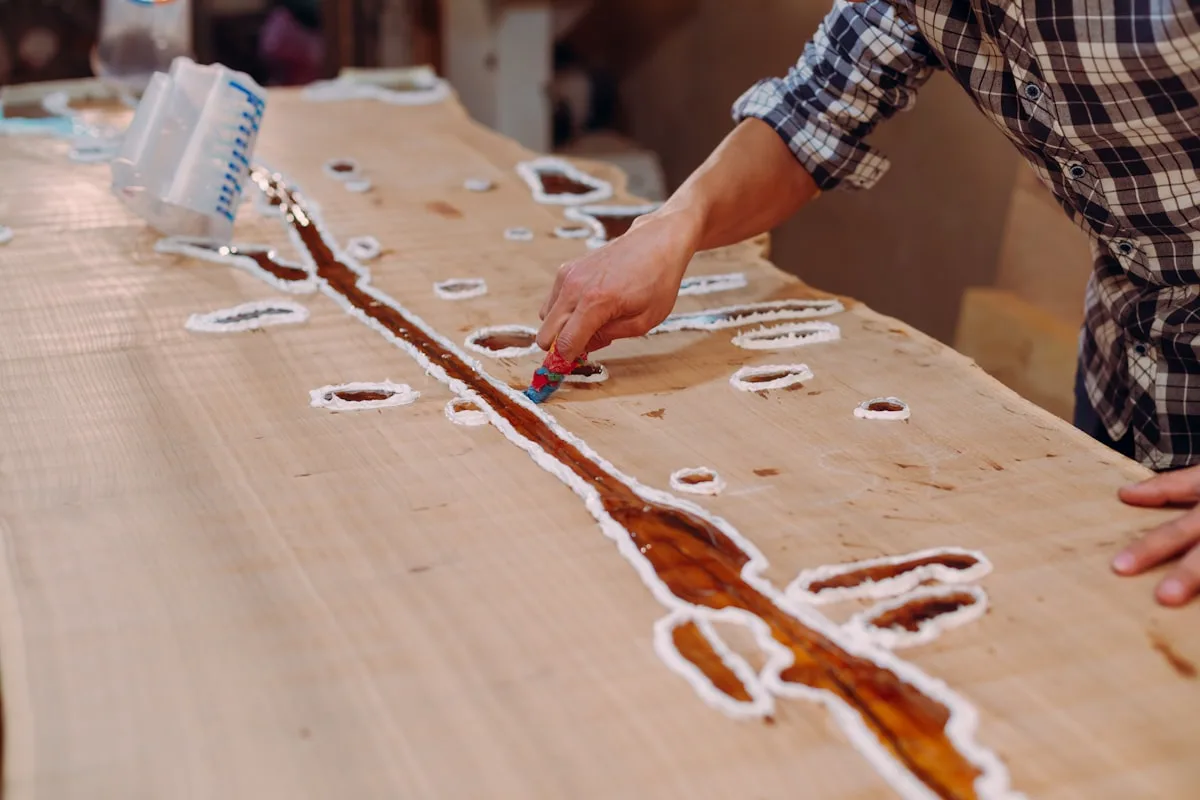
The workshop smells like warm epoxy and citrus solvent. A desk lamp is angled low across the bench so the light rakes the surface of four little molds, and a butane torch hisses for two seconds at a time as it chases bubbles up out of the resin. The wood strips down the center of each coaster have gone dark and glossy where the epoxy crept over them. Nothing can be touched for another day. Tomorrow there will be sanding, and the fine grit dust that gets into everything, and the slow reveal under the polish where you finally find out whether the pour was any good.
This is the part of resin art the photos never show. The finished river coaster looks like a single clean object — pour, cure, sell. The cost of that object is spread across two days, a dozen small purchases, and a stack of hours nobody put on the price tag. Let's add it all up.
The short answer: a four-coaster river set costs roughly $61 to make once you count materials (~$23), labor at about 1.4 hours, a reject reserve, and equipment wear — about $15 per coaster before a single selling fee. That's why a $14 coaster loses money, and why a profitable set usually has to retail in the $85–$95 range. The rest of this post shows exactly how those numbers stack up, line by line, so you can run the same math on your own work.
The set that "felt clever" at $14 a coaster
Meet Dana (a composite example, not a real person — assembled from the kinds of decisions common in one-person resin shops). Dana makes river-style coasters: a walnut strip down the middle, translucent ocean-blue epoxy on either side, sold in sets of four. She prices them at $14 each, $48 for the set, and for a while that felt smart. The resin kit was "only" about fifty bucks, and a kit makes a lot of coasters. The math, in her head, was resin-cheap and margin-fat.
The math in her head was missing most of the costs.
When you actually reproduce the cost of one set — not the ingredient list, the cost — the picture inverts. Here is that set, torn down line by line.
The teardown: one river coaster set, line by line
This is the "cost label" for a single set of four river coasters. Each line is numbered; what each one actually means is explained below.
| # | Cost line | Per set of 4 |
|---|---|---|
| (1) | Epoxy resin + hardener (~230 g art resin) | $11.50 |
| (2) | Walnut center strips (offcuts) | $4.00 |
| (3) | Pigment / mica / dye | $1.20 |
| (4) | Silicone mold wear (amortized) | $0.65 |
| (5) | Consumables (cups, sticks, gloves, sandpaper, torch fuel, finish) | $2.80 |
| (6) | Cork feet + backing | $0.80 |
| (7) | Packaging (box, tissue, care card, sticker) | $2.50 |
| (8) | Materials subtotal | $23.45 |
What each line means:
(1) Resin — $11.50. Cheaper per set than you fear, more expensive per year than you think. A $50 art-resin kit of about 1,000 g (a one-quart kit) works out to roughly $0.05 a gram. A four-coaster set uses around 230 g, so the resin itself is about $11.50. The trap isn't any single pour — it's that resin is the line you notice, so it becomes the only line you cost.
(2) Wood — $4.00. "Free" until you count the offcuts you bought to get it. Even using scrap walnut, that scrap came from a board. Attribute a fair share — about $4 a set — or you're quietly subsidizing every coaster with last month's lumber receipt.
(3) Pigment — $1.20. Pennies per set and easy to forget entirely. A few drops of mica and dye land around $1.20. Small, yes. But "small and forgotten" is how three or four dollars walk out of every set.
(4) Mold wear — $0.65. Molds wear out, so each pour owes the mold a little rent. In this teardown, Dana assumes a $25 silicone coaster mold lasts about 40 clean sets before it yellows or loses its shine — roughly $0.65 of mold per set. Your own figure will vary with mold brand, resin type, and how gently you demold, so track your own rebuy cadence and substitute it.
(5) Consumables — $2.80. The line that never gets written down. Mixing cups, stir sticks, nitrile gloves, the sandpaper grit ladder, butane for the torch, painter's tape, and the wipe-on finish. None of it is reusable. Together it's ~$2.80 a set, every set, forever.
(6) and (7) Cork feet + packaging — $3.30. Part of the product, not afterthoughts. Cork pads so the set doesn't scratch a customer's table, plus a box, tissue, a care card, and a sticker — that's $3.30 a set the customer is absolutely paying for whether or not you costed it.
Add it up and the materials alone are $23.45 per set — about $5.86 per coaster. Already, that $5.86 is 42% of a $14 coaster's price, spent before a single minute of labor is counted. And the minutes are where it gets ugly.
The cure-time tax
Here's a cost that never shows up as a dollar on any line: time the mold is occupied. A coaster pour cures for roughly 24 to 72 hours before demolding — the exact window depends on your resin and how warm the room is — and that mold can't do anything else while it waits. If you own four molds, your entire output ceiling is four sets every few days no matter how motivated you are. Cure time doesn't cost cash — it caps revenue. Given that cure window, for most epoxy-resin work the practical scaling lever is more molds, not more skill: you can sharpen your technique, but you can't rush the chemistry.
The cost you can't see: your own hours
Resin work is deceptively hands-on. It just doesn't feel like labor because so much of it is fiddly two-minute tasks scattered across two days.
Walk the actual clock for one set:
- Day one (~35 min): prep and tape the wood, cut and sand the strips, measure resin by weight, mix to ratio, tint, pour in stages, torch out bubbles, cover against dust.
- Day two (~40 min): demold, sand up the grit ladder (220 → 400 → 600 and beyond), wipe clean, apply finish or polish, inspect.
- Finishing line (~10 min): glue cork feet, pack the set, write the care card, label the box.
That's roughly 85 minutes of genuine hands-on work per set — call it 1.4 hours. Pay yourself even a modest $22 an hour and that's $30.80 of labor in a single set. Per coaster: about $7.70.
Stack labor on top of materials and one coaster has now cost roughly $13.56 to make — before rejects, before equipment, before a single platform fee. Selling it at $14 isn't a fat margin. It's a rounding error away from working for free.
The reject reserve: budgeting for bad pours
Resin punishes you for things you didn't do wrong. A stray dust nib, a humid afternoon, a micro-bubble that surfaces overnight, one edge that cures tacky. Some pours just don't make it — sometimes the whole set if the river line drifts. The fix is a reject reserve: set aside a slice of every good set to cover the bad ones. A sensible starting point is around 10% of materials-plus-labor, then adjust to your own scrap rate once you've tracked it for a month — scrapping roughly one coaster for every ten you finish lands you right at 10%, and if you're cleaner you can dial it down. Without a reserve, your "good" sets are silently paying for your bad ones and you'll never see where the money went. For Dana's set — 10% of the $54.25 in materials and labor — that reserve is about $5.43.
From cost-to-make to cost-to-sell
Add the last two quiet lines and you finally have the real floor:
| Cost layer | Per set of 4 |
|---|---|
| Materials | $23.45 |
| Labor (1.4 hr @ $22) | $30.80 |
| Reject reserve (~10%) | $5.43 |
| Equipment depreciation (torch, sander, scale, lamp) | $0.90 |
| Electricity / cure-space overhead | $0.40 |
| True cost to make | $60.98 |
The last two lines are small but real, and worth showing your work on. Equipment depreciation ($0.90) spreads the cost of your durable tools across the sets they make: four tools at roughly $35 (torch), $60 (sander), $25 (scale), and $20 (lamp) come to about $140, and over their ~155-set lifetimes that's around $0.90 a set. Electricity and cure-space overhead ($0.40) covers the lamp, the heat you keep on so the resin cures in winter, and a share of the bench space. Neither is large alone; both vanish entirely if you never write them down.
That comes to about $15.25 per coaster just to produce — already more than Dana's $14 sale price. And she hasn't sold it yet.
Selling adds its own bite, and on a marketplace it's worth costing as precisely as everything else. On Etsy, a sold set carries roughly a 6.5% transaction fee, about 3% + $0.25 payment processing, and a $0.20 listing fee (Etsy's published fee schedule (opens in new tab)) — on an ~$85 set that comes to about $8–$9 in platform fees, more if Offsite Ads fire (they add a 12–15% commission on that order — see Etsy's Offsite Ads policy (opens in new tab)). Coasters are also heavy for their size and fragile, so shipping means real padding, a rigid box, and dimensional-weight math that rarely favors you — figure $6–$10 a set. (For how marketplace ad fees stack against margin, see Are Etsy Ads Worth It?.)
Run those layers honestly and the verdict is blunt. Start from the ~$61 cost to make, add the $8–$9 in fees and $6–$10 in shipping above (so roughly $14–$19 of selling cost), and you need to clear about $75–$80 just to break even — which is why a four-coaster river set has to retail somewhere in the $85–$95 range to leave any real profit, not $48. The $14 coaster wasn't underpriced by a little. It was underwater. (Fee percentages change; confirm Etsy's current rates before you price.)
What to actually track so this never sneaks up on you
The fix isn't to work faster or buy cheaper resin. It's to make every one of those lines visible before you set a price — and to keep them current as resin prices drift and molds wear out.
That's exactly the bookkeeping a tool like Ardent Seller is built for. You can store each product as a recipe — resin, wood, pigment, mold, consumables, packaging — so a per-piece cost rolls up automatically instead of living in your head. Equipment like your pressure pot, torch, and sander can be tracked with straight-line depreciation so a fair sliver lands on every set. And because resin art is a true variant matrix — color × size × style × mold — auto-generated SKUs keep an ocean-blue round coaster distinct from a forest-green square one without a spreadsheet meltdown. When resin jumps a few dollars a kilo, you change one cost and every product reprices itself.
The point of all of it is a single number you can trust: what this thing actually costs me to make. Once you have that, pricing stops being a feeling and becomes arithmetic.
Dana's coasters are genuinely good. That was never the problem. The problem was that the most beautiful part of the work — the pour — was the only part anyone was paying for. Count the wood, the cure-time bottleneck, the sanding hours, and the rejects, and a $48 set quietly becomes an $85 one. Same coasters. Honest math.
So pull your last batch out of the cabinet and run it the way we just ran Dana's: materials, your hours, your scrap rate, the channel. If the number that comes back is bigger than your price tag, you didn't fail at resin — you just found the leak. The next step is to make that number live where you can see it. Start tracking your true per-piece cost with Ardent Seller and let the next price you set be one you can defend.
Related reading
- Recipe Costing 101 — The foundational five-category cost framework behind every teardown like this one, applied to any handmade product.
- What Is a Bill of Materials for Makers? — Turn the resin, wood, pigment, and packaging in this post into a reusable recipe so the per-piece cost rolls up automatically.
- The True Hourly Wage of a Handmade Business — How to put a real number on the sanding-and-pouring hours that this teardown showed were the biggest cost line.
Free resources
A few free downloads from the Ardent Workshop library that pair well with this teardown:
- Product Pricing Calculator — Plug in your resin, wood, labor, and packaging to get a defensible per-piece price instead of a guess.
- Recipe Scaling & Batch Calculator — Keep your resin-to-hardener ratio and pigment percentages exact when you scale a pour up from one set to ten.
- Should I Raise My Prices? Decision Tool — Walks you through whether a price bump is overdue once you've seen your real cost-to-make.
This article is provided for educational purposes only and does not constitute financial, tax, or business advice. Cost structures, pricing examples, and margin figures are illustrative and will vary by your specific circumstances. Consult a qualified accountant or small-business advisor before making financial decisions based on this content.