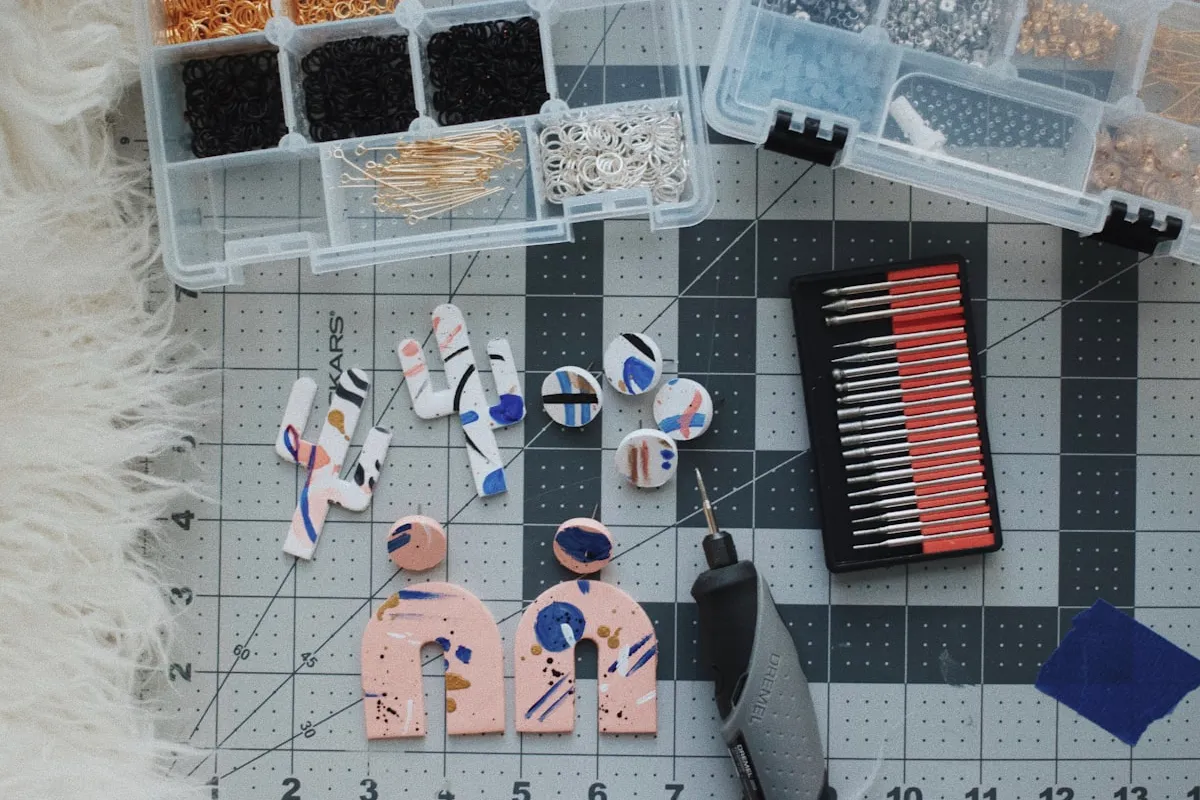
The cheapest thing about a pair of polymer clay earrings is the clay.
That sentence is the whole problem. You buy a block of polymer clay for a few dollars, it makes dozens of pairs, and somewhere in your head the math settles into "these basically cost nothing to make." So you price them like they cost nothing — generously, you think, at a multiple that would make a spreadsheet blush. Then at the end of a strong month you look at the bank balance and it doesn't match the number of earrings that left the studio. The earrings sold. The money didn't show up.
It didn't vanish. It was never in the price to begin with, because the price was built on the one input that barely matters.
The short version: A pair of polymer clay earrings costs far more than its clay. Price it on the full stack — materials + findings & packaging + hands-on time (in minutes) + tool overhead + marketplace fees — not on a multiple of the clay. The biggest cost is your time, and because it never shows up on a receipt it rarely makes it into the price. The result: your highest-priced pieces are often your least profitable per minute of work. Price by the minute, not by the sticker.
Why "cheap to make" is a trap, not a feature
A lot of maker pricing advice starts with material cost and multiplies. Polymer clay breaks that habit immediately, because the material cost is almost a rounding error. A 2 oz block of name-brand clay usually costs a few dollars — check your own receipt for the figure that matters — and holds roughly 57 grams, so a typical block works out to around six cents a gram. A pair of stud earrings might use six grams. That's about thirty-seven cents of clay. You could triple it, quadruple it, multiply it by ten, and you'd still be pricing a coffee.
The trouble is that "ten times my material cost" feels like a windfall and is actually a trap. Ten times thirty-seven cents is $3.70, and you cannot run a business at $3.70 a pair. So you ignore the multiplier (good instinct) and instead pick a price that "feels right" for earrings (dangerous instinct), usually by glancing at what everyone else on Etsy charges. Now your price is anchored to other people's guesses, which were anchored to their clay cost, which is also a rounding error. It's guesses all the way down.
The way out is to cost the things that aren't clay.
The two costs nobody puts on the price tag
Two categories quietly eat polymer clay margins, and neither one is the clay.
The first is findings and packaging — the unglamorous hardware. Titanium or surgical-steel posts and backs, ear wires, jump rings, the occasional brass connector, a dab of E6000, the earring display card, the little cello sleeve. None of it is expensive on its own. All of it together, per pair, often costs more than the clay by a wide margin. Many buyers now look for hypoallergenic posts — titanium and surgical steel — especially in online jewelry shops, and they cost more than plain plated posts.
The second is your time, and it's the big one. Conditioning clay through a pasta machine, rolling an even sheet, mixing a marble or pressing a cane, cutting shapes, piercing holes before baking, sanding every edge after, sealing, gluing posts, attaching hardware, and carding the finished pair — that's a lot of small motions. Batching makes each pair faster, but "faster" is not "free." A simple stud might be eight hands-on minutes; a two-part statement dangle can be half an hour once you count the fiddly assembly.
Time never prints on a receipt, so it never enters the mental math. That's the mechanism that can leave skilled makers earning less per hour than the kid at the drive-thru. Let's put it on the receipt.
Worked example 1: the terrazzo stud (the one that works)
Meet Camille. She's fictional, but her numbers are realistic — they reflect the kind of cost structure that's common in a small polymer clay business. She runs a small Etsy shop and does two markets a month, and her bestseller is a terrazzo-speckled stud. Here's what one pair actually costs her, batched twenty at a time. (Every figure here — including the per-pair timings — is illustrative, so plug in your own.)
Materials, per pair:
- Clay, ~6 g at $0.06/g — $0.37
- Gold-leaf flecks and a touch of mica — $0.10
- Titanium flat-pad posts and backs (bought in bulk) — $0.45
- A dab of E6000 — $0.05
- Display card + cello sleeve — $0.20
- Materials subtotal: $1.17
Time: 8 hands-on minutes per pair when batched. At a target wage of $20/hour — pick your own number; this post walks through how to set your maker hourly wage — that's $2.67 of labor.
Overhead: a slice of pasta machine, oven thermometer, blades, sandpaper, and the electricity to bake — call it $0.30 per pair.
True cost: $1.17 + $2.67 + $0.30 = $4.14.
Camille sells the studs for $12. Etsy takes its bite — roughly 6.5% transaction ($0.78), payment processing ($0.61, at the US rate of ~3% + $0.25; other countries differ), and the $0.20 listing fee (Etsy's published fees (opens in new tab), as of June 2026) — about $1.59 in fees. That leaves $10.41. Subtract her $1.17 in materials and $0.30 of overhead, and $8.94 is left to cover labor and profit. Her labor "cost" was $2.67, so she clears $6.27 of real profit on top of paying herself $20 an hour — 52% of the sale price left over after the wage is already covered. The studs are doing their job.
Hold onto that $8.94, because it's the number that matters — and it's about to look very different on a piece that costs three times as much.
Worked example 2: the statement dangle (the one that lies to you)
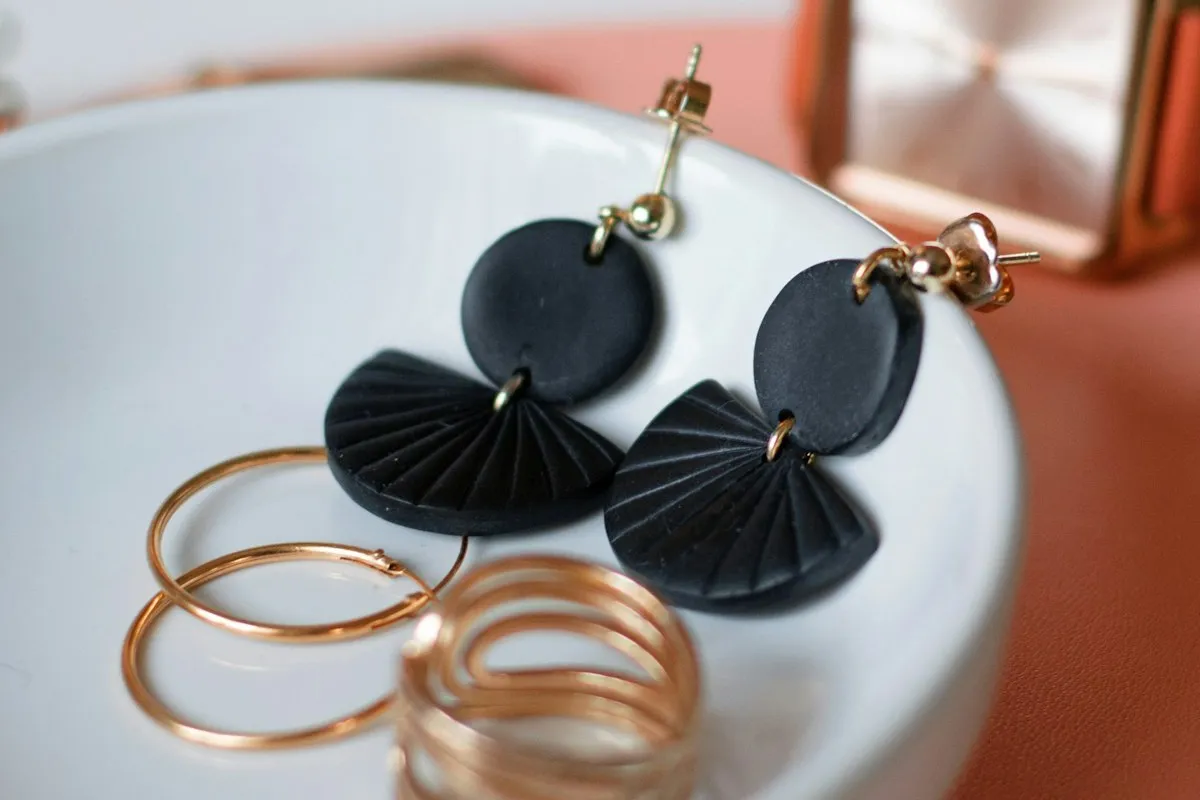
Camille's other style is a big marbled two-part dangle with a brass connector. It photographs beautifully, it gets the most compliments, and it carries the highest price in her shop. It is also, quietly, losing her money — and the high price is the reason she can't see it.
Materials, per pair:
- Clay, ~14 g at $0.06/g — $0.84
- Brass connector — $0.60
- Four jump rings + titanium ear wires — $0.70
- Varnish coat + E6000 — $0.15
- Display card + cello sleeve — $0.20
- Materials subtotal: $2.49
Time: 28 hands-on minutes per pair. Marbling, cutting two shapes, piercing four holes, sanding the edges twice, then the genuinely slow part — opening jump rings, linking the two halves, attaching wires without scratching anything. At $20/hour, that's $9.33 of labor.
Overhead: $0.40 per pair.
True cost: $2.49 + $9.33 + $0.40 = $12.22.
Now here's where the sticker price lies. Camille prices the dangle at $14, because $14 feels like a generous price for earrings whose materials "only cost $2.49." Watch what $14 actually does:
- Price: $14.00
- Etsy fees (6.5% + ~3% + $0.25 + $0.20 listing): $1.78
- Net after fees: $12.22
- Minus materials ($2.49) and overhead ($0.40): $9.33 left
- Her labor for those 28 minutes was worth $9.33
Profit: zero. Not "thin." Zero. At $14, the dangle pays Camille exactly her hourly wage and earns the business nothing — no cushion for the pairs that crack in the oven, no reserve for the slow January, no fund for the next pasta machine. And $14 is right about where a lot of makers feel they need to land to stay competitive — a price set by feel, not by math. Drop to $12 and she's now subsidizing her own customers out of her hourly pay.
The dangle costs more, sells for more, and earns less. That is the trap in one sentence.
The number that actually matters: dollars per minute
Sticker price is a vanity metric. The honest one is how much you keep per minute of hands-on work — the money left after materials, overhead, and fees, before you pay yourself.
How much does a pair of polymer clay earrings earn per hour?
Run both styles through that lens:
| Style | Price | Net after costs & fees | Minutes | Per min (pre-wage) | Per hour (pre-wage) |
|---|---|---|---|---|---|
| Terrazzo stud | $12 | $8.94 | 8 | $1.12 | ~$67 |
| Marbled dangle | $14 | $9.33 | 28 | $0.33 | ~$20 |
| Marbled dangle | $24 | $18.38 | 28 | $0.66 | ~$39 |
These figures are gross — the money left before you pay yourself. At a $20/hour target, your own wage costs $0.33 a minute, so subtract that to get net profit per minute.
The studs earn more than three times as much per minute as the dangle does at $14. Bumping the dangle to $24 doubles its rate — from $0.33 to $0.66 a minute — but even then it earns about $39 an hour against the stud's $67; to truly match the stud, the dangle would need to sell closer to $38. The compliments were never the problem. The pricing math was.
Rule of thumb: When two products earn wildly different amounts per minute, the fix is rarely "make fewer of the slow one." It's "price the slow one for what the minutes are worth, or redesign it to take fewer minutes." Usually both.
What to do about it (without quitting the dangles)
You don't have to fire your favorite designs. You have to make three of them carry their weight:
- Cost the minutes, not just the materials. Time one batch of each style with a stopwatch — actually time it — and convert to a per-pair labor cost at a wage you'd accept. This single number rewrites most polymer clay price lists overnight.
- Reprice by dollars-per-minute, not by sticker feel. Decide what you want to earn per hands-on hour, then back into the price. The dangle that "felt expensive" at $14 was the cheap one all along.
- Attack the slow steps. If assembly is the time sink, that's a design problem with design solutions — fewer jump rings, pre-opened findings, a connector that doesn't fight you. Shaving ten minutes off the dangle does more for its margin than a $3 price bump.
Where this gets unmanageable — and where software helps
This is fine to do for two styles with a stopwatch and a notebook. It stops being fine at forty styles across a dozen colorways, when "the dangle" is actually nine variants and you genuinely cannot remember whether the speckled blue ones use the brass connector or the gold one. The per-pair cost you so carefully worked out drifts out of date the moment your findings supplier raises prices, and you find out at tax time.
This is the boring, unglamorous job that Ardent Seller is built for. You track clay, findings, and packaging as inventory and build each style from a bill of materials, so making or selling a pair deducts the right components and rolls up a real per-pair cost — your timed labor included, not just the clay.
From there it scales the way your shop does. Every colorway lives as a variant instead of a loose SKU, and when a findings supplier raises prices, the cost on every affected style updates with it and your margin report flags which pieces to make more of and which to quietly retire. Here's how that maps to polymer clay earring sellers.
The goal isn't to turn your craft into accounting. It's so that the next time a strong sales month doesn't match your bank balance, you can find the leak in five minutes instead of wondering for a season.
Your earrings are not cheap to make. They never were. The clay was just the part you could see. Time one batch this week, run the dollars-per-minute on your bestseller and your "fancy" piece, and let the comparison decide what gets repriced. If you've been quietly funding your customers' jewelry collections, this is the week you stop.
Want the math done for you? Start with the free Jewelry Maker's Cost-Per-Piece Calculator — it runs the per-pair breakdown from this article in a single sheet.
Related reading
- The True Hourly Wage of a Maker Business — The dollars-per-minute idea, taken all the way to the number that should actually set your prices.
- Margin vs Markup — Why "ten times my cost" feels like a windfall and quietly isn't, plus the conversion math the studs example skates past.
- Recipe Costing 101 — The five cost categories every per-pair price needs, so nothing — including your time — slips off the sheet.
Free resources
A few free downloads from the Ardent Workshop library that pair well with this post (the Jewelry Maker's Cost-Per-Piece Calculator linked above is the most direct companion):
- Maker Hourly-Rate Pricing Calculator — Turn "what should I earn per hour" into the actual price each style needs to hit, so the dollars-per-minute math does itself.
- Product Pricing Calculator — Layer materials, labor, overhead, and channel fees into a defensible retail and wholesale price for every style in your shop.
This article is provided for educational purposes only and does not constitute financial, tax, or business advice. Cost structures, pricing examples, and margin figures are illustrative and will vary by your specific circumstances. Consult a qualified accountant or small-business advisor before making financial decisions based on this content.