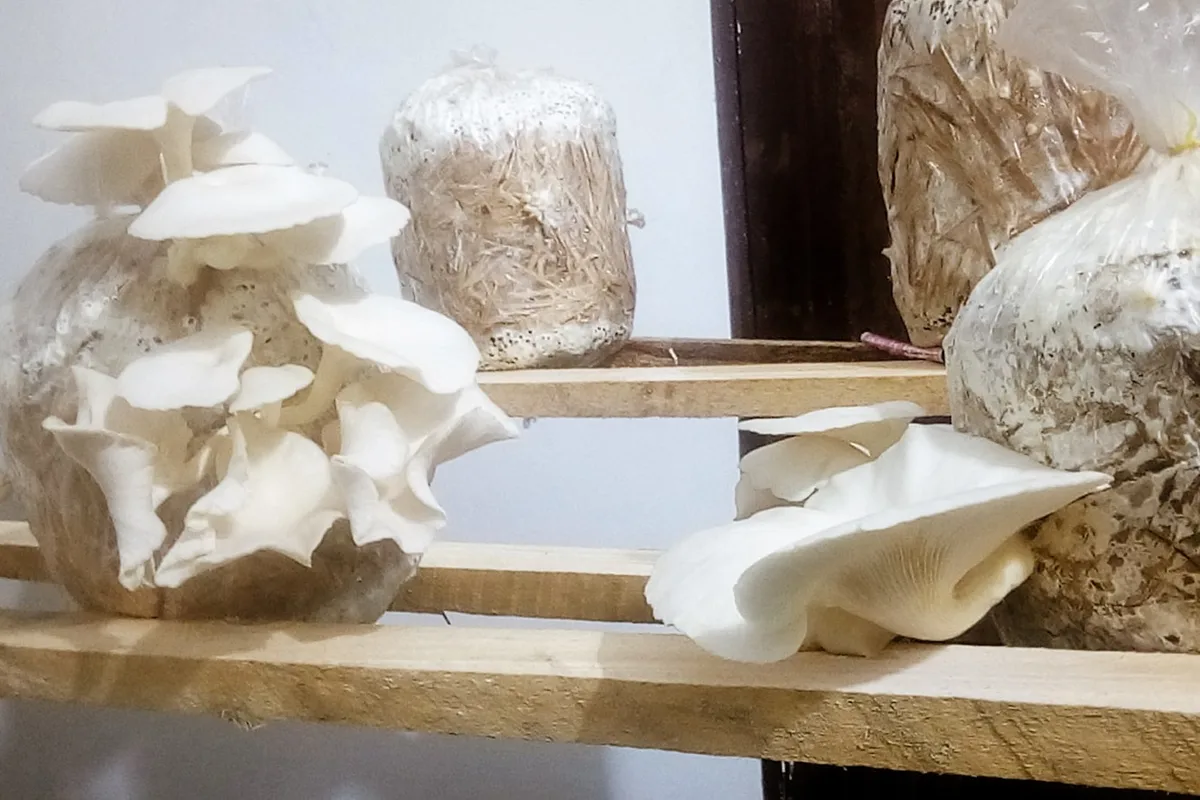
Picture a coffee roaster who can tell you exactly how many bags they sold last week but couldn't tell you their gross margin if you held a gun to their head. They'd be out of business in a year, right? Yet a typical small mushroom farm can describe its last harvest down to the strain and the smell of the room without ever once dividing fresh-fruit pounds by dry-substrate pounds. That ratio has a name. It's called biological efficiency — BE for short — and it is the single most important number on a small mushroom farm.
This post is for the grower who has a few cycles under their belt, is starting to think about whether the math actually works at scale, and wants the percentage to stop feeling like jargon and start feeling like a steering wheel.
What BE actually measures (and what it doesn't)
Biological efficiency is the ratio of fresh mushroom yield to the dry weight of the substrate that produced it, expressed as a percentage. The formula is exactly as boring as it sounds:
BE = (fresh harvest weight ÷ dry substrate weight) × 100
A 5-pound dry block that yields 5 pounds of fresh mushrooms across all of its flushes has a BE of 100%. Get 7.5 pounds of fresh fruit off that same 5-pound dry block and you've hit 150% BE — which sounds impossible until you remember that mushrooms are 90% water and the formula is comparing dry input to wet output. The percentage isn't a thermodynamic conversion rate, it's an industry shorthand.
Here's what BE doesn't measure, and where new growers get tripped up:
- It's not profit. A 150% BE oyster crop sold at wholesale at $5 per pound and a 65% BE lion's mane crop sold at retail at $18 per pound can net the same amount per block. BE tells you about yield, not revenue.
- It's not the wet-substrate ratio. Some growers compute "BE" from the hydrated block weight, which is wrong and will make your numbers look catastrophically worse than they are. Always divide by the dry weight you mixed in before water.
- It's not a single flush. BE is computed across the entire fruiting lifetime of the block — flush 1, flush 2, flush 3, and the dribs-and-drabs of flush 4. We'll come back to this distinction in a few sections, because it matters more than almost any other operational decision.
What BE does tell you, beautifully, is whether a given crop punched above or below its weight class. And that's the whole game.
Why BE is the mushroom farmer's gross margin
Every business has one number that everyone in the industry uses to compare operations. Coffee roasters track yield loss percentage. Bakers track flour-to-finished-product ratio. Brewers track extract efficiency. Mushroom growers track BE.
The reason BE is so powerful is that it normalizes across the two variables that otherwise make mushroom yields impossible to compare:
- Block size. A 4-pound yield from a 5-pound dry block (80% BE) is a strong crop. A 4-pound yield from a 10-pound dry block (40% BE) is a failure. Same raw pounds, very different stories.
- Substrate type. A king oyster crop on supplemented hardwood and a wine cap crop on outdoor wood chips operate on totally different yield curves. Stating "I got 6 pounds per block" tells you nothing useful; stating "I got 120% BE on master's mix" tells another grower exactly where you're sitting on the curve.
Once you start thinking in BE, every operational decision starts having a measurable consequence. Tweak your hydration? You'll see it. Switch from generic sawdust to soy-hull-supplemented? You'll see it. Move from a 65°F fruiting room to a 70°F one? You'll see it. The percentage moves, the dollar amount moves, and you start steering instead of guessing.
The six species, the six BE neighborhoods
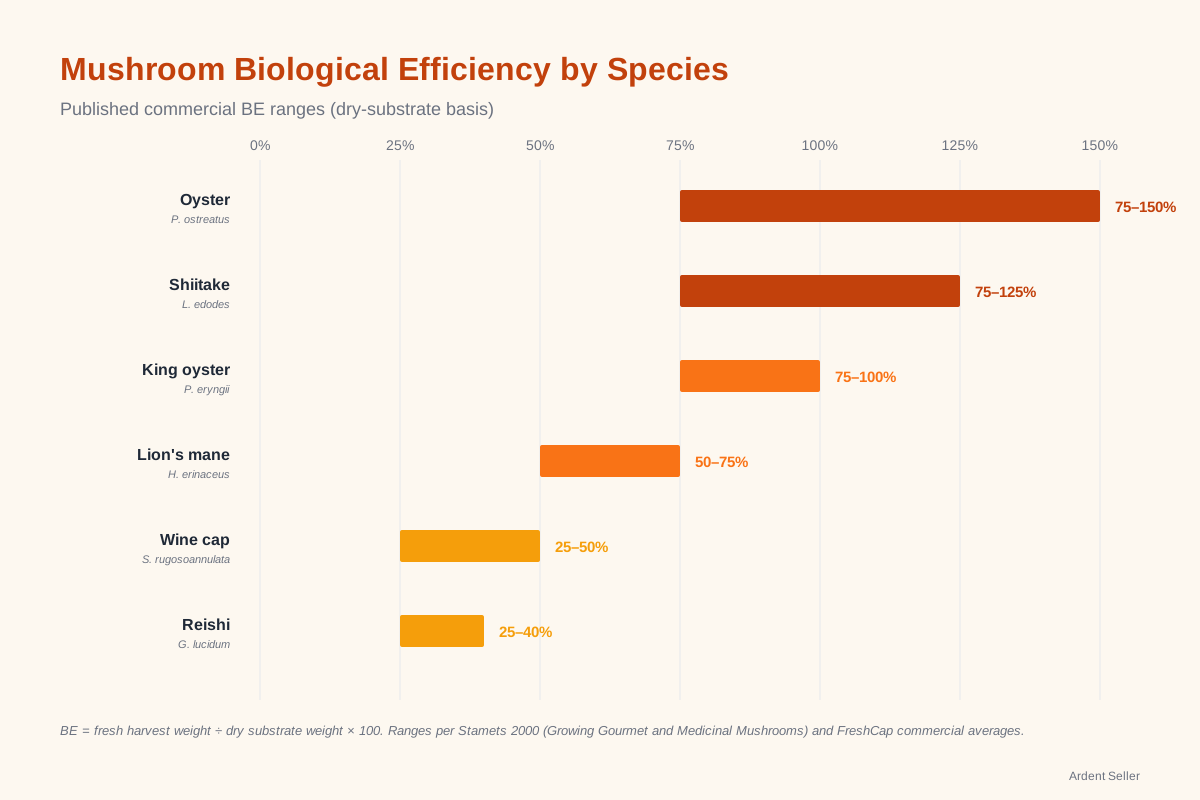
Different species live in different BE neighborhoods, and confusing them is one of the most common mistakes new growers make. Here's where each one tends to land on dry-substrate basis, based on widely-cited commercial averages and the ranges Paul Stamets published in Growing Gourmet and Medicinal Mushrooms (opens in new tab) (Ten Speed Press, 2000):
| Species | Typical BE range | Common substrates | Cycle length |
|---|---|---|---|
| Oyster (Pleurotus ostreatus) | 75–150% | Master's mix, pasteurized straw, CVG | 4–6 weeks |
| Shiitake (Lentinula edodes) | 75–125% | Supplemented hardwood sawdust | 8–12 weeks |
| King oyster (Pleurotus eryngii) | 75–100% | Master's mix, supplemented hardwood | 6–8 weeks |
| Lion's mane (Hericium erinaceus) | 50–75% | Master's mix, supplemented hardwood | 6–8 weeks |
| Wine cap (Stropharia rugosoannulata) | 25–50% | Outdoor wood chips, straw | 12+ weeks |
| Reishi (Ganoderma lucidum) | 25–40% | Supplemented hardwood sawdust | 10–14 weeks |
A few things jump off the page here. Oyster mushrooms are the workhorse of small mushroom farming for a reason — they top the BE chart, they fruit fast, and the substrate (CVG and master's mix in particular) is cheap to assemble. Lion's mane and wine cap, beautiful and high-value as they are, simply produce less fresh fruit per pound of dry input. That's not a defect; it's biology. The trick is to price each species against its yield neighborhood, not against oyster.
The other thing that jumps off the page is the range. A "75–150%" range for oyster is enormous — the high end of the range produces twice the fresh fruit per block as the low end. That spread is where the operational levers live.
Sam's lion's mane problem
Imagine a composite small grower — call them Sam — running a one-person mushroom farm out of a converted shipping container behind their house. Sam runs three crops a month: oyster on master's mix (because it pays the rent), shiitake on supplemented hardwood (because the chef accounts love them), and lion's mane on master's mix (because the retail markup is gorgeous and the customers keep coming back).
For their first six months, Sam tracked everything in two columns of a spreadsheet: date and total fresh pounds harvested. Crops were "good" or "bad" by gut feel. Some weeks felt great. Some weeks felt like the container was haunted.
Then Sam started weighing dry substrate before mixing in water, and they did the BE math for the first time. Here's what came out the other side of a quarter's worth of data:
- Oyster on master's mix: 95% BE average. Right in the middle of the published range. Healthy.
- Shiitake on supplemented hardwood: 88% BE average. A touch under the midpoint, but solidly in the published range.
- Lion's mane on master's mix: 52% BE average. Just barely above the low end of the published range, and miles below where lion's mane should be running on a quality master's mix.
Sam had been quietly assuming the lion's mane crop was their best — the per-pound price is higher, the customers love it, the boutique grocery account had become a weekly fixture. The dollars were coming in. But on a per-block basis, the lion's mane crop was producing barely half the fresh fruit it should have been. They were leaving money on the floor of the shipping container, one flush at a time.
This is the moment BE earns its keep. Without the percentage, Sam would have kept happily producing lion's mane at 52% BE forever. With the percentage, they had a number to chase.
Lever 1: The substrate formula
The first place to look when your BE is below the published range for your species is the substrate. Not because substrate is the most common culprit (it isn't — hydration usually is), but because substrate is the variable that growers most often assume is correct without verifying.
Master's mix — 50/50 supplemented hardwood sawdust and soy hulls — is the workhorse formula for high-BE crops on indoor blocks. It works because soy hulls are nitrogen-dense, hardwood sawdust holds water and provides structure, and the combination is easy to pasteurize or sterilize. Sam was using master's mix. So far so good.
But "master's mix" isn't a single recipe. The supplier matters. The soy hull source matters. The freshness of the sawdust matters. Sam pulled their substrate invoices and discovered the soy hulls had been coming from a feed-grade supplier for the past four months — older stock, higher moisture content variance, possibly partially rancid. Switching to a fresher mushroom-cultivation-grade supplier added $0.18 per pound to the substrate cost but bumped the lion's mane BE from 52% to 61% on the very next cycle.
That's not a huge jump. But it's a real one, it's directly attributable to a single change, and it's the kind of move that compounds over a year.
Here are the substrate questions worth asking when your BE is sagging:
- Is the formula nitrogen-balanced for the species? Lion's mane prefers slightly less supplementation than oyster — too much nitrogen and you get contamination instead of yield.
- Is the sawdust species-appropriate? Hardwood (oak, beech, maple) for shiitake and lion's mane; softwoods are mostly a no-go.
- Is the supplier fresh? Old soy hulls, oxidized bran, or moldy sawdust will quietly destroy your numbers.
- Are you actually weighing dry, or weighing hydrated? Experienced growers get this wrong all the time. Mark a tare. Use a digital scale. Be honest with yourself.
Lever 2: Hydration and the moisture content trap
If substrate is the variable most-often assumed correct, hydration is the variable most-often measured incorrectly. Most cultivation references put master's mix and supplemented hardwood at 65% moisture content for the final hydrated block. The squeeze test — grab a fistful of hydrated substrate, squeeze hard, and you should get a few drops of water but not a steady stream — is the field-grade way to check. The lab-grade way is to weigh a sample, dry it, and back-calculate.
Sam had been doing the squeeze test by feel for two years. After looking at the BE numbers, they pulled out the kitchen scale and dried a 50-gram hydrated sample of master's mix in the oven on low until it stopped losing weight. The dry weight came out to 13.5 grams, which means their actual moisture content was 73% — way over the 65% target. The blocks were waterlogged.
Hydration above target does two things to BE, neither of them good:
- It dilutes the nutrient density per volume. The mycelium is colonizing a wetter, less-concentrated food source.
- It encourages contamination. Standing water in the pores invites bacterial and competing-fungal growth.
Dropping hydration to a real 65% (verified by oven-drying, not just squeezing) added another 8 percentage points to Sam's lion's mane BE. They were now at 69% — squarely in the middle of the published range.
Lever 3: The fruiting environment
Substrate and hydration are inputs. The fruiting environment is the conditions under which those inputs actually produce mushrooms, and it's where the published BE ranges most often go to die in home grow rooms.
The four fruiting variables that matter, in roughly the order they affect BE:
- Humidity. Lion's mane wants 85–95% RH during pinning and 80–90% during fruiting. A single 80°F summer day with a humidifier that ran out of water can stunt an entire flush.
- Fresh air exchange (FAE). Carbon dioxide is the silent BE killer. Lion's mane is especially sensitive — high CO₂ produces the "antler" malformations that look striking but weigh almost nothing.
- Light. All commercial mushroom species need some light to fruit properly. Total darkness is fine for incubation; it kills your yield during fruiting.
- Temperature. Each species has a sweet spot. Lion's mane fruits best at 65–70°F. Cold rooms slow things down; hot rooms encourage contamination.
Sam's container had a humidifier on a timer and a small inline fan for FAE, both of which had been running on the same settings for two years. The container's actual conditions had drifted as the seasons changed — winter air is drier, summer air is more humid, and a static humidifier setting can't keep up with either. Sam added a cheap digital hygrometer/thermometer with min/max memory and started writing the readings on the clipboard next to the door every morning. Within three cycles, they had identified a pattern: humidity was dropping into the 60s overnight when the heater kicked on. A second humidifier and a continuous-run setting brought RH back into range and added another 6 percentage points of BE.
Sam's lion's mane crop now ran at 75% BE — the top of the published range, double where they'd started.
Worked example: what 23 percentage points of BE actually pays out
Numbers in isolation are abstract. Let's translate Sam's lion's mane improvement into dollars.
Sam runs 40 lion's mane blocks per cycle, each with 5 pounds of dry substrate. They sell wholesale at $12 per pound and retail (farmers market and direct-to-restaurant) at $18 per pound, with a roughly 50/50 split.
Before (52% BE):
- Yield per block: 5 lb × 0.52 = 2.60 lb fresh
- Yield per cycle: 40 × 2.60 = 104 lb fresh
- Revenue per cycle at blended $15/lb: 104 × $15 = $1,560
After (75% BE):
- Yield per block: 5 lb × 0.75 = 3.75 lb fresh
- Yield per cycle: 40 × 3.75 = 150 lb fresh
- Revenue per cycle at blended $15/lb: 150 × $15 = $2,250
Same labor, same room, same equipment, same substrate cost. The BE improvement put $690 per cycle of additional revenue into the farm. At three lion's mane cycles per month, that's roughly $2,070 per month or $24,840 per year in margin that was always there — Sam just hadn't been collecting it.
The lesson isn't "improve your BE and earn an extra $25k a year." It's "you can't improve a number you're not measuring." Sam had been three lever-tweaks away from this revenue for two years. The percentage gave them a target to chase. Hitting it was operational, not magical.
Worked example: bumping a king oyster crop from 75% to 95%
Let's do one more, because king oyster math is where new growers often find their second wind.
Imagine a grower running 60 king oyster blocks per cycle at 5 pounds of dry substrate each. Master's mix substrate at $0.85 per dry pound, plus $1.10 per block in grain spawn, plus $0.40 per block in bags and supplies, plus 8 minutes of labor per block at a fully-loaded $22 per hour, plus $0.95 per block in amortized overhead (room rent, electricity, depreciation).
Cost per block: (5 × $0.85) + $1.10 + $0.40 + (8/60 × $22) + $0.95 = $4.25 + $1.10 + $0.40 + $2.93 + $0.95 = $9.63 per block
Cost per cycle: 60 × $9.63 = $577.80
At wholesale $10 per pound (king oyster is a wholesale-leaning species — restaurants love it):
At 75% BE (low end of king oyster range):
- Yield: 60 blocks × 5 lb × 0.75 = 225 lb
- Revenue: 225 × $10 = $2,250
- Gross profit: $2,250 − $577.80 = $1,672.20 per cycle
At 95% BE (top of king oyster range):
- Yield: 60 blocks × 5 lb × 0.95 = 285 lb
- Revenue: 285 × $10 = $2,850
- Gross profit: $2,850 − $577.80 = $2,272.20 per cycle
The 20-percentage-point BE improvement adds $600 per cycle of gross profit — and the cost side didn't move at all. Every dollar of that $600 falls straight to gross margin.
This is the structural reason BE matters so much on small mushroom farms: costs are almost entirely fixed per block (substrate, spawn, bags, labor, overhead), but revenue scales linearly with yield. Move BE, move the bottom line, full stop.
The flush distribution nobody tells you about
One thing newer growers often discover the hard way is that yield is not evenly distributed across flushes. The widely-cited commercial average — which the Mushroom Substrate & BE Calculator on this site uses for its yield estimates — is roughly:
- Flush 1: ~45% of the block's total yield
- Flush 2: ~28%
- Flush 3: ~17%
- Flush 4: ~10%
That distribution is a commercial average compiled by industry references like FreshCap (opens in new tab) and aligned with the ranges in Stamets 2000. It varies by species, strain, and growroom conditions, but the shape — front-loaded with a long tail — is consistent.
Why this matters: a lot of small growers compost their blocks after flush 2 because "the harvest is getting smaller." If you stop after flush 2 you're capturing 73% of the block's lifetime BE and walking away from the remaining 27%. On Sam's 40-block lion's mane cycle at 75% BE, that's about 40 lbs × 0.27 = 40 pounds of fresh fruit per cycle left on the shelf — call it $600 per cycle of revenue at blended pricing.
The third and fourth flushes are smaller, yes. They also require almost no incremental labor and zero additional substrate. The marginal economics of running blocks all the way out are spectacular. If you've been pulling blocks early, the easiest BE-equivalent gain on your farm is probably hiding behind your composter.
How to actually measure your own BE
Enough talking about BE in the abstract. Here's the operational recipe for measuring yours, on the next crop you mix up:
- Weigh dry substrate per block before mixing in water. Use a digital scale. Mark the dry weight on a sticker or in your production log — not in your head.
- Tag the cohort. Give the batch a name or a number. Date it. Note the species, strain, and substrate formula.
- Weigh every flush. Every harvest from every block in the cohort, fresh weight, no exceptions. If you compost a flush because it contaminated, weigh the fresh portion before tossing the rest.
- Wait until the cohort is fully spent. Don't compute BE early. The third and fourth flushes meaningfully change the number.
- Sum the fresh harvest, divide by total dry substrate, multiply by 100. That's your cohort BE.
- Compare to the published range for your species. Above the midpoint? You're running a healthy crop. Below the low end? Something's off — start with hydration, then substrate, then fruiting environment.
- Run the next cohort with one variable changed. Don't change three things at once. You'll get a number, but it won't tell you what worked.
The single biggest barrier to measuring BE isn't math, it's discipline. Every harvest gets weighed. Every block gets tagged. Every number gets logged in the same place you'll find it in three months. That's it.
The Ardent Seller production-run feature is designed exactly for this — log a block as a production run, record the dry substrate weight as input, record each per-flush harvest as output, and the system computes your actual BE per crop automatically. Anomalies (a low-BE cohort from contaminated grain spawn, say) surface in the per-crop report before they cost you a month of cycles. The production-run with input/output tracking section on the features page has the details, but the short version is: instead of two columns in a spreadsheet, you get a real per-crop P&L that knows what BE you ran at and what it paid out.
What "good" BE looks like, once you've been measuring for a while
After a few cycles of disciplined measurement, you'll start to notice patterns specific to your room, your supplier, and your hands. Here's what experienced growers tend to converge on as personal targets, by species:
- Oyster, small commercial: 100% BE is healthy, 125% is excellent, 150% is "you should be teaching."
- Shiitake on supplemented hardwood: 90% BE is healthy, 110% is excellent.
- King oyster: 85% BE is healthy, 95%+ is excellent.
- Lion's mane: 65% BE is healthy, 75%+ is excellent.
- Wine cap (outdoor): 40% BE is healthy for outdoor wood-chip beds.
- Reishi: 30% BE is healthy; reishi cycles are long, so the per-cycle BE matters less than per-month productivity.
These targets are personal. The point isn't to hit a number on a chart; it's to know what your operation does on a typical cycle, and to notice the moment it drifts.
The percentage is your steering wheel. Use it.
Related reading
- Recipe Costing 101 — The foundational five-bucket cost framework for any production-based business; lays out the substrate / spawn / packaging / labor / overhead stack that the per-block math above plugs into.
- Batch Tracking for Food Sellers — How to set up lot codes and cohort tracking, which is exactly the discipline you need to compute BE per cohort across multiple crops.
- Seed-to-Sale: Small Farm Crop Costs and Profit per Bed — Adjacent crop-level economics for small farms thinking about which crops to expand and which to retire — the BE-equivalent for outdoor growers.
Free resources
A few free downloads from the Ardent Workshop library that pair well with this post:
- Mushroom Substrate & Biological Efficiency Calculator — The interactive companion to this post. Pick a species, substrate, and block size; the tool estimates yield from published BE ranges and computes per-block cost and profit at your wholesale and retail prices.
- Recipe Scaling & Batch Calculator — Scale your master's mix or supplemented hardwood formulas across different block counts without re-doing the arithmetic each cycle.
- Small-Batch Production Planning Playbook — A planning template for batched production cycles — exactly the shape of work mushroom farms run on.
Whether you measure BE or not, your farm has one. Measuring it just means you get to choose what it is.
This article is provided for educational purposes only and does not constitute financial, business, or food-safety advice. BE ranges cited are commercial averages from published sources (Stamets 2000; FreshCap and similar industry references) and real yields vary substantially by strain, hydration, sterility, fruiting environment, and operator experience. Mushroom cultivation also intersects with food-safety and labeling requirements that vary by jurisdiction; consult your state agriculture or health department before selling cultivated mushrooms.