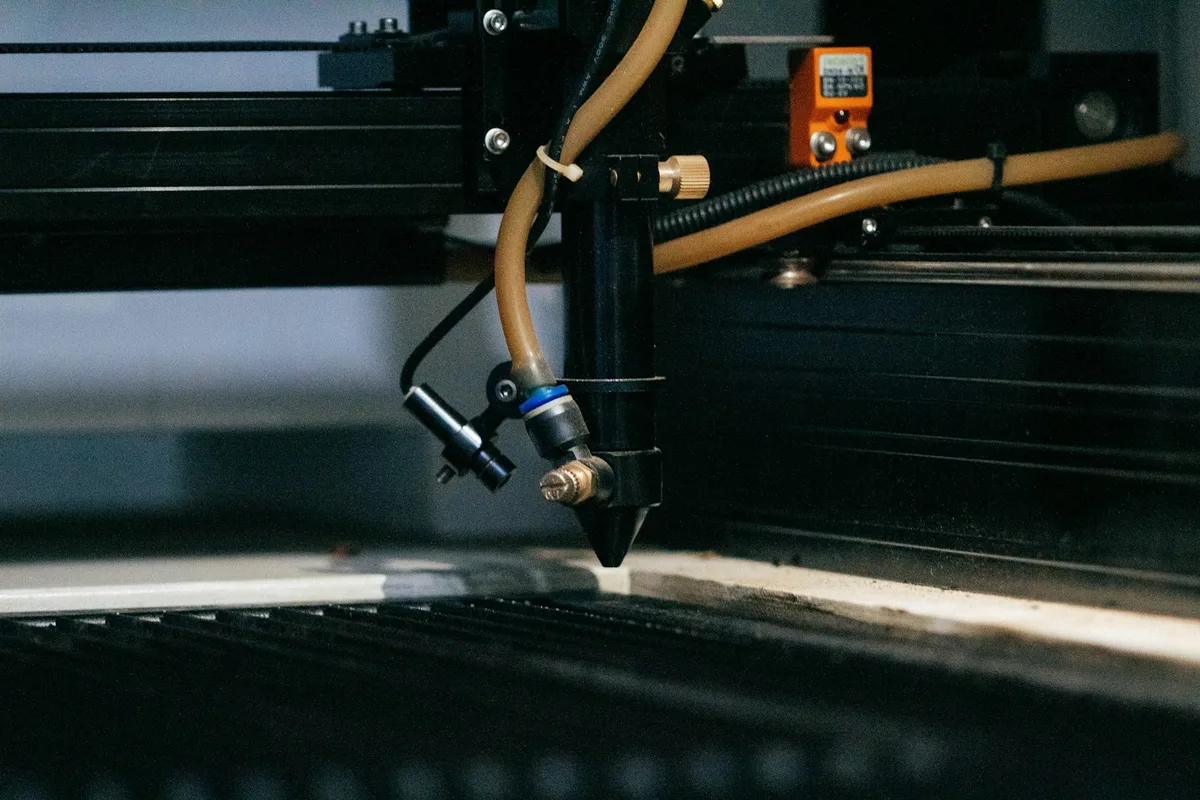
The workshop smells faintly of charred MDF and yesterday's coffee. A CO2 laser is in its eighth minute on a 12-by-8-inch walnut blank, the head tracking the bottom curve of a custom address sign. A fume extractor hums under the bench. On a magnetic strip above the machine, a half-burned reject from a misaligned file leans against an unused 3-inch hole saw. Nobody is looking at the laser; the laser is fine. The phone is in the other room because the Etsy app has been pinging every fifteen minutes since a TikTok mentioned address signs, and the price on the listing is $42.
The quote that generated that $42 was written six months ago, in a hurry, on the back of a vendor envelope. The math behind it was: walnut blank $8, "machine costs nothing because I already own it," half an hour of "my time" at $25, round up to make it look intentional. The maker who wrote it down has now sold 340 of these signs.
What tends to happen with that kind of math is not a sudden disaster. It is a slow one. The laser tube wears down at roughly its rated 8,000 hours of life and needs replacing for somewhere between $400 and $900. The fume extractor's HEPA filter loads up and stops pulling air at the rate the room needs. A heat-stressed lens fogs and is swapped out at $35. The desktop CNC across the bench has consumed its third $12 collet because of an out-of-spec bit chatter that nobody felt at the time. None of these costs were in the original quote. The $42 price is still on the listing.
This post is for the maker running a Glowforge, an xTool, a Shapeoko, an X-Carve, or any of the desktop laser-and-CNC class machines on personalized goods between $15 and $80. The job costing logic for that class of work is different from a fab shop's — fab shops quote $1,000+ jobs and amortize machine time across long bookings. The desktop class quotes $42 signs and amortizes machine time across thousands of small jobs, most of which were never properly costed. The math is simpler. The math is also more punishing if you skip layers.
What follows is a walkthrough of the six cost layers a defensible per-part quote needs, and then an annotated teardown of one real-looking job sheet. The numbers throughout are rounded toward typical figures for the desktop class; substitute your own where they differ, which they will.
The layer most quotes silently skip
The structure of a complete per-part cost looks like this:
- Material — the blank, the substrate, the rod stock.
- Machine-hour cost — depreciation plus electricity, computed by the hour and charged by the minute.
- Labor — hands-on minutes only, separated into setup, run, and post-processing.
- Design amortization — the one-time art or CAD investment, spread across the number of pieces it will sell.
- Consumables and post-processing materials — masking tape, finishing oil, sandpaper, dust collection bags, lens cleaner.
- Packaging, shipping, and platform fees — what the marketplace and the carrier take before the rest reaches the bank.
Of these six, the one that most desktop quotes leave out is layer two. The reasoning is intuitive: "I already paid for the machine, so every hour it runs is free." The accounting is not. A $6,000 machine with a five-year useful life is consuming roughly $1,200 of its purchase price per year whether it runs ten hours a week or forty. The only thing the runtime decides is whether that $1,200 gets spread across two hundred jobs or two thousand. Charging zero per machine-hour amounts to deciding the machine was a gift, which it was not.
The pattern that appears in the work of makers who have been at it for three or four years is that they did the layer-one math from day one, the layer-three math by month six, and the layer-two and layer-four math after a piece of equipment failed unexpectedly and the replacement cost landed against zero accumulated reserve. The point of doing all six layers up front is to put each of them in the price so the replacement fund builds itself.
Layer 1: Material
Material is the easiest layer because it is the most visible. The walnut blank cost what the invoice said. The acrylic sheet cost what the supplier billed, divided by however many parts come out of the sheet. The brass rod cost what the order line said, divided by the number of cuts.
The complication, when there is one, is yield. A 12-by-24-inch sheet of 1/8-inch baltic birch plywood costs roughly $9. If the nested cut layout fits eight ornament pieces per sheet, the per-piece material is $1.13. If the nesting was lazy and only fits six, it is $1.50. Over a thousand-piece run, that gap is $370. The yield from a sheet is part of the material cost; the cost is not the sheet price, it is the sheet price divided by parts-per-sheet at the layout you actually used.
What tends to happen with material costing is that the maker enters the receipt total into a spreadsheet, divides by the eyeballed parts-per-sheet, and moves on. This is fine for a starting estimate. It becomes wrong over time because supplier prices drift, and a sheet that was $9 in 2024 is now $11, and the quote that was based on $1.13 per ornament is now based on $1.38. If the listing price has not moved in eighteen months, the margin has compressed by about three percentage points just from material drift.
The discipline that addresses this is unglamorous: re-cost the bill of materials at least once a quarter, and any time a supplier sends a price change notice. Most makers do not. The ones who do tend to know what their margin actually is.
Layer 2: Machine-hour cost
Machine-hour cost is the layer that separates a hobby quote from a sustainable one. The math has two parts: depreciation per hour, and electricity per hour.
Depreciation per hour is the machine's capital cost divided by the total hours of use expected over its useful life. A Glowforge Pro purchased today is roughly $6,000 all-in once the air filter, vent fittings, and pass-through-slot wider stock have been added. A desktop diode laser like an xTool S1 is in the $2,000–$2,800 range. A Shapeoko 5 Pro or a Carbide 3D Nomad lives between $2,500 and $4,500 depending on size. A professional CO2 cutter (a Boss Laser, a Thunder Nova, an OMTech mid-tier) crosses $5,000 and runs to $12,000.
Useful life for the desktop class is typically estimated at five years for tax purposes (the IRS MACRS 5-year class for manufacturing equipment), though many machines outlast that with maintenance. For costing purposes, five years is a defensible floor.
The question that decides depreciation-per-hour is not what the machine costs. It is how many hours per year you actually run it. A Glowforge that runs ten hours a week — a fair estimate for a part-time Etsy seller — accumulates 520 hours per year, or 2,600 hours over five years. A $6,000 machine divided by 2,600 hours is $2.31 per machine-hour, or $0.039 per minute.
The same machine, run forty hours a week as a full-time business, accumulates 10,400 hours over five years. Per-hour depreciation drops to $0.58. The same machine. Same purchase price. Different cost per job. This is why the formula matters more than the number — the cost per hour is not a property of the machine, it is a property of how hard you run it. The calculator linked at the end of this post solves for the per-hour figure from the inputs you actually have.
Electricity per hour is the smaller of the two components but does not vanish. A Glowforge Pro draws about 0.8 kilowatt-hours during a continuous cutting hour. The national average US residential electricity rate is roughly $0.16 per kWh per the EIA's monthly electricity data (opens in new tab), with significant state-by-state variance — California and Hawaii crowd $0.30+, while the Southeast and Pacific Northwest sit near $0.11. A desktop diode laser draws closer to 0.2 kWh; a small CNC router draws 0.4 to 0.6 kWh during cuts and roughly zero between them.
For the Glowforge at the national average, electricity adds about $0.13 per machine-hour, or about a penny per typical eight-minute job. This is small but not zero. Over a year of 520 hours, it is $67 — the price of a lens or a small consumables order.
Combined, the ten-hour-a-week Glowforge runs at roughly $2.44 per machine-hour, or $0.041 per minute. A fourteen-minute job carries $0.57 of machine cost. Held against a $42 listing, that is 1.4% of the price — which sounds negligible until you notice that the listing also pays a 6.5% Etsy transaction fee, a roughly 3% payment processing fee, and may or may not be paying into Offsite Ads at 12–15% on the orders it produces. The percentages do not look small once you stack them.
Layer 3: Labor (and which minutes count)
Labor is the layer most makers underprice the most, and the underpricing is structural rather than emotional. The structural problem is that there is no consensus among small makers about which minutes count as labor. The defensible answer is: hands-on minutes only.
A laser job has three distinct labor windows:
- Setup minutes — opening the file, adjusting the artwork to the blank dimensions, taping the blank, jigging it on the bed, focusing, running the trace.
- Run minutes — the time the machine is cutting or engraving while the operator is in the room but not actively touching the work.
- Post-processing minutes — peeling masking tape, sanding char, applying finish, photographing for the listing, packaging.
Of these three, the one that is almost always charged at zero is run minutes. The maker is standing nearby with a fire extinguisher within reach (which is the correct safety posture), but the hands are not on the work. Charging full labor for those minutes overprices the job; charging zero for those minutes is correct.
Setup and post-processing should be charged at the maker's target hourly rate. The defensible floor for a skilled craft operator is the BLS Occupational Employment Statistics (opens in new tab) median for "Cutting, Punching, and Press Machine Setters, Operators, and Tenders, Metal and Plastic" (occupation code 51-4031), which sat near $21/hour as of the May 2024 release. For a sole proprietor running a personalized-goods business, the appropriate floor is higher, because the rate has to cover both the labor and the self-employment tax (an additional 15.3% on net earnings up to the Social Security wage base (which the SSA adjusts annually — see the IRS Self-Employment Tax page (opens in new tab) for the current year)), plus benefits, plus a reserve for sick time, plus the unpaid administrative work that surrounds every billable hour.
A common floor for solo desktop-machine operators on personalized goods is $30 per hand-on hour. That is $0.50 per minute. Five setup minutes plus four post-processing minutes is nine hands-on minutes, or $4.50 in labor on a fourteen-minute job. The fourteen run-minutes contribute zero to labor and $0.57 to machine cost.
The pattern that appears in maker pricing audits is the inverse of what you might expect: makers who charge nothing for run minutes are usually more profitable than makers who charge full labor for them, because the makers in the second group are also typically the ones charging zero for setup and post-processing. The categorization matters more than the volume.
Layer 4: Design amortization
Design amortization is the layer that distinguishes one-of-a-kind custom work from catalog work, and it is the one most likely to be left out entirely.
If a custom address sign was designed for one customer and will never be sold again, the entire design time goes into that single job. Three hours of CAD or file prep at $30/hour is $90 of design cost on one piece. The $42 listing price does not begin to cover it; a custom-design quote should have started at $150 or higher to absorb it.
If the same three hours of design produced a file that will sell as a catalog item — say, "Welcome to the [Family Name]" signs, with the family name as a customizable field — the $90 is amortized across however many sales are realistic. The calculator linked below asks for an expected re-sells number. A modest catalog item priced at $42 might realistically sell 50 copies before it is rotated out. $90 divided by 50 is $1.80 per piece of design amortization. That is a defensible number. $90 divided by 1 is not, unless the listing price is set accordingly.
This is the layer that, more than any other, determines whether a maker's hour of design work was a one-time gift to one customer or a slow-burning asset that pays back across a year of catalog sales. Many makers treat all design hours as if they were a one-time gift, then wonder why catalog sales never feel as profitable as they should.
The discipline is to ask, before starting any design work, whether the file will be a one-off (price the design into a single-job quote) or a catalog asset (spread the design hours across a realistic re-sell count). Both are valid; conflating them is not.
Layer 5: Consumables and post-processing materials
Consumables are the layer that most spreadsheets do not have a row for. They include:
- Masking tape — used on most laser engraving jobs to prevent char on the unburned surface. A roll of paper transfer tape covers maybe 40–60 jobs at a few cents per linear foot used.
- Finishing oil, wax, or sealant — a $18 bottle of cutting-board oil treats roughly 30–50 small signs; figure $0.50 per piece.
- Sandpaper or scotch pads — pennies per piece on average, but they add up.
- Lens cleaner and cotton swabs — small per-use, but a lens that does not get cleaned weekly fogs and degrades cut quality, leading to scrap.
- Replacement laser tubes (for CO2 machines) — typical rated life is 8,000 to 10,000 hours; replacement runs $400 to $900 depending on power class. On a 2,600-hour, five-year accumulation, this works out to about $0.15 per machine-hour as a consumables reserve.
- CNC bits, collets, and dust collection bags — bits dull and break; a typical 1/8-inch endmill runs $12–$30 and may last 8–20 hours of cutting depending on material.
The total contribution of all consumables to a typical $42 sign is in the $1.00 to $2.00 range. It is not large per job. It is real per year, and the reserve has to come from somewhere. Charging $1.50 of consumables into every job and setting that money aside is how the next bottle of finishing oil and the next replacement lens get paid for without disturbing the operating account.
Layer 6: Packaging, shipping, and platform fees
The last layer is the one that is most often known but worst situated. Most makers know what shipping costs them; many know what Etsy fees come out per sale. Where the math goes wrong is in the order of subtraction. The price the customer sees is gross. The price the maker keeps is net of everything in this layer.
For a $42 Etsy sale of a personalized item, the math looks roughly like:
- Transaction fee — 6.5% of (item + shipping + personalization fee). On a $42 item with $8 shipping, that is $3.25.
- Payment processing — varies by country. In the US it is roughly 3% + $0.25 per order. On the same $50 gross, that is $1.75.
- Listing fee — $0.20 per listing, amortized across the listing's renewal period and sales count. For a moderately active listing this typically rounds to $0.04–$0.10 per sale.
- Offsite Ads — opt-in or mandatory depending on shop revenue. If subject to mandatory participation, fee is 12% for shops above the revenue threshold and 15% below it, charged only on orders attributed to the program. Treat as 0%–15% with the realistic average closer to 1%–3% across all orders.
- Regulatory operating fee — varies by jurisdiction; the US current rate is roughly 0.25% of (item + shipping).
- Shipping — the box, the void fill, the label. A $8 charged shipping line on a USPS Ground Advantage label might actually cost $7.20 in postage and $0.90 in packaging, netting $0.10 negative if the listing was set to charge below cost.
- Packaging materials — the box itself, tissue, sticker, thank-you card. Even minimal packaging for a personalized sign tends to run $0.80 to $1.50.
All in, on a $42 listing with $8 shipping and average Offsite Ads exposure, the platform-and-fulfillment slice tends to land near $6.50 to $8.50.
The annotated quote
Here is one job sheet, line by line, with numbered callouts. The job is a single 12-by-8-inch walnut address sign, engraved and edge-cut, with a $42 Etsy listing price and $8 charged shipping.
Job: Custom address sign · walnut · 12x8
Machine: CO2 desktop laser (Glowforge Pro class)
Run: 14 min · Setup: 5 min · Post-processing: 4 min
Channel: Etsy · listing $42 · shipping $8
─────────────────────────────────────────────
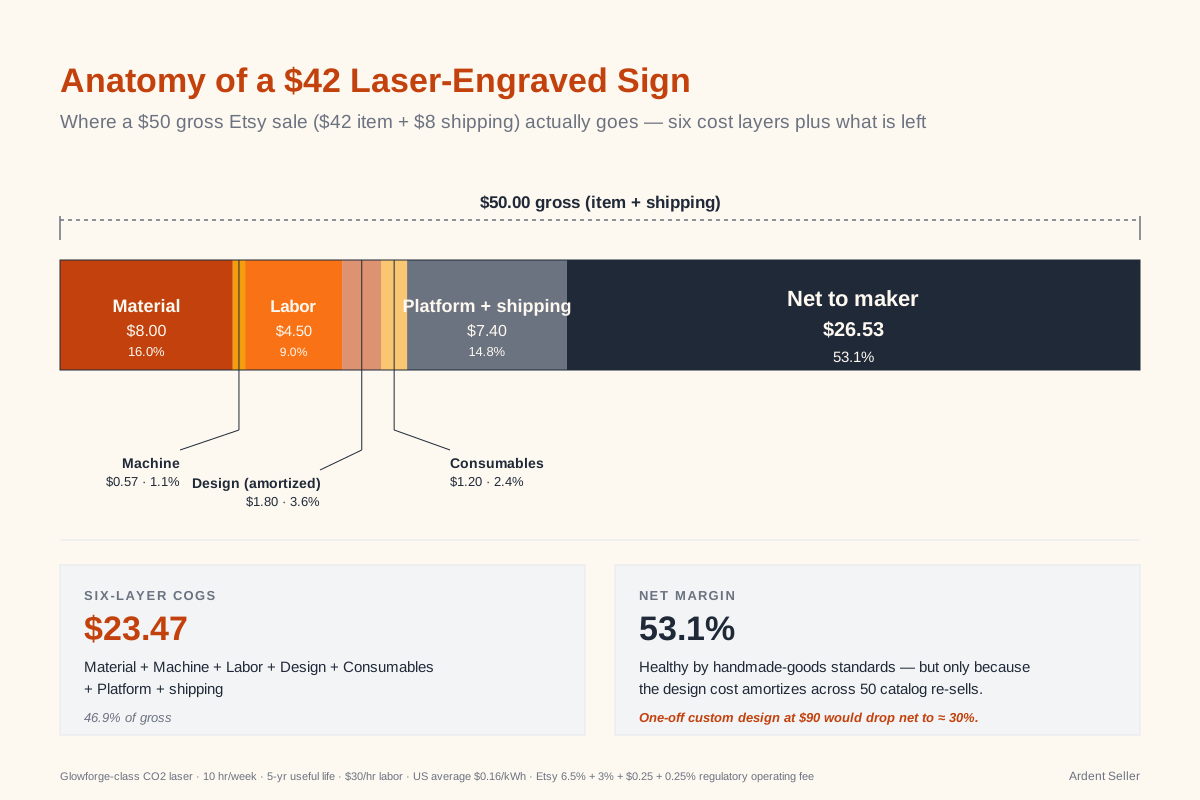
LAYER 1 · MATERIAL                       $8.00   (1)
LAYER 2 · MACHINE                        $0.57   (2)
LAYER 3 · LABOR (9 hands-on min)         $4.50   (3)
LAYER 4 · DESIGN AMORTIZATION            $1.80   (4)
LAYER 5 · CONSUMABLES                    $1.20   (5)
LAYER 6 · PLATFORM + SHIPPING            $7.40   (6)
─────────────────────────────────────────────
COGS                                     $23.47
LISTING REVENUE (item + shipping)        $50.00
NET                                      $26.53
NET MARGIN                                  53%        (7)
(1) Material — $8.00. A 12x8 walnut blank from a wholesale plywood and hardwood supplier, before yield. If multiple pieces were cut from a larger blank, this number drops; if the cut produced an unusable offcut, it does not. The figure here assumes one piece per blank.
(2) Machine — $0.57. Fourteen run-minutes at $0.041 per minute, which is $2.44 per machine-hour at a 2,600-hour, five-year accumulation on a $6,000 machine plus 0.8 kWh/hour at $0.16/kWh. A maker running 40 hours a week would see this drop to under $0.15. A maker on a $2,500 diode laser would see roughly $0.21. The number is not a constant; it follows from the machine and the runtime.
(3) Labor — $4.50. Five setup minutes plus four post-processing minutes is nine hands-on minutes at $30/hour, which is $0.50/minute. The fourteen run-minutes contribute zero to labor because the hands are not on the work. If the maker chose to charge a partial "supervised run" rate of, say, $5/hour for tube-life-watching presence, that would add $1.17. Most desktop operators do not, and that is defensible.
(4) Design amortization — $1.80. This is a catalog item: a customizable "Welcome to the [Family Name]" sign. Three hours of original design at $30/hour is $90, amortized across an expected 50 catalog re-sells, is $1.80 per piece. For a true one-off custom design — different family asks for a completely different style — this line item would be $60–$150 instead, and the listing would need to be priced as a custom quote, not a catalog item.
(5) Consumables — $1.20. Includes a portion of the masking tape used, the finishing oil applied, sandpaper for edge cleanup, lens-cleaning supplies, and the per-hour reserve for the eventual laser tube replacement ($0.15 × 0.233 hours = $0.035, rounded into the broader consumables line). The line is small but reserves a real number to a real bucket.
(6) Platform + shipping — $7.40. Etsy transaction fee ($3.25) + payment processing ($1.75) + amortized listing fee ($0.05) + regulatory operating fee ($0.13) + packaging materials ($1.00) + USPS Ground Advantage cost on a 1-pound shipment ($7.20 against $8.00 charged shipping = net $0.80 deficit, but this becomes a negative contribution to net rather than a positive cost). The line assumes Offsite Ads contribution averaged near zero on this particular sale.
(7) Net margin 53%. This is healthy by handmade-goods standards. The 30% net margin threshold is a common rule of thumb for wholesale-ready pricing; 50%+ on a direct-to-consumer Etsy listing is room to breathe. The $42 listing price is defensible. What this teardown reveals is not "the maker is overcharging." It is the opposite: the $42 listing is profitable today because the design amortizes across 50 re-sells; the moment the catalog item is replaced with a fresh one-off design, the same $42 listing becomes unprofitable at the new design-cost layer.
What to do with the number
A defensible cost stack is not a price. It is the floor under a price. The price is set by the market — what comparable signs sell for on Etsy and Amazon Handmade, what local consignment shops will pay wholesale, what direct customers say yes to when quoted. The cost stack tells you what you keep when the market sets the price.
Three patterns appear in the pricing decisions of makers who have done this layered math:
The first is that wholesale margin floors become legible. A maker who knows a sign costs $23.47 to make stops accepting wholesale orders at $18 and starts negotiating from a floor of $35 (which leaves the wholesaler the standard keystone markup to $70 retail). The wholesale account either accepts the new floor and the relationship continues, or declines and the maker has not given away a year of unpaid work.
The second is that one-off custom work gets repriced. A custom design that was being quoted at $85 because "it feels like double the catalog price" now gets quoted at $150 because the design hours are real and need to be paid for at the maker's actual rate. Some customers walk. Some pay. The ones who pay are the relationship the business actually needs.
The third is that catalog items get pruned. A listing that sits in the bottom quartile of the shop's sales and amortizes its design across a smaller-than-expected number of pieces is, on the layered math, frequently breakeven or slightly negative. The discipline is to either rotate it out or raise its price; leaving it in the catalog at the old price is a slow leak.
Where the calculator picks up
A line-by-line walkthrough is useful for understanding the structure. It is not what most makers want to do at the bench every time a new product launches. The Laser & CNC Job Cost Calculator takes the same six layers, applies the math automatically from machine-class presets and your specific inputs, and returns a defensible quote with a margin verdict. Substitute your machine's actual capital cost and power draw, your utility rate, your real setup and run minutes, and the expected re-sells for the SKU. The output is the same teardown above, parameterized to your shop.
For makers who want the math to live continuously across the catalog rather than re-running it per quote, Ardent Seller's equipment tracking and recipe costing carries the same logic into the day-to-day operation. Each piece of equipment logs its actual runtime, depreciation accrues on the schedule you set, and the per-job machine cost flows into your product recipes alongside materials and labor. When the laser tube gets replaced and the depreciation line bumps, every recipe that uses the machine reprices on its own. The teardown stops being something you do periodically and starts being something the system does in the background.
Whichever approach fits — periodic recalculation with the calculator, continuous costing in the equipment tracking feature — the underlying discipline is the same: six layers, each priced separately, each defensible against an actual invoice or a real depreciation schedule. The $42 listing is fine. The $42 listing without the six-layer teardown behind it is a guess that has been correct so far.
Related reading
- Laser Engraving Blank Inventory Tracking — Layer one is only as accurate as your blank counts; this is how to track tumblers, boards, and acrylic sheet by size and color so the material line matches the shelf.
- Equipment Depreciation for Small Makers — The deeper version of layer two: depreciation methods, useful-life choices, tax-side mechanics, and the replacement fund that ties machine cost to pricing.
- 3D Printing: True Cost Per Part — The same six-layer thinking applied to a different machine class, useful as a sanity check for whether your laser/CNC stack feels complete.
- The True Hourly Wage of a Handmade Business — Pairs with layer three: how to back-solve the hourly rate your shop actually needs to charge to clear a target take-home after channel fees and self-employment tax.
Free resources
A few free downloads from the Ardent Workshop library that pair well with this post:
- Laser & CNC Job Cost Calculator — Run the six-layer teardown above against your own machine, utility rate, and expected re-sells; returns a defensible quote with a margin verdict.
- Product Pricing Calculator (Live) — A general-purpose pricing tool for makers who sell across multiple categories beyond laser and CNC work.
- Maker Hourly-Rate Pricing Calculator — Pairs with layer three; solves for the hourly rate you should be charging given your target take-home and channel mix.
This article is provided for educational purposes only and does not constitute financial, tax, or business advice. Machine capital costs, electricity rates, useful-life assumptions, labor rates, and platform fee structures vary by jurisdiction and change frequently; substitute your specific figures before pricing actual work. Consult a qualified accountant or small-business advisor before making financial decisions based on this content.