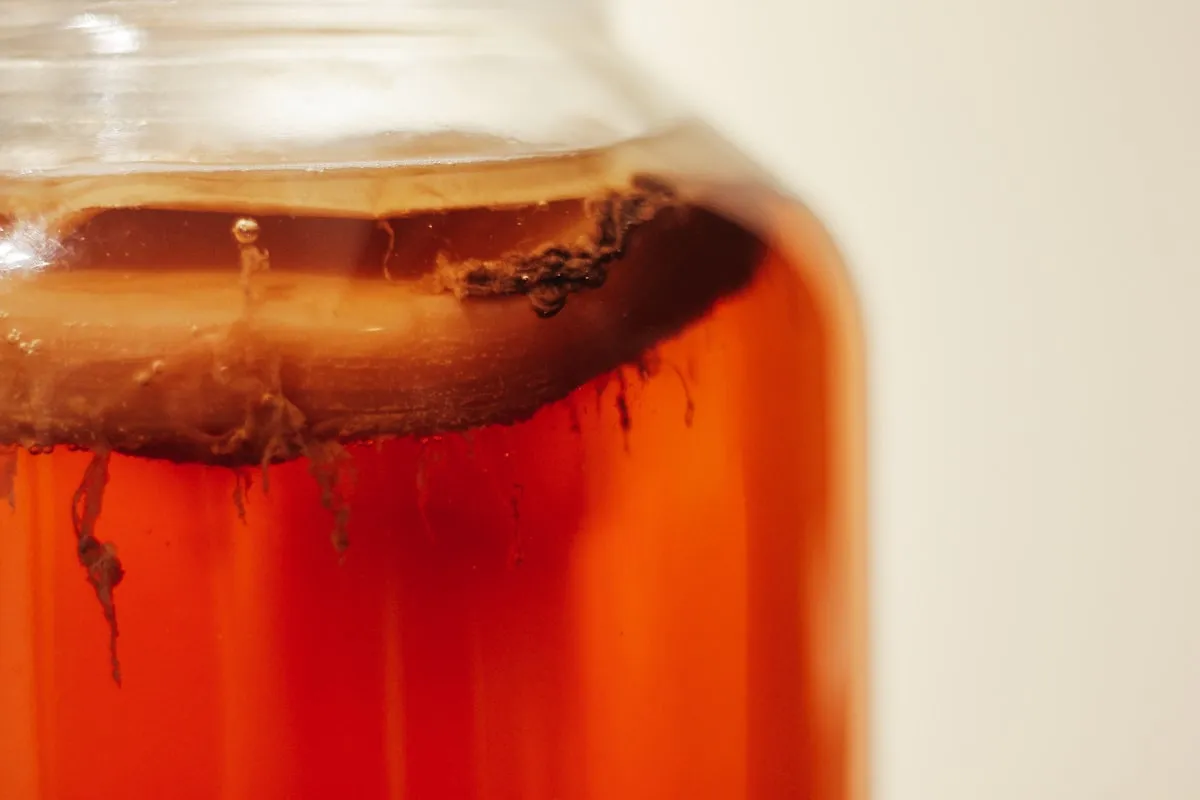
The brewery smells the way it always smells in late March — apple-cider vinegar tang from the primary tank, faint yeast bloom from the bottle conditioning rack, and the muted refrigerator hum from the cold-crash room two doors down. A SCOBY in the third tank has gone slightly translucent at the edges; that one is on its eighth batch and the next refresh is overdue. The label printer is paused mid-roll. Outside, a delivery van's brakes hiss.
Brewing kombucha is patient, humid, slow work. The numbers underneath it should not be.
Most small-batch brewers can describe their tea-and-sugar costs to the gram and have only a fuzzy sense of what each finished bottle actually costs them. What tends to happen is the obvious inputs get tracked carefully and the less-obvious ones — SCOBY amortization, days the tank is occupied, secondary-fermentation loss, the ABV-test reserve — quietly absorb whatever margin survives the bottle.
This post walks through seven numbers every brewer should be able to state from a notebook page. Not all at once. Not perfectly. But well enough that the per-bottle figure at the end of the year matches the bank statement.
The short version: Per-bottle kombucha cost at small commercial scale typically lands around $2.30 once all seven cost layers are named (tea/sugar/water, SCOBY, tank-days, cold-crash, packaging, secondary loss, ABV reserve, labor). Packaging is the single largest layer at about $1.39 per bottle. Brewers who track only ingredients and bottles undercost themselves by 15 to 25 percent.
Number one: The SCOBY is not free, and it does not last forever
A SCOBY — symbiotic culture of bacteria and yeast — is the closest thing kombucha has to a depreciable asset. It started life as a gift from another brewer, as a starter pulled from a previous batch, or (rarely) as a purchase from a culture supplier. Either way, it does not last forever. After enough cycles the colony's vigor drops, off-flavors creep in, and the brewer pulls it for compost and refreshes from a daughter mother.
The amortization is straightforward but rarely written down.
A starter culture purchased from a reputable supplier runs roughly $25 to $45 shipped, depending on volume and species. A well-maintained brewing SCOBY typically yields six to twelve usable batches before flavor degradation becomes detectable, with the lower end of that range applying to brewers running short primary cycles (under eight days) at higher temperatures. The cost per batch is the acquisition cost divided by the cycles you get out of it — usually a number between $2 and $7 per batch, depending on cycle length and how aggressively the brewer refreshes.
If a 50-liter primary batch produces roughly 130 × 12-ounce bottles, a $5-per-batch SCOBY cost lands at about $0.04 per bottle. Trivial in isolation. Significant when paired with the next six numbers.
Why "harvested from a friend" does not make it free
Brewers who acquired their starter from a friend often treat its cost as zero. The acquisition was free; the maintenance is not. The mother culture occupies tank space, demands tea and sugar to maintain between brewing cycles, and represents a real opportunity cost if it fails. A reasonable convention is to value the SCOBY's annual maintenance at the cost of one batch of sweet tea per month (~$36 per year) and spread that across the year's batches. For a brewer running 50 batches per year, the maintenance-only figure is roughly $0.72 per batch — small, but worth tracking. Most brewers also keep a backup mother in a separate jar, which doubles this maintenance line. Worth the redundancy; worth tracking.
Number two: Days times tank — the cost of patience
This is the number that most brewers genuinely do not know.
A fermentation tank is a fixed asset with a depreciable cost. A 50-liter food-grade brewing vessel costs roughly $350 to $600 at the small-commercial end of the market. Spread across a seven-year useful life and roughly 35 batches per year, the per-batch depreciation lands at about $1.50 to $2.50. Per bottle (130 bottles per batch), that is roughly $0.01 to $0.02 — small.
But tank depreciation is only one component of "days times tank." The fuller picture is: how many days does the tank sit occupied per batch, and what is the all-in cost of that occupancy? Tea, sugar, water, the kitchen-floor square footage the tank stands on, the temperature control to keep the brewery between 22 and 26 degrees Celsius, the time the brewer spends checking acidity each morning.
What tends to happen is brewers underestimate the third part of that math. A tank that sits for fourteen days during primary fermentation, three days during secondary preparation, and two days during cold crash is occupied for nineteen calendar days per batch. The all-in occupancy cost — including electricity for ambient temperature control, modest pro-rated rent, and the brewer's quick daily acidity check — typically runs $0.45 to $0.85 per occupied tank-day at small scale.
Pick the midpoint at $0.65 per tank-day. Nineteen days times $0.65 equals $12.35 per batch. Divided across 130 bottles, that is roughly $0.09 to $0.10 per bottle.
This is the number that turns a quick "let's let it go another three days for more carbonation" into a real decision.
Why shorter primary cycles are not always cheaper
A brewer who shortens primary from ten days to seven saves three days of occupancy — about $2 in batch cost. But shorter primaries often produce kombucha with slightly higher residual sugar, which then ferments through in secondary and bottle-conditioning. That secondary ferment-through is what produces gushers, bottle-bomb risk, and unstable shelf life. The $2 saved on occupancy can return as twenty bottles of secondary loss at $2.30 each. The math nearly always favors the longer primary.
Number three: The cold-crash bottleneck
Cold crashing — bringing the finished kombucha down to refrigerator temperature for 24 to 72 hours before bottling — is what gives the brewer control over carbonation, clarity, and shelf life. It also occupies refrigerated square footage, which is the most expensive square footage in the brewery.
A small walk-in cold room or chest-freezer-array setup costs roughly $2,200 to $4,500 at the entry end of commercial kombucha brewing. Depreciation aside, the operating cost of that cold space — electricity, occasional defrosting downtime, the brewer's labor in moving carboys in and out — adds up. A typical small cold room running 35 batches per year sees roughly $1.10 to $1.80 per crashed batch in direct operating cost.
Per bottle, that is roughly $0.01 to $0.02. Smaller still than the SCOBY number.
The hidden cost of cold crash is timing, not electricity. A brewer who can run only one batch through the cold room at a time has built a single-track production system. The cold room is the bottleneck. Expanding the brewery's weekly output past a certain point requires either a second cold-crash unit or a slower bottling cadence — both of which change the per-bottle math significantly. This is the kind of thing that surprises brewers in year two, when demand grows past what the cold room can handle.
The "skip the cold crash" tradeoff
Some brewers skip cold crashing entirely, bottling directly from primary at near-fermentation temperature. The savings are real — $0.02 per bottle plus a day of throughput. The costs show up later. Bottle-conditioning becomes less predictable, shelf-life claims become harder to defend, and gusher rates climb. Most brewers who skip cold crash either operate at very small scale (sell-through is fast enough that shelf-life variance does not matter) or eventually return to it after a difficult summer.
Number four: Bottles eat the margin
This is the number every brewer knows, and most still underestimate.
A 12-ounce swing-top glass bottle in small commercial quantities runs roughly $0.85 to $1.25 each, depending on supplier, freight, and order size. The cap or stopper adds another $0.05 to $0.20, depending on whether it is a metal crown cap with sealed liner or a reusable ceramic-and-rubber swing-top. The label — printed, applied, and trimmed — adds $0.10 to $0.40 per bottle, depending on whether the brewer prints inkjet labels at home or orders from a label printer in 5,000-unit runs.
Take the midpoint: $1.05 bottle plus $0.12 cap plus $0.22 label equals $1.39 in pure packaging per bottle.
For a kombucha that retails at $5.50, packaging alone is 25 percent of the shelf price.
This is the moment most brewers either flinch and start looking at cheaper bottles, or stop and re-do the math. Cheaper bottles often mean thinner glass, which means a higher breakage rate during cold crash and shipping. Cheaper labels often mean smudged ink on a damp bottle, which means a higher re-label rate at the brewery. The packaging line item rarely shrinks by much when a brewer chases cost down.
What tends to work better is reducing breakage and re-label rate at the existing quality tier, then negotiating freight on the next reorder.
The growler and refillable-bottle alternative
Some brewers offer refillable growlers — typically 32 to 64 ounces — as a way to spread the per-bottle packaging cost across more liquid. The math works if the brewer can capture the same per-ounce price point as bottled product, which is rarely true; growler kombucha typically prices 15 to 25 percent below bottle equivalent. The growler path tends to work best as a complement to bottled product at farmers-market and taproom channels, not as a replacement for bottles. A deposit-return program for growlers and (more recently) swing-top bottles can recover 30 to 50 percent of packaging cost if the customer base is local and the return ritual becomes part of the brand.
Number five: Secondary ferment loss is real and trackable
This is the number that quietly compounds.
After primary fermentation, a brewer who flavors with fruit, herbs, or juice introduces a second fermentation cycle — usually two to seven days, typically at ambient temperature in sealed bottles. Secondary fermentation produces carbonation, the small remaining sugar gets eaten by yeast, and the bottle develops its characteristic effervescence.
Three things go wrong, predictably:
Gushers. A bottle that secondary-ferments too aggressively — too much added sugar, too warm, too long — produces enough CO2 to gush when opened. Some brewers can save these by re-pouring and re-sealing at smaller volume; most write them off.
Blow-offs. A small fraction of bottles develop pressure beyond what the seal can hold. The cap pops, the liquid spills, the bottle gets re-cleaned and the kombucha is gone.
Ferment-through. A bottle that finishes secondary with less residual sugar than expected presents as flat or under-flavored. Often these get re-blended or pulled from the channel and sold at half-price as cooking kombucha.
A typical small brewer running careful secondary protocol sees roughly 2 to 5 percent total loss across these three categories. At the higher end of that range, a brewer producing 130 bottles per batch loses 5 to 7 bottles. At a per-bottle COGS of roughly $2.30 (the number this post arrives at in the worked example below), that is $12 to $16 of loss per batch — $0.09 to $0.12 per surviving bottle.
This is the number that justifies the temperature-controlled secondary cabinet that the brewer always meant to budget for and never quite did.
Logging secondary loss is the hardest discipline
Most brewers can describe their primary protocol to the minute and have only a rough sense of secondary loss because the losses happen at small scale, distributed over many bottles, over several days. The discipline that catches it is a single-column logbook entry per batch: "Batch #47, secondary lost 6 of 130 bottles — 3 gushers, 1 blow-off, 2 flat." Three months of that logbook reveals patterns the brewer's memory does not. A trend that shows blow-offs cluster in summer batches, or gushers cluster on stone-fruit flavorings, tells the brewer where to spend the next adjustment.
Number six: ABV is a switch, not a slider
This is the regulatory number, and it is the one that bends the cost stack in one specific way.
Under federal Alcohol and Tobacco Tax and Trade Bureau (TTB (opens in new tab)) rules, a beverage containing 0.5 percent or more alcohol by volume is regulated as an alcoholic beverage, with all the licensing, label-approval, excise-tax, and distribution-tier complications that follow. A beverage under 0.5 percent ABV is regulated as a soft drink by FDA (opens in new tab) and is allowed in most cottage-food and small-food-producer channels without a federal alcohol license.
Kombucha lives near this threshold. Fresh-bottled product is usually well under 0.5 percent. Product that has been in secondary fermentation longer than expected — particularly when held at higher temperatures — can drift past it. A brewer selling under 0.5 percent commercially is required to periodically verify, document, and pull product that has crept over.
The cost of compliance with the under-0.5-percent path is small but not zero:
- A handheld ABV-rated refractometer or hydrometer runs $80 to $250 (amortize over five years).
- Weekly batch testing takes 15 to 25 minutes of the brewer's time.
- Records retention costs roughly nothing in materials but represents a sustained recordkeeping discipline.
- An occasional batch that drifts over 0.5 percent must be pulled and either dumped, re-pitched, or processed by a licensed alcohol producer (a license most small brewers do not hold).
Pulled-batch reserve is the right way to think about this. A small brewer who pulls one batch per year due to ABV drift, at roughly $300 of bottled product, is absorbing about $0.06 per surviving bottle in compliance reserve.
The TTB threshold and the FDA's role in regulating sub-0.5 percent kombucha as a non-alcoholic beverage have been in place since the early 2010s, when the kombucha-as-beverage category first came under federal regulatory attention. What is less settled is state-by-state distribution and retail rules, which vary considerably; check your state agriculture and alcoholic-beverage-control offices before assuming the federal framing applies in your channel.
The hard-kombucha path
A separate category — "hard kombucha" — is brewed deliberately past 0.5 percent ABV (often 3 to 8 percent) and operates under full alcoholic-beverage licensing. The cost stack is fundamentally different: TTB brewer-permit fees, state alcohol licenses, distributor relationships, age-restriction labeling, excise taxes. A small brewer considering crossing into hard kombucha is not adjusting numbers; they are entering a different business. The decision is rarely reversible without re-establishing the soft-drink license track from zero.
Number seven: Per-bottle cost, all in — a composite walkthrough
The brewery in the walkthrough below is a composite. The numbers and operating pattern are illustrative of what a small kombucha brewery's cost stack typically looks like at this scale; the brewery itself is not a real business and any resemblance to a specific brewer is coincidental.
The composite brews a 50-liter primary batch each week, with secondary fermentation in 12-ounce swing-top bottles. The brewery is a converted single-bay garage with a small walk-in cold room, two primary fermenters, and a secondary-conditioning shelf. The brewer (one person, part-time) bottles every Wednesday for Saturday farmers-market sales and weekly Tuesday wholesale delivery to three local cafes.
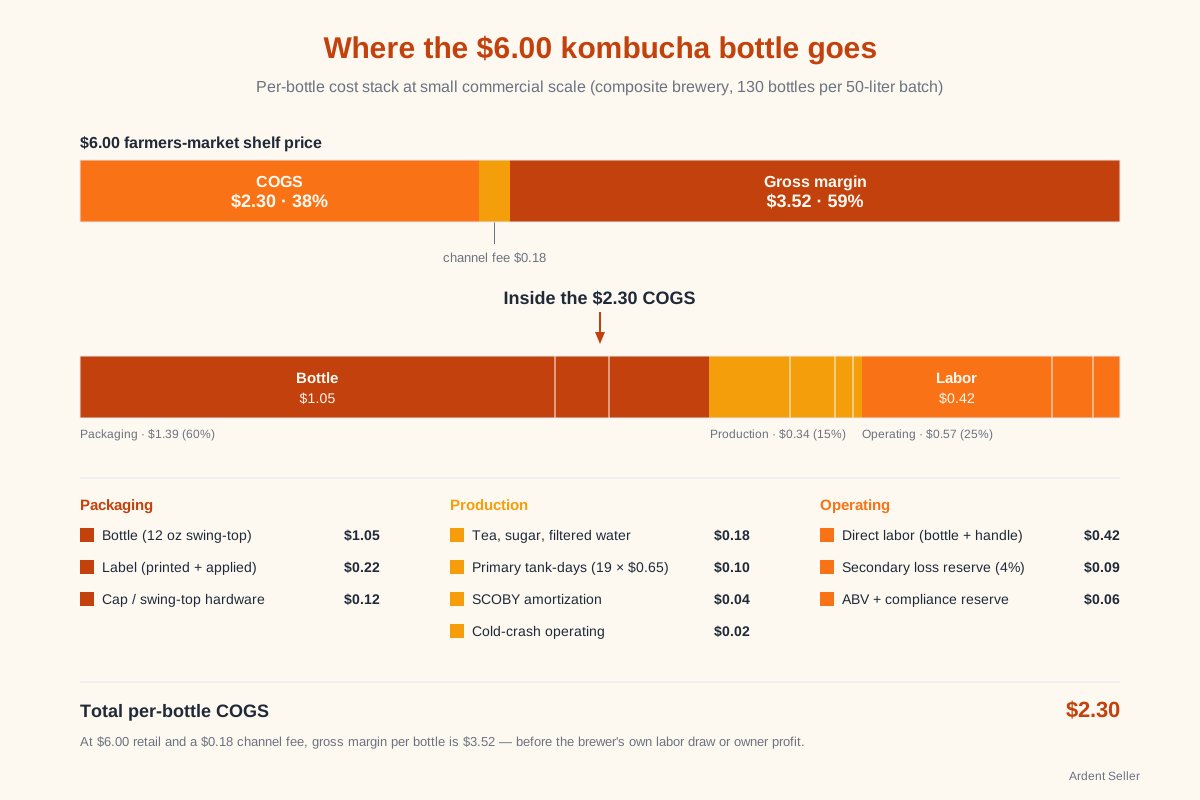
A typical batch produces roughly 130 sellable 12-ounce bottles after secondary loss. Here is the per-bottle cost stack:
| Cost layer | Per bottle |
|---|---|
| Tea, sugar, filtered water | $0.18 |
| SCOBY amortization | $0.04 |
| Primary tank-days (19 days × $0.65 ÷ 130 bottles) | $0.10 |
| Cold-crash operating | $0.02 |
| Bottle | $1.05 |
| Cap / swing-top hardware | $0.12 |
| Label (printed and applied) | $0.22 |
| Secondary fermentation loss reserve (4 percent) | $0.09 |
| ABV testing and compliance reserve | $0.06 |
| Direct labor (fill, label, handle, deliver) | $0.42 |
| Per-bottle COGS, before channel | $2.30 |
That $2.30 is the number that has to clear before the brewer gets paid.
If the bottle retails at $6.00 at the farmers market, with stall rent and card-reader fees allocating about $0.18 per bottle in channel cost, the brewer keeps roughly $3.52 per bottle in gross margin. At 130 bottles per batch and 50 batches per year, that is roughly $22,900 in annual gross margin from the market channel — before the brewer's own labor draw, equipment replacement, or any owner profit.
If the same bottle wholesales to a cafe at $3.50, the brewer keeps roughly $1.20 per bottle in gross margin. The wholesale channel is the lower-margin half of the business but represents the only path to growth past Saturday-market capacity.
This is the number that turns "I'm growing!" into "I'm growing into a channel that is eating my margin."
You can walk through your own version of this stack in the Product Pricing Calculator — paste in your ingredient, packaging, labor, and channel-fee figures and the worksheet will show the same per-bottle picture for your brewery.
What changes at 65 bottles per batch versus 260 bottles per batch
The most volatile layers in the stack are the fixed-cost lines — tank-days, cold crash, ABV test reserve. At 65 bottles per batch (half scale), per-bottle COGS climbs to roughly $2.55. At 260 bottles per batch (double scale), per-bottle COGS drops to roughly $2.13. The packaging cost layer barely moves; the fixed-cost layers move materially.
Brewers who are debating whether to invest in a second primary fermenter usually frame it as "can I sell the extra volume?" The fuller question is "can I sell the extra volume and hold per-bottle COGS to where the gross margin still funds the second tank and a small labor draw?" The math sometimes says yes and sometimes says no, depending on whether the new volume goes through the wholesale channel (lower margin per bottle, lower marginal labor per bottle) or the market channel (higher margin per bottle but capped by market-day attendance).
What this changes about pricing
The per-bottle cost stack is the price floor. Above it, three considerations bend the price up or down.
The first is channel mix. A brewer with strong farmers-market demand and weak wholesale demand should hold the wholesale price firm rather than chase volume that erodes the cafe channel's contribution. A wholesale price that does not survive the brewer's own per-bottle math is a price that the brewer will resent within six months and quietly stop honoring.
The second is bottle reusability. Brewers who can recapture 30 to 50 percent of their bottles through a market-day deposit-return program effectively reduce their largest single cost layer. The deposit ritual also tends to deepen the customer relationship, which is why the brewers who do it well usually keep doing it well.
The third is ABV compliance latitude. A brewer with disciplined batch testing and tight secondary protocols has room to push primary fermentation longer for flavor complexity, which usually commands a higher retail price. The discipline is the unlock; the longer primary is the consequence.
What tends to happen in year one is brewers price by reflex against other local kombucha. What tends to happen in year three is brewers price against their own cost stack, with an eye on the local market for context. The shift in framing is the harder part of the math than the cost arithmetic itself.
Where Ardent Seller fits
The seven numbers in this post are tractable in a spreadsheet — most small brewers start there and stay there longer than they should. What spreadsheets tend not to track well are three things: per-batch lot lineage (which SCOBY did this batch come from, on which cycle, in which tank), the secondary loss log over time (which is the input that drives the compounding reserve), and per-channel margin that separates the market-day economics from the wholesale economics.
Ardent Seller handles per-batch lot tracking with multi-stage recipe costing, separate per-channel margin reporting, and an inventory model that distinguishes the tank-occupied state from bottle-conditioning state from sellable state. Pricing starts at the Maker tier for solo brewers running fewer than 100 batches per year. The farmers market vendor and hot sauce and condiment maker use case pages cover adjacent fermentation and channel-mix patterns that map cleanly to small-batch kombucha brewing.
The discipline of tracking these numbers matters more than the tool. A brewer who logs SCOBY cycle counts, secondary loss bottle-by-bottle, and per-channel gross margin on paper learns more than one who imports it into a tool and never reads the report. Start with a notebook and a Tuesday-morning ritual. The tool is what catches the patterns the notebook reveals.
The seven numbers do not get easier with scale. They get more important, and the cost of not tracking them quietly compounds. Start with one — pick the one your gut is least sure about — and write it down for three months. The next number tends to suggest itself.
Related reading
- Batch Tracking for Food Sellers — The lot-tracking spine that makes a kombucha recall a 130-bottle problem instead of a 1,300-bottle problem; pairs directly with the SCOBY cycle-count discipline in this post.
- Mushroom Grower Biological Efficiency — A sibling process-yield walkthrough for the other live-culture food business, with the same "name the loss number, then improve it" framing.
- Shelf Life, Spoilage, and Inventory Costs — How to track the spoilage, expiration, and shrinkage layers that secondary-ferment loss is a specific instance of.
Free resources
A few free downloads from the Ardent Workshop library that pair well with this post:
- Product Pricing Calculator — The worksheet that builds the per-bottle cost stack from scratch, with channel-fee and target-margin inputs already wired in.
- Recipe Scaling & Batch Calculator — For the moment a brewer wants to scale from a 50-liter test batch to a 100-liter or 200-liter production batch without losing ingredient ratios.
- Small-Batch Production Planning Playbook — A weekly and monthly rhythm for managing overlapping fermentation cycles, secondary conditioning, and bottling days.
This article is provided for educational purposes only and does not constitute legal, regulatory, financial, or tax advice. Cost structures, pricing examples, ABV-compliance protocols, and TTB and FDA labeling guidance vary by jurisdiction, product, and channel, and change over time. Consult a qualified accountant, a food-and-beverage regulatory consultant, your state alcoholic-beverage-control and agriculture or health offices, and an attorney before making financial, compliance, or product-safety decisions based on this content.