In 1634, the town of Boston set aside a plot of land and an appointed day for buying and selling food. The order is usually credited to Governor John Winthrop, and it is the first official record of a European-style public market in what would become the United States (City of Boston (opens in new tab)). The country itself would not exist for another 142 years. The farmers market got there first.
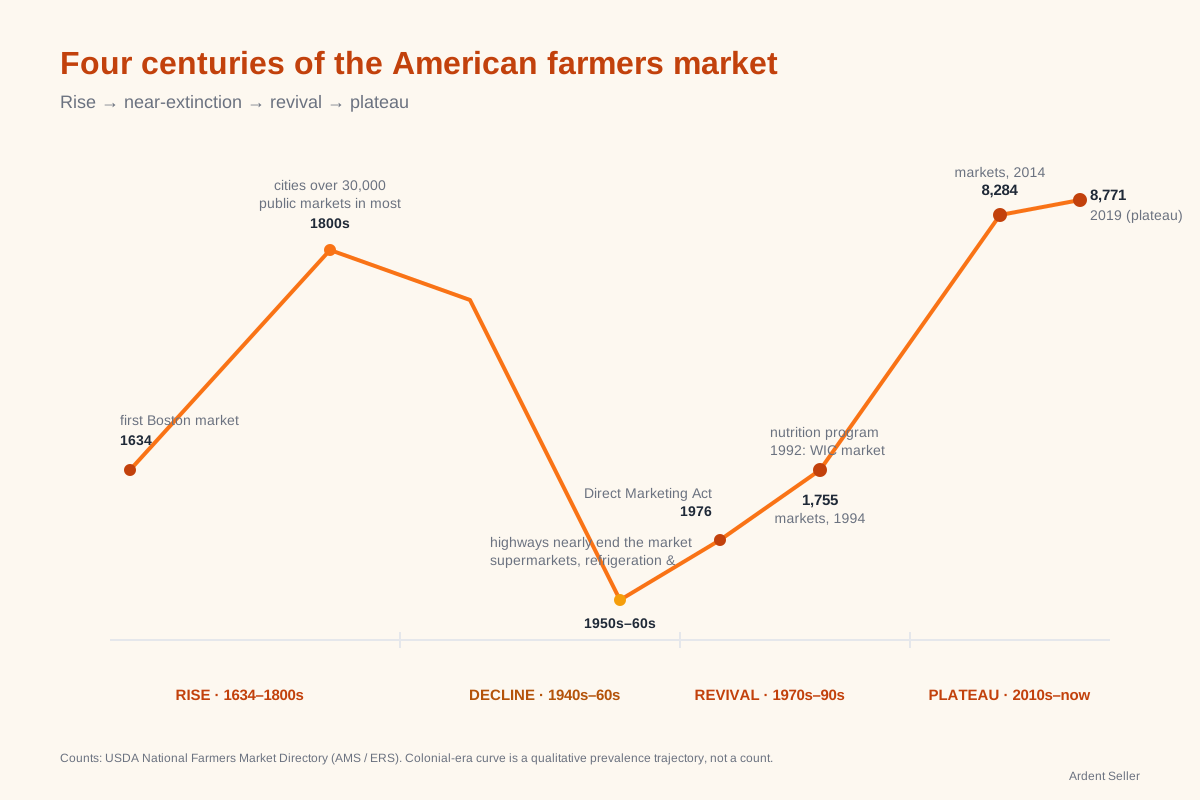
Skip forward almost four centuries. By 2019, the USDA's National Farmers Market Directory listed 8,771 markets across the United States (USDA Economic Research Service (opens in new tab)). In between those two dates sits a story that is far stranger than "people have always liked buying tomatoes outdoors." The American farmers market rose to become the default way a city fed itself, then nearly went extinct, then staged one of the more improbable comebacks in the history of American retail.
It is worth knowing that story if you sell at one. The market you set up at on Saturday is not a quaint throwback. It is a 400-year-old institution that has already survived being declared obsolete at least once.
When the market was the grocery store
For most of American history, there was no other option. If you lived in a town and you wanted meat, dairy, or vegetables, you went to the public market, because the alternative was owning a farm.
Boston's 1634 order set the template, and other colonial towns followed with the enthusiasm of people who needed to eat. Hartford opened a market in 1643. New York City had one by 1686. Philadelphia followed in 1693 (City of Boston (opens in new tab)). These were not weekend novelties — they were municipal infrastructure, as essential as a well or a road, and town governments regulated them accordingly: approved days, assigned stalls, official weights.
1730 — Lancaster, Pennsylvania, deliberately set aside a central square for market use (City of Boston (opens in new tab)). Lancaster Central Market still runs on roughly that footprint today, nearly three centuries later.
By the 1800s the pattern was nearly universal. Most American cities with more than 30,000 residents ran a municipal market where farmers sold directly to the people who would eat their food (City of Boston (opens in new tab)). The market hall was a civic landmark, a social hub, and the place where a city's food supply and its gossip changed hands at the same counter. The phrase "farm to table" had not been invented, because there was nothing else to call it. It was just lunch.
How the farmers market almost died
Here is the part most "support local farms" posts skip: the farmers market did not gently fade. It was outcompeted, decisively, by something shinier.
The decline came from a stack of mid-century inventions that each made the public market a little less necessary. Refrigeration meant food could travel and wait. The interstate highway system meant it could travel far. Suburbanization scattered shoppers away from the downtown market square and toward parking lots. And then the supermarket arrived to gather all of it under one fluorescent roof — produce, meat, dairy, canned goods, and the new frozen-food aisle — open every day, no haggling, no weather.
By the 1950s and 1960s, the farmers market was widely treated as a dying relic — a thing your grandparents did before the A&P showed up.
It is easy to be sentimental about this in hindsight, but the convenience was real. A 1950s shopper could buy a week of groceries in one climate-controlled trip instead of negotiating with six different stall-holders in the rain. People did not abandon farmers markets because they stopped caring about farmers. They abandoned them because someone built a better mousetrap and put a parking lot in front of it. For a couple of decades, the farmers market looked like a chapter the country had finished reading.
The unlikely comeback
The revival, when it came, was driven less by nostalgia than by a problem at the other end of the supply chain: the farmers were not doing well either.
By the 1970s, the same industrial food system that gave shoppers cheap convenience was squeezing small growers hard. The federal advice of the era was blunt — the prevailing policy, often summarized as "get big or get out" — and a lot of small farms got out. The ones that stayed needed a way to capture more of the retail dollar instead of handing most of it to a distributor. Selling directly to the people who ate the food was an obvious answer, and it happened to be the oldest answer there was.
Washington noticed. In October 1976, Congress passed the Farmer-to-Consumer Direct Marketing Act (Public Law 94-463), explicitly meant to "promote the development and expansion of direct marketing of agricultural commodities from farmers to consumers." It made direct marketing an officially recognized federal program — with the stated aims of lower prices for consumers, better returns for farmers, and fewer middlemen in between (Congress.gov (opens in new tab); USDA National Agricultural Library (opens in new tab)). It is not every day that the federal government passes a law to revive a 17th-century retail format, but here we are.
The timing helped. The 1970s back-to-the-land movement had primed a generation of shoppers to care where food came from, and the farm crisis of the early 1980s — when debt fell punishingly hard on the smallest operations — gave the cause a moral urgency. The farmers market stopped being a relic and started being a statement. Buying a misshapen heirloom tomato from the person who grew it became, quietly, a small act of resistance against the climate-controlled mousetrap.
From fringe to fixture
The numbers from here are where the comeback stops being a vibe and becomes a measurable phenomenon.
When the USDA began formally counting in 1994, it found 1,755 farmers markets nationwide (USDA Economic Research Service (opens in new tab)). Then the line went nearly vertical.
1,755 → 8,284 — the number of U.S. farmers markets grew almost fivefold between 1994 and 2014 (USDA Economic Research Service (opens in new tab)).
Two policy moves turned the market from a boutique into something closer to public infrastructure again. In 1992, Congress created the WIC Farmers' Market Nutrition Program (Public Law 102-314), which put federal nutrition benefits directly into the hands of low-income families to spend on fresh produce at markets (P.L. 102-314, U.S. Code (opens in new tab); USDA Food and Nutrition Service (opens in new tab)). The later rollout of SNAP/EBT card readers at market booths did the same thing for food-stamp dollars. Both changes quietly answered the oldest criticism of the farmers market — that it was a luxury for people who could pay cash for arugula — by making it a place where benefit dollars worked too.
By 2019, the directory counted 8,771 markets (USDA Economic Research Service (opens in new tab)). A format that had been written off in the Eisenhower era was now operating in thousands of communities across the country, and "farmers market" had become shorthand for a whole way of thinking about food.
The plateau, and what it actually means
The growth did not continue forever, and the reason it stopped is the most interesting part of the whole story.
Somewhere around 2011, the explosive expansion began to cool. By 2016–2017, the annual growth rate in new farmers markets had dropped below 1% (USDA Economic Research Service (opens in new tab)). The count did not crash — it plateaued, settling into the high 8,000s. The doom-spiral of the 1950s did not repeat. But the curve flattened.
The flattening is not a sign that people stopped wanting local food. It is a sign that they won. Local food got so popular that it leaked out of the market tent and into everywhere else: the grocery store with a "local" shelf tag, the restaurant naming its farm on the menu, the regional distributor moving small-farm product into both. The USDA's own read is that the slowdown in direct-to-consumer outlets like markets tracks with the rise of these intermediate channels (USDA Economic Research Service (opens in new tab)). The farmers market didn't lose. It franchised its idea to the whole food system.
For a vendor standing behind a folding table on Saturday morning, that is the strategic reality worth sitting with. The market is no longer the only place to buy a local strawberry, which means the strawberry alone is not the product anymore. The product is the thing a "local" shelf tag can never reproduce — the grower's face, the question answered on the spot, the sample, the recipe, the small loyalty that builds when a customer comes back to you three Saturdays in a row.
Which is exactly why the operational side matters more now than it did when the market was the only game in town. A vendor competing on relationship and freshness still has to know which products actually make money, which ones sell out by ten and which ones go home in the cooler, and what a market day truly costs once the stall fee, the gas, and the unsold inventory are counted — the kind of per-event break-even math the free Craft Show Prep and Profit Tracker is built to run. That is unglamorous bookkeeping, and it is also the difference between a market habit that sustains a business and one that quietly drains it.
Tools like Ardent Seller exist to keep that side of a market business honest — tracking inventory across the workshop and the booth, and showing which Saturdays and which products were genuinely worth the early alarm.
Four centuries in, and still adapting
Step back far enough and the pattern is almost funny. The farmers market was the original food system, got declared obsolete by the supermarket, came back as a protest, became a mainstream phenomenon, then got so successful that its own idea spread everywhere and slowed its growth. Most retail formats get one act. This one is on its fourth.
The 1634 Boston market and the 2026 Saturday market are recognizably the same thing: a grower, a customer, and a transaction with nobody in the middle. Everything around it has changed — the refrigeration, the EBT readers, the Instagram account, the competition from a grocery store's local shelf — and the core has not. That durability is not an accident. It is what happens when an institution keeps being genuinely useful while everything around it reinvents itself.
If you sell at a market, you are not running a hobby stall. You are the current operator of one of the longest-running retail formats in the country, and your job is the same one Winthrop's Bostonians had: show up, sell good food directly, and give people a reason to choose the person over the parking lot. The history says that reason has always been enough to keep the market alive. The numbers say it is your move now.
Want to run your market stall like the durable small business it is? Start free with Ardent Seller and set up before next Saturday — track inventory, costs, and which products actually carry the table.
Sources
- Colonial market history (Boston 1634, Hartford 1643, NYC 1686, Philadelphia 1693, Lancaster 1730, the "cities over 30,000" pattern): City of Boston — A Brief History of Farmers Markets in the United States (opens in new tab).
- Farmer-to-Consumer Direct Marketing Act of 1976 (P.L. 94-463), establishing direct marketing as a recognized federal program: Congress.gov, H.R. 10339, 94th Congress (opens in new tab) and USDA National Agricultural Library (opens in new tab).
- WIC Farmers' Market Nutrition Program, established 1992 (P.L. 102-314): U.S. Code, Title 42 Chapter 13A (opens in new tab) and USDA Food and Nutrition Service (opens in new tab).
- Market counts for 1994 and 2014 (1,755 → 8,284): USDA Economic Research Service — "Number of U.S. farmers' markets continues to rise" (opens in new tab).
- Market count for 2019 (8,771), the post-2011 slowdown, and sub-1% annual growth in 2016–2017: USDA Economic Research Service — "Growth in the number of U.S. farmers markets slows" (opens in new tab). General program reference: USDA Agricultural Marketing Service (opens in new tab).
Data reflects USDA figures through 2019, the most recent clean directory count published in the ERS series; government data of this kind typically lags one to two years.
Related reading
- Farmers Market Mistakes Costing You Money — Once you've appreciated the institution, this is the unsentimental list of the ten ways a market stall quietly leaks profit — and how to plug each one.
- Q4 Holiday Runway for Farmers Market Vendors — Now that you know the market is a seasonal institution with deep roots, here is how to plan its busiest, most lucrative stretch instead of just surviving it.
- A History of the Modern Maker Movement — If the long view suits you, this traces how Etsy, cottage food laws, and the 2020 surge reshaped the wider world the farmers market now sells into.
Free resources
If you'd like to take this off-screen, these free downloads pair well with running a market stall:
- Craft Show Prep and Profit Tracker — Runs the pre-show break-even, a booth-setup checklist, and a post-event reconciliation so every Saturday gets a verdict, not a guess.
- Product Pricing Calculator — Materials, labor, packaging, and fees in, a defensible market price out — so the products that carry your table are the ones actually earning their square foot of canopy.