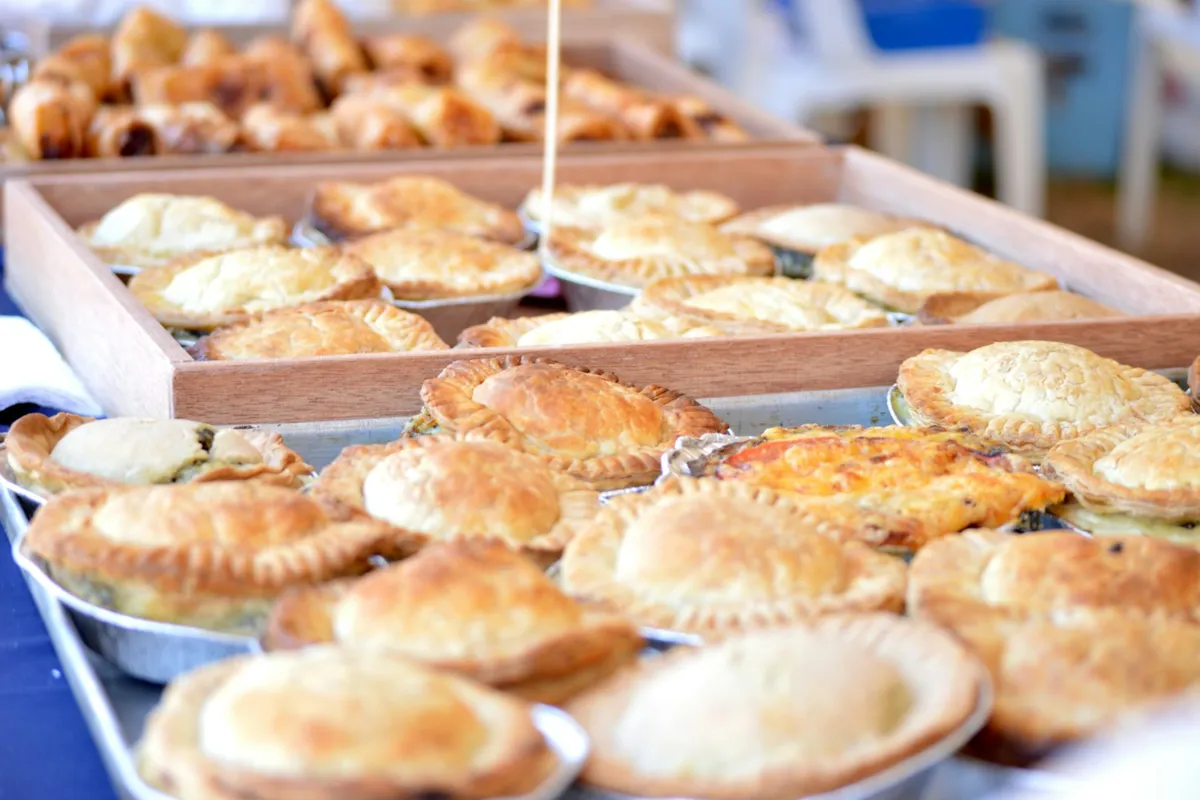
A morning in Mesa is two months past the start of summer, which means the kitchen at 6:30 a.m. is the only kitchen anyone wants to be in. By 9 a.m. the air conditioner is the only thing standing between a tray of fresh empanadas and a refrigeration violation. Rosa has been getting up at 5:15 since the third week of May, baking through the cool hours, and packing the morning's work into a cooler by 9:15 so the cooler does the work the kitchen no longer can.
Rosa is also, this Tuesday, looking at a question she could not have asked an Arizona cottage food producer two years ago. The empanadas she has been making for her Saturday market are a beef-and-potato recipe her mother brought up from Sonora. Until September 2024, those empanadas could not legally have been sold from her home kitchen. After HB 2042, they can. The catch is that they have to leave her hand and arrive in her customer's hand within two hours, with the cooler holding the temperature the entire way.
The question is whether the two-hour rule is a constraint she can build around, or a constraint that breaks the recipe she wanted to sell in the first place.
The short version
What Arizona's cottage food framework actually does: Arizona's program lives in ARS § 36-136 (opens in new tab) and in ARS Chapter 8, Article 2 (§§ 36-931 through 36-933) (opens in new tab), added by HB 2042 (2024) (opens in new tab) and implemented by Arizona Administrative Code R9-8-101.02 (opens in new tab). Administered by the Arizona Department of Health Services (opens in new tab). No revenue cap. Free registration, renewed every three years. Food handler training from an accredited program (a Food Manager Certification also qualifies) is required before registration, and the certification must stay active. No home kitchen inspection. The statute at § 36-931(3)(a) describes a kitchen in the individual's residential home or dwelling (or in a facility for individuals with developmental disabilities) "of a type that is normally found in a residential home and that does not exceed one thousand square feet." The food list now includes shelf-stable baked goods, candies, jams and jellies, dry mixes, roasted nuts, honey, dry pasta, roasted coffee, and acidified and fermented foods — plus foods that require time or temperature control for safety (TCS), with meat and poultry only from federally inspected sources or qualifying federal exemptions. Sales channels include direct, farmers markets, online, and third-party vendors such as retail food establishments — but TCS items and anything containing meat or poultry must be sold and delivered directly and in person by the preparer, at the required temperature, to one destination, within two hours. The label must carry the preparer name, registration number, all ingredients, production date, the verbatim statement "This product was produced in a home kitchen that may come in contact with common food allergens and pet allergens and is not subject to public health inspection," a disclosure if the product was made in a facility for individuals with developmental disabilities, and the statement directing consumers to azdhs.gov/Cottagefood. Excluded: alcoholic beverages, unpasteurized milk, fish, shellfish, marijuana products, and (per ADHS) CBD and pet treats. Out-of-state sales are not authorized.
What HB 2042 actually changed
For the years between Arizona's original cottage food rule and HB 2042, the framework was conventional: shelf-stable foods only, no TCS items. The producer registered with ADHS, posted a label disclaimer, and operated within the limits.
HB 2042 (Laws 2024, Chapter 18) was signed by Governor Hobbs on March 29, 2024 and took effect on September 14, 2024. The bill did three structurally distinct things.
It carved cottage food out of the general food-handling statute and gave it its own article. Before HB 2042, the cottage food exemption was a paragraph buried inside ARS § 36-136 (opens in new tab), the section that defines the powers and duties of the ADHS director. After HB 2042, cottage food has its own three-section article — definitions at § 36-931, requirements at § 36-932, enforcement at § 36-933 — that reads as a coherent regulatory framework rather than a footnote inside a larger statute. This is procedurally minor but practically useful: it gave the Department a clean target for the implementing rule at AAC R9-8-101.02, and it gives producers a single place to read the law rather than a paragraph cross-referenced from somewhere else.
It added TCS foods to the allowed list. This is the substantive change. The original cottage food framework was non-potentially-hazardous foods only — the standard "shelf-stable" envelope that most states' cottage food laws share. HB 2042's definition at § 36-931(1)(a)(ii) now includes foods that are potentially hazardous or that require time or temperature control for safety. That is not limited to foods containing dairy, meat, or poultry — ADHS has approved TCS items such as bean tamales, soups, cut fruit, fresh juices, and lemonades. Meat and poultry carry an added sourcing condition:
- TCS foods generally — including dairy-based items such as a cheesecake, a quiche, or a custard pie. Unpasteurized milk is still excluded. Each item still has to be on the producer's approved menu with ADHS.
- Meat — from a federally inspected source or a qualifying federal exemption (9 CFR § 303.1(d)). In practice that means buying meat from an inspected or exempt source and using it as an ingredient in cottage food products — meat pies, empanadas, breakfast burritos.
- Poultry — from a federally inspected source or a qualifying federal exemption under 9 CFR § 381.10(c) or (d).
It built in the in-person delivery rule as the structural counterweight. This is the part most cottage food producers don't read carefully. The expanded food list is paired with ARS § 36-932(E) (opens in new tab) and AAC R9-8-101.02(D)(4), which require that any TCS cottage food product — or any product containing meat or poultry, including shelf-stable meat like jerky — must be:
- Sold and delivered directly by the food preparer (not by a third-party vendor like a grocery store, and not through a third-party carrier);
- Sold in person, OR sold remotely (online, by phone, by text) for in-person delivery;
- Not delivered through a third-party food delivery platform (DoorDash, UberEats, Grubhub, Instacart), a prohibition that also appears in ARS § 36-932(E)(2);
- Kept at the required temperature throughout transport;
- Delivered to one destination, and not sold to the public except at that initial destination; and
- Delivered within two hours, including traffic delays.
ADHS also says perishable items may be offered for sale only on the day they leave the household.
The two-hour window is the binding constraint, and traffic counts against it. A producer in Tucson delivering a refrigerated cheesecake to a customer in Phoenix has little or no margin for a delay on the road. A producer in Mesa can reach much of the East Valley and central Phoenix within the window, but a delivery to Prescott or to Sedona is hard to fit. The "one destination" requirement also bears on multi-stop runs: twelve quiches in a cooler driven along a six-customer route means six destinations, so a producer planning that kind of route should confirm it with ADHS first.
Non-TCS cottage food that contains no meat or poultry — cookies, jams, dry mixes, candies, honey — is not subject to the in-person delivery rule. A producer may sell those products through a third-party vendor, ship them in-state through a third-party carrier, or hand them to an UberEats driver. The in-person rule applies to TCS foods and to anything containing meat or poultry, including shelf-stable jerky.
What the law now lets you sell
The combined effect of the original framework plus the HB 2042 additions is a broad cottage food list. The categories below draw on the implementing rule at AAC R9-8-101.02 and the ADHS cottage food program guidance. ADHS approves the items on each producer's menu, and adding products requires approval first:
Shelf-stable (non-TCS) — no delivery restriction:
- Baked goods without cream, custard, or meat fillings (breads, rolls, biscuits, cookies, scones, muffins, quick breads, cakes with shelf-stable frostings, pastries without dairy filling, pies without unbaked fresh fruit and not requiring refrigeration)
- Candies and confections (fudge, brittles, hard candies, dipped chocolates, toffees, caramels, marshmallows)
- Fruit jams, jellies, preserves, and fruit butters
- Honey and honey products
- Dry mixes (cake mix, bread mix, brownie mix, dry soup mix, dry seasoning mix, dry baking mix)
- Granola, trail mix, snack mixes, breakfast cereals
- Roasted nuts (plain or seasoned)
- Popcorn, popcorn balls, kettle corn, caramel corn
- Dry pasta
- Roasted whole-bean and ground coffee
- Dried herbs and herb mixtures
Acidified and fermented — on ADHS's approved list:
- Salsa, hot sauces, pickles, kimchi, sauerkraut, miso, and pepper jams
- Without lab testing, these are treated as TCS foods (direct sale and in-person delivery only)
- Once lab-tested as non-TCS, they may be sold through retail
TCS, plus anything containing meat or poultry — added by HB 2042, in-person delivery required:
- Bean tamales, soups, cut fruit, fresh juices, and lemonades (TCS items ADHS has approved)
- Baked goods with fresh dairy or cream filling (cheesecake, cream pies, custard pies, éclairs, cream puffs, dairy-frosted cakes)
- Quiches, frittatas, savory tarts with dairy or meat fillings
- Meat pies, hand pies, empanadas, savory pasties with USDA-inspected meat
- Breakfast burritos, breakfast sandwiches, meat-containing baked goods
- Pasta dishes with meat or dairy sauces
- Foods containing poultry from federally inspected sources or qualifying federal exemptions
- Meat jerky from USDA-inspected meat sources (shelf-stable, but still under the in-person rule because it contains meat)
Excluded categorically:
- Alcoholic beverages (alcohol may be used as an ingredient when the finished product is not meant to intoxicate; vanilla and almond extracts are approved)
- Unpasteurized (raw) milk
- Fish and shellfish
- Marijuana products and CBD
- Pet treats
The TCS expansion is the biggest change HB 2042 made, and it is where Arizona differs most from states whose cottage food laws cover only shelf-stable foods. A maker who lives in Tucson and a maker who lives twenty miles south of Tucson in Nogales, Sonora are governed by different food-safety regimes; the Tucson maker can sell a cheesecake under the state cottage food framework and the Mexican maker would do so under a separate Mexican food-handling regime. A maker who lives in Yuma and a maker who lives in El Centro, sixty miles west across the California border, are also governed by different regimes — the Yuma maker can sell a meat empanada under Arizona cottage food; the El Centro maker is governed by California's rules, not Arizona's.
Registration and the food handler card
The Arizona registration mechanic is unusually clean. There is no fee and no kitchen inspection, though ADHS says processing can take up to four to six weeks.
Step 1 — Food handler training. Before registering, the applicant must complete a food handler training course from an accredited program; a Food Manager Certification also qualifies. Courses such as ServSafe Food Handler (opens in new tab), Learn2Serve Food Handler (opens in new tab), StateFoodSafety (opens in new tab), and the 360training Food Handler (opens in new tab) course are available online. The statute requires the preparer to maintain active certification, so check the certificate's expiration date against the three-year registration cycle.
Any county food handler requirement for general food workers is separate from the state cottage food registration; check with the county health department where you operate.
Step 2 — Online registration. Submit the registration on the ADHS Cottage Food Program (opens in new tab) page, including the cottage food products the applicant intends to make and the food handler training. ADHS says processing can take up to four to six weeks, so register well before a planned first market day.
Step 3 — Receive the registration number and start selling. Once ADHS approves the registration, the producer receives a registration number. The number goes on every product label. Registration is renewed every three years by completing a new registration, and the preparer must keep food handler certification active. Changes must be reported to ADHS within 30 calendar days, and adding products to the menu requires ADHS approval before those products are sold.
What the framework does not require: a home kitchen inspection or a registration fee. Tax and local licensing are separate questions. ADHS notes that food intended for home consumption is exempt from tax at the state level, but some cities charge tax on retail food sales — check with your city and the Arizona Department of Revenue TPT system (opens in new tab) about any transaction-privilege-tax (TPT) or local business license obligation.
The state registration itself is free, so the upfront cost to legally start selling Arizona cottage food is mostly the food handler course plus any local licensing that applies.
Three Arizona producers, three sides of the rule
The clearest way to see how the post-HB-2042 framework actually operates is through three composite Arizona producers, each of whom is doing something slightly different and ends up in a different relationship with the rule.
Rosa bakes in Mesa. Empanadas, breakfast burritos, the occasional batch of meat pies. All of her products contain USDA-inspected ground beef or pork, which means all of her products fall under the in-person delivery rule. She does about $22,000 a year, almost all of it through a Saturday morning market in downtown Mesa plus a weekday online ordering channel for East Valley delivery. The Saturday market is straightforward: customers buy in person at the booth, the cold chain has held from the cooler in her trunk to the cooler at her booth, and the handoff is hand-to-hand. The weekday online channel is where the two-hour rule binds. Rosa has mapped a delivery window from 11 a.m. to 1 p.m. that covers her ZIP code plus the four ZIP codes adjacent to it; orders outside the window are politely declined with a note that the rule does not authorize the delivery. She is fully compliant, her registration is current, and her food handler card was renewed in March.
Aanya bakes in Scottsdale. She runs a small business selling shelf-stable spice blends, chai mixes, and ghee-flavored cookies — all non-TCS under the rule. She does about $48,000 a year, almost all of it through Etsy with shipping to in-state customers. She also has a small wholesale arrangement with two boutique grocery stores in Old Town Scottsdale that carry her spice tins on a separate shelf with a sign indicating the products are homemade and exempt from state licensing and inspection. Because nothing in her product line is TCS or contains meat or poultry, none of her sales are subject to the in-person delivery rule — she can use in-state shipping carriers, third-party retailers, and delivery platforms. The $48,000 would exceed the cottage food revenue cap in many other states. In Arizona, it is a continuing cottage food operation with no impending transition required.
Marcus bakes in Flagstaff. Sourdough bread, cinnamon rolls, croissants, and a small but growing line of dairy-cream-filled pastries — éclairs, cream puffs, a passion-fruit Bavarian. The bread and the cinnamon rolls are shelf-stable and move freely. The cream-filled pastries are TCS and bind under the in-person delivery rule. Marcus runs a Friday and Saturday booth at a Flagstaff farmers market plus a small Sunday booth at a downtown coffee shop's outdoor space; all three are within walking distance of his home, the cold chain holds, and the handoffs are hand-to-hand. He has been asked twice by a Phoenix-based delivery startup to add his cream-filled pastries to their platform; both times he has declined, because the platform is a third-party delivery platform, which ARS § 36-932(E)(2) does not allow for TCS cottage food. He could sell the dry-bread line through that channel — but the cream pastries cannot move that way.
Three producers, three different relationships with the same rule. None of them is doing anything wrong. Each of them has built their business around what the framework actually allows rather than around what they wish it did.
What goes on an Arizona cottage food label
The label rule at ARS § 36-932(A) (opens in new tab) and AAC R9-8-101.02(C)(3) sets out six elements — one of which applies only to products made in a facility for individuals with developmental disabilities — and the statement wording is statutory, so paraphrasing it does not satisfy the rule. Labels may be printed or handwritten.
Required elements:
- Food preparer name and registration number. The preparer's name and the registration number from the ADHS registration. Both must appear on every package.
- All ingredients. The statute says the label "Lists all the ingredients," including the ingredients in any components; it does not require descending order of predominance by weight. Listing the ingredients of compound ingredients looks like "imitation vanilla extract (water, sugar, caramel color, natural flavor)". For TCS products containing meat or poultry, the source description should be specific enough to allow a consumer to identify the protein and any allergens (e.g., "ground beef (90/10 USDA-inspected, sourced from XYZ Ranch)" is best practice, though the source identification is not strictly required by the rule).
- Production date. The date the product was prepared, in a format that is unambiguous to a consumer.
- Statutory statement (ARS § 36-932(A)(3)). Verbatim, on every package: "This product was produced in a home kitchen that may come in contact with common food allergens and pet allergens and is not subject to public health inspection." The wording may not be paraphrased. Producers occasionally try to soften it ("Made with love in our home kitchen") or to shorten it ("Made in a home kitchen — not state-inspected") — both of those phrasings fall outside the rule and would not satisfy a compliance check.
- Developmental disabilities facility disclosure (ARS § 36-932(A)(4)). If the product was made in a facility for individuals with developmental disabilities, the label must include a statement disclosing that fact. Products made in a residential home kitchen skip this element.
- Website statement (ARS § 36-932(A)(5)). AAC R9-8-101.02 words it as: "To obtain additional information about cottage foods or to report a foodborne illness, go to azdhs.gov/Cottagefood".
Online sales must display all of the label information as a prominent notification (AAC R9-8-101.02(E)). ADHS accepts either a picture of the label alongside the product picture or the information in the product description, and the requirement applies to online pre-orders for pickup as well. Either way, the listing must carry the full label information, including the verbatim statement.
Allergen and contact information beyond the required elements. ADHS's cottage food FAQ leaves additional allergen and contact information to the preparer's discretion. A voluntary "Contains:" line naming any of the nine major U.S. allergens — milk, eggs, fish, crustacean shellfish, tree nuts, peanuts, wheat, soybeans, and sesame — is one way to add it.
Tamper-evident seal. AAC R9-8-101.02(C)(4)(b) requires the packaging to contain a tamper-evident seal, which could be the label itself. A shrink band, a wax seal, a tape seal that visibly breaks when removed, or a heat-sealed bag can also serve. A package with no tamper-evident seal does not satisfy the rule.
How Ardent Seller helps with the Arizona label
Ardent Seller assembles this label. Pick a finished product, choose Arizona, and the cottage food label generator pulls together the food preparer's name and ADHS registration number, the ingredient statement with sub-ingredients in parentheses, the production date, a "Contains:" allergen line, and the verbatim ARS § 36-932(A)(3) statement — rendered exactly as the statute words it, never paraphrased. It surfaces an azdhs.gov/Cottagefood consumer-information statement, plus a reminder for the tamper-evident seal the package needs. A validation checklist shows the required elements and blocks printing while any of them is missing. Output is a PDF sheet (Avery 5163, 4″×6″, or full page) or a direct print.
Generate your Arizona cottage food label with Ardent Seller free — the label generator is included on every plan, including the free tier.
The retail-venue path: how to wholesale to grocery stores and restaurants
This is the part of the framework that opens retail shelves to shelf-stable producers. Under ARS § 36-932(E)(4) (opens in new tab), an Arizona cottage food producer may sell non-TCS cottage food products that contain no meat or poultry through a third-party vendor — a retail food sales establishment, a grocery store, a convenience store, or a coffee shop — provided the vendor displays the products as the statute requires.
The display rule requires:
- A separate section or display case for the cottage food items.
- A sign that indicates that the cottage food products are homemade and exempt from state licensing and inspection. The statute describes what the sign must convey; it does not set exact wording.
The display and the sign sit on the vendor's premises, but in practice the cottage food producer is the one who has to negotiate the retail placement and explain the requirement to the vendor; some retailers are not aware of the rule until a producer brings it to them. A producer pitching a grocery store should arrive with a sample label, a copy of the ARS § 36-932 text, and an offer to provide the sign.
A few more limits apply on this path. The products must stay in their unaltered packaging — ADHS does not cover open sampling, assembly, or pouring drinks. A cottage food product may not be used as an ingredient in food sold at a permitted retail food establishment (ARS § 36-932(F)(1) (opens in new tab)), so a restaurant or coffee shop cannot use it in its own menu items. And cottage food products may not be stored outside the preparer's home (ARS § 36-932(D)(2)).
TCS foods and anything containing meat or poultry cannot be sold through this channel. A producer's empanadas, quiches, cheesecakes, or meat pies can only be sold and delivered directly and in person by the producer. Only non-TCS products without meat or poultry — baked goods, jams, candies, dry mixes, roasted nuts, honey, and acidified or fermented foods that lab testing shows are non-TCS — can move through the retail-venue path.
This is the path for shelf-stable producers who want to scale through retail placement.
How Arizona compares with its neighbors
Producers thinking about which state's framework to operate under often look at adjacent jurisdictions. Arizona shares borders with California, Nevada, Utah, Colorado, and New Mexico, and the cottage food rules in those states differ from Arizona's on revenue caps, registration, allowed foods, and sales channels.
| State | Cap | Registration | TCS allowed | Online | Third-party vendors | Acidified and fermented |
|---|---|---|---|---|---|---|
| Arizona | None | Free | Yes (meat and poultry from federally inspected or exempt sources) | Yes | Yes (non-TCS, no meat or poultry) | Yes (treated as TCS unless lab-tested non-TCS) |
For the current rules next door, see the state pages for California, Nevada, Utah, Colorado, and New Mexico rather than relying on an older side-by-side summary.
Under the Arizona framework, a producer in the Phoenix metro can make empanadas, quiches, or cream pies in a home kitchen, provided every sale follows the in-person delivery rule.
A producer who lives in Yuma and wants to sell into the Imperial Valley (across the California border) cannot do so under either state's cottage food framework — the moment the package crosses the state line, federal FDA jurisdiction applies. The cottage food framework is bounded by the state, regardless of how close a customer is to the producer's home.
Three places the internet gets Arizona cottage food wrong
Several third-party state-law summaries and aggregator pages still describe the pre-HB-2042 framework. The three most consequential errors:
"Arizona cottage food does not allow dairy / meat / poultry." For TCS foods, this was true until HB 2042 took effect on September 14, 2024. It is no longer true. HB 2042 expanded the food list to include foods that require time or temperature control for safety, with meat and poultry from federally inspected sources or qualifying federal exemptions. Any guide that lists Arizona's cottage food food list and does not include TCS items is using pre-HB-2042 data.
"Arizona cottage food has a $10,000 cap" (or "a $25,000 cap"). This is wrong. Neither ARS § 36-931 et seq. nor AAC R9-8-101.02 sets a revenue cap on cottage food sales, and HB 2042 did not add one. Sources that quote a dollar cap for Arizona are likely conflating Arizona with another state's framework.
"Arizona allows interstate cottage food shipping." It does not. ARS § 36-932 and AAC R9-8-101.02 do not authorize sales outside Arizona, and federal FDA jurisdiction picks up the moment a package crosses a state line regardless of state law. The Arizona framework allows in-state online sales and in-state wholesale — but not out-of-state shipping. A producer who wants to ship out of state has to operate outside the cottage food framework.
If a source describes Arizona cottage food in terms that conflict with ARS § 36-931 (opens in new tab) or AAC R9-8-101.02, the statute and the implementing rule control.
When the framework is and isn't the right home
For most Arizona home producers who are making cottage-food-eligible items, the framework is the right home — usually permanently. The combination of no cap, free registration, and the broad food list means that there is no built-in reason to graduate out of the framework as the business grows. A producer doing $12,000 a year and a producer doing $120,000 a year are governed by the same rules, file the same labels, and operate on the same three-year renewal cycle. Most other states' cottage food frameworks have a built-in graduation pressure — a cap that eventually pushes successful producers into a commercial license — that Arizona simply does not have.
The framework is not the right home for three specific situations:
Interstate sales. If the producer's business model depends on shipping outside Arizona — selling through Etsy to a national customer base, fulfilling Amazon orders, mailing to out-of-state customers — the cottage food framework cannot accommodate it regardless of cap or food list. The next legal home is a licensed commercial food operation, with the licensing and federal obligations that come with it.
Marketplace-driven TCS delivery. If the producer wants to sell TCS items or products containing meat or poultry (cheesecakes, empanadas, quiches) through a third-party delivery platform like DoorDash or UberEats, the in-person delivery rule, including ARS § 36-932(E)(2), prohibits it. The producer either accepts the in-person delivery constraint (and structures the business around a tight geographic radius and direct-to-consumer handoffs), pivots the menu to non-TCS items without meat or poultry, or moves to a licensed commercial food operation.
Restaurant or food service operation. The cottage food framework is for packaged goods sold to consumers in unaltered packaging; ADHS does not cover open sampling, assembly, or pouring drinks. A producer who wants to operate a restaurant, a food truck, a catering business, or a home kitchen serving prepared meals is operating outside the cottage food rule and needs a different license — typically through the relevant county health department.
For everyone else, the framework is the framework, and it is a permissive one.
Worked example: what $36,000 of Arizona cottage food actually costs to run
To make the framework concrete, here is a year of expenses for a hypothetical Phoenix-area producer doing about $36,000 in gross cottage food sales — a mix of shelf-stable spice blends sold online and at farmers markets, plus a smaller line of TCS empanadas delivered in person on Tuesdays and Thursdays:
| Category | Amount |
|---|---|
| ADHS cottage food registration (averaged across 3-year cycle) | $0 |
| Food handler course (averaged across 3-year cycle) | $4 |
| Local TPT or business license, if required (averaged) | $15 |
| Ingredients (spices, flour, ground meat, dairy, produce) | $8,200 |
| Packaging (jars, tins, kraft boxes, labels, tamper seals) | $2,100 |
| Farmers market booth fees ($35/week × 36 weeks) | $1,260 |
| Insurance (product liability, $1M coverage) | $340 |
| Cold-chain equipment (coolers, gel packs, thermometers, depreciation) | $180 |
| Etsy listing + transaction fees (~8% blended) | $920 |
| In-person delivery mileage (TCS deliveries, IRS standard rate × ~600 mi) | $402 |
| Quarterly estimated tax (federal SE + AZ income tax) | varies |
| Direct + operating costs | ~$13,421 |
| Gross sales | $36,000 |
| Net before owner labor | ~$22,579 |
The state-fee component is essentially zero — $4 a year averaged across the three-year cycle is below the noise floor of any other expense category. The structural cost of operating under the Arizona framework is the in-person delivery mileage for the TCS portion (about $400 a year for a producer doing roughly two delivery runs per week within a tight geographic radius) and the cold-chain equipment. A producer who could ship the same TCS items through a third-party delivery platform would save the delivery mileage and most of the cold-chain capital cost, but the rule does not allow that — so the cost is what the cost is.
For a producer who wants to think systematically about the cost structure, the true hourly wage load — including the in-person delivery hours that cannot be charged to the customer separately — is the more revealing number than the gross margin. The framework's no-cap, no-fee headline rate is real, but the in-person delivery rule does carry a real time cost that doesn't show up in any state-fee line.
Quick reference: the things to track if you operate under the rule
For a producer operating under the Arizona cottage food framework, four things are worth tracking from the first day:
- Food handler certificate expiration. The statute requires the preparer to maintain active food handler certification. Mark the certificate's expiration date and renew at least 60 days in advance so the renewal lands before the certificate lapses.
- Registration renewal date. Cottage food registrations are renewed every three years by completing a new registration. Mark the renewal date and budget the (zero-dollar) renewal cycle — the cost is in your time, not in money. Between renewals, changes are due to ADHS within 30 calendar days, and new menu items need approval before they are sold.
- In-person delivery log for TCS products. For producers selling TCS items, keeping a delivery log — order date, customer name, delivery address, departure time from your home, arrival time at the customer, temperature reading on the cooler at arrival — protects against a future complaint or inspection. A log is not among the delivery requirements listed above, but a producer who has one is in a much stronger position if the Department asks for documentation of compliance with the two-hour and temperature rules.
- Sales tax on food. ADHS notes that food intended for home consumption is exempt from tax at the state level, but some cities charge tax on retail food sales. Check with your city and the Arizona Department of Revenue (Transaction Privilege Tax (opens in new tab)) about whether a TPT license and tax collection apply to your sales. Any TPT registration is separate from the cottage food registration.
Producers using inventory and recipe tracking software like Ardent Seller naturally track gross sales by channel and ingredient costs by batch as part of their normal workflow — which means any local tax filing and the year-end income figure are numbers you already have, not numbers you have to reconstruct from receipts. For producers running TCS deliveries, recording the delivery time stamps and cooler temperature in the same place you record the sale closes the documentation loop without adding a separate logbook.
Related reading
- Washington Cottage Food Law — Washington's $35,000 capped framework is the structural opposite of Arizona's no-cap regime, and the two-path Cottage Food Permit vs. Food Processor License model contrasts sharply with Arizona's single-tier expansion.
- California Cottage Food Law — California is Arizona's largest neighbor and the most-trafficked cottage food market in the country. The Class A vs. Class B tier framework, the indexed caps, and the categorical TCS exclusion all sit on the opposite side of how Arizona handles the same questions.
- Hot Sauce Compliance and the FDA Acidified-Foods Framework — what kicks in for an Arizona producer who wants to make hot sauce, salsa, or pickled vegetables at scale: the FDA 21 CFR 114 framework that applies on top of any state-level rule once acidified foods enter interstate commerce or move beyond what the state framework authorizes.
Free resources
Three free downloads from the Ardent Workshop library that pair well with this post:
- Cottage Food Laws by State: The 50-State + DC Quick Reference — the full 51-jurisdiction PDF that this Arizona guide is the deep-dive companion to. Useful for comparing Arizona's framework against neighboring states or for confirming the rule in any other state where a customer or vendor relationship crosses a border.
- Cottage Food Revenue Cap Tracker — an interactive tracker that runs year-to-date gross sales against the cap for the producer's state. For Arizona producers it confirms the "no cap" framing in real time; for producers in adjacent states (California, Nevada, New Mexico, Colorado, Utah) it surfaces the limits that apply across the border.
- Schedule C Tax Expense Tracker — an Excel workbook that pre-organizes maker-business expenses (ingredient costs, packaging, market fees, delivery mileage, home-office) in the Schedule C categories the IRS expects, with a year-end summary the CPA will recognize on sight. Pairs naturally with the in-person delivery mileage that an Arizona TCS producer is going to want to log anyway.
Use Ardent Seller's recipe and batch tracking to keep ingredient costs, gross sales, batch lots, and the production-date label field in one place — so the cottage food label statement, any local tax filing, and the year-end conversation with a tax preparer are all numbers you already have, not numbers you have to reconstruct.
This article is provided for educational purposes only and does not constitute legal, regulatory, food-safety, or health advice. Cottage food laws, labeling rules, registration requirements, and Arizona Administrative Code provisions vary by jurisdiction and change frequently. Consult the Arizona Department of Health Services, your local health department, a qualified compliance consultant, or an attorney before making compliance, safety, or business decisions based on this content.