The buyer from a twelve-store gift chain is standing in your booth on day two, holding one of your jars, asking whether you can do 400 units by October 15. You have wanted this conversation for three years. You say yes.
Then you drive home and do the math on the back of a show directory, and discover that the 400 units require six production weeks you do not have, that the invoice will not pay until December, and that the $750 booth was the cheapest part of the whole exercise.
That is the trade show problem in one paragraph. Wholesale shows do not sell you money. They sell you receivables and a production obligation, both due before the cash arrives. Whether the show was worth it depends on numbers you can calculate before you send the deposit — so let's calculate them.
A trade show is not a craft fair, and the math is not related
This trips up more first-time exhibitors than anything else here, because the two events look identical from the aisle: booths, drapes, a folding table, your product on risers.
At a craft fair you sell finished units to consumers. Money changes hands on the day. Your break-even is booth fee plus costs divided by margin per unit sold, and by Sunday night you know the answer. That post-mortem is its own exercise — Why Your Craft Fair Booth Isn't Making Money walks one show day hour by hour, and Juried Craft Show: Break-Even Math & Profit covers the pre-show version.
At a wholesale show you write orders. Nothing is sold. A written order is a promise from a buyer who has not yet paid, for goods you have not yet made, typically at around half your retail price (a common wholesale-to-retail ratio, though it varies by category). You go home owing production. The money follows only once the invoice terms you negotiated come due — commonly somewhere in the Net 30 to Net 90 range — and only if the order ships intact and the store is still solvent when it does.
So the wholesale question is never "did I cover the booth?" It is "did I acquire accounts worth the working capital they just consumed?"
What a booth actually costs — two rate cards you can read right now
Most trade show advice quotes national averages, which are useless because they blend a $650 regional gift show with a convention-center exhibit that can run into the tens of thousands once space, decor and freight are added. Better to read two real, currently published rate cards for shows aimed at exactly this audience.
| Item | Great Lakes Gift Show (opens in new tab) (Kalamazoo, MI · Mar 3–5, 2026) | Wisconsin Gift Show (opens in new tab) (Mar 15–17, 2026) |
|---|---|---|
| 10' x 10' | $650.00 | $650.00 |
| 10' x 20' | $1,200.00 | $1,200.00 |
| 10' x 30' | $1,700.00 | $1,800.00 |
| 10' x 40' | $2,000.00 | $2,200.00 |
| 10' x 10' corner | $750.00 | $750.00 |
| Premium high-traffic booth | — | $850.00 |
| Show directory ad | $75 half page · $150 full page | $100 half page · $200 full page |
| Included | 8' black drape backwall, 3' sidewall, two folding chairs, one 8' covered table, wastebasket, Wi-Fi, electricity at no charge | 8' black drape backwall, 3' sidewall, two folding chairs, one 8' covered table, wastebasket, electricity at no charge |
Two things jump out.
First, the entry price for a wholesale order-writing show is genuinely modest. Six hundred and fifty dollars buys you three days in front of buyers, with the furniture and the power included. The barrier is not the booth fee.
Second, these two rate cards are near-identical, down to the drape spec. Two shows are not a market survey, but where regional shows do cluster like this, it is good news: it means you can shop them on buyer quality rather than price, because the price is roughly the same either way.
Now the contrast. Try to find a booth rate for a national market and you will not. NY NOW's exhibit page (opens in new tab) asks for your requested booth size in square feet and gives you a contact form — no rates. AmericasMart's leasing page (opens in new tab) does the same: request information, no numbers. Whether that is deliberate or not, the practical consequence for you is the same. You can budget a regional show from your kitchen table this afternoon. You cannot budget a national one without getting on the phone with a leasing rep first.
When you do get on that phone, ask for two documents, not one: the rate card and the exhibitor service kit. At convention-center shows, things the regional shows fold into the booth fee — electrical, carpet, material handling for your freight — are separately billed services in that kit. Material handling in particular is frequently billed by weight with a minimum charge rather than at a flat rate, which is how a maker who ships a pallet of display fixtures discovers a line item nobody mentioned. Ask for the service kit up front so the number is not a surprise.
The four costs that are not on any rate card
The booth fee is roughly a third of what you will actually spend. The rest:
- Travel and lodging. Three or four nights near a show venue, fuel or airfare, meals you did not cook. As a rough planning number, budget $600 to $900 for a regional drive-in show. For a fly-in, expect more than the booth itself.
- The booth build. Risers, shelving, tablecloths, a hanging banner, lighting, a sign that reads from ten feet away. This is a first-year capital cost, not a recurring one — buy it once, amortize it across three or four shows, and stop counting it in full every year.
- Samples, collateral, and giveaways. Product that walks out in buyers' bags, printed line sheets, order forms, and enough business cards that you are not writing your email on a napkin at 3pm. If you do not have a line sheet yet — the one-page product-and-price sheet buyers expect you to hand them — build one before you build the booth. Start from the Wholesale Line Sheet and have it costed and printed in an afternoon.
- The production days you do not run. Two show days plus travel and setup is most of a week. This one only counts if you would genuinely have produced and sold what those days would have made. If your bottleneck is demand rather than hours, the cost is close to zero. If you are already selling everything you can make, it is the largest number on this list.
The break-even formula: three numbers, not one
Most makers calculate booth fee divided by margin and stop. That answer is wrong in two directions at once, because it ignores the wholesale-only costs that eat the margin and the fact that some written orders never turn into money.
Use three numbers:
Break-even in written orders = Landed show cost ÷ (wholesale contribution margin % × collection rate)
Landed show cost is everything above — booth, travel, amortized booth build, samples, printing, and the production days if they genuinely cost you sales.
Wholesale contribution margin is what is left of a wholesale dollar after unit cost and the costs that exist only because it is a wholesale order: case packing, shelf-ready labeling, freight to the store, invoice processing. It is always lower than your direct-to-consumer margin, and if you have not separated the two, Wholesale Pricing for Handmade covers the arithmetic.
Collection rate is the share of written orders that ship and get paid. Buyers cancel. Stores close. Orders get short-shipped when a component runs out. Assume you will not collect 100% and you will be right.
A worked example
Odalys makes small-batch chili crisp. The persona and figures below are illustrative composites, not a real business, but the structure is the one to copy.
Her second-year landed cost for a regional show, with the booth build amortized across three shows:
- Corner booth: $750
- Travel, hotel, food: $640
- Booth build, amortized (of $520): $173
- Samples — 90 jars at $3.10 landed: $279
- Line sheets, order forms, cards: $95
- Total: $1,937
Her wholesale contribution per jar:
- Wholesale price: $7.00 (retail $14.00)
- Unit cost to make: $3.10
- Case packing and shelf-ready labeling: $0.22
- Freight to store, averaged: $0.55
- Invoicing and payment handling: $0.07
- Contribution: $3.06 per jar — $3.06 ÷ $7.00 = 0.4371, or about 43.7% of the wholesale price
Apply a 90% collection rate and each wholesale dollar written is worth about 39.3 cents to her — 0.4371 × 0.90 = 0.3934. So:
$1,937 ÷ 0.3934 = $4,924 in written orders to break even.
At $7.00 wholesale that is about 703 jars. At a 30-jar opening order minimum, roughly 23 stores — or 12 stores if the average order is 60 jars.
Her first year costs more, because the booth build is not yet amortized: $750 + $640 + $520 for the full booth build + $279 + $95 = $2,284, and $2,284 ÷ 0.3934 = $5,806 in written orders to break even.
Now hold that number next to your production calendar, because 703 jars over an eight-week delivery window is 88 jars a week on top of everything you already sell. That is the sentence that should decide whether you go.
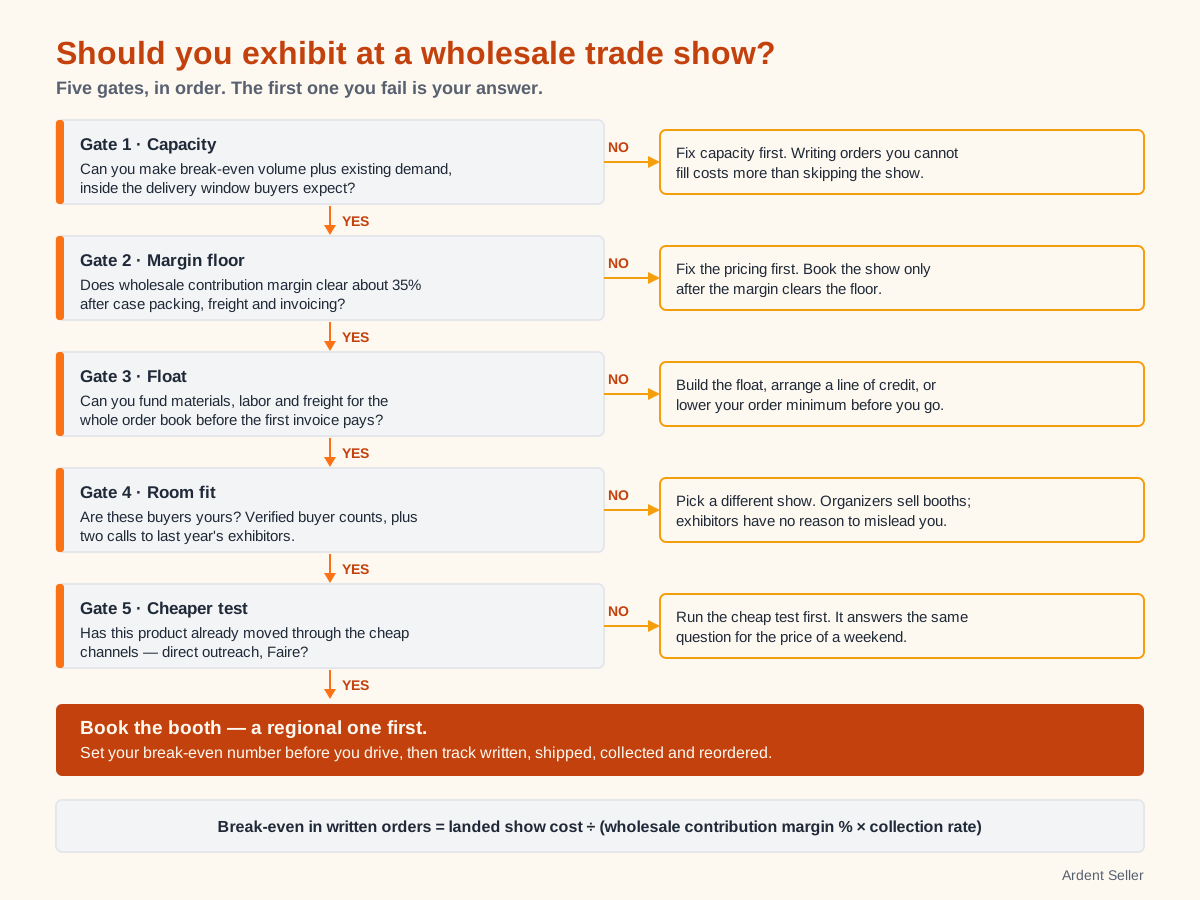
The five gates
Run these in order. The first one you fail is your answer — do not proceed to the next gate hoping it rescues the decision.
Gate 1 — Capacity. Can you produce your break-even volume, plus existing demand, inside the delivery window buyers will expect? Not "could you if everything went perfectly." Could you if one supplier is late and you get the flu. If no, stop here. Writing orders you cannot fill is worse than writing none: you burn the account, the referral, and the show's reputation for you all at once. A capacity plan you can hold up against a real order is the point of the Small-Batch Production Planning Playbook.
Gate 2 — Margin floor. Does your wholesale contribution margin survive the wholesale-only costs? Treat 35% contribution margin as a working floor rather than a researched threshold: run the formula above at your own margin and see how many stores the answer demands, because below roughly a third the required order volume climbs out of reach for a first booth. Fix the pricing, then book the show. Not the other way around.
Gate 3 — Float. Can you fund materials, labor, and freight for the full order book before the first invoice pays? A show that succeeds harder than expected can be a fast way to run out of cash, because the costs land weeks before the money does. Count the weeks between shipping and collecting, and make sure you can survive them without the money.
Gate 4 — Room fit. Is the buyer list actually your buyer? Ask for verified buyer counts and last year's exhibitor list, then call two exhibitors from that list who make something adjacent to your product and ask what they wrote. Show organizers sell booths; exhibitors generally have less incentive to oversell the room than the organizer does.
Gate 5 — Cheaper test first. Have the cheaper channels already proved this product moves wholesale? Ten cold pitches to boutiques within driving distance costs you a weekend and some samples. Faire costs a commission instead of a booth deposit — its published North American brand pricing (Faire Help Center (opens in new tab)):
- 15% commission on orders from retailers Faire sends you, plus a one-time $10 new-customer fee
- 15% on their reorders
- 0% commission on retailers you bring yourself through Faire Direct
- a separate payout fee on every order: 3.5% + $0.30 next-day, 2.4% + $0.30 at 30 days, 1.9% + $0.30 at 60 days
Note there is no free payout tier — getting paid sooner always costs more. Verify current rates before you plan around them, but the shape holds: losing 15% of an order you did not fly to is cheaper than losing a $2,000 booth investment. If the cheap channels cannot move your product, a trade show will not fix that. It will just cost more to find out.
Start regional, go national later
The instinct after a good year is to book the biggest show you can afford. Resist it for one cycle.
A regional show costs $650 to $850 for the booth and lets you drive your own freight in the back of a van, which erases the single most unpredictable line item at a convention-center show. You will make every rookie mistake — the booth is too dark, your order minimum is wrong, you brought samples of the thing nobody asked about and ran out of the thing everybody did — in an environment where those mistakes cost hundreds instead of thousands.
Go national when two things are true: you have a regional show's worth of data proving buyers reorder, and you have the production capacity to survive being discovered by a chain. Not before.
Track four numbers so next year's answer is a number
The reason most makers cannot tell you whether a show was worth it is that they measured the wrong thing — total orders written on the day, a number that flatters everyone and predicts nothing.
Track these instead, per show and per account:
- Written — the face value of every order taken.
- Shipped — what actually left your workshop. The gap between written and shipped is your real capacity ceiling, measured rather than guessed.
- Collected — what got paid, and how many days it took. This is your true collection rate for next year's break-even calculation.
- Reordered within 12 months — the only number that decides whether the show was an acquisition channel or an expensive weekend.
That last one is the whole game. A show that writes $9,000 and produces two reordering accounts beats a show that wrote $14,000 and produced none. If your accounts go quiet after the first order, the problem is usually diagnosable and fixable — Why Wholesale Accounts Stop Reordering covers the six usual causes.
This is also where a spreadsheet quietly stops working. A written order is not a sale yet. It is a commitment against future capacity, and it needs to live somewhere that also knows what you have in stock and what you can make. Ardent Seller tracks wholesale orders alongside inventory and production, so the 400-unit question from the buyer in your booth becomes something you answer from a screen instead of from optimism.
If the answer is no this year
Failing a gate is not a verdict on your business. It is a sequencing instruction.
Fail Gate 1 and your next twelve months are about capacity — a second set of hands, a production process that survives being handed to someone else, equipment that removes the bottleneck. Fail Gate 2 and you have a pricing project, not a marketing project. Fail Gate 3 and you need a line of credit or a smaller order minimum before you need a booth. Fail Gate 4 and the work is finding the right room, not paying for the nearest one. Fail Gate 5 and the cheap channels are your next quarter — and if they work, they may make the booth unnecessary rather than urgent.
None of that is glamorous, and all of it is cheaper to fix in your own workshop than in front of a buyer holding your jar and asking about October.
Run the three numbers this week — landed show cost, wholesale contribution margin, collection rate — and you will know whether the deposit is an investment or a very well-decorated donation. If the math clears, book the regional show, set your break-even number before you drive, and track what actually gets collected. Start tracking your wholesale orders free and keep them alongside your inventory and production capacity in one place, so the next time a buyer asks for 400 units by October, you already know the answer.
Related reading
- How to Cold Email Wholesale Buyers — the free alternative to a booth, and the Gate 5 cheap test written out: what belongs in the pitch email, the four-touch follow-up rhythm, and the CAN-SPAM rules that apply to B2B outreach.
- First Wholesale Account: A Decision Tree — six gates for the offer that arrives without a trade show, including the margin cushion floor and the retail price firewall you need before you say yes.
- Wholesale Pricing for Handmade — the pricing math behind Gate 2: MOQs, net terms, and how wholesale and consignment differ once the costs are separated.
- Why Wholesale Accounts Stop Reordering — what to do when the show worked, the orders shipped, and then the second order never came.
Free resources
Free companion downloads if you want to put any of this into practice:
- Wholesale Line Sheet — the one document a buyer will ask for in your booth, with the wholesale and retail pricing math already wired in.
- Small-Batch Production Planning Playbook — for Gate 1, so your capacity answer is a schedule rather than a hope.
- Wholesale Outreach Starter — the Gate 5 cheap test: pitch ten boutiques for the cost of a weekend before you pay for a booth.
This article is provided for educational purposes only and does not constitute financial, tax, or business advice. Booth rates, marketplace commission structures, cost examples, and margin figures are illustrative or current as of publication and will vary by show, channel, and your specific circumstances. Verify current rates directly with the show or platform, and consult a qualified accountant or small-business advisor before making financial decisions based on this content.