
If you have downloaded a business plan template, opened it, scrolled to a heading that said Market Analysis or Competitive Landscape, and quietly closed the tab — that is a reasonable response, and it is not a character flaw. Those templates were built for a business that is asking somebody else for money. You are asking nobody for money. You are trying to work out whether the candles are worth making at $28, and whether you should be doing markets at all next spring.
That question deserves a plan. It does not deserve forty pages.
The short version:
- The long plan exists for lenders and investors. If nobody is underwriting you, you are writing the wrong document.
- The SBA's own lean format is nine boxes on a single page, and it says the thing can take an hour.
- Seven of those nine boxes you can answer today from memory. Two of them — cost structure and revenue streams — carry the whole page, and those are the ones makers fill in with guesses.
- The four numbers that make the page real are cost per unit, gross margin per channel, monthly fixed costs, and the unit count that hits your take-home target. None of them come from a template.
- When a box has no honest answer, write the question and a date. Do not write a sentence.
Who the long plan is actually for
The Small Business Administration publishes both formats and is unusually direct about who each one suits. On its Write your business plan (opens in new tab) guidance, the traditional plan is described as the one to prefer "if you're very detail-oriented, want a comprehensive plan, or plan to request financing from traditional sources," and it notes those plans "can be dozens of pages long."
The lean startup format gets a very different description. Those plans "focus on summarizing only the most important points of the key elements of your plan," and — the sentence worth pinning above your bench — "can take as little as one hour to make and are typically only one page."
That is the federal agency whose job is small business formation telling you that one page and one hour is a legitimate plan.
So the first decision is not how to write the plan. It is whether anyone other than you is going to read it. If a bank, a landlord, a shared commercial kitchen, a grant committee, or a co-packer is going to ask for a document, you will eventually write the long one, and their requirements will tell you what goes in it. Until then, the long version is procrastination with a nice cover page.
The nine boxes, in maker English
The SBA's lean format has nine components. They are written in the vocabulary of a generic startup, which is why they bounce off makers — "key activities" and "value proposition" do not sound like anything that happens in a studio on a Tuesday. Here is each one alongside the question it is actually asking a person who makes physical things by hand.
| SBA component | What it is asking you | Roughly how long it takes |
|---|---|---|
| Key partnerships | Who do you depend on, and what happens the week one of them disappears? | 5 minutes |
| Key activities | What do you actually do that produces money, as distinct from what eats the week? | 5 minutes |
| Key resources | What do you have — equipment, space, certification, and the hours you personally have left after everything else? | 5 minutes |
| Value proposition | Why does someone buy yours at your price instead of the $9 one? | 10 minutes |
| Customer relationships | Is there a mechanism that brings a buyer back, or is every sale a first sale? | 5 minutes |
| Customer segments | Who specifically — gift buyers, self-buyers, wholesale accounts? They are not the same person. | 5 minutes |
| Channels | Where do sales come from, and in what proportion? | 5 minutes |
| Cost structure | What does one unit cost you, and what does the business cost per month whether you sell anything or not? | The rest of the hour |
| Revenue streams | What are your price points, and what is the mix between them? | The rest of the hour |
Notice the time column. Seven boxes are recall. You already know who your wax supplier is and what happens if they stop stocking your fragrance. Writing it down is still worth the five minutes, because a single-supplier dependency reads differently in ink than it does as a background worry — but it is not hard.
The two at the bottom are different in kind. They are arithmetic, they require records you may not currently keep, and they are the reason most one-page plans are worthless. A plan whose cost box says "materials, labor, packaging, overhead" is a list of nouns. A plan whose cost box says $11.16 per unit; $185/month fixed is a plan.
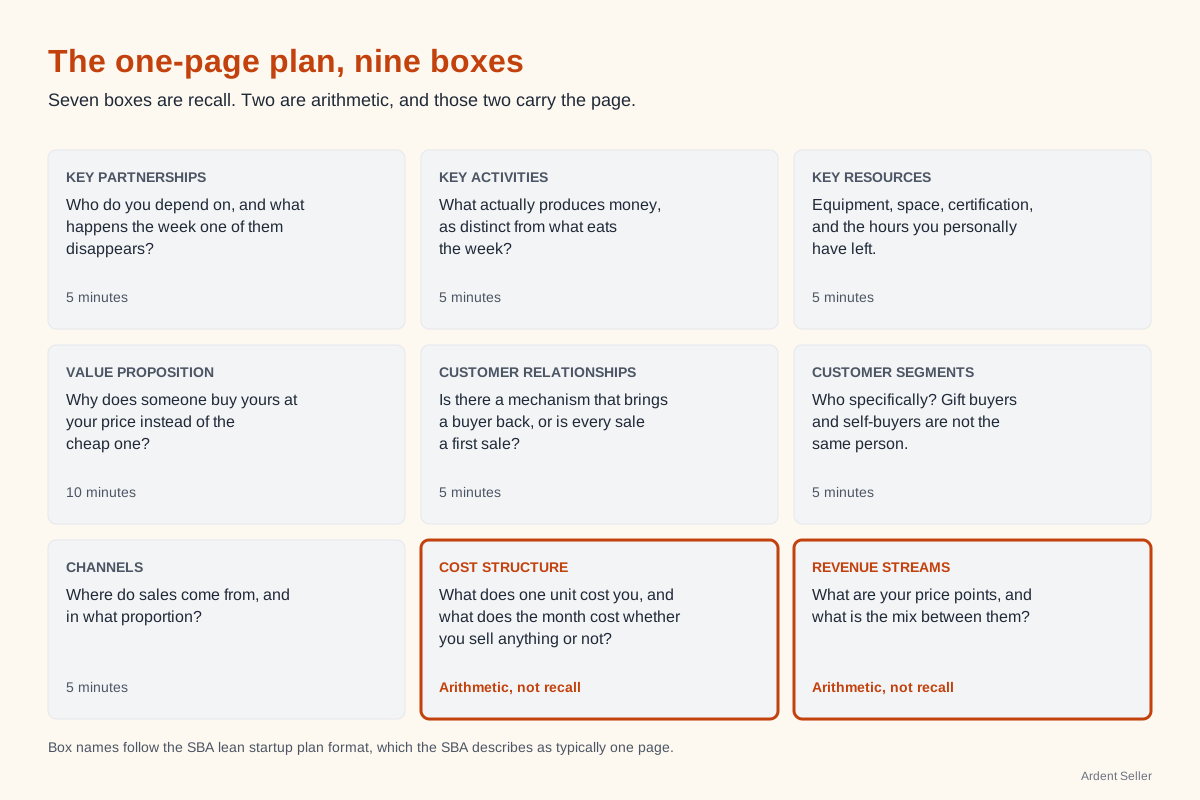
That grid is the template. Print it to work from as a prompt sheet, or rule nine blank boxes on your own paper and copy just the labels across — that second version is the one with room to write in, and the two arithmetic boxes need it. The structure is the whole of it; the rest of this post is about what goes inside.
A filled-in page
Here is the whole page for an illustrative two-year-old candle business selling an 8 oz soy candle. Every figure below is made up for the sake of showing the shape of the arithmetic; yours will differ, and the point is the structure rather than the numbers.
The top seven boxes are short on purpose. A box that runs to a paragraph is a box you are arguing with yourself in.
Key partnerships. One wax supplier, one fragrance house, two vessel sources, the Saturday market organizer. The fragrance house is the single point of failure — three of the four bestsellers use one oil, and there is no second source qualified.
Key activities. Pouring and curing, photographing, packing, standing at markets. Markets consume most of a weekend and produce under a third of revenue.
Key resources. A 12 ft garage bench, two melters, a cure shelf holding about 120 units, product liability cover, and roughly fourteen working hours a week after the day job.
Value proposition. A scent throw that fills a real room, in a vessel people keep and reuse, from someone whose name is on the label.
Customer relationships. Refill discount on returned vessels; nothing else. No email list, no reorder prompt.
Customer segments. Gift buyers (November and December, price-insensitive, want packaging), self-buyers (year-round, repeat, want the scent), and two wholesale accounts.
Channels. Own website, one marketplace, Saturday markets, two stockists.
Already, before a single number, the page has surfaced two things that were true all along and unsaid: the fragrance-house dependency, and a weekend that costs more than it earns. That is the actual work the top half does. It is not documentation — it is the act of writing an uncomfortable clause down where you will see it again in ninety days.
Then the two boxes that carry the page.
Cost structure. One candle, costed to the item:
- Wax: $1.94
- Fragrance oil: $1.62
- Wick and sticker: $0.18
- Vessel: $2.35
- Lid: $0.72
- Label: $0.11
- Shipper box: $0.94
- Hands-on labor, 9 minutes at $22/hour: $3.30
That is $11.16 a unit, labor included. Monthly fixed costs — insurance, software, the shop subscription, an averaged market stall fee — come to $185, and they arrive whether or not a single candle sells.
Revenue streams. Two price points, which is common and also the problem:
- Direct retail: $28, contribution per unit of $16.84
- Wholesale: $14, contribution per unit of $2.84
Now the line that makes the page worth writing. Suppose the owner wants $1,400 a month out of the business, on top of the $22/hour already sitting inside the unit cost. Required gross profit is $1,400 plus $185 of fixed costs, so $1,585 a month.
At retail, that is 95 candles a month. At wholesale, it is 559.
That is not a rounding difference. It is the difference between a busy home studio and a small factory, and it comes from one price decision. The wholesale number is not automatically wrong — volume, cash flow certainty, and not having to stand behind a table on a Saturday all have real value. But a plan that shows those two numbers side by side forces the question that a plan full of prose lets you avoid: at this wholesale price, how many accounts would I need, and do I want that business?
Worth noticing: the wholesale contribution collapses because the labor is honestly costed inside the unit. Price wholesale at twice your materials cost — a heuristic some makers use — and $7.86 becomes $15.72, which looks fine until you remember the nine minutes. Wholesale disappointment often traces back to a unit cost that never included the maker's hands.
The four numbers a template cannot give you
Everything above hangs on four figures, and no downloadable template contains them, because they are facts about your business rather than facts about business.
- Cost per unit, with labor in it. Not materials. The full landed cost of one sellable thing, including the packaging it ships in and the time it takes to make. If you have never produced this number, set aside an afternoon for it, and expect it to come in higher than the guess. The COGS primer here walks through what belongs inside it and what stays out, and if you want to do the sum once by hand before committing it to the page, the free Product Pricing Calculator takes a materials list and an hourly rate and returns the unit cost in the browser.
- Gross margin per channel, after fees. A $28 sale is not $28. Marketplace fees, payment processing, discount codes and the cost of a free-shipping threshold all come off before the margin is yours, and they come off at different rates on different channels. The margin you earn on your own site and the margin you earn on a marketplace are separate numbers and belong in separate rows.
- Monthly fixed costs. The amount the business spends to exist in a month when you make nothing. Insurance, software, storage, listing fees, a booth deposit amortized across the season. This one is easy to undercount, because it arrives in small, unmemorable pieces rather than as a bill.
- The unit count that hits your take-home target. Derived from the three above, and the only number on the page that tells you what to do on Monday.
This is the point where a spreadsheet stops being adequate, not because spreadsheets are bad but because these four numbers move every time you buy supplies at a different price. Ardent Seller computes cost per unit automatically as materials, labor, packaging and equipment flow into a recipe, so the figure in your cost box updates when your wax supplier raises prices instead of when you next remember to check. The Channel Profitability Report splits margin by marketplace, direct and in-person after fees, and the True Hourly Wage Report answers the uncomfortable version of number four: what the craft is actually paying you per hour, computed from the products you really sold.
If a spreadsheet is still giving you all four honestly, keep the spreadsheet. The plan does not care where the numbers come from. It only fails when they are invented.
What to write when a box is blank
You will hit a box you cannot answer. Possibly several. The temptation is to write a sentence that sounds like an answer — "our customers are people who value handmade quality" — and move on with the page looking complete.
Write the question instead, with a date on it:
Customer segments: Do repeat buyers come from markets or from the website? Unknown. Check against the next 60 orders — review 15 November.
That is a better line than any confident sentence you could have invented, for three reasons. It is honest, so the page stays trustworthy. It is actionable, because it names the evidence that would settle it. And it converts the plan from a document into a small queue of things worth finding out.
The same applies to the revenue box when you genuinely have not tested a price. If you have made one of something and never sold it at a real price to a stranger, the revenue line is a hypothesis, and the honest move is to run a test batch before committing a number to the page.
A one-page plan with two open questions and seven real answers is a working document. A one-page plan with nine assured sentences and no arithmetic anywhere is decoration.
Reviewing it, and when you do need the long version
Put a recurring reminder on the first of a quarter. Do not edit the old page — rewrite it from scratch, which takes about twenty minutes once you have done it twice, then put the two versions side by side. The differences are the actual report on your year: the channel that quietly became most of your sales, the wholesale account you kept servicing at $2.84 a unit, the supplier who stopped being a partnership and became a dependency.
Three situations genuinely call for the traditional plan, and all three have the same tell — somebody else's money or somebody else's liability is involved:
- You are applying for financing. The SBA names traditional-source financing as a reason to prefer the long format, and lenders will specify what they want to see. Write to their outline, not to a generic one.
- You are signing a lease or a shared-kitchen agreement. Commercial landlords and shared commercial kitchens frequently ask for projections before they will hold space for you.
- You are bringing in a partner or a first employee. The long plan's real function here is not persuasion. It is making sure two people who believe they agree actually do.
Outside of those, the page is the plan. Print it. Tape it inside a cupboard door where you will see it while waiting for something to cool.
For the cupboard door:
- Cost per unit, with labor in it.
- Gross margin per channel, after fees.
- Monthly fixed costs.
- The unit count that hits your take-home target.
Check all four before you change a price.
You do not need permission to run a business off one sheet of paper. You need the sheet to be true.
Ardent Seller turns the two hard boxes into live figures — automatic COGS as recipes and purchases change, margin split by channel after fees, and a Schedule C view that reconciles the whole thing at tax time. Start free and fill in your cost box with numbers you did not have to guess.
Related reading
- COGS Explained for Makers — the cost box on your page is only as good as your cost of goods sold; this is what belongs inside it and what quietly does not.
- How to Validate a Handmade Product Idea — if the revenue line is a hypothesis, run the test batch that turns it into a number before you commit it to the page.
- Should You Quit Your Day Job? — the decision the unit-count number is usually pointing at, with six questions to answer in writing first.
- 15 Numbers Every Maker Should Know — once the page exists, these are the figures worth checking between quarterly rewrites.
Free resources
Free companion downloads if you want to put any of this into practice:
- Product Pricing Calculator — a spreadsheet version of the cost-per-unit and margin arithmetic the plan's two hard boxes depend on.
- Hobby vs Business: IRS 9-Factor Test — worth running before the first rewrite, because the answer changes what the plan is for.
This article is provided for educational purposes only and does not constitute financial, tax, or business advice. Cost structures, pricing examples, and margin figures are illustrative and will vary by your specific circumstances. Consult a qualified accountant or small-business advisor before making financial decisions based on this content.