Picture a Saturday table at a Missouri farmers market. Sugar cookies in cellophane. Half-pint jars of blackberry jam. A tidy row of dried herb blends. And at the end, because a customer asked for it last week, four jars of tomato salsa.
Three of those four products are squarely inside Missouri's cottage food law. The fourth is not — and it isn't a technicality. Selling that salsa means you are no longer a cottage food production operation with a statutory shield against health department regulation. You are, in the state's own framing, running an uninspected food establishment. The Missouri Department of Health and Senior Services (DHSS) answers this exact question in its Home-Based Kitchen Food Production Guidance (opens in new tab) and does not hedge: salsa "is not a food item exempted by the Missouri Cottage Law."
That gap is the whole story of selling homemade food in Missouri. The state hands you one of the most generous exemptions in the country — no permit, no registration, no inspection, no revenue ceiling, and a statute that forbids your county from regulating your kitchen — and then draws the boundary of that exemption tighter than almost anywhere else. Understanding Missouri means understanding both halves at once.
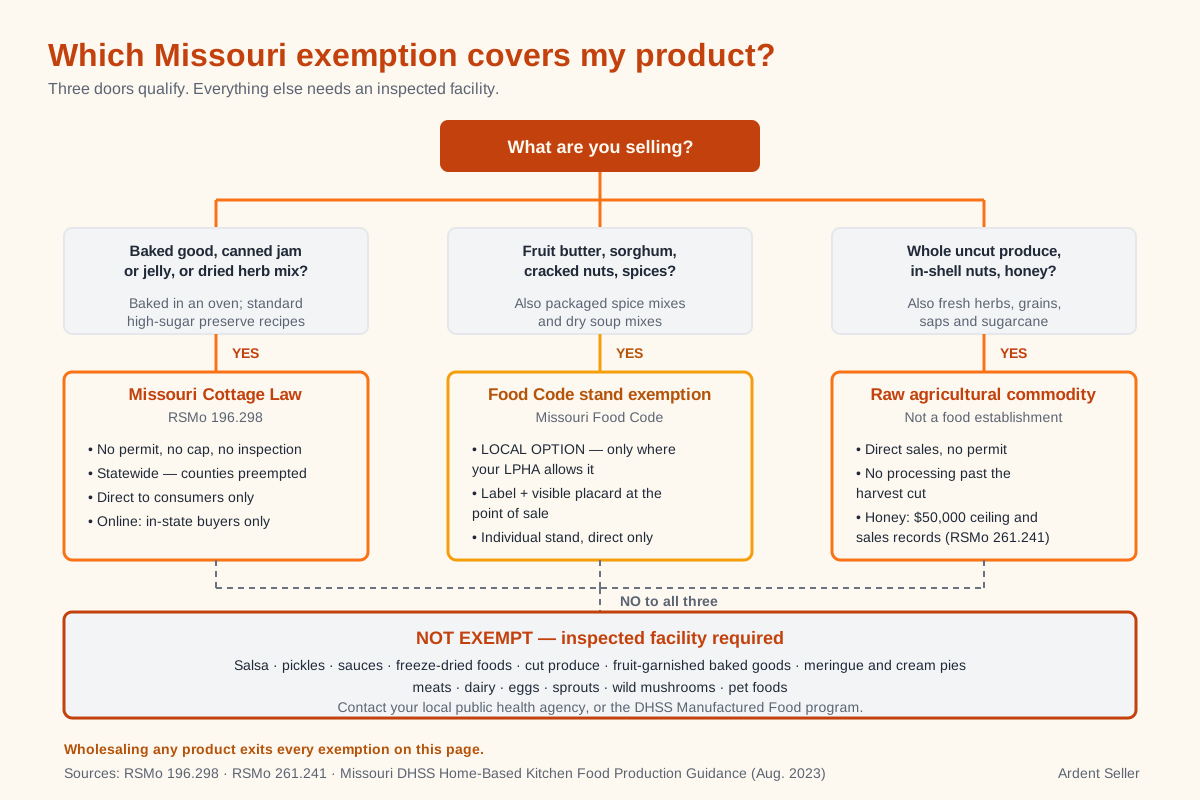
Missouri actually offers three separate doors — three distinct legal pathways to sell home-produced food without an inspected kitchen. Which one you are standing under determines what you may sell, where, and to whom.
The short version
- The cottage law covers three foods. Baked goods, canned jams or jellies, dried herbs and herb mixes — that is the complete list for that exemption. DHSS carves out "No Sugar Added," "Sugar Free," and hot pepper jams and jellies.
- No paperwork. No permit, license, registration, inspection, or required training. Your local health department is barred by statute from regulating your production.
- No cap. The old $50,000 ceiling was repealed effective August 28, 2022.
- Direct to consumers only. No wholesale, no retail shelves, no restaurants.
- You have to be the one selling. Per DHSS, only you or a household member may make the sale — no hired booth staff.
- Online is in-state only. Both you and the buyer must be in Missouri. No interstate shipping.
- Door two. A Missouri Food Code exemption covers other low-risk foods (fruit butters, spice blends, dry soup mixes) where your local agency allows it, with a placard requirement.
- Door three. Raw agricultural commodities — whole uncut produce, in-shell nuts, fresh herbs, honey — have their own exemption, provided you do no processing past the harvest cut. Honey keeps a separate $50,000 ceiling under RSMo 261.241 (opens in new tab).
Door one: the Missouri Cottage Law
The statute is RSMo 196.298 (opens in new tab), and it is unusually short. It was created in 2014 and substantially amended by HB 1697 (opens in new tab), which took effect August 28, 2022 — a date the statute's own legislative history line confirms.
What it gives you
Subsection 2 is the engine of the whole thing:
A cottage food production operation is not a food service establishment and shall not be subject to any health or food code laws or regulations of the state or department other than this section and rules promulgated thereunder for a cottage food production operation.
Subsection 3 then closes the local loophole that trips up sellers in other states: "A local health department shall not regulate the production of food at a cottage food production operation."
Read those together and you get something genuinely rare. In most states, "no permit required" means the state does not issue one, leaving counties and cities free to layer their own rules on top. Missouri wrote the preemption into the statute. DHSS restates it in its Home-Based Kitchen Food Production Guidance (opens in new tab): "There is no food permit or license for cottage food production operations, but products must meet the labeling requirements listed by law."
The 2022 amendment removed the last two real constraints on scale. The $50,000 annual gross income cap is gone — DHSS: "There is no longer a limit to how much a cottage food producer can make annually." And internet sales became legal, subject to one condition in subsection 5: both the operation and the purchaser must be located in Missouri.
What it costs you
The definition in subsection 1 is where the generosity stops. A cottage food production operation is an individual operating out of their home who "produces a baked good, a canned jam or jelly, or a dried herb or herb mix." That is the entire universe of permitted products.
A "baked good" is defined as "cookies, cakes, breads, danish, donuts, pastries, pies, and other items that are prepared by baking the item in an oven," and specifically excludes anything that is a potentially hazardous food.
Roughly speaking, that means a food needing temperature control because it can support the rapid growth of pathogens — unless it is acidic enough or dry enough to hold that growth back on its own. Missouri's Food Code draws the line at a water activity of 0.85 or below, or a pH of 4.6 or below measured at 75°F. That single mechanism explains most of what follows: why dairy and eggs are excluded outright, why a cream pie is, and why changing the sugar in a jam can quietly move it across the line. So the oven is doing real definitional work: a no-bake cheesecake, a confection, a dipped pretzel, and a chocolate bar are not baked goods no matter how home-produced they are.
DHSS is blunt that people try to stretch this. Its guidance warns against treating the law as an "umbrella or all-encompassing term to allow an individual to make any food item out of their home," and states the consequence: "If the food item does not fall under the list of items that can be sold under the Missouri Cottage Law, it cannot be sold or claimed under the Missouri Cottage Law exemption."
The department publishes an explicit list of what falls outside:
- Cut produce
- Baked goods garnished with fresh fruit
- Freeze-dried foods
- Salsa
- Pickles
- Sauces (BBQ sauce, hot sauce, and the like)
- Sprouts
- Wild mushrooms
- Meats
- Dairy
- Eggs
- Pet foods
Two exclusions catch experienced bakers off guard. Baked goods garnished with fresh fruit are out — the strawberry on top converts an allowed product into a disallowed one. And meringue and cream pies are named separately in the guidance as potentially hazardous foods that "will need to be made in an approved and inspected facility."
Jams and jellies have their own trap. The exemption assumes a standard, high-sugar recipe. DHSS names three kinds that are out: "due to changes in the sugar content 'No Sugar Added,' 'Sugar Free,' and hot pepper jams and jellies could have an altered pH or water activity that no longer classifies them as non-potentially hazardous. Because these products vary so greatly, they cannot be sold under the Missouri Cottage Law." That puts hot pepper jelly outside the cottage law, not just the sugar-free versions. DHSS also addresses artificial sweeteners in its Q&A: they "can alter the pH or water activity of the product and may result in a potentially hazardous food item," such a product "will need to be tested," and the seller "must contact their Local Public Health Agency for additional instructions and guidance." The safe reading is that a sugar-free, no-sugar-added, or hot pepper jam or jelly is not a cottage food; ask your local public health agency what route, if any, is open to it.
Recap — Door one
Best for: bakers, jam and jelly makers, dried herb blenders. You get: no permit, no registration, no inspection, no cap, statutory protection from local regulation. You give up: every food outside three categories (including no-sugar-added, sugar-free, and hot pepper jams and jellies), all wholesale, and any sale that crosses the state line.
Door two: the Missouri Food Code individual-stand exemption
Here is the part most Missouri sellers have never heard of, and it is the reason two neighbours can get different answers to the same question.
Separate from the cottage law, the Missouri Food Code contains an exemption that DHSS describes this way — "LPHA" here is your local public health agency, the county or city health department that inspects food businesses where you live: "Where local laws allow, other low-risk non-potentially hazardous foods may be sold from an individual stand direct to consumer without being inspected by the LPHA." The examples the department gives are foods the cottage law does not reach at all:
- Fruit butters
- Sorghum
- Cracked nuts
- Packaged spices and spice mixes
- Dry soup mixes
DHSS adds that freeze-dried, non-potentially hazardous foods such as candy may fall under this exemption where local laws allow, while freeze-dried fruits and vegetables must be processed in an approved and inspected facility. If you make apple butter or a jar of taco seasoning, this — not the cottage law — is the exemption you are relying on. And that distinction matters enormously, because the two doors behave differently.
The cottage law is statewide and county-proof. The Food Code exemption is neither. DHSS explains in its guidance that under Chapter 192, RSMo, local public health agencies (LPHAs) "are granted the authority to adopt local food ordinances that are equal to or more stringent than current state regulations" — that sentence is the department's own summary of the chapter, not a quotation from the statute. DHSS then spells out what it means for this exemption: "If the local agency has their own code, other non-potentially hazardous foods may or may not be exempted from routine inspection."
So whether you can legally sell packaged spice blends from a stand in Missouri genuinely depends on which county you are standing in. Cookies do not. That is the single most useful thing to know about Missouri's framework, and it is why "just check with your local health department" is real advice here rather than a disclaimer.
The Food Code exemption also carries one requirement the cottage law does not: alongside the product label, you need a clearly visible placard at the sales or service location stating that the food was prepared in a kitchen not subject to inspection by DHSS. The same seller rule applies as under the cottage law: DHSS says the food must be sold by the person who prepared it or by a household member with extensive knowledge of the product.
Recap — Door two
Best for: makers of fruit butters, sorghum syrup, cracked nuts, spice blends, and dry soup mixes. You get: a wider product list than the cottage law allows. You give up: the statewide guarantee. This exemption exists only "where local laws allow," and it adds a point-of-sale placard on top of the label.
Door three: raw agricultural commodities
The third path is not an exemption for something you made — it is a category for things you did not process. DHSS lists raw agricultural commodities as unprocessed foods in a raw or natural state: unprocessed whole fruits and vegetables, in-shell nuts, fresh herbs, raw unprocessed fish, grains, saps, sugarcane, and honey. These "may be sold directly to the end consumer without the operation being considered a food establishment."
The boundary is sharp and worth memorizing if you grow anything. Fruits and vegetables qualify "only ... in their whole, uncut form. The only cut that can be done is the harvest cut or removal of the item from the source. Anything after the harvest cut is considered processing and will require inspection."
Whole heads of lettuce: fine. Bagged salad mix: not fine. A pint of whole strawberries: fine. The same strawberries hulled and sliced: not fine.
Honey deserves its own note because two separate rules govern it.
First, pure honey is a raw agricultural commodity, and DHSS says apiaries that "harvest, filter and package their own pure honey on-farm" are not routinely inspected. Four things break that exemption:
- Sending honey off-farm to be packaged.
- Packaging someone else's honey on your site.
- Adding ingredients to the honey.
- Processing it further in any way.
Second, layered on top, is RSMo 261.241 (opens in new tab), which exempts honey sellers from certain health standards on four conditions:
- The honey is bottled in the seller's own domicile.
- The label carries the preparer's name and address, the common name of the food, and all ingredients.
- Annual gross honey sales stay at $50,000 or less.
- The seller keeps a record of "honey bottled and sold," available to the regulatory authority on request.
Which is a small irony worth noticing: Missouri repealed the revenue cap and the sales-record duty for cookies, and left both standing for honey.
One more way door three differs from the other two: it is the only path with any route into a business's back door. DHSS states that "food establishments may obtain Raw Agricultural Commodities directly from farms, even if the farm does not provide documentation of inspection," noting that not all farms are subject to federal food-safety oversight. That is a rule about what a restaurant or grocer is allowed to buy, not a general wholesale license — the moment you process the commodity, you leave the exemption and the ordinary inspection rules apply. But a grower selling whole produce to a local kitchen is on firmer ground than a baker trying to sell cookies to the same kitchen, which the cottage law flatly forbids.
Recap — Door three
Best for: growers, foragers of cultivated produce, and beekeepers. You get: direct sales without becoming a food establishment — and, uniquely among the three doors, farms may supply raw commodities to food establishments without inspection documentation. You give up: any processing past the harvest cut. Honey carries its own $50,000 ceiling and a sales-record duty under RSMo 261.241.
Side by side
| Cottage Law (196.298) | Food Code stand exemption | Raw agricultural commodity | |
|---|---|---|---|
| Applies statewide? | Yes — locals preempted | No — local option | Yes |
| Permit or registration | None | None | None |
| Revenue cap | None | None | None (honey: $50,000 under 261.241) |
| Product label required | Yes | Yes | Honey: yes, under 261.241 |
| Placard at point of sale | No | Yes | No |
| Online sales | In-state only | Not addressed — ask your LPHA | Not addressed — ask your LPHA |
| Wholesale | No | No | No — but food establishments may buy raw commodities farm-direct |
What has to be on the label
The statute itself asks for very little. Subsection 4 requires only "the name and address of the cottage food production operation and a statement that the food is not inspected by the department or local health department."
DHSS guidance expands that into the working list, and this is the version to build your label from:
- Full name and address of the cottage food production operation
- Common name of the food
- Name of all ingredients, in descending order of weight
- Net weight of the food
- List of any allergens in the food
- A statement that the product is prepared in a kitchen that is not subject to inspection by the Missouri Department of Health and Senior Services
Two things about that disclosure statement. First, Missouri does not prescribe exact wording. The statute specifies required content, not a verbatim sentence, which means you will find several different phrasings circulating and none of them is the official one. Anything that plainly conveys "this kitchen is not inspected" satisfies the requirement. Second, if you are selling under the Food Code stand exemption rather than the cottage law, the same six elements apply plus the visible placard at your table.
The allergen item is worth treating as federal, not state, homework. Under the Food Allergen Labeling and Consumer Protection Act (opens in new tab) as amended by the FASTER Act, there are nine major allergens (opens in new tab): milk, eggs, fish, crustacean shellfish, tree nuts, peanuts, wheat, soybeans, and sesame. The DHSS guidance lists the same nine. A "Contains:" statement naming the specific tree nut or fish species is the safest construction.
If you would rather not hand-build labels for every product, Ardent Seller generates cottage food labels from your recipe data with the state's required elements already laid out — including Missouri's operator-supplied disclosure, which it leaves editable precisely because the statute does not fix the wording.
The rules almost nobody quotes
Four requirements sit outside the headline summary and cause more real-world trouble than the food list does.
Only you or your household can sell it. DHSS: "Only the person preparing the food item or a member of their household with extensive knowledge of the food items can sell the cottage food item." The stated reason is that the consumer must be able to get questions answered at the point of sale. Practically, this means you cannot hire a booth worker, cannot hand your inventory to a friend covering the market for you, and cannot drop product with a third party to sell on your behalf.
Worth noting that this particular rule appears in DHSS guidance rather than in the statute, and the guidance opens by stating that it "does not create or confer any rights for or on any person and does not operate to bind federal, state or local food safety regulatory agencies." It reflects how the department reads the law — which is what your local agency will be working from.
Samples are a different activity. DHSS lists "sampling activities" among the things requiring inspection by the local public health agency. In practice this is handled locally and the requirements are concrete: Springfield-Greene County (opens in new tab) charges $144 per year, pro-rated, for a Farmers' Market Permit covering "preparing bite-sized samples or whole portions of potentially hazardous foods at market," and requires a temporary handwashing station with soap and paper towels plus sanitized utensils or gloves for vendors offering samples. Selling a wrapped cookie and handing out a piece of one are not the same regulatory act.
Wholesale ends the cottage law exemption completely. The statute limits you to selling "only directly to consumers." DHSS: "If foods are to be wholesaled, they no longer are exempted by the Missouri Cottage Law." The destination is the DHSS Manufactured Food program, and an operation doing both direct and wholesale "will be inspected by both the LPHA and DHSS Manufactured Food program." There is no gentle on-ramp here — the first pallet to a grocery distributor changes your regulatory category entirely. (The one narrow exception sits in door three, and it is not really yours: a food establishment may buy raw commodities farm-direct, as covered above. Anything you baked, canned, or blended is out.)
Complaints still reach you. The cottage law shields your production from routine regulation, not from investigation. Subsection 3(2) requires every local health department and DHSS to "maintain a record of a complaint made by a person against a cottage food production operation," and subsection 6 preserves the department's authority "to conduct an investigation of a food-borne disease or outbreak." No inspector will knock on a normal Tuesday. If someone gets sick, one will.
The farmers market question, answered honestly
Short answer: yes in practice — but confirm with your local agency before you pay a booth fee. This is the one place where the sources genuinely disagree, so it is worth laying out rather than papering over.
The statutory definition says a cottage food production operation "produces a baked good, a canned jam or jelly, or a dried herb or herb mix for sale at the individual's home." Read strictly, "for sale at the individual's home" describes where the sale happens — and at least one widely used cottage food database reads it that way, listing events, farmers markets, restaurants, retail stores, and roadside stands as prohibited venues (opens in new tab) under Missouri's cottage law.
Three things cut the other way. DHSS's guidance discusses farmers markets at length and never states that cottage foods are barred from them. Local agencies affirmatively say the opposite: Springfield-Greene County's farmers market permit page (opens in new tab) answers "Who does NOT need a Farmers Market Permit?" by putting cottage law first on the list: anyone in Missouri "preparing non-potentially hazardous foods in their home for sale to the end consumer." And Lincoln County Health Department (opens in new tab) tells producers their goods "may be sold directly to the consumer from the home where the products are produced. They may also be sold through farm markets, church bake sales, etc."
The practical answer is that Missouri farmers markets are full of legally sold cottage food and local agencies treat it as permitted. The honest caveat is that the statutory text is what it is, the enforcement happens locally, and the LPHA directory (opens in new tab) exists for exactly this kind of question. A five-minute phone call before you pay a booth fee is cheap insurance.
While you are on that call, ask whether your agency recognizes the Food Code stand exemption. That one really does vary, and it is the difference between selling spice blends and not.
Check the date on everything you read
Missouri's law changed materially in 2022, and a striking amount of published material never caught up.
The repealed $50,000 cap is the clearest tell. It still appears on county health department pages — Lincoln County Health Department's cottage foods page (opens in new tab), as of this writing, states that "cottage food operations can sell up to $50,000 of products per year," a limit removed effective August 28, 2022. If an official county page can carry the old number four years on, an out-of-date handout or vendor packet can too.
It also survives for a legitimate reason, which makes it harder to spot: $50,000 is still a live number in Missouri food law, just for honey under RSMo 261.241. A seller who encounters it out of context has no easy way to tell whether they are reading a stale cottage food cap or a current honey ceiling.
The rule of thumb: if a Missouri cottage food source mentions a revenue cap and is not specifically discussing honey, it predates August 2022 and everything else on the page deserves a second look.
What did not change in 2026
Missouri's framework has been stable since 2022, and the 2026 session did not move it.
HB 3108 (opens in new tab), sponsored by Rep. Bruce Sassmann, was introduced on January 28, 2026 and would have expanded homemade food sales well beyond the current three categories — extending the exemption to a broader class of non-potentially hazardous homemade food, and permitting sales through designated agents and third-party vendors including retail shops and grocery stores, per the official House bill summary (opens in new tab). It was referred to the House Government Efficiency Committee on April 9, 2026. A public hearing was scheduled for April 16 and the bill was not heard.
So the three-category list and the direct-to-consumer limit remain the law. If you have been waiting for wholesale to open up before investing in production capacity, that wait continues.
What to do this week
- Classify your products against the three categories. Not "is this homemade and safe" — "is this a baked good, a canned jam or jelly (other than a no-sugar-added, sugar-free, or hot pepper jam or jelly), or a dried herb mix." Anything that is not gets sorted into door two, door three, or the inspected-facility path.
- Call your local public health agency from the LPHA directory (opens in new tab). Ask two questions: does your agency recognize the Food Code individual-stand exemption, and does it require anything at farmers markets for cottage law sellers. Write down who you spoke to and when.
- Build one label template with all six elements and your own wording for the not-inspected statement. Get it right once and reuse it.
- If you sell anything acidified or canned beyond standard jams and jellies, find a process authority. The AFDO Food Processing Authorities directory (opens in new tab) is the list DHSS points to. Salsa, pickles, and sauces need a validated process and an inspected facility, not a workaround.
- Decide about sampling before market day, not at the table. If you plan to hand out tastes, ask your LPHA what that triggers and budget for it.
- Start a batch log with batch one. Missouri asks you for no records at all, which means the only person who will have them when a customer calls with a question is you. The batch tracking guide covers what to record and why lot codes matter.
That last point is the real shape of the deal Missouri offers. The state has decided not to inspect your kitchen, not to cap your revenue, and not to let your county second-guess either decision. What it has not done is make the underlying obligations disappear. Nobody is coming to check your label, but the label still has to be right. Nobody is auditing your production, but a foodborne illness investigation is still on the table. The absence of oversight is not the absence of responsibility — it just moves the whole job to your side of the counter.
Ready to put your recipes, ingredient lots, and batch records somewhere sturdier than a notebook? Start a free Ardent Seller account and set up your first cottage food product before your next bake day.
Related reading
- Illinois Cottage Food Law — the bordering state with a registration requirement and a far wider food list, worth reading if you are near the river and weighing where to base production.
- Tennessee Cottage Food Law — a neighbour with no cap and no registration that also permits acidified foods, which is the single biggest thing Missouri's three categories rule out.
- Batch Tracking for Food Sellers — how to build the lot-tracking habit that turns a customer complaint into a one-batch question instead of a whole-season one.
Free resources
Two free downloads from the Ardent Workshop library if you want to work through this away from the screen:
- Cottage Food Laws by State — the side-by-side reference for every state's caps, venues, and label rules, useful the moment a customer in Kansas asks you to ship.
- Craft Seller Startup Checklist — the business-side steps that sit beside the food-safety ones: licensing, insurance, recordkeeping, and pricing before your first sale.
This article is provided for educational purposes only and does not constitute legal, regulatory, food-safety, or health advice. Cottage food laws, allowed-food lists, and labeling requirements change frequently, and Missouri's framework is administered locally by public health agencies whose ordinances may be more stringent than state rules. The Missouri Department of Health and Senior Services notes that its own guidance "does not create or confer any rights for or on any person and does not operate to bind federal, state or local food safety regulatory agencies." Consult DHSS, your local public health agency, or an attorney before making compliance decisions.