
If you have run the numbers on going full-time and stopped at the health insurance line — not because the figure was too big, but because you could not work out what the figure even was — this is for you. It is an easy place to stop, and a quiet one. It feels less like a business problem than an admission.
It is a business problem. It has rules, most of them published, and two of those rules changed in ways that land hardest on exactly the people reading this: anyone whose income arrives in uneven lumps. Together, they turn a mistake that used to cost a few hundred dollars at tax time into one that can cost several thousand.
Dana makes soap. She is a composite, not a customer — assembled from the situation these rules create for anyone whose making becomes their whole income. She left a hospital scheduling job in March, kept the wholesale accounts she had built on evenings and weekends, and has spent five months being genuinely good at the part of the business that involves lye and mica, and genuinely lost at the part that involves the word "attestation." Her questions are below, in roughly the order she asked them.
Where do I buy health insurance if nobody employs me?
The individual Health Insurance Marketplace, in almost every case. The dividing line is narrower than most makers assume. HealthCare.gov puts it plainly: "If you run a business that produces income and has no employees, you're considered self-employed," and it adds that "you're not considered an employer only because you hire independent contractors to do some work" (HealthCare.gov, health coverage for the self-employed (opens in new tab)).
So the market stall helper you pay by Venmo and send a 1099 to does not make you a small employer. The part-time packer you put on a W-2 does, and opens up the SHOP Marketplace as an option instead.
Dana has no W-2 employees. She buys the same way an unemployed person buys, which felt insulting for about a day and then stopped mattering.
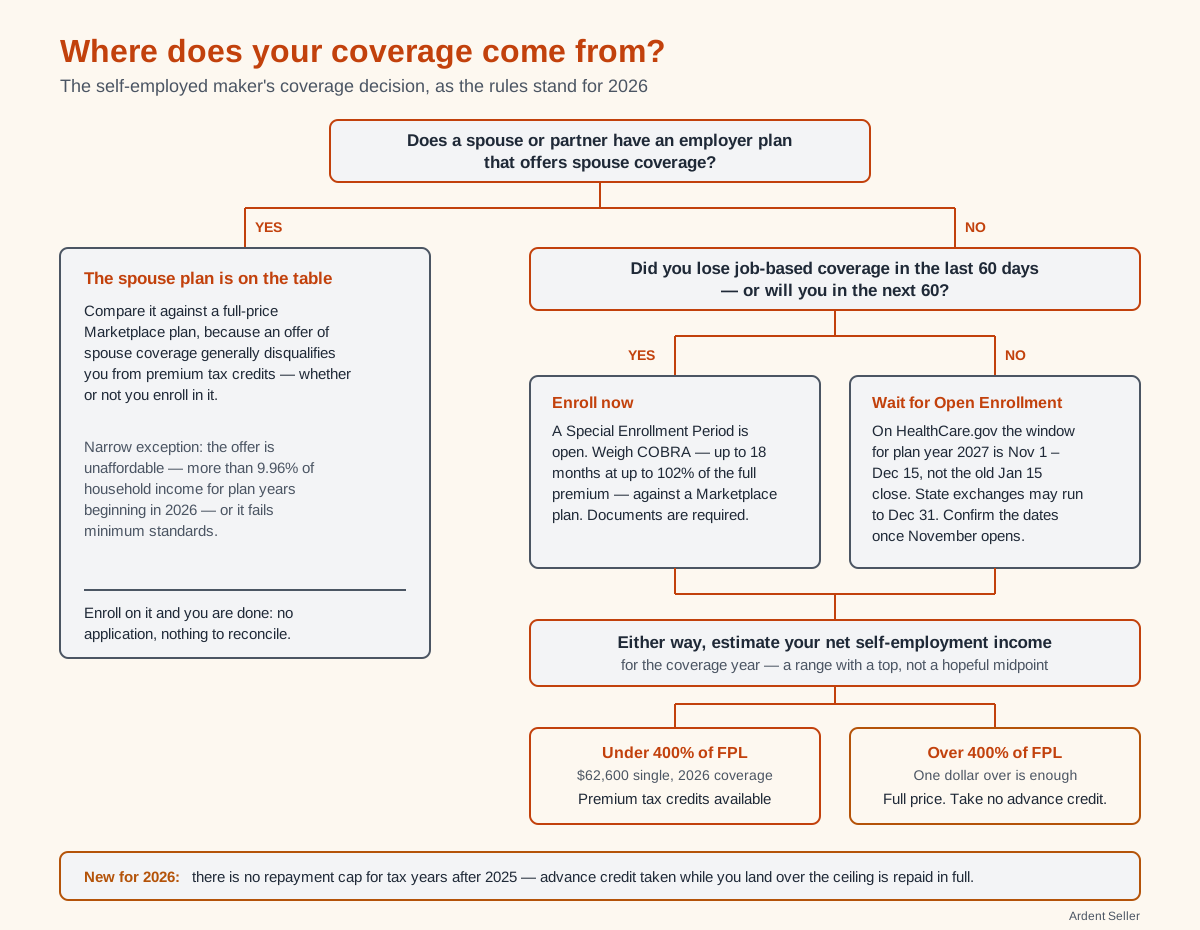
Where that purchase starts depends on two questions, and what it finally costs depends on a third: whether you qualify for a premium tax credit, the ACA subsidy that lowers what you pay — either paid to your insurer month by month, or claimed on your return. The map below is a summary of the whole post, not a preview of the next section; the sections work through its branches in the order the questions actually come up.
What income do I put on the application when I have no idea what I'll make?
Your estimate of this year's net self-employment income. Not last year's, not your revenue, and not a number your accountant will bless in April.
Two sentences from HealthCare.gov do most of the work here. First: "Marketplace savings are based on your estimated net income for the year you're getting coverage, not last year's income." Second, on what "net" means: "Your net income from self-employment is what you report on Schedule C of your federal tax return" — that is, gross receipts minus business expenses (HealthCare.gov, reporting self-employment income (opens in new tab)).
The application is less formal than it looks. When it asks what kind of work you do, the official guidance is to just describe it: "If you make jewelry, enter 'jewelry making.'" And if the Marketplace cannot match your attested income to IRS data — common for anyone in their first or second year of full-time self-employment — you will be asked to upload a self-employment ledger, which HealthCare.gov (opens in new tab) defines as "any accurate, detailed record of your self-employment income and expenses. It can be a spreadsheet, a document from an accounting software program, a handwritten 'ledger' book."
Worth noting: there is no standard ledger format, which means the burden is on you to produce something legible under time pressure. A maker who already tracks materials, batches, and sales in one place can export that. A maker whose records live across a bank app, an Etsy dashboard, and a shoebox is going to spend a weekend on it. This is one of the least glamorous arguments for keeping real inventory and transaction records — and one of the ones that actually comes due.
Estimating is the hard part, and it deserves more than a shrug. Dana's honest answer in March was "somewhere between $30,000 and $55,000, depending on whether the two boutiques reorder." That range straddles a line she did not yet know existed.
Why did my premium jump for 2026?
Because a temporary rule expired, and its expiry did two separate things.
From 2021 through 2025, Congress suspended the income ceiling on premium tax credits. The IRS describes it precisely: "For tax years 2021 through 2025, Congress temporarily expanded eligibility for the Premium Tax Credit by eliminating the requirement that a taxpayer's household income may not be more than 400 percent of the federal poverty line" (IRS Fact Sheet 2025-10 (opens in new tab), Q7). That expansion was not renewed. For 2026 the general rule is back: individuals and families may be eligible "if their household income for the year is at least 100 percent but no more than 400 percent of the federal poverty line for their family size."
That is a cliff, not a slope. One dollar over the top of the range and the credit is zero.
| Household size | 2026 coverage (uses 2025 FPL) | 2027 coverage (uses 2026 FPL) |
|---|---|---|
| 1 person | $62,600 | $63,840 |
| 2 people | $84,600 | $86,560 |
| 3 people | $106,600 | $109,280 |
| 4 people | $128,600 | $132,000 |
Figures are 400% of the HHS poverty guidelines for the 48 contiguous states and DC. The 2025 guidelines (opens in new tab) ($15,650 for one person, $26,650 for three, $32,150 for four) govern 2026 coverage; the 2026 guidelines (opens in new tab) ($15,960 for one person, $27,320 for three, $33,000 for four) govern 2027 coverage. Each extra household member raises your ceiling by $22,000 for 2026 coverage and $22,720 for 2027 — that is 400% of the per-person increment in the guidelines themselves, which is $5,500 under the 2025 figures and $5,680 under the 2026 figures. Alaska and Hawaii use higher figures.
The second effect is subtler. Below the ceiling, the share of income you are expected to pay went back up. Under the 2026 applicable percentage table, a household between 300% and 400% of the poverty line is expected to contribute 9.96% of income toward a benchmark plan (Rev. Proc. 2025-25 (opens in new tab)) — the benchmark being the second-lowest-cost Silver plan in your area, which the Marketplace uses to size your credit whether or not you enroll in it. The expired rule had capped that contribution at 8.5%, and had zeroed it out entirely below 150%.
Before the expiration was certain, KFF projected that average annual premium payments for subsidized enrollees would rise 114%, from $888 in 2025 to $1,904 in 2026 (KFF analysis, September 30, 2025 (opens in new tab)). Treat that as a national average across all subsidized enrollees, not a forecast of your own renewal notice.
What happens if I guess low and then have a good fourth quarter?
This is the change that matters most, and it has been very quietly delivered.
When you take premium tax credits in advance — paid monthly to the insurer to lower what you pay — you reconcile them on Form 8962 at tax time. If your actual income came in higher than you estimated, some of that advance was not yours to keep.
Until 2025, there was a ceiling on how much of it you had to give back. Not anymore. IRS Fact Sheet 2025-10 (opens in new tab), question 31, updated December 23, 2025:
There is no repayment cap for tax years after 2025. For tax years after 2025, you must repay the full amount by which your advance credit payments exceed your Premium Tax Credit.
Read that alongside the returned 400% cliff and the shape of the risk becomes clear. If Dana estimates $48,000, takes advance credits all year, and then two boutiques reorder and a holiday market goes unusually well — pushing her over $62,600 — she does not lose a portion of the credit. She loses all of it, retroactively, for all twelve months, and repays the whole advance as an addition to her tax bill. Nothing stands between her and that number.
The defenses are unremarkable, and they work:
- Estimate toward the top of your plausible range, not the middle. Being over-conservative means a smaller monthly credit and a refund at reconciliation. Being optimistic means a bill.
- Report income changes to the Marketplace when they happen, not in April. The IRS is explicit that doing so "will decrease the likelihood of a significant difference between your advance credit payments and your actual Premium Tax Credit" (IRS Fact Sheet 2025-10 (opens in new tab), Q4). A signed wholesale order is a reportable change in circumstances.
- Take less advance credit than you qualify for. You can elect a reduced advance and claim the balance on your return. Slightly higher monthly cost, no repayment exposure.
- Watch the levers that lower MAGI. Household income for this purpose is modified adjusted gross income (IRS FS-2025-10 (opens in new tab), Q8), so deductions that reduce adjusted gross income (AGI) can pull you back under the ceiling. A 2026 HSA contribution of up to $4,400 for self-only coverage or $8,750 for family coverage (Rev. Proc. 2025-19 (opens in new tab)) is the cleanest one available to most makers, provided the plan qualifies as a high-deductible health plan — for 2026 that means a deductible of at least $1,700 self-only or $3,400 family.
The first three of those depend on knowing your net profit while the year is still happening, not five months after it ends. That is the whole argument. A maker who can pull a current-year profit figure on a Tuesday in October can act on defense 2 or 3 while it still helps. A maker who reconstructs the year each spring finds out at the same moment the bill does.
My spouse has a plan through work. Should I just get on it?
Frequently yes, and the reason is that the alternative is often full price.
HealthCare.gov (opens in new tab): "If your spouse's plan offers coverage to spouses and dependents, in most cases you won't qualify for premium tax credits and other savings on a Marketplace plan." The same page delivers the rule that surprises people, in the parallel context of taking a job: "Once you have an offer of job-based coverage, in most cases you'll no longer qualify for a premium tax credit and other savings on a Marketplace plan. This is true whether you enroll in the job-based coverage or not."
The offer disqualifies you. Declining it does not restore eligibility. There is a narrow exception where the employer's coverage is not affordable or does not meet minimum standards — for plan years beginning in 2026 the affordability threshold is 9.96% of household income (Rev. Proc. 2025-25 (opens in new tab)) — and it is worth running rather than assuming, particularly where the employee's own premium is cheap and the family add-on is not.
Can I deduct the premiums?
Usually, and it is a better deduction than most makers realize: above-the-line on Schedule 1 (Form 1040), line 17, computed on Form 7206. It reduces AGI whether or not you itemize.
Two limits do the real work.
The first is profit. The deduction cannot exceed your net earnings from the business the plan is established under. Premiums of $9,000 against a Schedule C net profit of $6,000 gets you a $6,000 deduction, not $9,000.
The second is the one that catches households. From the Form 7206 instructions (opens in new tab): you cannot take the deduction "for any month you were eligible to participate in any employer (including your spouse's) subsidized health plan at any time during that month, even if you didn't actually participate." That test runs month by month, not year by year — so a maker whose spouse changed jobs in July has two different answers inside one tax year, and needs to know which months are which.
One caution worth flagging to whoever prepares your return: if you bought through the Marketplace and claimed premium tax credits, the deduction and the credit each depend on the other, and the Form 7206 instructions send you to Publication 974 for the iterative calculation. Software handles it. A hand calculation frequently does not.
What about COBRA, health shares, and short-term plans?
Three very different things that get shelved together as "the cheap options." Only one of them is insurance.
COBRA is real coverage — it is the plan you already had. It typically runs up to 18 months, and the plan may charge up to 102% of the cost of the coverage, meaning the employer's share plus your share plus 2% for administration (U.S. Department of Labor (opens in new tab)). That sticker is what makes people flinch, but it is the honest price of what your employer was buying. Its best use is as a bridge: it preserves your deductible progress and your doctors mid-treatment. Note one trap — when COBRA runs out you get a Special Enrollment Period; if you simply stop paying for it, you do not.
Health care sharing ministries are not insurance, and the regulators say so without hedging. The National Association of Insurance Commissioners: they "are not insurance and can't guarantee the payment of claims," they may share funds with members who have health needs but "are not legally required to do so," "State insurance regulators don't supervise HCSMs," and they "do not have to comply with the consumer protections of the federal Affordable Care Act (ACA), like covering treatments for pre-existing conditions or capping out-of-pocket costs" (NAIC consumer guidance (opens in new tab)). People do use them and are satisfied with them. What they are not is something you can sue over a denied claim.
Short-term, limited-duration insurance sits in an unsettled place right now, and you should know that before you shop it. A 2024 final rule limited "the length of the initial contract term to no more than three months and the maximum coverage period to no more than four months, taking into account any renewals or extensions" (CMS fact sheet on the STLDI rule (opens in new tab); the rule itself is at 89 FR 23338 (opens in new tab), April 3, 2024). In a statement dated August 7, 2025, the Departments of Labor, HHS, and Treasury said that "until future rulemaking is issued and applicable, the Departments do not intend to prioritize enforcement actions for violations related to failing to meet the definition of 'short-term, limited-duration insurance' in the 2024 final rules," and encouraged states to take a similar approach (CMS statement, August 7, 2025 (opens in new tab)). In practice: what is available to you depends on your state, and none of it has to cover pre-existing conditions.
I'm reading this in August. What can I actually do right now?
Two things, and one of them has a date on it that has moved.
If you lost job-based coverage in the last 60 days, or expect to in the next 60, you have a Special Enrollment Period and you can enroll today. HealthCare.gov's list of qualifying events also includes marriage, a birth or adoption, and a move to a new ZIP code or county — and it warns that documentation is not optional: "If you don't provide acceptable documents about losing coverage, you won't qualify for a Special Enrollment Period" (HealthCare.gov, Special Enrollment Periods (opens in new tab)).
If you have no qualifying event, your next window is Open Enrollment this autumn — and it is shorter than it used to be. The 2025 Marketplace Integrity and Affordability final rule states that "for Exchanges on the Federal platform, the OEP will run from November 1 through December 15 preceding the coverage year, beginning with the OEP for plan year 2027," with state-run exchanges permitted to start no later than November 1, end no later than December 31, and run no longer than nine calendar weeks (CMS fact sheet on the Marketplace Integrity final rule (opens in new tab)).
Plan year 2027 is the one now approaching. Worth saying honestly: as of this writing, HealthCare.gov's own dates-and-deadlines page still displays the old January 15 close. Consumer pages lag rulemaking. Plan around December 15, and confirm the operative dates on HealthCare.gov's dates and deadlines page (opens in new tab) once November opens.
Between now and then, the useful work is not on a government website. It is working out what your net profit is actually going to be this year, and what it will plausibly be next year — a range with a top, not a hopeful midpoint. Dana ran hers in August rather than November, found that her plausible top was about $9,000 above the cliff, and made a different decision about a fourth-quarter wholesale order than she would have made in the dark. The order still happened. The estimate she filed simply matched it.
That number is not a health insurance question. It is a bookkeeping question that becomes a health insurance question every autumn, and a tax question every April. If you cannot answer it in October, that is the thing to fix first — and it is what Ardent Seller is built to keep answerable, tracking materials, production, and sales in one place so current-year profit is a figure you look up rather than reconstruct.
Health insurance is not the reason to stay in a job you have outgrown. Not knowing your own numbers is.
Related reading
- Should I Quit My Day Job? — The decision this post sits inside: the runway math, the revenue floor, and what else stops arriving on your last day.
- Hobby vs. Business: Taxes and Record-Keeping — Whether the IRS treats your making as a business at all, which is upstream of every deduction discussed here.
- Home Office Deduction for a Craft Business — The other deduction that lowers AGI, and therefore the MAGI figure the Marketplace measures you against.
- Product Liability Insurance for Handmade Sellers — The insurance that protects the business rather than the body, and the one makers more often skip entirely.
Free resources
Free companion downloads if you want to put any of this into practice:
- Small Business Tax Deduction Cheat Sheet — Walks the Schedule C lines that produce the net profit figure doing double duty here: the income you attest to the Marketplace, and the ceiling on your health insurance deduction.
- Quarterly Estimated Tax Worksheet — Its income log gives you a running current-year total, which is the number you need in October to decide whether to update your Marketplace estimate.
This article is provided for educational purposes only and does not constitute legal, tax, insurance, or accounting advice. Premium tax credit rules, poverty-line thresholds, enrollment dates, and state insurance requirements vary by jurisdiction and change frequently — several of the rules described here changed within the last year. Consult a qualified CPA, tax preparer, licensed insurance broker, or a Marketplace Navigator before making decisions that affect your coverage or your tax return.