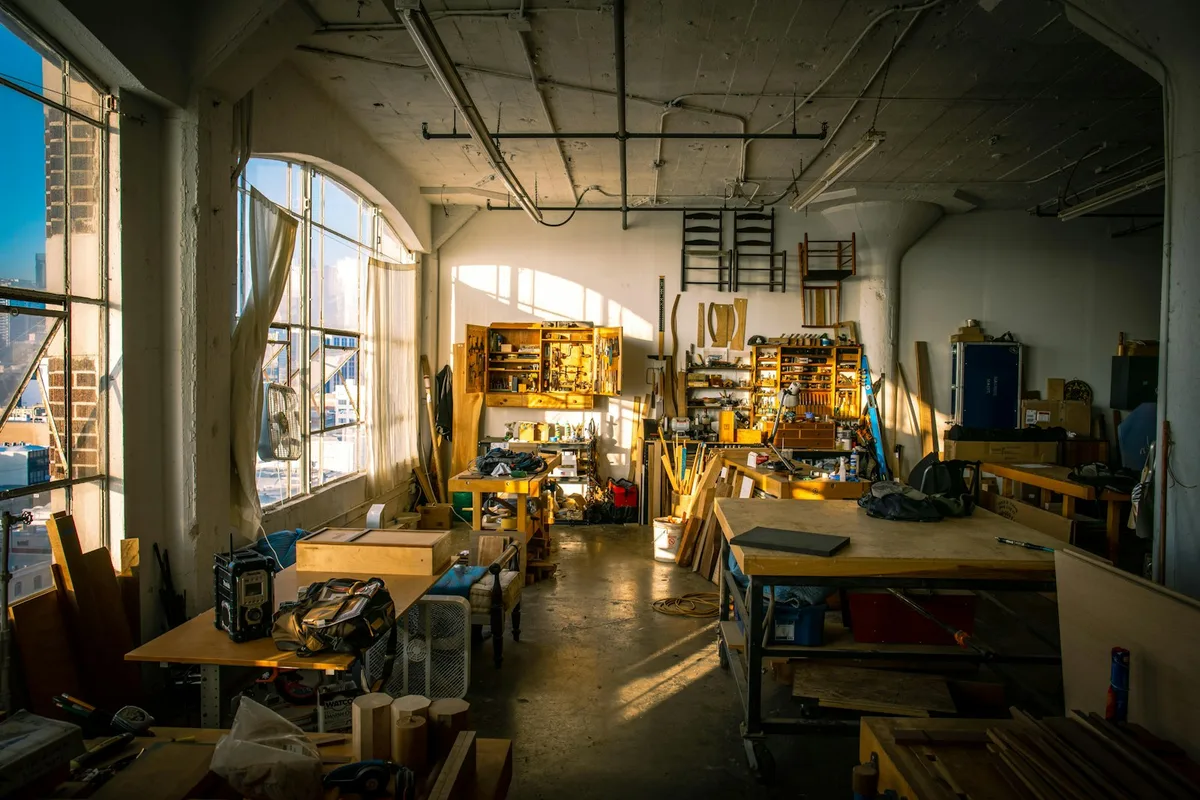
The shop is cold at 6:40 in the morning, the way a detached garage gets cold in a way the house never does. There's last night's sawdust still hanging in the light from the one east window, fine enough that you can see it move. The walnut leaning against the wall smells faintly of the chocolate-and-pencil-shavings thing walnut does. Somewhere behind the bench, the dust collector ticks as it warms up. Nothing here has earned a dollar yet today, and it's already costing one.
That last part is the thing it's easy to run a one-person woodshop for years without ever putting a number on. A day in a small woodshop is full of work that's real — sweat-real, sawdust-real — but invisible on the price tag. Most of what makes a handmade board or a small table expensive isn't the wood. It's the hours that never make it onto an invoice, and the wood that never makes it into the finished piece. So let's follow one of those days, start to finish, and watch where the time and the money actually go.
We'll spend the day with Theo, an illustrative composite — not a real person, but a stand-in for how a one-person woodworking business tends to run a Saturday. He sells cutting boards and small furniture at two markets and through an online shop. He prices most pieces from a common starting point: figure the wood cost, multiply by three, round to something that feels fair. By 6:20 tonight he's going to find out what that multiplier hides.
6:55 a.m. — Choosing the wood, and losing some of it
The first real decision of the day is which boards to cut into, and it's also the first place money quietly leaves the room.
Theo pulls a wide walnut plank for a run of three cutting boards. On paper it's an 8-foot board, about 10 board feet, bought kiln-dried at a price that made him wince at the lumberyard. But a rough board is not the same as usable wood. The last six inches are checked — fine cracks running in from the end grain — so that's offcut. There's a knot he'll cut around. Once he rips it to width and skims both faces flat, the board that measured 10 board feet on the receipt yields something closer to 7 of actual, in-the-piece wood.
What tends to happen is the lumber gets priced at what the receipt says, not at what ends up in the product. Theo's plank lost roughly three of its ten board feet to offcuts, milling, and that checked end — nearly a third of what he paid for, gone before the first glue-up, and still sitting on the receipt.
Then the day's first wrong turn. Theo runs the nicest walnut piece through the planer, and a hairline check he didn't see opens into a real crack halfway down. The board's done. Not catastrophic — maybe six dollars of wood — but it's six dollars that vanished before 7:30, plus the ten minutes spent milling a piece that's now kindling. He grabs a backup, mills it more carefully, and keeps moving. He'll forget this happened by lunch. The price he charges tonight won't remember it either, which is exactly the problem.
8:15 a.m. — Gluing up, and the hour the clamps work instead of you
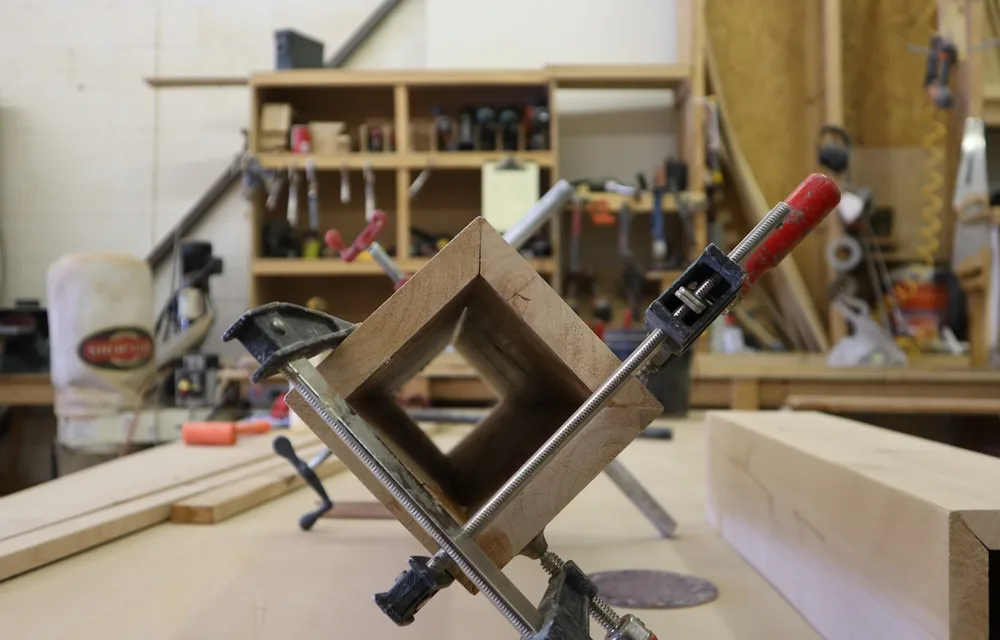
By a quarter past eight the strips are milled, laid out for grain, and ready to glue. The glue-up itself takes twelve minutes of actual handling — spread, align, clamp, scrape the squeeze-out. Then the boards sit in the clamps for an hour while the glue cures, and there is nothing to do but wait.
This is the part of the day that feels like progress and isn't billable. The clamps are working. Theo is not, at least not on these boards. A bigger shop would have three more glue-ups going and a second bench; a one-person shop has one set of hands and a finite number of clamps. So he uses the hour to mill stock for a small shelf commission, which is the right move — but notice what just happened. The cutting boards needed an hour of calendar time that produced no billable labor, and the only way to recover it was to start a second job that now also has to fit into the day.
Throughput in a solo shop isn't limited by how fast you work. It's limited by how many things can cure, dry, or clamp at once while you do something else. That ceiling is invisible until you try to take on a rush order.
Hold that thought. The rush order is coming.
10:30 a.m. — The grit ladder nobody puts on the invoice
The clamps come off, and now the sanding starts. If you want to know why handmade wood costs what it costs, this is the answer, and it's deeply unglamorous.
Each board climbs the grit ladder: 80 to knock down the glue lines and level the surface, then 120, 150, 180, and a final pass at 220 for anything that'll be touched or eaten off. Between grits, a wipe with mineral spirits to raise the grain and catch the scratches the previous grit left. Edges eased, ends sanded, the little router round-over and then hand-sanding where the router can't reach.
For three cutting boards, that's roughly forty minutes of Theo standing at the bench with a sander buzzing in his hand and dust in the air despite the collector. Forty minutes is not a rounding error. It's the single largest block of labor in the whole piece, and it's the one most likely to get waved away as "just sanding" when the price gets set. Sanding rarely shows up as a line item. Customers don't see it. Theo barely counts it himself, because it doesn't feel like the skilled part — the joinery feels skilled, the design feels skilled, sanding feels like chores. But the chores are most of the clock.
12:50 p.m. — The text
Theo's phone buzzes while he's eating a sandwich over the bench, because lunch in a one-person shop happens standing up. It's a repeat customer: Any chance you could do a custom board with my sister's last name engraved, by Friday? It's a wedding gift.
Here's the moment, and it has friction in it.
The easy answer is yes. She's a good customer, it's a nice gift, and "yes" feels like good service. But Friday is three days out, and Theo already has the shelf commission milled and waiting. A custom board means a fresh glue-up (another hour in the clamps he doesn't have free), the full grit ladder again, a finish cure that needs at least a day before it can ship, plus setting up and running the engraving, plus a trip to the post office. The honest cost of "yes" is not the wood. It's that it eats an evening he hadn't sold yet, and it pushes the shelf back.
What Theo almost does is quote his normal cutting-board price plus a flat ten dollars for "the engraving." What stops him — and this is the part that took him a couple of underpriced rush jobs to learn — is remembering that the rush isn't the engraving. The rush is the calendar. A job that has to jump the queue is worth more than the same job with no deadline, because the deadline is what costs him, not the laser.
He texts back: yes, with a rush price that names the real number, and a note that it ships Friday because the finish needs the time. She says yes without blinking. The deadline was worth something to her too. It often is, when you ask.
The deadline is part of what the customer is buying. Price a rush on the slot it takes from everything else you could have made that day — and if you've never charged a calendar premium, you've been handing deadline customers your best margin for free.
2:30 p.m. — Finishing, and the 48 hours you can't sell
Mid-afternoon, the boards get their finish. For food-contact pieces Theo uses a food-safe oil and a wax topcoat — flood the surface, let it soak, wipe back, wait, repeat, then buff. The hands-on time is maybe fifteen minutes a board across the coats. The waiting is the rest.
A freshly finished board can't be wrapped and shipped that afternoon. The oil needs to cure, and the wax needs to set, and rushing it means a customer opens a box that smells like a hardware store. So the boards go on the curing rack for a day or two — longer, depending on the finish and the shop's temperature and humidity — which means today's work becomes sellable inventory on Monday or Tuesday, not today. Cash that's earned but not yet collectible.
The consumables here are small per board and easy to ignore — a few cents of oil and wax, the slice of a $7 sandpaper pack each board used up, the glue, a worn router bit amortized across a hundred pieces. None of it is much. All of it is real, and across a year of boards it's a line item that deserves to exist instead of disappearing into "supplies."
The cost you can see — the wood — is the one you'll remember to charge for. The costs you can't easily see — the consumables, the cure time, the tool wear — are the ones that quietly set your real margin.
4:45 p.m. — One board, boxed
Late afternoon, Theo packs a board from last week's cured batch to ship to an online order. This is its own small lesson in where money goes.
The board is heavy and flat, which the shipping carrier loves to charge for. Between the box, the corner protectors, the void fill, and the tape, the packaging is a couple of dollars before postage. Then dimensional weight makes a flat, dense object cost more to ship than its actual weight suggests. Then the marketplace takes its cut of the sale, and the payment processor takes a slice on top of that. By the time the label prints, a meaningful piece of the sale price has gone to getting the thing from the bench to the buyer's porch — none of it to Theo, and none of it wood.
It's the kind of cost that's almost impossible to feel in the moment of pricing, because pricing happens at the bench and shipping happens at the laptop, and the two never sit in the same column. Until tonight, when Theo finally puts them there.
6:20 p.m. — The twenty minutes that change the price
The shop's swept, the tools are away, and Theo does the thing that actually pays for itself: he sits down and logs the day before he forgets it.
Not a guess — the real numbers. The walnut he cut into, including the board that cracked. The minutes on each operation. The finish and consumables. He runs one board all the way through, the plain $48 cutting board he sells without thinking, and the math comes out uncomfortable.
The wood that ended up in the board, plus its honest share of the cracked piece and the offcuts: call it $13.50. Finish and consumables: about $1.10. If it ships, packaging is another $2.40 and the marketplace and processing fees on a $48 sale run around $5.50 — a combined transaction-and-processing bite of roughly 11%, though the exact rate depends on the platform. That leaves roughly $25.50 of the sale price to cover his labor — and his labor on that board, milling through packing, was about an hour and forty minutes. That's right around $15 an hour. Before a cent toward the shop's electricity, the planer and the saw slowly wearing out, or the cracked board that never sold. Fold those in — roughly, since he's never added them up — and the board he was quietly proud of is paying him something closer to $10 an hour for skilled work he spent years learning.
"Materials times three" told him the board cost about $13.50 to make and $48 was a healthy markup. The day told him the board costs an hour and forty minutes of his life plus a stack of small expenses he'd never written down, and that $48 is a wage he wouldn't accept from anyone else.
This is the value of writing it down while it's fresh. Memory rounds everything toward "that went fine." A log doesn't. When Theo tracks the wood by what actually ends up in the piece, logs the minutes on each operation, and lets the consumables show up as their own lines, the per-board number stops being a feeling and starts being a fact he can price against.
That end-of-day log is exactly the work Ardent Seller's costing tools are built to carry: board-foot usage and waste, the hands-on minutes, finish and hardware as tracked materials, and a true per-piece cost. (Woodworkers can see how it fits together on the Ardent Seller for woodworkers page.) The twenty minutes stops being a worry and turns into a number.
He doesn't change every price tonight. He changes one: the plain cutting board goes from $48 to $62, because $62 is what gets him to a wage he'd actually work for once the invisible parts are counted. It's not a punishment for the customer. It's the first honest price he's set all year.
What a day actually costs
Nothing about Theo's day was wasted. The cracked board, the hour in the clamps, the forty minutes of sanding, the cure time, the trip to the post office — that's not inefficiency, that's woodworking. The mistake was never the work. The mistake was pricing as if the only thing that cost anything was the wood.
If you run a one-person shop and you've never timed a full piece from rough board to boxed, do it once this month. Pick your most common item, write down the minutes and the materials honestly — including the board that cracked — and let the number land. A blank product pricing calculator makes the tally faster if you'd rather not build the columns from scratch. You might keep your price exactly where it is. But you'll be keeping it on purpose, which is a different thing entirely from hoping the math works out.
The wood is the part everyone sees. The hours are the part that pays you. Start counting both: create a free Ardent Seller account — no credit card required — and build a price that pays for the whole day, not just the part that smells like walnut.
Related reading
- Woodshop Lumber & Pricing Math — The costing how-to behind this story: turn board-foot waste and build time into a project cost sheet that actually prices the whole job.
- The True Hourly Wage of a Maker Business — Take tonight's "$15 an hour" reveal and work it backward into a target rate you can price against.
- Equipment Depreciation for Makers — The planer and the saw slowly wearing out is a real cost; here's how to fold tool depreciation into every quote instead of pretending the machines were free.
Free resources
A couple of free tools from the Ardent Workshop library that pair well with this post:
- Maker Hourly-Rate Pricing Calculator — Turn the "what am I actually earning per hour" question from tonight's log into a target price you can set with confidence.
- Product Pricing Calculator — Build a per-piece price that already accounts for materials, labor minutes, consumables, and marketplace fees.
This article is provided for educational purposes only and does not constitute financial, tax, or business advice. Cost structures, pricing examples, and margin figures are illustrative and will vary by your specific circumstances. Consult a qualified accountant or small-business advisor before making financial decisions based on this content.