The garage smells like roasting cacao — a deep, faintly winey warmth that a stranger would swear was baking brownies. A repurposed convection oven ticks in the corner. On the bench, a stone melanger has been turning the same batch for thirty-six hours, its granite wheels dragging through a pool of chocolate that started the week as a burlap sack of beans from a co-op in Tanzania. Everything about the scene says ingredient. The whole room is perfumed by the one thing the customer thinks they're buying.
Which is why the number can catch you off guard. In a representative small-batch bar, the cacao — the actual beans, the thing this entire craft is named for — costs the maker somewhere around seventy cents. On a bar that sells for twelve dollars, the beans are a rounding error. What costs real money is everything the beans have to pass through on their way to a wrapper.
Here is the whole stack, one 2 oz bar at a time.
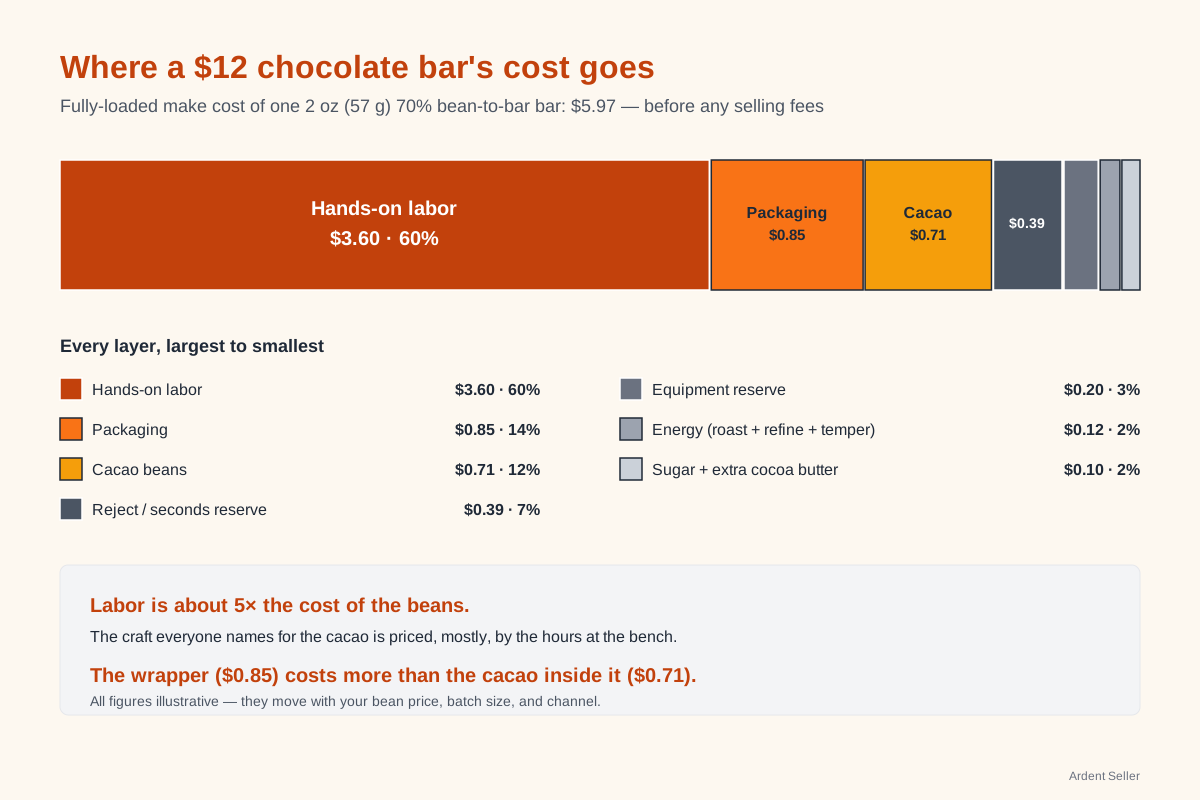
The short version: For an illustrative 2 oz (57 g) 70% bar, the fully-loaded cost lands near $6.00 — about half of a $12 retail price. Cacao beans are roughly $0.71 (12%). Hands-on labor is about $3.60 (60%). Even the packaging, at $0.85, costs more than the cacao inside it. Price off the beans alone and you're working for free without noticing.
Meet the maker, and the math
To keep this concrete, meet Dominic — an illustrative composite of the bean-to-bar makers this post is written for. He roasts and refines at home, sells a few single-origin 70% bars at a Saturday market and a handful online, and buys direct-trade specialty beans at about $14 per kilogram — a level that reflects how far cocoa has run above its long-run average since it hit an all-time high in late 2024 (opens in new tab) after poor harvests in Ivory Coast and Ghana. Every figure below is illustrative and built around him; your own numbers will move with your bean price, your batch size, your packaging, and your channel.
The bar we'll cost is a plain 70% dark bar: 70% cocoa, 30% sugar, with a touch of extra cocoa butter to smooth the snap. Two ingredients and a garnish of a third. It could not be simpler. That simplicity is exactly what makes the labor so easy to overlook.
Start with the bean — and the shell you throw away
The first thing costing chocolate teaches you is that a kilogram of beans is not a kilogram of chocolate. Between the sack and the bar, a meaningful fraction of what you paid for goes in the compost.
Roasting drives off moisture. Then winnowing — cracking the roasted beans and blowing away the papery shell — removes another slice, because the shell is inedible husk you can't sell and can't use. Add the flat, moldy, or debris-flecked beans you hand-sort out before roasting, and you can lose roughly a fifth of the bean's weight before any of it becomes chocolate — the exact share varies with your beans, your roast, and how aggressively you winnow.
Worked example 1: how many beans per bar
- A 2 oz bar is 57 g. At 70% cocoa, that's 40 g of cocoa mass and 17 g of sugar.
- Because roughly 22% of the raw bean is lost to moisture, shell, and sorting, usable nibs are only about 78% of raw-bean weight.
- So the raw beans needed = 40 g ÷ 0.78 ≈ 51 g of beans per bar.
- At $14/kg, that's 51 g × $0.014 = $0.71 of cacao per bar.
Seventy-one cents. Notice what just happened: if you'd costed the beans at their raw weight — 40 g instead of 51 g — you'd have undercounted the cacao by more than a quarter, because you'd have quietly assumed the shell was free. It isn't. You paid for it by the kilogram and then swept it off the bench.
What actually goes into the bar
Add the sugar and the finishing cocoa butter, and the full ingredient cost is still almost nothing.
Worked example 2: ingredient cost per bar
| Ingredient | Amount | Cost |
|---|---|---|
| Cacao beans | ~51 g @ $14/kg | $0.71 |
| Organic cane sugar | 17 g @ ~$2.50/kg | $0.04 |
| Extra cocoa butter | ~3 g @ ~$20/kg | $0.06 |
| Total ingredients | $0.81 |
Eighty-one cents of edible material in a twelve-dollar bar. If the story ended here, chocolate would look like easy money. It doesn't end here, because a bare disc of tempered chocolate sitting on a bench is not a product yet. It's an ingredient that has spent a lot of time and electricity becoming itself, and it still has to be wrapped, and someone has to have made it.
The costs that aren't chocolate
Three lines have nothing to do with cacao and together dwarf it.
Packaging. Craft chocolate lives or dies on the shelf by its wrapper, and buyers expect something worthy of a $12 price. A printed outer wrapper or sleeve, plus an inner foil or glassine to keep the bar from blooming, runs Dominic about $0.85 per bar. Read that number against the $0.71 of beans and sit with it for a second: the wrapper costs more than the cacao it wraps. That's not a mistake — it's what the wrapper actually costs, and it's easy to miss when you price off the beans alone.
Energy. Roasting, then a day-and-a-half of the melanger grinding, then tempering, all draw power. Spread across a batch it's small — call it $0.12 per bar — but it's real, and it's one of the easiest lines to leave off the page.
Equipment reserve. The roaster, the winnower, the melanger, the tempering setup, the polycarbonate molds — a modest home operation has a few thousand dollars of gear that wears out and will need replacing. If you set aside a reserve for it rather than pretending the machines were free, it lands around $0.20 per bar. (Figure $4,500 of equipment over a three-year life; at about 7,500 bars a year, that's $4,500 ÷ ~22,500 bars over the three years ≈ $0.20 a bar.)
Ingredients plus these three non-chocolate lines: $0.81 + $0.85 + $0.12 + $0.20 = $1.98 per bar, before a single minute of labor.
The hours that go unpriced
Then there's the part of chocolate that no machine has taken over: the person standing at the bench for the better part of a day.
A bean-to-bar batch is not passive. Someone hand-sorts the beans. Someone runs the roast and watches it. Someone cracks and winnows, weighs and loads the melanger, comes back to add the sugar, checks it over the hours it turns. Then, at the end, someone tempers the chocolate by hand — the fussiest step in the whole craft, the one that decides whether the bar snaps or crumbles — molds it, cools it, unmolds it, and wraps and labels every single bar one at a time. The melanger's day and a half is passive. The work around it is not.
Worked example 3: labor per bar
- One melanger run yields about 40 finished bars.
- Hands-on labor across the batch — sorting, roasting, winnowing, tending the refine, tempering, molding, wrapping, labeling — comes to roughly 6 hours. (The 36 hours of melanging in between is unattended; only the hands-on time counts.)
- At a real wage of $24/hour, that's 6 × $24 = $144 of labor per batch.
- Divided across 40 bars: $144 ÷ 40 = $3.60 per bar.
Three dollars and sixty cents of labor. That is five times the cost of the beans, and it is the single largest line on the sheet by a wide margin. This is the number that decides whether a chocolate business is a business or an expensive way to donate your Saturdays. Skip it — and it's easy to skip, because your own time doesn't show up on any receipt — and the bar looks wildly profitable right up until the year ends and there's nothing in the account.
The bars you can't sell
One more line, and it's the one that separates a hopeful estimate from a real cost: not every bar makes it out the door.
Chocolate blooms. Temper fails and a batch turns dull and streaky. A mold comes out with an air bubble or a chipped corner. A wrapper creases. None of these bars are sellable at full price, and some aren't sellable at all — but you already paid to make them. Fold in a modest reject and seconds reserve of about 7% on the roughly $5.58 of cost so far — the $1.98 of materials, packaging, energy, and equipment plus $3.60 of labor — and it adds roughly $0.39 per bar.
Putting it together: the true cost of a $12 bar
Stack every line and the plain 70% bar looks like this:
| Cost layer | Per bar | Share of make cost |
|---|---|---|
| Cacao beans | $0.71 | 12% |
| Sugar + extra cocoa butter | $0.10 | 2% |
| Packaging | $0.85 | 14% |
| Energy | $0.12 | 2% |
| Equipment reserve | $0.20 | 3% |
| Hands-on labor | $3.60 | 60% |
| Reject / seconds reserve | $0.39 | 7% |
| True cost per sellable bar | $5.97 | 100% |
About six dollars to make a bar that retails for twelve — and that's before a cent of selling cost. The cacao that gets all the attention is 12% of it. Labor is 60%. The wrapper outweighs the beans. Once you've seen the stack this way, "the chocolate is expensive" stops being the story; the hours are the story.
Worked example 4: what's left after the channel
The $12 price does different things depending on where the bar sells.
- At the Saturday market: $12.00 − $5.97 = $6.03 gross profit, about a 50% margin — before you spread the booth fee across the day's bars.
- Online (marketplace): subtract roughly $1.59 in fees on a $12 sale — for Etsy (opens in new tab), about 6.5% transaction ($0.78), 3% + $0.25 payment processing ($0.61), and a $0.20 listing fee (rates as of 2026; confirm current fees). That leaves $12.00 − $5.97 − $1.59 = $4.44, a 37% margin — and that's before the insulated, ice-packed shipping a chocolate bar needs in July, which suppresses conversion even when the buyer pays for it.
Same bar, same cost, two different businesses. Which is the whole argument for knowing the $5.97 cold: you can't tell whether a channel is worth it until you know what the bar costs to put in the box.
Where this gets easier to see
This table is easy to skip building, because the numbers live in five different places — the bean invoice, the packaging order, the utility bill, the wage you never pay yourself, the batch that bloomed. Costing a bar by hand means chasing all of them down and redoing the math every time your bean price moves. And in a market where cacao has been anything but stable, it moves.
This is the kind of bookkeeping Ardent Seller is built to carry. You enter a bar as a recipe — its beans, sugar, cocoa butter, packaging, and the labor time per batch — and it holds the true per-unit cost for you, recalculating the moment a bean price changes or a supplier raises the wrapper cost. Batch tracking ties each run of 40 bars back to the exact lot of beans it came from, so a reject rate or a yield change shows up as a number instead of a hunch. When the cocoa market lurches again — and it will — you see what it did to every bar's margin without rebuilding a spreadsheet from scratch.
None of that changes what a bar costs. It just means you find out on the day the beans get more expensive, instead of at the end of a year you can't get back.
The craft is in the roast, the temper, the origin you chose to champion. The business is in knowing that when someone hands you twelve dollars, six of them were already spoken for — and only seventy cents of that was ever really about the chocolate. Cost your bars like the labor counts, because it does, and price so the Saturdays are worth it.
Ready to see what your bars actually cost? Start free with Ardent Seller and build your first bar's cost in an afternoon.
Related reading
- Recipe Costing 101 — The five cost categories every maker should roll into a unit cost, with the labor and overhead lines that are easy to leave out — the foundation the chocolate math above is built on.
- Your True Hourly Wage — If labor is 60% of a bar, the number that actually matters is what you're paying yourself per hour. Here's how to find it.
- The Bean-to-Bar Chocolate FAQ — Licensing, cottage-food eligibility, and the practical questions of selling chocolate, once you know what a bar costs to make.
Free resources
A few free downloads from the Ardent Workshop library that pair well with this post:
- Recipe Cost & Pricing Calculator — Build a bar's cost the way this post does — ingredients, packaging, labor, and reserves — and see the margin fall out at any price.
- Hourly Rate Pricing Calculator — Put a real number on the 6 hours a batch takes so your labor stops being the invisible line.
This article is provided for educational purposes only and does not constitute financial, tax, or business advice. Cost structures, pricing examples, and margin figures are illustrative and will vary by your specific circumstances. Consult a qualified accountant or small-business advisor before making financial decisions based on this content.