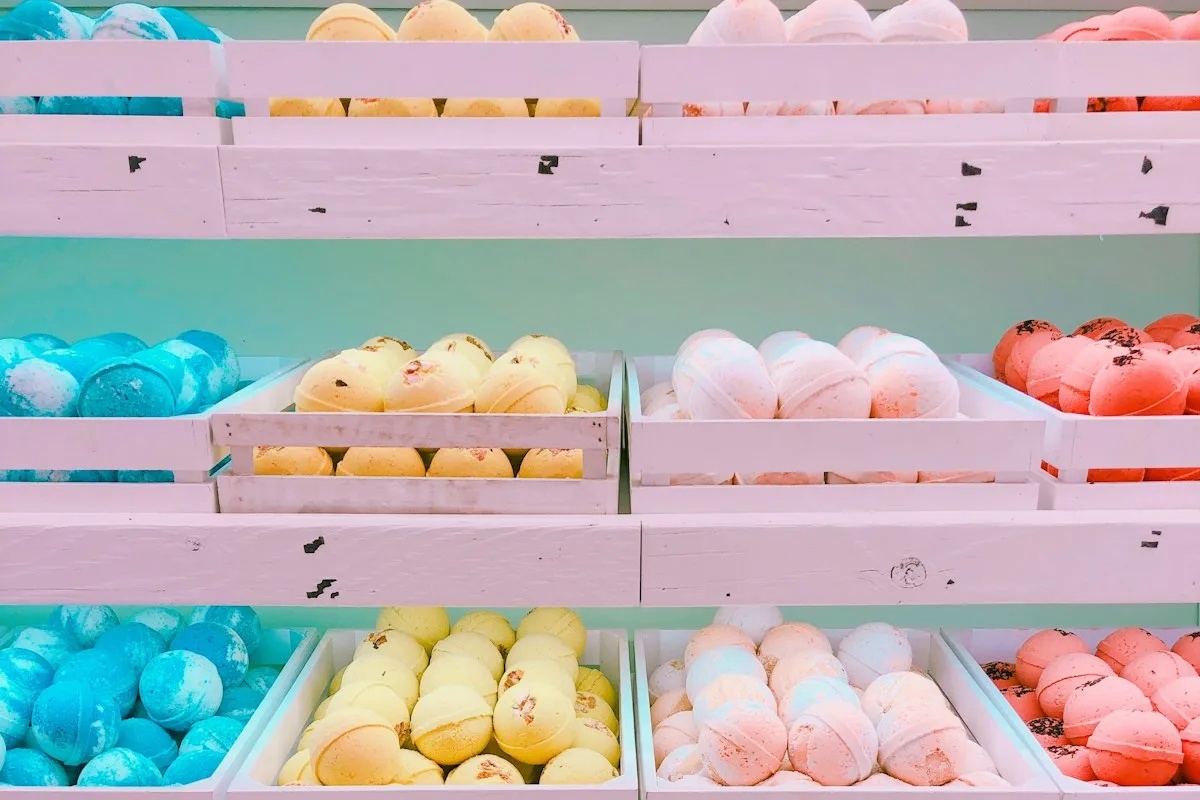
You priced your 4.5-ounce bath bomb at $7. The baking soda and citric acid inside it cost you maybe 55 cents. Margin city, right?
Then add the mica, the fragrance oil, the polysorbate, the shrink wrap, the kraft box, the label, the batch that cracked last Tuesday, and the twelve minutes you spent pressing and wrapping. Suddenly that $7 bomb is netting you closer to $1.80 — and less than that if it arrives in three pieces because the post office played soccer with your mailer.
Bath bombs are one of the most deceptive products to cost. The headline ingredients are dirt cheap, so it feels like you're swimming in margin. The expensive parts hide in the corners: the colorant you use a teaspoon of, the fragrance you pour by feel, the packaging that quietly costs more than the product, and the failed batches that rarely make it into the costing at all.
Here are the eleven mistakes that do the quiet damage — and what to do instead. None of them require an accounting degree. They require knowing what actually goes into the bomb, and weighing it.
The short version: In a bath bomb, the cheapest-looking ingredients — baking soda and citric acid — are not the ones that decide your margin. The real cost hides in fragrance, colorants and additives, packaging, your own labor, and the failed batches that never make it into the math at all. Each mistake below trims a few points off your true margin, and together they can quietly halve it. Every one comes with a fix. Every dollar figure here is illustrative — your own cost sheet will land somewhere different.
1. Costing only the baking soda and the citric acid
This is the original sin of bath bomb pricing. You cost the two ingredients that make up most of the weight, see a number under a dollar, and call it done. The problem is that the two cheapest ingredients by weight are nowhere near your two most expensive ingredients by cost.
A pound of baking soda runs you pennies. A pound of fragrance oil can run you twenty to forty dollars. You use far less fragrance, but the cost-per-bomb of that fragrance often beats the cost-per-bomb of the entire dry base.
The fix: Cost every ingredient that touches the bowl, then divide by the number of bombs the batch yields. Every one. The 30-second shortcut of "it's basically baking soda" is exactly how a bomb you think clears 70% margin turns out to be clearing half that.
2. Pouring fragrance by feel
Fragrance and essential oils are usually the single most expensive line in a bath bomb, and they're the easiest to over-pour. "A few good glugs" is not a measurement. If your recipe calls for, say, 30 grams of fragrance per batch and you eyeball 38, that is a 27% overage on your priciest input — on every batch you pour.
There's a safety angle here too: skin-contact products have recommended maximum usage rates for a reason, and "more scent" past a certain point isn't better, it's an irritant. Costing discipline and skin-safety discipline happen to point the same direction.
The fix: Weigh your fragrance to the gram and write the number on the batch sheet. Pick a target load that's both skin-safe (check your supplier's usage guidance) and costed. Then hit that number every time instead of chasing your nose.
3. Ignoring the "small but mighty" extras
Mica. SLSA. Polysorbate 80. Witch hazel. Kaolin clay. A splash of skin-safe oil or a knob of cocoa butter. Individually, you use a teaspoon or two, so they feel free. They are not free. Micas and skin-safe colorants in particular can rival or even exceed your fragrance cost per gram — especially specialty, high-pigment micas — and the fancy biodegradable glitter often costs more still.
Rule of thumb: If an ingredient is expensive per gram, it does not matter that you use only a little — cost it anyway. The small jars are where a surprising share of your true cost hides, precisely because you reach for them in pinches.
The fix: Build the recipe once with every additive priced in, including the ones measured in pinches. You do the work a single time; after that, the per-bomb cost updates itself whenever your supplier prices change.
4. Measuring by scoop instead of by weight
Volume measurements lie. A "scoop" of citric acid is a different mass on a humid day than a dry one, and a heaping scoop is a different cost than a level one. When you measure by volume, you can't actually know your cost per bomb — and you can't reproduce a batch that came out perfectly, which means more cracks and crumbles (see mistake #5).
The fix: Weigh everything in grams or ounces, including the water or witch hazel. A $25 kitchen scale pays for itself in consistency alone. Once you weigh, your costing becomes exact instead of approximate, and your reject rate drops as a bonus.
5. Never costing the failed batches
This is the big one, and it is the easiest to skip. Bath bombs crack, crumble, stick in the mold, and turn to powder if the humidity is wrong. Say you press 100 bombs and 12 are unsellable. Your real cost per sellable bomb is not the batch cost divided by 100 — it is divided by 88. That is a 14% jump in true cost that never shows up if you only cost perfect units.
Take a maker we'll call Dana — a composite character whose numbers are illustrative. Suppose Dana costs her bombs at 88 cents each based on a perfect batch and prices accordingly. Her actual yield runs around 85%, dropping closer to 75% in summer humidity, and she gives away or remakes the rejects without ever writing them down. Her real cost is over a dollar a bomb before packaging. She is not bad at math. She is costing a batch that only exists on paper.
The fix: Track yield per batch — units pressed versus units sold. Divide batch cost by sellable units. If your reject rate is high, that number tells you to fix your recipe or your curing setup before you touch your price. Ardent Seller's production and recipe costing records production runs and finished-good output and makes this automatic: log the batch, log what came out sellable, and your cost per unit reflects reality instead of your best day.
6. Letting packaging cost more than the bomb
Shrink wrap, kraft box, label, tissue paper, the little "ingredients" card, the mailer, the void fill. Add it up and the packaging stack can easily cost more than the bath bomb itself — and unless you've deliberately costed it, it's probably not in your numbers at all.
A bomb that costs you 90 cents to make can easily carry a dollar of packaging once you add a printed box and a label. If you priced off the 90-cent figure, you just gave the packaging away.
The fix: Cost packaging as its own line on every product. List each component with its real per-unit cost (a box of 100 shrink bags divided by 100, not "shrink wrap, like a nickel"). Then decide deliberately which products earn the fancy box and which ship naked in a compostable bag.
7. Buying ingredients at craft-store sizes
The 12-ounce jar of citric acid from the craft store and the 50-pound bag from a soap supplier are not the same ingredient at the same cost. They can be several times more expensive per ounce. If you're costing off retail-size purchases while planning to scale, your numbers will look terrible and your pricing will follow them down.
The fix: Cost off the size you actually buy at your current volume, and re-cost when you size up. The day you move from 12-ounce jars to a 50-pound bag, your margin on that ingredient can climb sharply with no price change at all — but only if your costing reflects the new purchase size.
8. Pretending your labor is free
Mixing, pressing, de-molding, curing, wrapping, labeling, boxing. A bath bomb is touched a lot of times by your hands. If you don't put a number on those minutes, your "profit" is partly just you working for nothing.
You don't have to pay yourself a salary to count labor. You just have to pick an hourly rate you'd accept and divide it across what you actually produce in an hour. If you can press, cure-handle, and wrap 40 bombs an hour and you value your time at $20, that's 50 cents of labor per bomb — in this example, more than the dry ingredients alone.
The fix: Assign an hourly rate, time one honest production session, and load the per-bomb labor into your cost. If the loaded cost makes a product unprofitable, that's not a reason to ignore labor — it's the product telling you to raise the price, batch larger, or retire it.
9. Pricing every size and recipe the same
A 2-ounce mini and a 6-ounce bomb with embeds, a toy inside, and three colors of mica are not the same cost. Neither is your plain lavender bomb and your glitter-bomb-with-a-surprise. When you flat-price across a line, the cheap-to-make products subsidize the expensive ones, and you can't tell which products are actually carrying you.
The fix: Cost each recipe and each size separately, then look at margin per product, not just average margin. You'll usually find one or two SKUs quietly losing money while a boring bestseller keeps the lights on. See how Ardent Seller works for bath bomb makers, tracking cost and margin per SKU instead of per batch — it's what turns "we're roughly profitable" into "this exact bomb earns its shelf space."
10. Eating shipping breakage as a cost of doing business
Bath bombs are fragile and heavy, which is a punishing combination for shipping. Every cracked-in-transit bomb you replace for free is a second unit's full cost — ingredients, packaging, labor, and a second round of postage — booked against the margin of the first sale. Two or three breakage replacements a week adds up to real money by year-end.
The fix: Track breakage and returns as their own loss category, the same way you'd track spoilage. Once you can see the number, you can act on it: better void fill, individual wrapping, a sturdier mailer, or a small "fragile handmade" cost baked into shipping. You can't fix a leak you're not measuring.
11. Giving away samples and markdowns without writing them down
The farmers-market freebies. The "take an extra one" you toss in for a good customer. The end-of-season markdown bin. The influencer PR box. Each one is fine in isolation and invisible in aggregate — until you realize you gave away 200 bombs this year at full cost and called it marketing without ever checking whether it worked.
The fix: Log giveaways, samples, and markdowns as their own line. You don't have to stop doing them — generosity sells. You just have to know the number so you can decide whether it's marketing or just leakage.
Your bath bomb costing checklist
Print this and tape it next to your scale. Before you set a price on any bath bomb, you should be able to answer yes to every line:
- Every ingredient is costed — base, acid, fragrance, colorant, additives, oils, and the stuff measured in pinches.
- Fragrance is weighed to the gram, not poured by feel, with the number on the batch sheet.
- Expensive extras are costed by weight, not by the jar — you know the per-gram cost of your mica and colorants, not just the container price.
- Everything is weighed, not measured by scoop.
- Cost is divided by sellable units, not units pressed — failed batches are in the math.
- Packaging is a separate costed line, component by component.
- Ingredient costs reflect the size you actually buy, and get re-costed when you scale up.
- Labor has an hourly rate loaded into the per-bomb cost.
- Each size and recipe is costed and priced on its own, with margin tracked per SKU.
- Breakage, replacements, and returns are tracked as their own loss category.
- Samples, giveaways, and markdowns are logged with a real cost number, not treated as free.
If you can't answer yes to all eleven today, you're not failing — you're just costing the bomb that exists on a perfect day instead of the one that ships in July. Fix the costing first, and you'll know your real margin per product instead of carrying a vibe about the whole line. The pricing gets easy once the math is honest.
The makers who hold healthy margins on bath bombs aren't the ones with the cheapest baking soda. They're the ones who know — to the cent — what a sellable, wrapped, shipped bomb actually costs them, mica and cracks and all. That number is the whole game. Start tracking your true cost per bath bomb with Ardent Seller and let the recipe do the math while you make the next batch.
Related reading
- Recipe Costing 101 — The foundation under every mistake on this list: how to build a recipe cost that includes the five categories most makers forget.
- Candle Maker Cost Math — The fragrance-load math from mistake #2, worked all the way through for the closest cousin to a bath bomb.
- Pricing Handmade Skincare — Per-drop, per-gram costing for cosmetic products where pennies of mispriced ingredient decide the margin.
Free resources
A few free downloads from the Ardent Workshop library that pair well with this post:
- Recipe Scaling & Batch Calculator — Cost a full batch (additives and pinches included), then divide by sellable units so failed bombs land in the math, exactly like mistakes #1 and #5.
- Product Pricing Calculator — Take the per-bomb cost from the batch calculator, add your markup, and get a retail and wholesale price that holds the margin you're aiming for.
This article is provided for educational purposes only and does not constitute financial, tax, or business advice. Cost structures, pricing examples, and margin figures are illustrative and will vary by your specific circumstances. Consult a qualified accountant or small-business advisor before making financial decisions based on this content.