
Ask three of the most-cited handmade-pricing teachers how to price a product and you will get three different numbers. Mei Pak of Creative Hive (opens in new tab) tells you to start with "at least a 2.2 times markup." Janet LeBlanc, the CPA behind Paper + Spark (opens in new tab), tells you to "stay as close to 4 as possible." And Erin Mooney of Made Urban (opens in new tab) tells you to throw the multiplier out entirely, because a fixed markup "is not based on what your overhead expenses actually are."
No wonder pricing feels impossible. The advice is everywhere, it is confident, and on the surface it contradicts itself.
But line the experts up side by side — read what each of them actually teaches, not the one-line version that gets passed around in Facebook groups — and something more useful appears. The formulas differ. The reasoning underneath them barely does. Four ideas show up in nearly every credible source, and once you see them, the contradictions stop looking like contradictions and start looking like the same lesson wearing different math.
Here is what six respected voices in the handmade world actually teach, where they genuinely split, and what all of that means for the price you set this week.
The short version: the six most-cited handmade-pricing teachers reach for different formulas, but they agree on four fundamentals — cover materials, labor, and overhead (not just materials); treat any formula as a floor, not the final price; price from your own value, not your cheapest competitor; and price to actually pay yourself. The arithmetic they argue about matters far less than those four points of agreement.
The six methods, side by side
Below is each teacher's core approach at a glance — how the method works and who it fits. None of these people are wrong; they are optimizing for different things.
| Source | The method in one line | Best for |
|---|---|---|
| Megan Auman, Designing an MBA | Price from the market's high end down; use costs as a floor underneath | Makers with a real brand or premium audience |
| Mei Pak, Creative Hive | Item cost (supplies + time) × at least 2.2, tuned to perceived value | Sellers who want a fast, adjustable starting number |
| Janet LeBlanc, Paper + Spark (CPA) | (Supplies × ~4) + labor + overhead, built from real figures | Makers who want a price grounded in tracked numbers |
| Erin Mooney, Made Urban | No fixed multiplier — build up every cost, then add profit + markup | Anyone who suspects a tidy formula hides a loss |
| Etsy Seller Handbook | No single formula; cover indirect costs and future plans too | Sellers who want the platform's-eye view |
| Tara McMullin, What Works | A reframe: price to be paid for good work, not just to break even | Makers whose real block is permission, not math |
The cards below unpack each method — including the specific way each one breaks.
Megan Auman — Designing an MBA (opens in new tab): price from the top down. Auman's five-step method starts not with your costs but with the market: "Look for the high end of the marketplace," then calculate costs, then articulate the value you provide. A formula, she says, is only where you begin — "if you've never calculated all your costs before, it's a good place to start" — because "you control your price by showing your customers the value your products provide."
- Best for: makers with a real brand, a distinct look, or a premium audience — anyone whose product is worth more than the sum of its parts.
- Where it breaks: if you skip the costing step underneath it, "value-based" quietly becomes "vibes-based," and you can price high and still lose money on materials you never fully counted.
Mei Pak — Creative Hive (opens in new tab): a flexible multiplier, tuned to perceived value. Pak's formula is compact: Supplies + Your Time = Item Cost; Item Cost × ~2.2 = Wholesale; Wholesale × ~2.2 = Retail. Crucially, the multiplier flexes: "You can set your markup to more than 2 times if you want, as long as your market can bear the higher prices." She is blunt about the cost of pricing too low — you "risk running a loss because you don't have enough money to pay for your marketing," plus the perception you invite: "cheap, poor quality, low value, bargain buy, unmemorable."
- Best for: product-based sellers who want a fast, repeatable starting number they can adjust category by category.
- Where it breaks: the multiplier is only as honest as the "Item Cost" you feed it — undercount your time and every downstream number is wrong.
Janet LeBlanc — Paper + Spark (opens in new tab): the accountant's build-up. LeBlanc, a Certified Public Accountant (opens in new tab) who sold handmade jewelry before building bookkeeping tools for makers, teaches: (Supplies × 4) + Labor + Overhead Rate = Retail Price, with overhead calculated as your annual business expenses divided by the units you expect to sell. Her warning about shortcut formulas is direct — a simpler markup "most likely will not get you a profit… because it leaves out a whole bunch of other fees and expenses." And on nerves: "it's a lot easier to price your product for a profit now, even if it feels too high," and lower it later if you need to.
- Best for: makers who want their price grounded in actual, trackable numbers — and who are willing to know their overhead.
- Where it breaks: it demands data. Without per-product material costs and a real overhead figure, the formula has nothing to stand on.
Erin Mooney — Made Urban (opens in new tab): the case against the shortcut. Mooney is the loyal opposition to the multiply-by-two rule. Her objection is that it "is not based on what your overhead expenses actually are," and that "just because your production costs are high doesn't mean your overhead costs will be too" — so, crucially, "you can't be sure you're profiting or calculate how much you're profiting." Her scrunchie example lands it: double the materials and you get a $3.40 wholesale price on a product that costs $3.50 to make. Her alternative is a full build-up — Materials + Production Wages + Overhead Expenses + Overhead Wages — with profit and markup added deliberately on top.
- Best for: anyone who suspects their tidy formula is hiding a loss.
- Where it breaks: it is more work, and it forces you to confront numbers (your true overhead, your real hourly wage) that a shortcut lets you avoid.
Etsy's Seller Handbook (opens in new tab): there is no one-size-fits-all. Etsy's own guidance sidesteps a single formula on purpose. Its Ultimate Guide to Pricing argues an effective strategy goes beyond the direct costs of producing an item — you also have to address the indirect costs that chip away at your margin, and price toward your future business plans rather than just this month's break-even.
- Best for: sellers who want the platform's-eye view of everything a price has to absorb (fees, indirect costs, growth).
- Where it breaks: it is a framework, not a number. It tells you what to account for, not what to charge.
Tara McMullin — What Works (opens in new tab): pricing is a pay question. McMullin, who writes on creative and small-business work, zooms out furthest — and her contribution here is a reframe rather than a formula. Writing about work and fair pay (not craft pricing specifically), she argues that people doing meaningful work "can do 'good' work and still ask for good pay, clear boundaries, and sustainable conditions." Applied to pricing, the point lands hard: the reflex to underprice is often less a math problem than a permission problem — a quiet belief that passionate work should cost the maker rather than pay them.
- Best for: the maker whose real pricing problem is permission — the one who knows the number should be higher and can't make themselves type it.
- Where it breaks: conviction without costing is still guesswork. Mindset gets you to raise the price; the math tells you how far.
Where they actually agree — the four things worth writing down
Strip away the different arithmetic and the same four convictions show up again and again.
1. Materials are the cheap part. The money leaks out of labor and overhead. Every build-up method — LeBlanc's, Mooney's — adds labor and overhead as explicit lines, and Etsy's guidance hammers "indirect costs" for the same reason. The through-line is that the cost you can see (your supplies) is rarely the cost that sinks you. It's the hour of your time you didn't charge for, and the rent, fees, and packaging spread invisibly across every unit.
2. A formula is a floor, not a final answer. This is near-unanimous. Auman calls the cost formula "a good place to start." Pak says push the multiplier higher "as long as your market can bear the higher prices." LeBlanc says price high now and "lower your price later." Etsy refuses to name a single number at all. No respected teacher tells you the formula is the price — they tell you it's the lowest number you should be willing to accept.
3. Look up, not sideways. A recurring caution is against pricing by copying competitors — Paper + Spark devotes a whole piece to the pitfall of comparing yourself to the competition (opens in new tab). The logic: many nearby sellers may themselves be underpriced, so matching them just locks you into a race to the bottom. Auman's method points the opposite way — study the top of your market and the value you deliver, not the cheapest listing on page one.
4. Underpricing is the default failure — and it compounds. Pak spells out the downstream damage: too little margin means no money for marketing, plus a "cheap, low value" brand perception you then have to fight. McMullin frames it as a livelihood problem: good work should pay the maker, not cost them. LeBlanc notes it's psychologically easier to lower a price than raise one. They arrive from different directions at the same warning: the maker's reflexive price is almost always too low, and the cost of that shows up everywhere later.
Where they genuinely split
Not everything reconciles. Three real disagreements are worth understanding, because which side you land on changes your method.
Multiplier vs. build-up. Pak and LeBlanc are comfortable with a materials multiplier as the engine of the price. Mooney rejects fixed multipliers outright, precisely because a flat number can't reflect your actual overhead. This is the sharpest divide in handmade pricing, and it's less about who's right than about your tolerance for effort: multipliers are fast and approximate; build-ups are slow and exact.
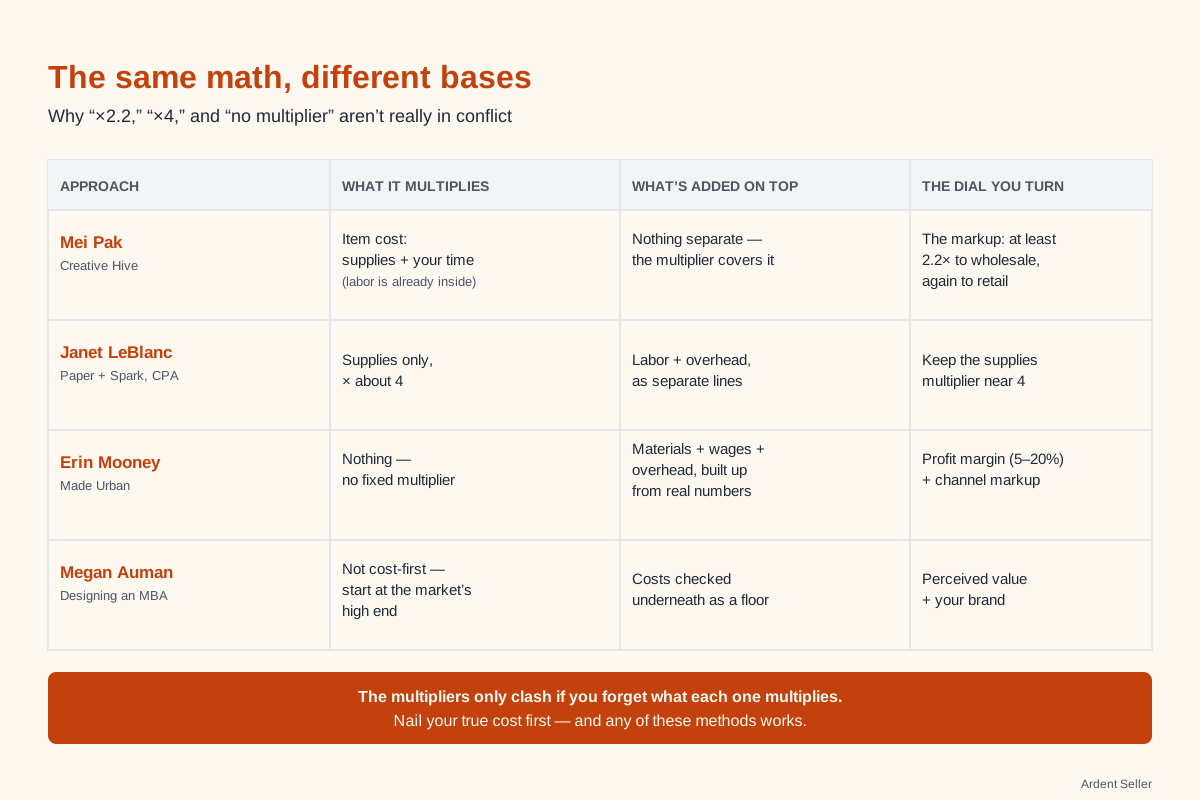
The multiplier number itself — and why it's a mirage. Here is the reconciliation that dissolves half the confusion. Pak's "2.2×" and LeBlanc's "4×" are not two answers to one question — they multiply different things. Pak multiplies your full item cost, including your time, to get wholesale. LeBlanc multiplies supplies alone by four, then adds labor and overhead as separate lines. Run the same product through both and the retail prices land far closer than the raw multipliers suggest. The lesson: never borrow a multiplier without knowing what base it was meant to sit on.
Cost-up vs. value-down vs. pay-first. LeBlanc and Mooney build the price from costs upward. Auman starts from the market's ceiling and works down. McMullin starts from what you need to earn to keep doing the work. All three are legitimate entry points — and the strongest pricing usually triangulates all three rather than picking one.
What this means for the price you set this week
The experts disagree on the arithmetic and agree on the substance, which is oddly freeing: you don't have to pick the "correct" guru. You have to do the thing every one of their methods secretly depends on.
Know your true per-product cost first. Materials at the unit level, a real hourly wage for all the time a product takes, and a fair slice of overhead. Every formula above — multiplier or build-up, value-down or cost-up — is worthless without these three numbers. This is the unglamorous work that makes the rest possible, and it's exactly where a purpose-built tool earns its keep: Ardent Seller tracks materials, labor, and overhead per product so the number you feed into any expert's formula is a real one, not a guess. (A free product pricing calculator will get you the same math for a single item if you'd rather start by hand.)
Use the formula as a floor, then raise your eyes. Set the lowest number that covers everything and pays you. Then ask Auman's question — what does the top of my market charge, and what value justifies moving toward it? — and Pak's — what will my market bear? The floor keeps you solvent; the ceiling is where the profit lives.
Stop pricing sideways. If your method is "look at what similar shops charge and land just under," you have adopted the mistakes of strangers who may be losing money. Price from your costs and your value, and check the market for context, not permission.
Then give yourself permission. McMullin's point is the one no spreadsheet delivers: good work deserves good pay. Once the math says the higher number is right, the last obstacle is usually just the nerve to type it.
Pricing will never feel finished — the experts don't agree, your costs keep moving, and the "right" price shifts with your brand and your market. But the makers who price with confidence aren't the ones who found the one true formula. They're the ones who know their real numbers cold, treat the formula as a starting line, and let the market pull them up instead of down.
Start with the number underneath every method: what your product actually costs you to make. Everything the experts teach is built on top of it. Track your true costs and price with real numbers in Ardent Seller — free to start, no card required.
Related reading
- Why Handmade Businesses Fail — the companion roundup, same format applied to a harder question: six educators on what actually ends a maker business. Three of the teachers quoted here appear there too, and none of them names pricing as the cause.
- Recipe Costing 101 — the costing groundwork every formula in this roundup runs on: how to total materials, labor, and overhead before you pick a method.
- Margin vs Markup — the one arithmetic mix-up that quietly wrecks any of these formulas, and how to convert between the two correctly.
- Against "Just Charge More" — the fuller case behind Tara McMullin's point here: why "just raise your prices" is incomplete advice on its own.
Free resources
If you'd like to put any of this into practice, these free downloads from the Ardent Workshop library pair well with the post:
- Product Pricing Calculator — do the materials-plus-labor-plus-overhead math the experts all insist on, for a single product, before you pick a formula.
- Maker Hourly-Rate Pricing Calculator — settle the number every method leans on: a real hourly wage for your time, so your labor line stops sitting at zero.
- Should I Raise My Prices? Decision Tool — a structured way to answer the question the roundup keeps circling: is your current price a floor you've already outgrown?
This article summarizes pricing guidance published by independent craft-business educators and Etsy's Seller Handbook; each source is linked at the point it is cited. It is general educational information, not financial advice, and the formulas and figures mentioned are illustrations rather than benchmarks. Your right price depends on your own costs, market, and goals — verify the numbers against your own books before you set a price.