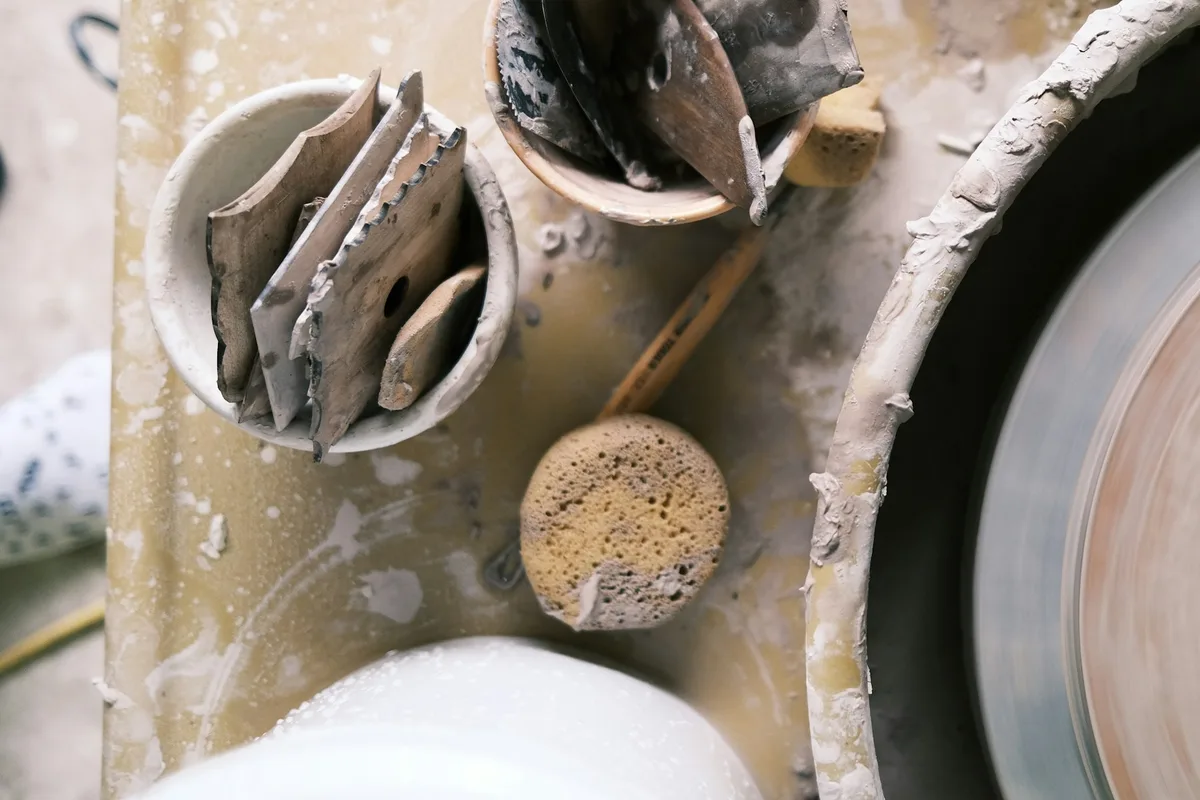
The damp room smells like wet clay and the inside of a cellar. There are ninety-something mugs on the wire shelves in various states of not-being-mugs-yet — some leather-hard and waiting for handles, some bone dry and pale as chalk, one lying on its side with a crack running clean through the foot. Down the hall, six buckets of glaze sit under snap lids with masking-tape labels that have been rewritten enough times to go furry at the edges. The kiln is cooling. It will be Tuesday before anyone knows how the week went.
Somewhere on a laptop, there is a spreadsheet that describes all of this in four rows.
The short version: a spreadsheet is the right tool right up until it stops answering questions faster than walking to the shelf and counting. Three things push a clay studio past that line, and this post follows one wholesale order through all three — a glaze whose cost is concentrated in the chemical you use least, losses that cost wildly different amounts depending on which day they happen, and a kiln load that charges a mug and a platter the same. Any one of them is a nuisance you can absorb. Two of them means the sheet is costing you more than it saves.
Meet Theo, who is not a real person — a composite of the way small clay studios tend to run — and who has just accepted an order for eighty mugs in a cobalt blue. Follow one production week of that order, Monday to Sunday, and you can watch the spreadsheet lose track of it three separate times.
Monday: the bucket that is really a recipe
Theo mixes the blue. It is a straightforward cone 6 base with a colorant addition, and it goes into the bucket at ten kilograms of dry material plus water.
Here is what that bucket actually costs, using an illustrative recipe and prices in the range a small studio pays at retail:
| Material | Dry weight | Illustrative cost |
|---|---|---|
| Feldspar | 3.5 kg | $7.00 |
| Silica | 2.5 kg | $4.00 |
| EPK kaolin | 2.0 kg | $3.60 |
| Whiting | 1.5 kg | $1.79 |
| Talc | 0.5 kg | $1.20 |
| Base subtotal | 10.0 kg | $17.59 |
| Cobalt carbonate (1.5% addition) | 0.15 kg | $13.08 |
| Bucket total | 10.15 kg | $30.67 |
Look at the last two rows for a second. The cobalt is 1.5% of the dry weight and 43% of the money.
That is not an accident of this particular recipe — it is the shape of ceramic glaze costing generally. Writing in Ceramics Monthly (opens in new tab), Joe Thompson prices the base ingredients of a glaze at roughly $1.19–$2.40 per kilogram — and then prices cobalt carbonate, separately and in a tier of its own, at $203 per kilogram, "the most expensive" thing in the cupboard. US suppliers land lower but tell the same story: Axner's base rate (opens in new tab) is $39.56 a pound, sold in five-pound increments, falling to $28.14 at 110 pounds and up. Feldspar is sand with a price tag. Cobalt is jewelry.
(Both the recipe and the per-material prices above are illustrative, and the two published sources are not directly comparable — the Ceramics Monthly figures are UK-denominated and run well above US retail, which is why the ranking travels between them and the absolute number does not. Substitute your own recipe and your own last invoice. The point is the distribution, not these particular numbers.)
Now open Theo's spreadsheet. There is a row that says Glaze — blue and a number next to it that Theo typed in during a tidy-up two Februaries ago. There is another row that says Glaze — clear liner with the same number next to it, because it seemed close enough at the time.
It is not close. Strip the cobalt out and the liner glaze is about $1.76 per kilogram of dry material against the blue's $3.02 — a seventy-plus percent gap sitting under two rows that look identical. Multiply that across six buckets Theo re-mixes several times a year and there is a few hundred dollars of standing chemical in the studio that the workbook has no opinion about whatsoever.
Per mug, the gap is pennies. Be honest about that: nobody's business is failing over a few cents of cobalt. What matters is the structure of the error, because the same structure is about to cost real money twice more this week.
A spreadsheet stores a price. A studio performs a conversion — twenty-odd raw chemicals become six buckets become forty products — and a flat list has no way to represent the middle step. So the middle step gets guessed, once, and then quietly never revisited.
The fix is structural, not clerical. The bucket is a recipe, the same way the mug is. Cost the dry batch from what you actually paid, and let every product that dips in it inherit the number. Do that and "what does the blue cost me" stops being a question you answer from memory.
Tuesday through Saturday: a hundred mugs, and not a hundred mugs
Theo throws a hundred to deliver eighty, because that is what you do.
Here is where they go — and if any of the vocabulary below is unfamiliar, the pottery seller's glossary has the short version of each term:
- Six die before the bisque. Two S-cracks in the bottoms, three handles that popped at the join while drying, one that got knocked off a board. Materials absorbed: clay, and nothing else.
- Four die in the bisque. A blow-out from a piece that went in a shade too damp, and it took a neighbor with it. Materials absorbed: clay, plus a share of the bisque firing.
- Five die across the glaze firings. Eighty mugs do not fit in one load, so the order goes through the kiln in batches over several days. Two crawls, one pinholed past selling, one where the glaze ran and welded a foot to the shelf, one that dunted on the way down. Materials absorbed: clay, glaze, and both firings. One of those firings also cost a kiln shelf, which now needs grinding — a real cost, and not counted in any of the numbers below.
- Two come out sellable but not right — a thin patch, a slightly off pour line. Seconds table at the spring sale.
By the end of the week, eighty-three mugs have come out at full price. Eighty go to fill the order; the spare three go on the shop shelf.
But run the money. Using the per-piece figures worked out in the companion post on kiln costs — roughly $1.50 in clay, $0.60 in glaze, and $1.82 in kiln overhead for a medium electric kiln at $0.15/kWh — the fifteen dead mugs did not cost the same amount as each other. Not remotely.
| Where it died | Count | Cost absorbed each | Subtotal |
|---|---|---|---|
| Before the bisque | 6 | ~$1.50 (clay) | $9.00 |
| In the bisque | 4 | ~$2.15 (clay + bisque share) | $8.60 |
| In the glaze fire | 5 | ~$3.92 (clay + glaze + both firings) | $19.60 |
| Total | 15 | — | $37.20 |
A third of the losses account for over half the money. The five that died in the glaze firings are 33% of the breakage and 53% of the cost, because a piece that fails in the last firing is carrying everything the process put into it.
Theo's spreadsheet knows none of this. It has a cell labeled Breakage % with 15 in it, applied to finished unit cost. Fifteen dead at $3.92 apiece comes to $58.80 — which overstates the real figure by more than twenty dollars, because it charges the mug with the S-crack in the bottom for two firings it never saw.
That overstatement is worth sitting with, because it cuts against the usual sales pitch. The spreadsheet is not necessarily underestimating your losses. It might be inflating them. The problem is not the direction of the error. It is that a single blended percentage cannot tell you where to spend the fix.
If most of your money is dying on the wheel, the answer is compression and drying. If most of it is dying in the glaze fire — as it is here — the answer is application thickness, a slower cool, waxing the feet properly. Same total loss, completely different Tuesday. A percentage in a cell will never tell you which studio you are running.
The tell: if you can state your breakage rate but not name the stage it clusters in, your records are describing an outcome rather than a process. Every loss has an address. A flat percentage throws the address away.
Two footnotes on the table above, because one of its rows is firmer than the others. First, the figures are materials and firing only — no labor. Neither this post nor the companion one puts a defensible hourly figure on a potter's time, and inventing one here would only widen the same gap it is already showing.
Second, the bottom row is exact ($1.50 clay + $0.60 glaze + $1.82 kiln overhead, that last figure already covering both firings) but the middle row is not. The companion post prices bisque electricity at $0.58 a piece and never splits element wear or consumables between the two firings, so the bisque share here is that $0.58 plus a small allowance for the rest. Round it to $0.65 and treat the row as approximate.
Sunday: the load is the batch, not the pot
Go back to Sunday morning and the week's last glaze load, because it is worth a closer look than the tally gave it. Like most of them, it is a mixed load: eight mugs from the wholesale order, four bowls from the shop stock, and two platters Theo has been meaning to finish since June.
Fourteen pieces. That kiln post puts the full bisque-plus-glaze cycle for a medium kiln at about $30.25 in electricity, element wear, and consumables.
Theo's spreadsheet does the obvious thing: $30.25 ÷ 14 = $2.16 a piece.
Walk into the kiln room and look at the shelves, though. The platters are each eating most of a shelf. The mugs are packed six to a level with room to spare. Charging them the same is not a rounding error — it is a claim about your product line that happens to be false.
Allocate by the space each piece actually occupies instead. Using illustrative footprints of 0.35 sq ft for a mug, 0.50 for a bowl, and 1.40 for a platter, the load is 7.6 square feet of shelf, and the firing costs $3.98 per square foot:
| Piece | Count | Footprint each | Firing cost each | Flat per-piece split |
|---|---|---|---|---|
| Mug | 8 | 0.35 sq ft | $1.39 | $2.16 |
| Bowl | 4 | 0.50 sq ft | $1.99 | $2.16 |
| Platter | 2 | 1.40 sq ft | $5.57 | $2.16 |
The mug was overcharged by 77 cents — 55% too high. The platter was undercharged by $3.41, which means the flat split reported the platter's firing cost at 39% of what it was.
The total did not move. It never does; that is the whole nature of allocation. What moved is which of Theo's products looks profitable — and that is the number Theo uses to decide what to make more of next season. Price the platters off a flat split and they look like the star of the line. They are not. They are a shelf-hog with a shelf-hog's economics, and the mugs have been quietly subsidizing them for two years.
The fix here is arithmetic before it is software, and worth saying plainly: no inventory tool is going to walk into your kiln room and split a mixed load for you. Take a tape measure to your shelves once, work out a per-square-foot firing rate, and derive a firing cost for each form you make. What software changes is what happens next — that number stops being a division you redo in your head on the drive home and becomes a stored input on each product's recipe, applied identically every time, including the times you are tired.
What all three have in common
Three different problems, one underlying shape: a spreadsheet stores values, and a pottery studio runs on relationships.
Raw chemicals become a bucket. A bucket is applied to a pot. A pot passes through four states and may not survive any of them. A firing is shared by everything on the shelves. Every one of those verbs is a link between two things, and links are precisely what a grid of cells cannot hold.
You can fake any single one of them with a clever formula. Faking all four at once, indefinitely, is the part nobody manages — which is how a workbook that was accurate the day it was built turns into historical fiction without anyone deciding that it should.
None of that is a discipline problem, and it is worth being clear about that, because it is tempting to read "still on a spreadsheet" as one. Theo is not disorganized. Theo has a labeled damp room, a fired test tile for every glaze, and a kiln log going back four years. The workbook is failing at something workbooks were never built to do.
So which one should you actually use?
Here is the honest comparison, including the case for staying exactly where you are.
The spreadsheet
Pros:
- Free, already built, and shaped to your studio because you shaped it.
- Genuinely fast for a small, stable setup — bought glazes, a couple of forms, predictable loads.
- No migration, no subscription, no learning curve, no third party.
- Works on a laptop with clay dust in the keyboard, offline, in a cold studio.
Cons:
- Structure is voluntary, and there is no error message the day it stops being true.
- No relationships, so a chemical price change and a mug price have no path between them.
- No concept of a piece in an intermediate state, which is where most of a studio's value sits most of the time.
- Maintenance scales with your glaze library and your form catalog, and both only grow.
Best for: ready-made glazes, one or two forms, single-product kiln loads, and a maker who genuinely does not mind keeping the sheet current.
Purpose-built inventory software
Pros:
- Glazes can be recipes in their own right, so raw chemical costs reach the finished pot without a human retyping anything.
- Production runs consume material and produce output as one event, so what left the shelf and what arrived on it stay married.
- Cost history follows the purchase, so a batch mixed from last year's cheap feldspar and one mixed from this year's are not the same number.
- The kiln stops being invisible: an asset with a purchase price, a depreciation schedule, and logged hours against the work it did.
Cons:
- A genuine setup evening, plus a stretch of running both systems while you learn to trust the new one.
- Opinionated. It will ask you to model your studio its way in places where the sheet let you improvise.
- Another login, another thing to keep current — the failure mode is a system that is structurally perfect and six weeks stale.
- Overkill for a studio whose entire material holding fits on one wall and in one head.
Best for: mixed glazes, several forms, mixed kiln loads, and a studio where somebody eventually has to answer what was consumed without going and looking.
The honest hybrid
Pros:
- Keeps the sheet for what it is genuinely best at — a quick quote sketch, a firing schedule, a shopping list scribbled at the clay supplier.
- Puts the material, glaze, and production records where structure actually matters.
- No all-at-once migration, so a bad week in the studio never becomes a bad week in the books.
- Lets you test the software's model on one order before you commit your whole material list to it.
Cons:
- Two places to look, every time.
- A standing question about which one is authoritative — answer it once, out loud, or you will end up with the worst of both.
- Easy to let the split drift until neither system is complete.
- Doubles the discipline it asks of you rather than halving it, right up until you decide which system wins.
Best for: most studios in the middle, and nearly every studio in its first year after switching.
What moving actually involves
Less than rebuilding the workbook a third time, which is the real alternative most people are choosing between.
Your chemicals, clay bodies, quantities, and the prices you paid export to CSV, which is exactly what inventory software imports. In Ardent Seller, the three problems above have three specific answers:
- Nested recipes answer Monday. A glaze is its own item with its own recipe of raw chemicals, and the pots that dip in it list the glaze as an ingredient. Mixing a batch is a small production run, and what that batch actually cost — at the chemical prices on that day's invoices — is the number the mugs inherit. Not a figure you retyped in February.
- Production runs answer Tuesday through Saturday. A run records what went in and what came out, so the gap between them is data rather than a vibe. Record the bad load as its own short run and the loss has an address instead of a percentage.
- Consumables and equipment records answer part of Sunday. Kiln wash, shelves, and element sets can live as maintenance-and-repair items that a firing consumes, so they reach a price tag instead of dissolving into general expenses; the kiln itself is tracked as an asset with its depreciation and usage hours logged against the work. The electricity and the shelf-space split are still yours to compute, as the Sunday section says — but once computed they go somewhere that remembers them.
Test it the way you would test a new glaze: one tile, not the whole load. Rebuild a single order end to end — mix the glaze, throw the count, record the losses where they happened, fire it, price it — and see whether the number that comes out the far end matches what the work actually cost. That takes an evening on the free tier (plan details). For the same argument made without the clay, the product-level comparison lives at spreadsheets vs. Ardent Seller.
And if the answer comes back "the sheet was fine," take that seriously. It is a legitimate result, and this is one of the few pieces of business advice where doing nothing is frequently correct.
The tile tells you what the recipe cannot
You already know not to trust a glaze recipe on paper. You mix a small batch, you fire a tile, you find out what it does rather than what somebody wrote down in 1974. The numbers in your workbook deserve the same suspicion — they were also written down by somebody, also once, and they have never been fired.
Start free — rebuild one order end to end, and see what comes out of the kiln.
Related reading
- Kiln Costs Uncovered — The full per-firing math this post leans on: electricity, element wear, kiln furniture, and what a firing actually adds to a mug.
- The Pottery Seller's Glossary — Thirty-six terms you will meet on invoices, gallery contracts, and tax forms, from cone 6 to consignment split.
- Spreadsheet Breakup — The signs any maker business, in any craft, has outgrown Excel — what switching genuinely costs and how to choose what replaces it.
Free resources
Free companion downloads if you want to put any of this into practice:
- Pottery Studio Kiln Log — A printable firing log and glaze test-tile log. Logging where a load went wrong is how you find your own version of the glaze-fire number above instead of borrowing this post's.
- Spreadsheet vs Inventory Software: The Decision Guide — A self-assessment scorecard and migration checklist, so the stay-or-switch call above gets made on evidence rather than on whichever tab annoyed you most this week.
- Recipe Scaling & Batch Calculator — If you are staying on a sheet, at least mix from a better one: enter a glaze base, set a target batch size, and let every chemical scale with the cost rolling up as it goes.
This article is provided for educational purposes only and does not constitute financial, tax, or business advice. The glaze recipe, material prices, breakage counts, shelf footprints, and per-piece figures above are illustrative and will vary by your recipes, suppliers, kiln, and firing practice. Material prices cited from Ceramics Monthly and Axner reflect published figures at the time of writing and change frequently. Consult a qualified accountant or small-business advisor before making financial decisions based on this content.