
What does it actually cost you to grow one tray of sunflower shoots? Not the seed — the whole tray, start to clamshell. The short version: a 10x20 tray runs roughly $10 to grow once you count seed, growing medium, water, electricity, equipment wear, and about 18 minutes of your own labor — and closer to $11.55 per sellable tray after you carry the cost of the ones that fail. That works out to about $1.28 an ounce, or $2.40 per packed clamshell, before you've paid a booth fee or driven a delivery. The part that catches almost every grower: labor is nearly 60% of that cost, while the seed everyone fixates on is barely 10%.
If the number that came to mind was "a few bucks, mostly seed," there's a good chance you're underpricing — and microgreens are a genuinely good business when you don't. Most varieties run seven to fourteen days from seed to harvest, a standing weekly order from a chef who actually pays on time, prices that look fantastic next to a head of lettuce. But that speed hides the math. A crop you can grow this fast feels nearly free, and "nearly free" is exactly the feeling that erodes a margin one tray at a time. So let's build the real number from the bottom up.
Throughout, we'll follow Lena — a composite grower, not a real person, with every dollar figure here chosen to be illustrative rather than surveyed. She runs about 40 trays a week of sunflower, pea, and radish out of a spare room, selling at a Saturday market and to three restaurants. Your seed source, climate, and rent will move the numbers; the point isn't Lena's exact total, it's the shape of the cost stack, because that shape is the same in almost every microgreens operation.
Start with one tray, and count everything
Here's a sunflower tray, built layer by layer. We're costing a single 10x20 tray that germinates well and makes it to harvest.
Seed. A sunflower tray takes roughly 80 grams of seed. At a bulk price in the neighborhood of $6 a pound — the figure we'll use for Lena, though seed prices move with the season and the supplier, so price against your own catalog — 80 grams costs about $1.05. Hold onto that number — it's the one everyone fixates on, and it's about to look very small.
Growing medium. Coco coir or a soil blend, a couple of quarts per tray, works out to about $1.40 per tray once you spread a bag across the trays it fills.
Water and small consumables. Seed soak, rinses, a splash of food-grade hydrogen peroxide, kelp in the water, the paper towels you go through. Call it $0.55.
Electricity. Lights for ten or twelve days plus a circulation fan, amortized down to the tray, is small but real — about $0.45.
Equipment. Racks, trays, lights, a fan, the scale, the little harvest fridge — all of it wears out and gets replaced. Spread across every tray that rack will ever produce, that's roughly $0.65 per tray in depreciation. Easy to ignore, because nothing leaves your wallet today. It leaves it in eighteen months when the LED bar dies.
Labor. And here's the one. Seeding (weigh, soak, spread, press, mist), daily checks and watering, then harvest — cutting, weighing, packing, and washing the tray afterward. Even batched and efficient, that's something like 18 minutes of hands-on time per tray. At a target wage of $20 an hour — not a luxury, just paying yourself like an employee — that's $6.00 a tray.
Add it up:
| Cost layer | Per tray | Share |
|---|---|---|
| Seed | $1.05 | 10% |
| Growing medium | $1.40 | 14% |
| Water + consumables | $0.55 | 5% |
| Electricity | $0.45 | 4% |
| Equipment depreciation | $0.65 | 6% |
| Labor (18 min @ $20/hr) | $6.00 | 59% |
| Subtotal (a tray that succeeds) | $10.10 |
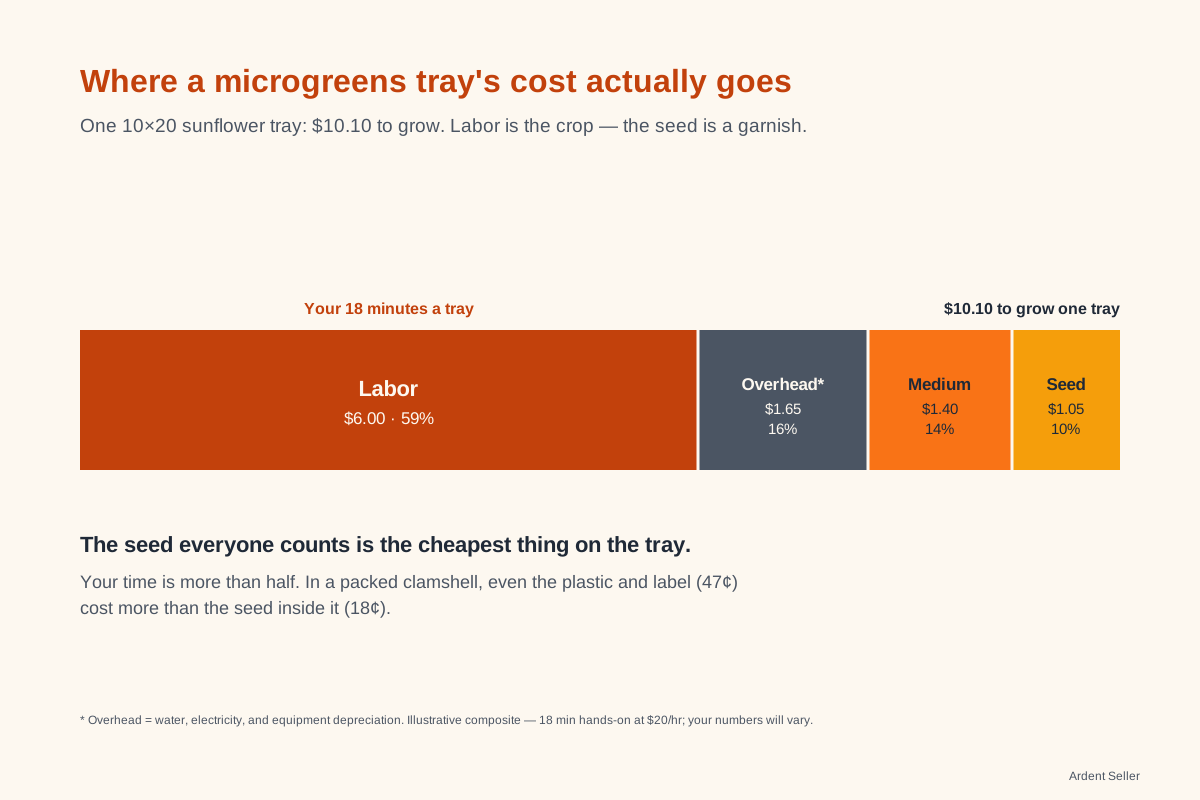
Look at the share column. The seed everyone obsesses over is barely 10% of the cost. Your time is nearly 60% — well more than half. (Shares are rounded and may not total exactly 100%.) This is the whole post in one table: microgreens isn't a seed business, it's a labor business. You're not selling sunflower seeds with water added. You're selling ten days of attention and twenty minutes of knife work, and the seed is a garnish on your own cost stack.
The same split, with water, electricity, and equipment grouped together as overhead:
One line Lena doesn't carry: rent. Her spare room adds no separate space cost, so it isn't in the stack. If you pay for a greenhouse, commercial-kitchen time, or dedicated growing space, add that as a fixed cost spread across your weekly tray count — at a few hundred dollars a month over 40 trays a week, that's roughly $2 a tray, more than the seed and electricity combined.
Now add the trays that didn't make it
That $10.10 is for a tray that germinates evenly and sells. Not every tray does. Some mold. Some come up leggy and pale. Some are perfect and just don't sell before they wilt — microgreens have a shelf life measured in days, not weeks.
Say one tray in eight is a write-off, between failures and unsold spoilage — a reasonable working assumption for a grower still dialing in airflow and successions, and a number you should swap for your own as soon as you have it. The cost of those dead trays doesn't vanish — it has to be carried by the trays that do sell. Spreading that one-in-eight loss (about 12.5%) across the survivors adds about $1.45 to each good tray.
Rule of thumb: Your real cost per tray isn't what a successful tray costs — it's what a successful tray costs plus its share of the failures. If you don't price in the dud, the dud comes straight out of your margin.
So the honest number Lena needs to price against is roughly $11.55 per sellable tray.
Turn that into a cost per ounce
A solid sunflower tray yields somewhere in the range of 8 to 16 ounces, depending on seed density, variety, and how hard you push it — wide enough that the only yield you can really price against is the one you weigh yourself. Lena gets a dependable 9 ounces of sellable greens per tray — she'd rather harvest a clean, consistent tray than chase a heavy one that sometimes molds.
$11.55 ÷ 9 ounces = about $1.28 per ounce to grow.
That's the number that should be taped to the wall. Whatever channel Lena sells through, she's starting from $1.28 an ounce in the ground before a single clamshell or market fee enters the picture. Radish will cost less (cheaper seed, fast yield); a slow specialty green like a fussy basil will cost more. But she knows her floor now, per crop, and a floor you can name is a floor you can price above on purpose instead of by accident.
From tray to clamshell
Most market customers don't buy by the ounce — they buy a clamshell. Lena packs 1.5-ounce clamshells, which means six per tray. Here's what one costs:
- Greens: 1.5 oz × $1.28 = $1.92
- Clamshell and lid: $0.35
- Label: $0.12
- Cost per clamshell: about $2.40
Now look at one quietly absurd detail. The seed that went into that 1.5-ounce clamshell is about 13 grams — roughly 18 cents of sunflower seed. The empty clamshell and label cost 47 cents. The packaging costs more than two and a half times the seed it's protecting. If you've ever felt a flash of guilt buying "expensive" seed, redirect it: the plastic is the splurge.
Pro tip: Price your clamshell line off the packed cost, not the greens cost. The container, the label, and your packing minutes are part of the product. Leaving them out is how a $2.40 clamshell gets priced like a $1.90 one.
Does each channel actually clear margin?
Knowing your cost is half the job. The other half is checking that each place you sell actually pays for itself. The cost to grow is the same; what changes is everything bolted on after.
Worked example: the Saturday market
Lena sells clamshells at $5.00 at the farmers market. Feels great — more than double her packed cost. But the booth isn't free. A $40 stall fee has to be spread across what she sells that day.
On a good Saturday she moves 35 clamshells. The booth is then about $1.14 per clamshell:
- Packed cost: $2.40
- Booth share: $1.14
- Loaded cost: $3.54
- Profit: $5.00 − $3.54 = $1.46 per clamshell (a 29% margin)
Healthy. But watch what a slow market does. If a cold, rainy Saturday means she sells only 18 clamshells, that same $40 booth becomes $2.22 each:
- Loaded cost: $2.40 + $2.22 = $4.62
- Profit: just $0.38 per clamshell
Same greens, same price, same booth — and the profit per clamshell collapsed by 74% because volume dropped. The lesson isn't "markets are risky." It's that a fixed cost like a booth fee is a number you have to earn down with volume, and a price that looks padded at 35 units is nearly breakeven at 18.
Worked example: restaurant wholesale
The three restaurants buy by weight at about $1.75 an ounce (roughly $28 a pound), which sounds like a steep discount off the $5 clamshell until you remember there's no clamshell, no label, and no Saturday spent standing behind a table.
- Cost to grow: $1.28/oz
- Bulk bag instead of a clamshell: about $0.10/oz
- Delivery (gas and her time, spread across the ~5 pounds she drops off): about $0.15/oz
- Loaded cost: roughly $1.53/oz
- Profit: $1.75 − $1.53 = $0.22 per ounce (around 13%)
Thinner per ounce — but it moves in volume, the orders are standing and predictable, and it doesn't eat a weekend. For some growers the calm of a Tuesday delivery beats the swing of a market Saturday. The right answer is usually both channels, sized so the predictable wholesale base covers the fixed costs and the market sales carry the fat margin. You can only balance them once you can see each one's real number.
Rule of thumb: A channel that "feels" profitable and a channel that is profitable are different claims. Run the loaded cost — packaging plus the fee or the drive — for each one, every season, because booth fees and gas don't hold still.
Why microgreens look more profitable than they are
Here's why so many growers never run these numbers: when you leave your own labor out, microgreens look absurdly profitable, and absurd profit doesn't beg to be examined. Watch the same tray flip:
- Labor counted as $0: the tray "costs" about $4.10, and six clamshells at $5 look like nearly $26 of pure profit.
- Labor counted at $20 an hour: the tray costs $10.10 — and that's before packaging, the booth fee, and the trays that didn't sell.
The $6.00 of labor didn't disappear in the first version; it just didn't show up as cash, so it got counted as zero. Pay yourself $0 an hour and of course the business looks rich. It's rich the way a job that doesn't pay you is rich.
The fix isn't complicated, but it is a habit: every tray gets seed, medium, consumables, equipment, and your time in the cost, plus its slice of the trays that failed. Do that and the prices almost set themselves, because you can finally see which crops, which pack sizes, and which channels are quietly working for free.
When a spreadsheet stops keeping up
You can run a few crops on a spreadsheet, and plenty of growers start there. The strain shows up when you're seeding eight varieties on staggered successions, seed prices jump mid-season, and you genuinely cannot remember whether last week's mold was three trays or seven. The cost per ounce you carefully calculated in March is fiction by June, and you don't notice until margins feel thin for no reason you can name.
This is the gap Ardent Seller's costing and inventory tools are built to close for fast-crop growers. You track seed, growing medium, and trays as real inventory, then build each variety from a bill of materials — so every seeded tray draws down actual stock and costs itself out automatically, labor and equipment included. Log a failed tray as waste and it lands where it belongs: in your real cost per ounce, not in a vague sense that something's off. Per-channel sales reporting keeps the restaurant standing orders and the market clamshells reconciled against one set of counts, so the question "is wholesale actually paying me?" has an answer instead of a guess. The microgreens costing tools are shaped around exactly the cycle above: seed to tray to clamshell, with the true cost surfaced at each step.
Whatever you track it in, the discipline is the same. Count everything — especially your time and your dead trays. A microgreens business lives or dies on a number most growers never write down, and now you know how to write it down. Pick your best-selling crop, run the full tray cost this week, divide by your honest yield, and see where your real floor sits. You might be pricing perfectly. You might be growing your bestseller at a loss. Either way, you'll finally know. When you're ready to stop re-running that math by hand, create a free Ardent Seller account and let your cost per tray update itself every time seed prices move.
Related reading
- The True Hourly Wage of a Maker Business — Labor is more than half of a tray's cost, so the wage you build it on is the whole game. This is how to set that number honestly.
- Farm Crop Costs & Profit Per Bed — The same cost-per-unit discipline applied to field crops: profit per bed instead of profit per tray, for growers running both.
- Shelf Life, Spoilage, and Shrinkage — Microgreens spoil in days, and those dead trays land in your real cost. This goes deeper on tracking the loss that quietly eats margin.
Free resources
A few free downloads from the Ardent Workshop library that pair well with this post:
- Product Pricing Calculator — Drop your per-tray seed, medium, labor, and packaging in and get a defensible per-clamshell price out, with a batch tab that shows how the math shifts at 10 trays versus 50.
- Maker Hourly-Rate Pricing Calculator — Since labor is more than half the cost of a tray, this sets your target hourly wage first and works backward to the minimum price that actually pays it.
- Small-Batch Production Planning Playbook — A printable playbook for sizing successions and logging runs so your standing weekly orders stay filled without overseeding into spoilage.
This article is provided for educational purposes only and does not constitute financial, tax, or business advice. Cost structures, pricing examples, and margin figures are illustrative and will vary by your specific circumstances. Consult a qualified accountant or small-business advisor before making financial decisions based on this content.