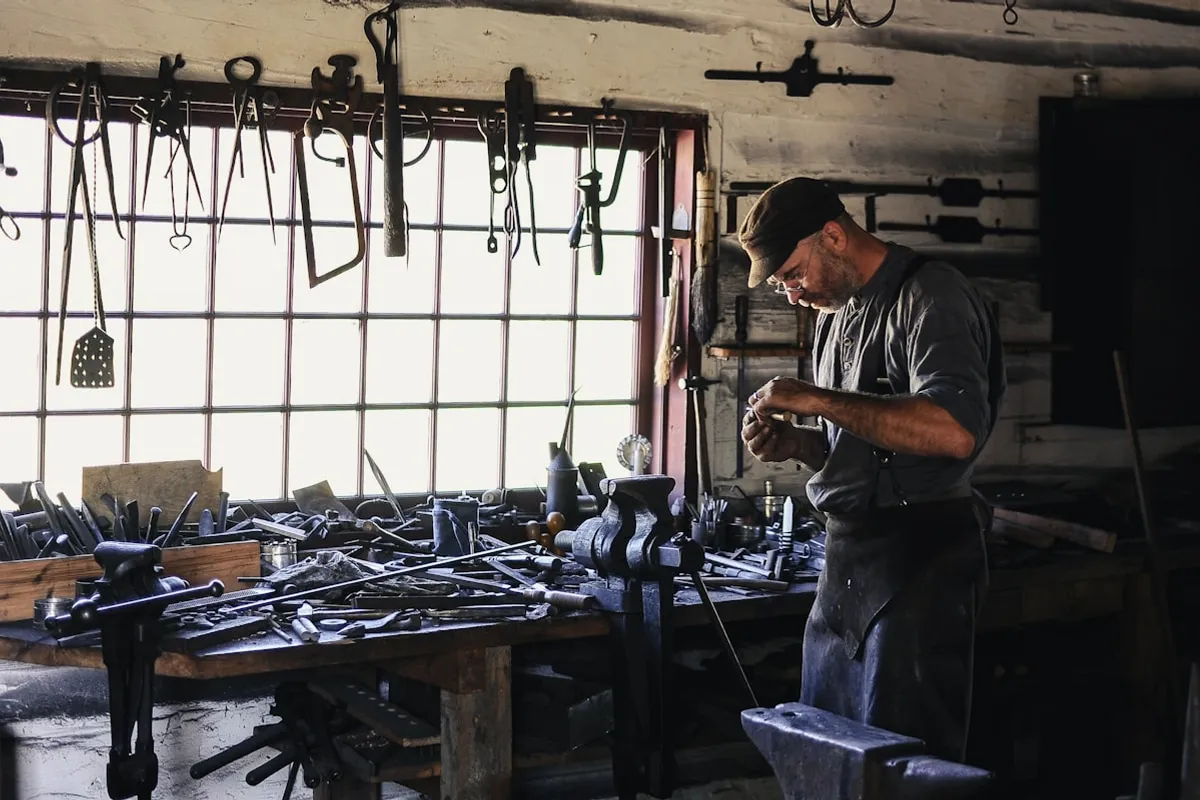
What does the steel in a hand-forged chef's knife actually cost? If you guessed somewhere around six dollars, you're in the right neighborhood — and that rough figure is often the first cost a maker underestimates.
Here's the trap hiding inside that six dollars: it's the one cost you can see. You bought the bar, the invoice said $6, and the blade you're holding is made of it. So the brain files the knife under "cheap to make" and prices accordingly. Meanwhile, a whole stack of real costs sits in a blind spot: the propane that forged and heat-treated it, the three sanding belts it wore out, the epoxy and pins and finish, the slow disappearance of your $1,200 grinder, and the six hours your hands spent on it. They're real, they're paid for out of the same bank account, and almost none of them show up in the price.
Metalwork is one of the most satisfying crafts to cost honestly, because once you actually lay the layers out, the math stops being mysterious and starts being useful. So let's lay them out. We'll forge a knife and we'll cast a bronze pendant, line by line, and find out what they each really cost to make.
The short version: A fully-loaded hand-forged chef's knife in this example costs about $216 to make — roughly $66 of materials and overhead ($58 cash plus an $8 equipment reserve) plus about $150 for six hours of hands-on labor — against a $285 sale. A single lost-wax bronze pendant costs about $66 to cast on its own, more than its $58 price; cast eight to a flask and the per-piece cost drops to about $30. The rest of this post builds both numbers up, layer by layer.
A note on the numbers: every dollar figure below is an illustrative example, not market data. Stock prices, belt life, kiln energy, and hourly rates vary wildly by shop, region, and supplier. Treat these as a template to drop your own numbers into — the structure is the point, not the specific dollars.
The cost stack for metalwork
A common pattern in handmade metalwork pricing is to build from just one or two layers: material, and maybe a rough guess at time. A defensible price needs all of these:
- Stock metal — the bar, the rod, the ingot, the sheet.
- Fuel and energy — propane for the forge, gas for the melt, electricity for the kiln and the grinder.
- Consumables — abrasive belts, sandpaper, flux, quench oil, investment, crucibles, polishing compound.
- Heat treatment — the energy (or the outside service fee) that turns soft steel into a knife that holds an edge.
- Finishing and findings — handle material, pins, epoxy, patina chemicals, chains, clasps, jump rings.
- Labor — the hands-on minutes, charged at a real hourly rate.
- Equipment reserve — a per-piece slice of what your forge, grinder, kiln, and caster will cost to replace.
- Packaging and platform fees — the box, the padding, and the cut the marketplace or payment processor takes.
Two of the layers most often left out of metalwork quotes are fuel and the equipment reserve — both invisible at the moment of sale. You don't write a check for "propane used on this specific knife." You write one check for a refilled tank and forget about it. We'll come back to both.
Example 1: A hand-forged chef's knife
Meet Marcus — an illustrative composite, not a real person — who forges kitchen knives in a converted single-car garage. He runs a propane forge, a 2×72 belt grinder, a drill press, and a small heat-treat kiln. His signature 8-inch chef's knife sells for $285 through his own website. He's proud of the price. He thinks of the knife as "about ten dollars of steel and wood plus my time."
Let's actually count.
| Cost layer | What it covers | Illustrative cost |
|---|---|---|
| Steel stock | One length of 80CrV2 bar | $6 |
| Handle material | Stabilized wood scales + pins + spacer | $14 |
| Fuel | Propane for forging + normalizing cycles | $7 |
| Abrasive belts | 3–4 belts worn from rough grind to finish | $9 |
| Consumables | Epoxy, sandpaper, etchant, finish oil | $5 |
| Heat-treat energy | Kiln electricity for the soak | $2 |
| Packaging | Box, padding, edge guard | $6 |
| Payment fees | ~3% of $285 on a direct sale | $9 |
| Cash cost subtotal | Materials, fuel, consumables, packaging, fees | $58 |
| Equipment reserve | Per-knife slice of forge, grinder, kiln, drill press | $8 |
| Labor | 6 hands-on hours × $25/hour | $150 |
| Fully-loaded cost | Cash cost + equipment reserve + labor | $216 |
At a $285 sale, that leaves Marcus a net of $69 per knife — about a 24% net margin. Not a disaster. But notice three things the bar-of-steel mental model completely missed:
- Labor is 69% of the cost in this example. The knife isn't a $6 object with some markup. It's a $150 act of skilled time wrapped around $66 of materials and overhead (the $58 cash cost plus the $8 equipment reserve).
- The belts and fuel together ($16) cost more than the steel — and more than the handle material, too. The consumables you can't see outweigh the metal you can.
- The "free" grinder isn't free. That $8 reserve is the only reason Marcus will be able to replace the grinder's motor without it feeling like a catastrophe.
If Marcus had priced from the bar of steel and a casual "half a day of my time at twenty bucks," he'd have landed somewhere near $130 — and lost roughly $86 on every knife while believing he was making money. The honest stack is what lets him hold $285 with a straight face, and it's what tells him the wholesale floor (where there's no $285 retail cushion) is a serious conversation, not a casual yes.
Why belts and propane outrun the steel
This catches many new smiths off guard, so it's worth sitting with. A single blade can eat three or four belts on its way from a rough 36-grit hog-off to a clean finish, and each belt runs a few dollars. The steel becomes the knife — you can hold it. The belts turn into grit and dust and go in the bin. Because one is visible and one vanishes, the visible one gets costed and the vanishing one doesn't.
Propane behaves the same way. A forging session, a couple of normalizing cycles, and a heat-treat soak all draw from the same tank, and that gas is gone for good. The fix isn't to track propane molecule by molecule. It's to take your annual fuel spend, divide it by the number of pieces you make in a year, and fold a flat per-piece fuel figure into every quote.
Rule of thumb: if a cost disappears into the work — gas, abrasives, flux, quench oil — it tends to get left out of the price, precisely because there's no invoice line reminding you it happened. Cost the things you can't see first.
Example 2: A cast bronze pendant
Now meet Renata — also an illustrative composite — who casts small bronze jewelry using lost-wax casting. She carves or injects a wax model, sprues it, invests it in a plaster flask, burns out the wax in a kiln, melts bronze, and casts. Her bestselling pendant finishes at about 30 grams of bronze and sells for $58.
Casting has a very different cost shape from forging, and it contains a trap that forging doesn't. Let's count a single pendant first.
| Cost layer | What it covers | Illustrative cost |
|---|---|---|
| Bronze metal | ~35g consumed (pendant + loss) | $2 |
| Wax | Injection wax + sprue wax | $0.50 |
| Investment | Plaster for one flask | $3 |
| Melt consumables | Crucible wear, flux, torch gas | $2 |
| Burnout energy | One long kiln cycle for the flask | $4 |
| Finishing | Sanding, tumbling media, patina, polish | $3 |
| Findings | Chain, jump ring, clasp | $5 |
| Packaging | Jewelry box + pouch | $3 |
| Payment fees | ~3% of $58 | $2 |
| Cash cost subtotal | Metal, wax, investment, melt, burnout, finishing, findings, packaging, fees | $24.50 |
| Equipment reserve | Slice of kiln, caster, tumbler | $4 |
| Labor | 1.5 hands-on hours × $25/hour | $37.50 |
| Fully-loaded cost | Cash cost + equipment reserve + labor | $66 |
Read that bottom line again. The pendant sells for $58 and costs about $66 to make one at a time. Renata is losing roughly $8 on every pendant — and she'd never know it, because the bronze (her "main material") is a $2 rounding error and everything feels cheap individually.
The bronze isn't the problem. The problem is that one little pendant is being asked to carry an entire flask of investment, an entire hours-long kiln burnout, an entire melt, and the full setup-and-cleanup labor — all by itself.
The casting fix: amortize the pour across a tree
This is the part casters learn early, and it surprises many makers who come from a per-piece costing mindset rather than a batch one. The expensive parts of a cast — the investment, the burnout cycle, the setup labor — cost almost the same whether you cast one pendant or eight on a single sprue tree. So you don't cast one. You build a tree.
Here's the same pendant, cast eight to a flask:
| Cost layer | Cost for a tree of 8 | Per pendant |
|---|---|---|
| Bronze metal (8 × $2) | $16 | $2.00 |
| Wax | $4 | $0.50 |
| Investment (one flask) | $3 | $0.38 |
| Melt consumables (one melt) | $3 | $0.37 |
| Burnout energy (one cycle) | $4 | $0.50 |
| Finishing | $24 | $3.00 |
| Findings | $40 | $5.00 |
| Packaging | $24 | $3.00 |
| Payment fees (~3% per pendant, sold individually) | $14 | $1.75 |
| Cash cost subtotal | $132 | $16.50 |
| Equipment reserve (more pieces share each kiln-year of wear) | $8 | $1.00 |
| Labor (4 hrs for the whole tree) | $100 | $12.50 |
| Fully-loaded cost | $240 | $30.00 |
Same pendant. Same $58 price. But now the fully-loaded cost is about $30, and Renata nets ~$28 per pendant — roughly a 48% margin. Nothing changed about the product. The metal, findings, finishing, and packaging still cost the same per piece; what dropped is everything fixed. The investment, burnout, and setup now serve eight pieces instead of one — and even the hands-on time compresses, because the wax-up, spruing, investing, pour, and cleanup are largely one-and-done for the whole tree, so per-piece labor falls from 1.5 hours to about half an hour.
Rule of thumb for casters: your per-piece cost is mostly a function of how many pieces share each burnout, each melt, and each setup. Batch size is a pricing decision.
Realized pieces per flask is also one of the most overlooked numbers in a casting operation, and it often goes untracked. If you sprue eight and two come out with porosity or incomplete fills, your real per-piece cost just jumped 33% — and if you're not recording yields, you'll keep pricing as if every pour is perfect.
The layers metalworkers skip most often
Across both examples, the same handful of costs are the ones that get left out. If you fix only these, your cost stack will already account for the layers that usually slip through uncosted.
Equipment reserve
A belt grinder, a forge, a kiln, a casting machine, a tumbler — these wear out and they fail. A $1,200 grinder you run hard for five years is consuming about $240 of itself a year whether or not you touch it. Divide that by the pieces you make in a year and put the slice in every quote. Do the same for the forge, the kiln, and the caster. The reserve isn't profit you're hiding from yourself; it's the fund that replaces a dead motor without wrecking a month.
Heat treatment
For knives, heat treat is the difference between a blade and a butter knife — and it has a cost, whether that's kiln electricity for your own soak or a per-blade fee to a professional heat-treat service (often a flat per-blade fee that varies by service and steel type — check current rates with a shop near you). If you send blades out, that fee is a hard cost per knife and belongs on the sheet. If you do it yourself, the energy and the wear on your kiln and quench setup still count.
Metal loss and scrap
You rarely cast or forge exactly the metal that ends up in the finished piece. Casting leaves a sprue and a button; forging leaves scale and grinding loss. Bronze button stock is recyclable, which softens the blow, but every remelt loses a little to oxidation and flux. Cost the metal you consume, not just the metal in the final object.
Hands-on labor
We've said it twice because it's the one that matters most: as the knife example makes clear, the largest single cost is often your own time. Charge for the minutes your hands are on the work. You don't have to bill for the kiln running a burnout unattended overnight — but the moment your forging, grinding, fitting, and finishing hours become free, the price stops being a price.
Turning a cost stack into a price
Knowing the fully-loaded cost is the hard part; turning it into a price is the easy part, as long as you don't confuse markup with margin. If Marcus's knife costs $216 fully loaded and he wants a 40% net margin, he doesn't add 40% (that would be $302 and only a 28% margin). He divides: $216 ÷ (1 − 0.40) = $360. The difference between "add 40%" and "I keep 40%" is real money, and it's a common arithmetic slip in handmade pricing.
A few practical moves once you have honest costs:
- Set a wholesale floor that still clears your fully-loaded cost — cash cost, equipment reserve, and labor. Wholesale takes away the retail cushion, so a piece that's only marginally profitable at retail will lose money at wholesale, especially if you leave the reserve out. Know your floor before someone offers you a 24-piece order.
- Price one-off custom work separately from catalog work. A custom knife carries design and setup time that a repeated catalog model amortizes across many sales. Quoting a one-off at catalog prices is a quiet way to work for free.
- Re-cost when your suppliers move. Steel, bronze, and propane prices drift. A price that was healthy two years ago may have silently lost five points of margin to material creep.
Keeping your cost stack current without a weekly spreadsheet session
Doing this math once, on a slow Sunday, is illuminating. Doing it for forty SKUs, keeping it current as belt prices and propane refills change, and knowing your real per-flask yield — that's where a spreadsheet starts to groan and pieces start slipping through uncosted.
This is the kind of work Ardent Seller's cost tracking is built for: you record what you paid for each bar of steel or ingot of bronze as a tracked material, build a recipe for each knife or pendant that pulls in stock, consumables, and labor, and let the per-product cost roll up automatically — including an equipment depreciation reserve so your grinder and kiln pay for their own replacements. When you cast a tree of eight, a production run divides the shared burnout and setup across the batch the same way the table above did, so your per-piece cost reflects the batch you actually ran, not a single-piece fantasy. If you're a metalworker pricing forged or cast goods, that's the difference between hoping the margins are there and knowing they are.
The bar of steel will almost always be the cheapest, most visible thing in your shop. The skill, the fuel, the belts, and the hours are where the real cost — and the real value — of your work actually live. Price for all of them.
Ready to find out what your own pieces really cost? Start tracking your materials and recipes for free and build a cost stack you can actually trust.
Related reading
- The True Hourly Wage of a Handmade Business — Labor was 69% of the knife's cost in that example; this post shows how to figure out what your hands-on hour is actually worth before you bake it into a price.
- Equipment Depreciation for Small Makers — The per-piece reserve that keeps a dead grinder motor from wrecking your month, explained in full.
- Laser & CNC Job Costing: A Cost-Stack Teardown — The same layer-by-layer costing logic applied to the desktop laser-and-CNC class, with an annotated job-sheet teardown.
Free resources
A few free downloads from the Ardent Workshop library that pair well with this post:
- Product Pricing Calculator — Drop your fully-loaded cost into a markup-vs-margin calculator so a 40% margin actually means you keep 40%.
- Hourly Rate Pricing Calculator — Work out the real hourly rate your forging and finishing time should earn before you bake it into a quote.
This article is for general educational purposes and reflects illustrative example figures, not market data or financial advice. Material prices, energy costs, equipment lifespans, and appropriate hourly rates vary widely by shop and region. Run the numbers for your own business — and consult a qualified accountant or financial professional for guidance specific to your situation — before setting prices.