
What would someone pay you, today, for the thing you have spent six years building?
Not what you would like to be paid. Not what the business feels like it is worth on a good month. What a stranger with a bank behind them would actually wire, after reading your records and deciding whether the thing still works when you are not standing in the middle of it.
Most small-business owners have never run that number, and there is no reason to think makers are the exception. In BizBuySell's Q2 2026 Insight Report, 52% of owners said they have an exit plan — but only 14% had completed a professional valuation, half had a rough estimate, and 35% admitted they had no idea at all (BizBuySell Insight Report, Q2 2026 (opens in new tab)). That is not a rounding error. That is a third of business owners planning to sell an asset they cannot price.
The short version:
- This is what a buyer would pay for the business, not a replacement-cost or insurance figure.
- Buyers price seller's discretionary earnings, not revenue. Take your SDE and multiply — roughly 2 to 3 for main-street businesses.
- For a sole proprietor, the famous owner-salary add-back does not exist.
- Inventory, equipment and goodwill are allocated separately, on a tax form both parties must file.
- If your sales run through Etsy, your storefront is not part of the sale at all.
Buyers do not price your revenue
The number that matters is seller's discretionary earnings — SDE. It is what the business produces for one full-time owner-operator before that owner takes anything out. BizBuySell's multiples data is explicitly built on it: earnings multiples there represent "Sellers Discretionary Earnings (SDE) as reported by the business owners or business brokers closing the sale listing" (BizBuySell, Business Valuation Multiples by Industry (opens in new tab)).
Revenue barely enters the conversation. The average revenue multiple across every sector in that dataset is 0.67, and it is the weaker of the two signals — which BizBuySell says outright: for small business valuation purposes, cash flow to the owner is a more reliable indicator than revenue (BizBuySell, Business Valuation Multiples by Industry (opens in new tab)).
Here is the market you would be selling into. In Q2 2026, 2,117 businesses changed hands in the United States, down 10% year over year, at a median sale price of $349,250. Median cash flow was $155,921 on median revenue of $692,087, and the average cash flow multiple was 2.7. In the retail sector specifically, where most maker businesses land, deal volume fell 15% but the median sale price held at $250,000 (BizBuySell Insight Report, Q2 2026 (opens in new tab)).
Read those figures together and the shape of the market is clear. Half of everything that sold was throwing off six figures of owner earnings. A handmade business doing $80,000 a year in revenue is not a small version of that median deal. It is a different animal, and it will be priced like one.
Worked example 1: Delia has been reading the wrong add-back list
Delia is a composite — an illustrative example, not a real seller — but her books are the shape a six-year soap and candle business actually takes. She files a Schedule C. Trailing twelve months:
| Line | Amount |
|---|---|
| Gross receipts | $148,000 |
| Cost of goods sold | $52,000 |
| Gross profit | $96,000 |
| Total Part II expenses | $84,600 |
| Net profit (Schedule C, line 31) | $11,400 |
Inside that $84,600 are a part-time helper at $18,200, studio rent of $10,800, marketplace and payment processing fees of $9,850, a $9,400 Section 179 deduction on a new pour tank and mixer, $1,180 of interest on the equipment loan, and a one-time $2,400 legal bill for a trademark filing.
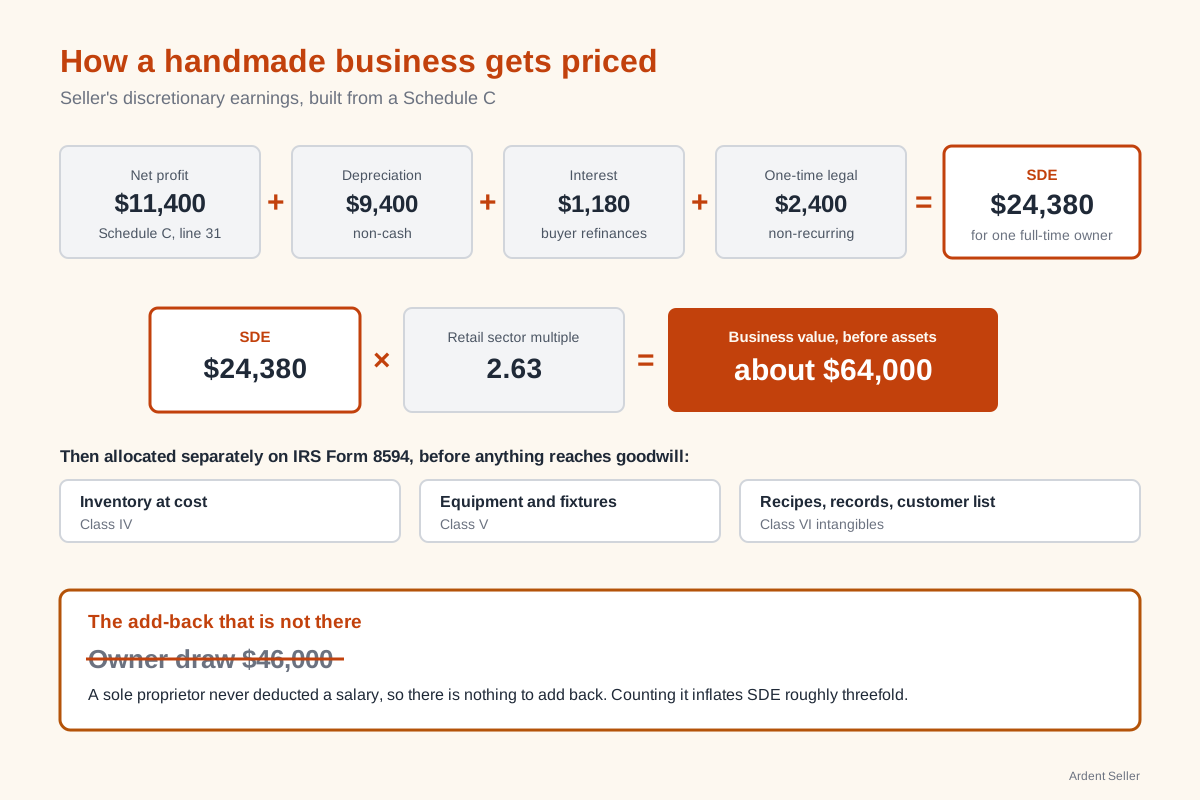
Delia reads a valuation article, finds the standard add-back list, and starts adding. Depreciation, yes. Interest, yes. One-time legal, yes. Then she reaches owner's compensation and adds back the $46,000 she paid herself last year, arriving at an SDE north of $70,000 and a mental price tag around $200,000.
That last add-back is not real.
A sole proprietor does not deduct an owner salary. There is no line for it on Schedule C (opens in new tab), because draws are not an expense — they are money leaving an account that already belongs to you. Line 31 net profit is already pre-owner-compensation. Adding a salary back to it counts the same dollars twice. This is the most common way a maker arrives at a number three times too large, and it happens because generic SDE add-back checklists are written with a C corporation or an S corporation in mind, where a real salary really was deducted.
Her actual SDE:
| Component | Amount | Why it belongs |
|---|---|---|
| Net profit (line 31) | $11,400 | Starting point — already before owner draws |
| Plus depreciation and Section 179 | $9,400 | Non-cash; the buyer sets their own basis |
| Plus interest expense | $1,180 | The buyer arranges their own financing |
| Plus one-time trademark legal fee | $2,400 | Non-recurring, documented as a single filing |
| Equals SDE | $24,380 |
At the retail sector's average 2.63 earnings multiple, that is roughly $64,000 — plus inventory, which we will come to.
Sit with what that means rather than arguing with it. Delia works full-time. The business generates $24,380 for that full-time work. A buyer who cannot personally make soap has to hire someone who can, at a real wage, and the earnings go to zero or below. That is not a pricing failure. It is the business telling her that at its current size, most of what she has built is a job she owns rather than an asset she can sell — and the fix is not a better broker.
What the multiple actually is, and what moves it
A multiple is not a grade. It is a payback period expressed backwards: a 2.6 multiple means a buyer expects to earn their purchase price back out of the business in a bit over two and a half years, assuming nothing breaks when the founder walks out of the door.
The figures below come from a different BizBuySell dataset than the quarterly numbers above: a five-year trailing average by sector rather than a single-quarter snapshot. That is why the all-sector earnings multiple here (2.58) sits slightly below the Q2-2026-only average (2.7), and why the retail median sale price below ($286,000, five-year trailing) differs from the Q2-2026-only retail median quoted earlier ($250,000). Both are SDE-based; the window is what differs.
| Sector | Revenue multiple | Earnings (SDE) multiple | Median sale price |
|---|---|---|---|
| Online and Technology | 1.09 | 3.28 | $850,000 |
| Manufacturing | 0.73 | 3.04 | $726,914 |
| Retail | 0.55 | 2.63 | $286,000 |
| Food and Restaurants | 0.42 | 2.27 | $200,000 |
| All sectors | 0.67 | 2.58 | $340,000 |
Source: BizBuySell, Business Valuation Multiples by Industry (opens in new tab). Eighty percent of the dataset sold between $50,000 and $2,000,000. BizBuySell's own caveat is worth repeating: these are relative indicators and "should not be relied upon to value a specific business."
Notice which sector pays best, because it is the one every maker is quietly closest to. Online and Technology carries a 3.28 multiple against Retail's 2.63 — roughly a 25% premium for what is, in many cases, the same product sold through a different mechanism. What the market is paying for there is not sophistication. It is transferability: a system that produces revenue without a specific pair of hands attached to it.
Within a sector, the same SDE can carry very different multiples. What moves it up:
What buyers pay a premium for:
- Documented processes anyone can follow
- A second person already running production
- A customer list you own outright
- Wholesale accounts on paper rather than on good terms
- Financials that reconcile to the bank statements without explanation
- At least two years of consistency
What pulls it down is the mirror image of that list — every place the business lives inside one person's head. Vipin Singh of Murphy Business Sales, quoted in the Q2 2026 report, is blunt about where the market has landed: "the era of unstructured, high-multiple exits for average businesses has subsided. Preparation, clean financials, and minimized owner dependence are now absolute prerequisites to securing a successful close" (BizBuySell Insight Report, Q2 2026 (opens in new tab)).
Worked example 2: same craft, same town, twice the multiple
Marcus makes the same category of product as Delia, in the same city, and started a year after she did. He is a composite too. His trailing twelve months: revenue $210,000, net profit $52,400, and after the same three legitimate add-backs, SDE of $68,000.
The SDE gap is the obvious part — nearly three times her earnings on 40% more revenue, because he moved 60% of his volume to wholesale and stopped paying marketplace fees on it. The interesting part is the multiple. Delia would be priced near 2.6. Marcus can defend 3.0, and the reasons are all boring:
- Every product has a written, costed recipe, and a new maker was trained from those documents last year without Marcus in the room.
- His part-time production lead runs the pour schedule. Marcus has been away for two weeks, twice, and revenue did not move.
- Eleven wholesale accounts have signed terms and reorder histories going back three years, which a buyer can read as forecast rather than hope.
- Retail sales run through his own site, with a customer list of 4,100 addresses that he owns, exports and can hand over.
$68,000 × 3.0 = $204,000, against $68,000 × 2.6 = $176,800. The documentation is worth about $27,000. Not because paperwork is inherently valuable, but because each of those four bullets removes a reason for the buyer to assume the earnings evaporate on closing day.
Your Etsy shop is probably not part of the sale
This is the part that catches makers off guard, and it is not a negotiating position — it is policy.
Etsy's help center could not be more direct: "No, you can't transfer your Etsy account to someone else. If you have sold the business you run on Etsy to someone else, you can't transfer your Etsy account to the new owner. Instead, the new owner must open a new Etsy account and shop." The same page adds that if Etsy believes an account transfer has occurred, "the account may be suspended without notice," and that a shop name can never be reused — even if the original shop closes (Etsy Help, Can I Transfer My Etsy Account to Someone Else? (opens in new tab)).
Picture a shop that has gathered 1,400 five-star reviews over eight years and runs 90% of its revenue through Etsy. None of that is transferable. The reviews are not an asset. The shop name is not an asset. The search ranking is not an asset. A buyer is purchasing a brand, some equipment, some inventory and a promise, then starting a brand-new shop from zero reviews on day one. They will price that risk, and they will price it hard.
Shopify sits at the opposite end. Its documentation walks the owner through a formal handover: from Settings → General, the store owner selects "Transfer store to a new owner outside your business," enters the new owner's email address, and the new owner accepts by email. There are conditions — an active Shopify Capital or Shopify Credit balance blocks the transfer, a Shopify Balance account has to be emptied first, custom domains move separately, and unpaid bills become the new owner's responsibility (Shopify Help Center, Change or transfer store ownership (opens in new tab)). Conditions, yes. But a path.
The practical consequence is uncomfortable and worth acting on early: the channel mix you build over years quietly decides how much of your business is sellable at all. A maker with an owned storefront, an owned email list and wholesale relationships has assets that change hands. A maker with a beloved Etsy shop and nothing else has a customer base that cannot follow the sale.
Inventory, equipment and goodwill are priced separately
There is no single lump. The IRS requires that a business sale be broken apart, and it requires both sides to agree on the breakdown: generally, both the purchaser and the seller must file Form 8594 with their income tax returns when a group of assets making up a trade or business changes hands and the purchaser's basis in those assets is determined wholly by the amount paid for them (Instructions for Form 8594 (opens in new tab), Rev. November 2021). That second condition is satisfied in an ordinary outright asset sale, which is what most maker-business deals are.
The form sorts everything into seven classes. Four of them matter to a maker:
- Class IV — inventory. Defined as "stock in trade of the taxpayer or other property of a kind that would properly be included in the inventory of the taxpayer," plus anything held primarily for sale to customers in the ordinary course of business. Finished goods, raw materials, packaging.
- Class V — everything tangible that is not in another class. The instructions note that furniture and fixtures, buildings, land, vehicles and equipment are generally Class V. The kiln, the pour tank, the label printer, the shelving.
- Class VI — section 197 intangibles other than goodwill. Read this one slowly, because the statutory list is a description of a maker's real work. Trimmed to the categories a handmade business actually holds, it covers:
- workforce in place;
- "business books and records, operating systems, or any other information base, process, design, pattern, know-how, formula, or similar item";
- any customer-based intangible;
- any supplier-based intangible;
- any license, permit, or other right granted by a government unit;
- any covenant not to compete entered into in connection with the acquisition;
- any franchise, trademark, or trade name.
- Class VII — goodwill and going concern value.
Two things follow from this that should change how you behave years before a sale.
First, the IRS has already told you which of your paperwork is an asset. Your recipes are a formula. Your production procedures are a process and an operating system. Your customer list is a customer-based intangible. Your vendor relationships are a supplier-based intangible. These are not soft factors a buyer might appreciate. They are named categories on a federal form, and they are worth nothing when they exist only as habit.
Second, goodwill is a residual, not a claim. Allocation follows the residual method under Regulations sections 1.338-6 (opens in new tab) and 1.338-7 (opens in new tab), applied to asset sales through section 1.1060-1(c) (opens in new tab): consideration is assigned to Class I first, then to Classes II through VI in order at fair market value, and only what remains lands in Class VII. So an inventory you cannot count, cost or substantiate does not quietly get swept into goodwill. It gets a low number, and the low number sticks, because the buyer has every incentive to allocate more to inventory and equipment — which they recover faster — and less to fifteen-year goodwill. If you have never valued your stock at cost, do it before the first conversation; the Year-End Inventory Reset Checklist walks the same count a buyer's accountant will eventually ask you to reproduce.
Worked example 3: Marcus's deal meets the lender
Marcus and a buyer agree on a price of $220,000. Then the financing arrives and rearranges things.
Roughly eight in ten buyers — 78% in BizBuySell's Q2 2026 survey — expect to use SBA financing to complete an acquisition (BizBuySell Insight Report, Q2 2026 (opens in new tab)). That means an SBA rulebook, not the handshake, sets the ceiling. The operative version is SOP 50 10 8, effective June 1, 2025; version 8.1 takes effect October 1, 2026, per the SBA's own document listing (opens in new tab). Two of its provisions decide what a small deal can actually be priced at.
The valuation cap. A change-of-ownership loan requires a valuation, and 7(a) proceeds are capped at the business valuation amount. Where the agreed price exceeds the valuation, the difference has to come from equity or subordinate financing rather than the guaranteed loan.
Who performs the valuation. For a standard business, the lender may value it in-house when the financed amount minus appraised real estate and equipment is $250,000 or less. Above that, or where buyer and seller are related, an independent valuation from a qualified source is required (QuickRead (opens in new tab), citing the SOP). Most handmade-business deals sit well under the threshold.
Both provisions are summarized, with citations to the SOP, in NACVA's QuickRead (opens in new tab) — a professional-association secondary source, used here because the SOP itself is distributed as a Word document rather than a linkable page.
Marcus's deal is small enough that the lender values it internally. It comes back at $204,000 — the number his own SDE math supported. The $16,000 of optimism does not disappear, but it stops being the bank's problem and becomes a negotiation between him and the buyer.
Then comes the second squeeze, and it is the widest gap in the market right now. Ninety percent of buyers expect seller financing to be part of their acquisition strategy. Only 29% of owners plan to offer it, and almost half say flatly that they will not (BizBuySell Insight Report, Q2 2026 (opens in new tab)). Marcus is asked to carry $25,000 as a seller note. If he refuses, the buyer's equity requirement rises and the deal probably dies. If he accepts, part of his sale price arrives over three years and depends on a business he no longer controls.
The headline number and the money are not the same thing. What actually lands is the agreed price, minus what the lender will not fund, minus what is deferred into a note, split across asset classes that are taxed differently. The allocation on Form 8594 is a negotiation with real money in it, and it is the point where a CPA earns their fee several times over.
The two years before you sell
None of this is fixable in the two weeks before a buyer appears. Almost all of it is fixable with ordinary discipline applied for long enough — which is exactly what the first point below asks for.
Get two clean years. Buyers and lenders want financials that reconcile without a story attached. Business money separated from personal money, every sale recorded once in one place, and a cost of goods figure derived from what materials actually cost rather than estimated in December.
Cost every product properly. An SDE built on a guessed COGS is an SDE the buyer's accountant will rebuild, downward. If you do not know what a unit costs to make, you do not know your margin, and neither will they.
Write down what is in your head. Recipes with quantities. Production procedures with steps. Supplier names, terms and lead times. The IRS calls these information bases, processes, know-how and supplier-based intangibles; the buyer calls them the reason they do not have to start over. This is where a system that already holds your recipes, batch history, vendor records and per-unit costs stops being an operational convenience and becomes part of what you are selling. Ardent Seller keeps those records as a by-product of running the business, so that when someone asks for two years of production history and a costed bill of materials, the answer is an export rather than a winter of reconstruction.
Reduce yourself. Train someone. Take two weeks off and see what breaks. Every dependency you remove is a reason for the buyer to keep the multiple where you want it.
Move some revenue somewhere transferable. An owned storefront, an owned email list, wholesale accounts with signed terms. Not because marketplaces are bad — they are excellent at finding customers — but because a channel you cannot hand over is a channel that leaves when you do.
Run the arithmetic on your own last twelve months this week. Net profit, plus depreciation, plus interest, plus anything genuinely one-off, times two and a half. If the answer disappoints you, that is not bad news. It is notice — and two years of clean records is the most useful thing you can do with it. Start free and let the records build themselves while you decide what to do with them.
Sources and methodology
Every figure in this post comes from one of the following, checked on 19 August 2026:
- BizBuySell Insight Report, Q2 2026 (opens in new tab) — the quarterly transaction and survey figures: 2,117 businesses sold, median sale price $349,250, median cash flow $155,921, median revenue $692,087, the 2.7 average cash flow multiple, the retail sector figures, the owner-preparedness percentages, the 78% SBA-financing expectation, the seller-financing gap, and the Vipin Singh quotation.
- BizBuySell, Business Valuation Multiples by Industry (opens in new tab) — the sector multiples table and the SDE definition. This is a separate, five-year trailing dataset covering deals closed from Q3 2021 through Q2 2026 — see the reconciliation above the table.
- Instructions for Form 8594 (opens in new tab) (Rev. November 2021) and Form 8594 (opens in new tab) — the filing requirement, the seven asset classes, and the residual allocation method.
- Schedule C (Form 1040) (opens in new tab) — the line 31 net profit figure that the SDE calculation starts from.
- Etsy Help, Can I Transfer My Etsy Account to Someone Else? (opens in new tab) — the account non-transferability policy, quoted directly.
- Shopify Help Center, Change or transfer store ownership (opens in new tab) — the transfer procedure and its conditions.
- SBA, SOP 50 10 document listing (opens in new tab) — confirms version 8 is effective June 1, 2025 and version 8.1 takes effect October 1, 2026. The lending provisions themselves are cited via NACVA's QuickRead (opens in new tab), a professional-association secondary source, because the SOP is published as a Word document rather than a linkable page.
On freshness: BizBuySell's quarterly data lags the quarter it reports on, and its multiples table is updated twice a year. SBA lending policy changes on its own schedule — check the SOP version in force at the time of your deal rather than relying on the dates above. Delia and Marcus are composites built to illustrate the arithmetic; their figures are invented, not drawn from any real business.
Related reading
- When to stop running your business on spreadsheets — the systems threshold that usually arrives long before the exit conversation does, and how to tell you have crossed it.
- Do you need an LLC for your handmade business? — whether you sell assets or an entity depends on what you formed, and this covers the structure question on its own terms.
- Hobby vs. business: what the IRS actually looks at — before a business can be sold it has to be a business, and the record-keeping test is close to the one a buyer applies.
- Equipment depreciation for small makers — the Class V side of the allocation, and why the deduction you took years ago shows up again at closing.
Free resources
Free companion downloads if you want to start building the evidence a buyer will ask for:
- Year-End Inventory Reset Checklist — the count-and-cost pass that turns your stock into a defensible Class IV number instead of a shrug.
- End-of-Month Closeout Checklist — twenty-four of these in a row is what two clean years looks like from the inside.
- Vendor & Supplier Contact Organizer — supplier relationships are a named intangible on Form 8594; this is where you stop keeping them in your phone.
This article is provided for educational purposes only and does not constitute financial, tax, legal, or valuation advice. Valuation multiples, worked examples, and purchase-price allocations are illustrative and will vary by your specific circumstances, and SBA lending rules and tax treatment change over time. Consult a qualified accountant, business appraiser, or attorney before making decisions about selling your business.