
What is the most expensive thing in a handmade greeting card?
It is not the cardstock. It is not the ink, or the little foil accent, or even the envelope. For a lot of card makers, the most expensive thing in the card is the hands-on time they never bill for — plus a dozen small costs that never make it onto the price sheet because each one, on its own, feels too tiny to matter.
That is the quiet math problem of paper goods. A card looks like a piece of folded cardstock and a marker, so it gets priced like one. But by the time it is scored, printed, folded, embellished, sleeved, backed, photographed, listed, and shipped, it has picked up a stack of costs that add up to more than the paper ever did. None of them will bankrupt you. All of them together will quietly hold your margin at break-even while you wonder why a business doing real sales volume never seems to leave any money behind.
The good news: none of this is hard once you can see it. It is not that you are bad at pricing — it is that the paper-goods cost sheet is unusually long and unusually easy to under-count. So let us count it. Below are eleven costs that hide the best in a greeting card and stationery business, and how to fold each one back into your price.
To keep it concrete, three composite makers run through this piece — all illustrative, with figures chosen to show the shape of the math rather than to quote real prices:
- Nadia hand-assembles greeting cards on a home printer and sells them as singles at markets and on Etsy, with a few boutique card racks starting to reorder.
- Theo makes letterpress and foil wedding invitations and stationery suites, outsourcing his print runs to a shop that charges plates, dies, and minimums.
- Priya designs planners, notebooks, and boxed stationery sets, carries a large catalog, and ships most orders in rigid mailers.
1. The envelope you forgot to price
The card gets all the attention; the envelope gets bought in a separate order and mentally filed under "free." It is not. A plain A2 or A7 envelope is cheap per unit, but the moment a customer wants a colored, lined, or square envelope — the ones that make the set feel special — the per-unit cost can multiply several times over.
Nadia buys her cardstock and her envelopes in different orders, months apart, so when she prices a card she is looking at the cardstock invoice and nothing else. The envelope never enters the number. Multiply a forgotten fifteen-cent envelope across a thousand cards a year and it is a real line in her P&L that simply is not in her price.
The fastest fix this week: price the card to include the exact envelope you send, and treat any upgraded envelope as a paid add-on — never a freebie you silently absorb.
2. The clear sleeve and the backing board
Retail cards almost never go out naked. They go out in a clear cello or biodegradable sleeve, usually over a kraft backing board that keeps the card flat and gives it a finished, rack-ready look. Together those two items might run somewhere around a dime a card — small, until you remember that every single retail card needs them, every time.
Wholesale and consignment make this worse, not better: boutiques expect shelf-ready, sleeved product, so the packaging you might skip on a market single becomes mandatory the moment the card lands on someone else's rack. That is a cost that arrives exactly when your margins are already thinnest.
3. Test prints, proofs, and color calibration
Between "final design" and "sellable card" sits a small pile of paper that never gets sold. The proof you printed to check the fold line. The three sheets where the blush pink came out salmon until you calibrated the printer. The test run on the good cardstock because the draft paper lied about how the ink would sit.
For a home-printer maker like Nadia, this is wasted cardstock and toner on every new design. For Theo, working with an outside press, it is press proofs — physical proofs the shop charges for before a run, plus the make-ready sheets a press eats getting the impression right. Either way, the rule is the same: the first few units of any new design cost you and earn nothing. Fold that waste into the design's cost, or it comes straight out of the margin on the units that do sell.
4. Print-run minimums, setup fees, and the box of overstock
This is the big one for anyone who outsources printing. Offset, letterpress, and foil printing all come with three costs that a home printer never sees: a minimum order quantity, a one-time setup fee for plates or dies, and the overstock you are left holding when the minimum exceeds real demand.
Theo orders a wedding suite at a minimum of 100 when the couple needs 85. He pays a plate setup fee whether he prints 85 or 850. And the fifteen extra invitations are not a bonus — they are cardstock he paid for that will most likely never sell, because the design was custom to one wedding. The honest way to cost this is brutal but simple: divide the setup fee and the full minimum by the number of units you realistically expect to sell, not the number you printed.
Run that math on an order like Theo's, and the per-card cost of a short custom run can land well above the tidy "price per unit at quantity" the quote implied — in a tight case like his, close to double it.
Rule of thumb: amortize setup and minimums — spread them across the cards you will actually sell, not the cards you actually printed. Overstock is not inventory — it is a risk you already paid for.
5. Foil, letterpress, and every "special" finish
Every finish that makes a card feel premium adds cost in two places, and makers usually count only one. Foil, letterpress, embossing, edge painting, and die-cutting each carry a per-unit charge and a setup cost — the foil die, the letterpress plate, the cutting die — that has to be paid before the first good card exists.
The seductive error is pricing the finish as a small per-card upcharge and forgetting the die that made it possible. A five-dollar foil die spread across a 40-card run is more than a dime a card before a single sheet is foiled. Charge for the finish as what it is: a premium tier with its own setup baked in, not a fifty-cent flourish.
6. Font and artwork licensing
The prettiest part of the card might carry a license. Commercial-use fonts, purchased illustrations, clip-art bundles, and stock florals frequently come with terms that are fine for personal projects and not fine for products you sell — or that cap how many units you may sell before you owe more.
This cost is invisible precisely because it is paid once, up front, long before the card sells. Priya licenses a script font and a set of botanical illustrations for a stationery line. Spread across the line's lifetime sales, the cost per unit is genuinely small. Ignored entirely, it is a compliance risk and an untracked expense that makes the line look more profitable than it is. Count it, amortize it across the line, and keep the license terms where you can find them.
7. The design hours (per new design)
Here is a cost that scales with your catalog, not your sales: the hours it takes to design each new card. Sketching, laying out, choosing type, adjusting until the fold and the art line up — that is real skilled labor, and it is spent once per design whether that design sells five copies or five hundred.
A maker with a big, ever-growing catalog is effectively running a design studio on top of a card business. Priya's 120 designs represent 120 unpaid design sessions if she never priced that time in. The fix is not to design less — it is to recognize that every new design carries a fixed cost that has to be earned back before the design is profitable, which is exactly why pruning slow designs so often beats adding new ones.
8. Hands-on assembly and finishing time
If design time is the fixed cost, assembly time is the one that repeats on every card. Scoring and folding. Mounting a layered panel. Tying a ribbon, adding a vellum overlay, placing a tiny gem. Slipping the card into its sleeve with its backer, straightening it, sealing it. Four minutes of careful handwork does not feel like much until you price a maker's time at even a modest hourly rate and realize those four minutes may be the single largest line on the whole cost sheet.
Nadia can make a card in her sleep, which is exactly the problem — because it is easy, she counts it as free. It is not free. It is the difference between a card that pays her for her time and a card that pays her for cardstock and asks her to donate the labor.
The highest-leverage fix of all: time yourself assembling ten cards, divide by ten, and multiply by an honest hourly rate. That per-card labor number belongs in every price you set.
9. A photograph for every single SKU
Every design needs a photo — usually several — and a big catalog means a big, recurring photography cost that has nothing to do with how many cards you sell. Styling the flat-lay, shooting it, editing it, cropping it for the listing and again for social: that is an afternoon per batch of designs, and it comes due every time you launch something new.
This is the cost that punishes catalog sprawl the hardest. Priya's 120 designs are 120 photo setups whether or not each one sells. Two makers with identical sales can have wildly different photography burdens depending purely on how many distinct designs they carry. If a design is not earning back its photo, its listing, and its design hours, it is not a product — it is a hobby line item wearing a SKU.
10. Mailers, boxes, and the free-shipping habit
The card is made; now it has to travel. Rigid mailers so cards arrive un-bent, boxes for boxed sets, tissue, a branded sticker, the little thank-you insert — packaging is a cost per order that rides on top of the cost per card. And then there is the quiet one: "free" shipping, which is never free. When a maker offers free shipping to stay competitive, the postage comes out of the item price, and if the item price was set without accounting for it, it comes out of the margin instead.
Priya ships planners in rigid mailers that cost real money each, plus the postage she folds into her "free shipping" pricing. Neither is visible in the price of the planner itself, which is exactly why both get missed.
11. The seconds pile — bent, smudged, and sampled
Finally, the pile every paper maker has and few makers price: the seconds. The card with the smudged corner. The one that got bent at a market. The envelope the printer chewed. The three samples handed to a boutique buyer to earn the wholesale account. The sheet that curled in humidity.
None of these sell, but all of them cost — cardstock, ink, labor already spent. In inventory terms this is shrinkage, the same loss category many food businesses build into pricing to cover spoilage. Build a small allowance for it into your own prices so the damaged and donated cards are already paid for by the cards that make it to a customer.
The pattern: the paper is never the cost
Read the eleven back to back and a pattern jumps out. Nadia's blind spots are envelopes, sleeves, and her own uncounted assembly time. Theo's are print minimums, setup fees, and specialty-finish dies. Priya's are design hours, a photo per SKU, and packaging that scales with her sprawling catalog. Three very different makers — and not one of them is losing money on cardstock.
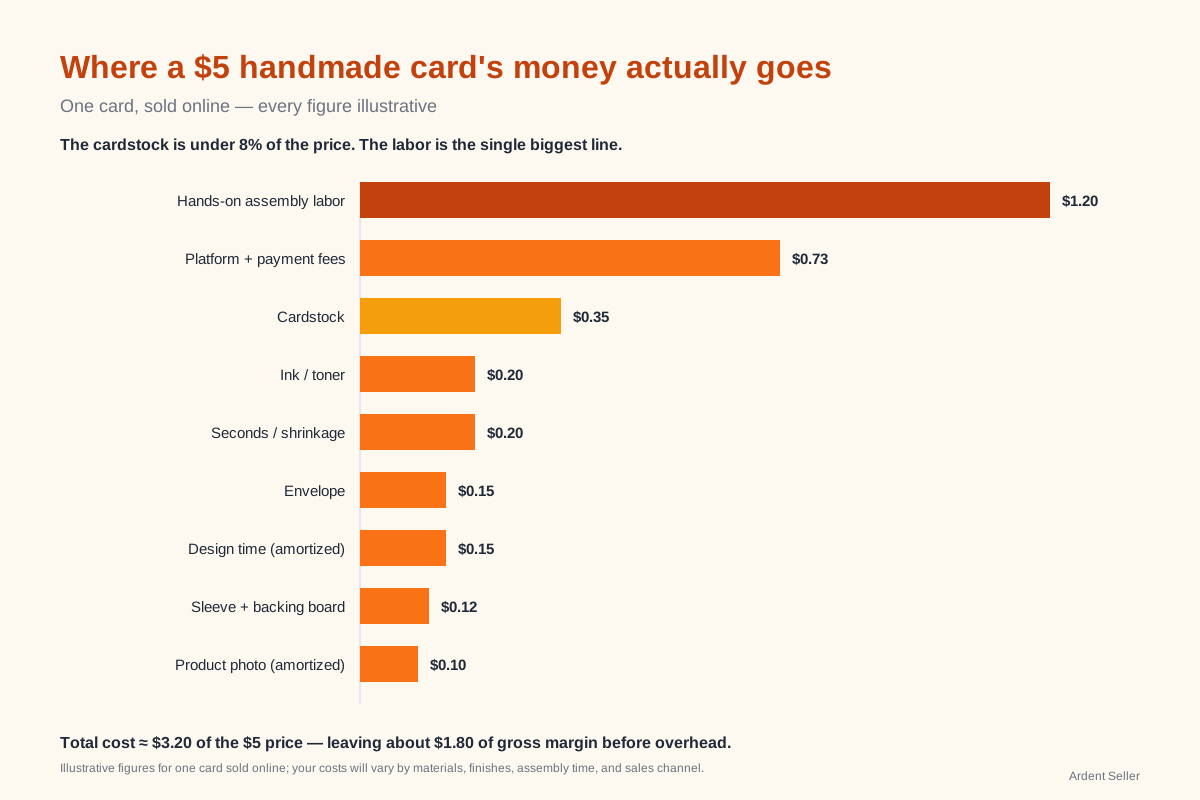
That is the whole lesson. The material that gives the product its name is almost always the smallest line on its cost sheet. Consider a single card that retails for $5, sold online. This is the per-card cost of that one sale, so a few of the eleven simply do not land on it: a home-printed design carries no print-run minimums, specialty-finish dies, or licensing, and the postage and mailer on an online order are normally billed to the buyer rather than absorbed into the card. Every figure below is illustrative, not a benchmark:
- Cardstock: about $0.35
- Envelope: about $0.15
- Sleeve and backing board: about $0.12
- Ink or toner: about $0.20
- Design time, amortized across the run: about $0.15
- Hands-on assembly (roughly four minutes of labor): about $1.20
- Product photo, amortized across the design's sales: about $0.10
- Platform and payment fees on a $5 online sale: about $0.73 (see note)
- Seconds and shrinkage allowance: about $0.20
Note on platform fees: this assumes an online marketplace sale — for example, roughly a 6.5% transaction fee plus about 3% + $0.25 payment processing on a $5 order (≈ $0.73), based on Etsy's published fees (opens in new tab) as one reference point, current as of mid-2026. A card sold in person at a market skips most of this.
That is roughly $3.20 of true cost against a $5 price — and the cardstock is under eight percent of the $5 price it sells for, while the labor is the single biggest slice. Skip four or five of these lines, as it is so easy to do, and the "$5 card with a fifty-cent cost" you thought was carrying a 90% margin is actually clearing a fraction of that.
A 10-minute hidden-cost audit
You do not need a new spreadsheet system to fix this today. You need ten minutes and one honest pass down the list. Pull up your best-selling card or set and check off each cost — if a line is not currently in your price, that is a leak you just found:
- Envelope — the exact one you send, at its real cost, including any upgrade.
- Retail packaging — cello sleeve and backing board, per card.
- Print/proof waste — the test prints, proofs, or make-ready this design ate before it was sellable.
- Print-run setup and overstock — setup fees and minimums, divided by units you will actually sell.
- Specialty finish setup — foil, letterpress, emboss, or die-cut, plus the plate or die that made it.
- Licensing — any font or artwork license, amortized across the line.
- Design hours — the time to create the design, earned back across its expected sales.
- Assembly labor — your real per-card handwork time at an honest hourly rate.
- Photography — the shoot and edit for this SKU, amortized across its sales.
- Shipping materials and postage — mailers, boxes, inserts, and any "free" shipping you absorb.
- Seconds allowance — a small buffer for bent, smudged, and sampled cards.
Any line you could not check is money the design is spending without being paid for it. That is not a failure — it is a to-do list.
Where a tool earns its keep
Some of these costs you can carry in your head; most you cannot, especially once one design becomes eighty and one sales channel becomes four. The two that reliably break spreadsheets are the ones that come up again and again in paper goods: building each card from its true parts and pricing the same design for retail singles and wholesale dozens.
This is exactly the bookkeeping Ardent Seller is built for. Each card can be a bill of materials — cardstock, envelope, sleeve, backer, embellishments — so finishing a card or packing a boxed set deducts the right components and rolls up the real material cost, and assembly time gets captured as labor so it lands in the price instead of vanishing.
Retail and wholesale pricing tiers sit side by side, consignment tracking shows what is on which boutique rack, and true-margin reports tell you which designs to reprint and which to retire. If you make cards, invitations, or stationery, the Greeting Card and Paper Goods use-case guide walks through how it fits your specific catalog.
None of the eleven costs above is the villain. The villain is only ever the one you did not see. Count them once — take the ten minutes — and the next card you price will finally pay you for all of the work you put into it, not just the paper it is printed on. Start a free Ardent Seller account and build your best-selling card as a bill of materials this week.
Related reading
- The "3× Material Cost" Rule for Stickers — The same trap in a neighboring paper craft: pricing off the material alone and ignoring the labor that dwarfs it.
- The True Hourly Wage of a Handmade Business — The assembly-labor line was the biggest slice above; here is how to put an honest hourly number on your own hands.
- Margin vs. Markup: The Pricing Math Mistake — Once you have the full cost sheet, this is how to build a price up from it correctly instead of guessing a multiplier.
Free resources
Three free downloads from the Ardent Workshop library that pair well with this post:
- Product Pricing Calculator — Build a card's price up from every line on the cost sheet above, including the labor and packaging that hide the best.
- Wholesale Line Sheet Template — Set your retail and wholesale card prices side by side with the margin math wired in, so the dozen-at-a-time price still clears your costs.
- Should I Raise My Prices? — A quick gut-check for when the audit above reveals your current prices were built on the cardstock alone.
This article is provided for educational purposes only and does not constitute financial, tax, or business advice. Cost structures, pricing examples, and margin figures are illustrative and will vary by your specific circumstances. Consult a qualified accountant or small-business advisor before making financial decisions based on this content.