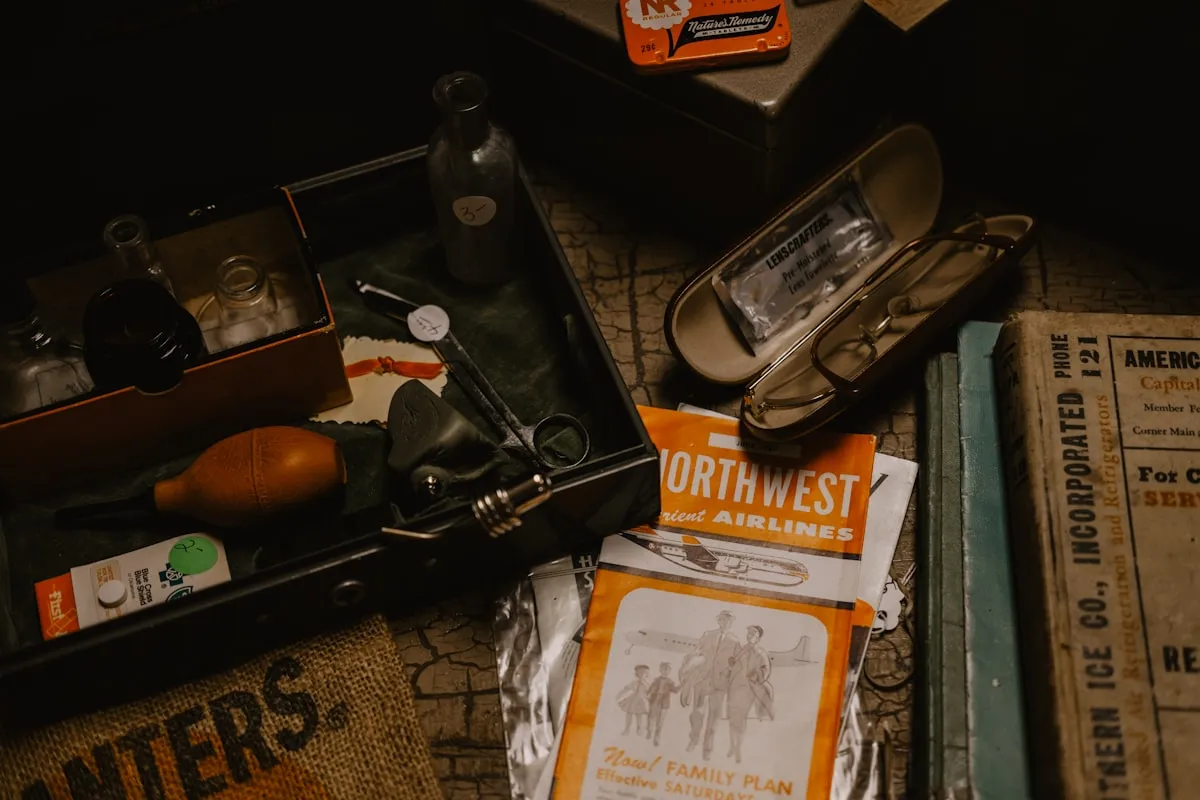
Your inventory tracking is probably fine for a maker who batches 200 candles. It is not fine for a vintage seller. The two businesses look adjacent from the outside; they are not in the same room.
A candlemaker pours 48 jars from one batch, each jar's cost rounds to the same number, and the spreadsheet handles itself. A vintage reseller drives 60 miles to an estate sale, comes home with a 2009 Toyota Corolla full of mid-century lamps, Pyrex, paperback paperbacks, and one mysteriously heavy ceramic owl — and every single item has a different acquisition story, a different shipping profile, a different sell-through window, and a different margin. The candlemaker's spreadsheet pretends none of that exists. So most year-one vintage resellers run that same spreadsheet and quietly hemorrhage money the whole time.
Here are 12 places the money goes.
1. The flat-rate cost-per-piece trap
Mistake: "I paid $40 for the lot of ten, so each item cost $4."
What actually happens: Two of those items will sell for $80, three will sell for $15, two will land in the donation pile, and three will sit on a shelf for nine months. The $4-per-item math gets the gross margin wrong on every single one.
The fix: Allocate the lot price across the items you actually intend to sell, not the items in the bag. If a $40 lot has six keepers and four obvious scraps, the acquisition cost per keeper is $6.67, and you write off the four scraps as part of the cost of doing business. Better yet: distribute the cost by expected sell price. A $40 lot where you expect $200 in revenue means each $20 expected-sale item carries $4 of cost, and each $40 expected-sale item carries $8. That gives you a defensible margin per item, not an averaged fiction.
2. Mileage that never gets logged
Mistake: "I'd track mileage if I sold more — it's just a side thing right now."
What actually happens: A 40-mile estate sale round trip is roughly $30 of deductible cost at standard IRS mileage rates. Twelve estate sales a quarter is $360 you are forgetting to deduct. Multiplied across a year, it is most of a Schedule C line.
The fix: Log every drive that exists because of inventory — estate sales, antique shows, post office runs, storage unit visits, consignment shop drop-offs. A note in a phone app is fine. A receipt from the gas station with the date is fine. What is not fine is reconstructing the year in March from memory. The IRS standard mileage rate is updated each year on its Standard Mileage Rates page (opens in new tab); apply the year-appropriate rate and you will be surprised what falls out.
3. No holding-period math
Mistake: Pricing a piece, listing it, and forgetting it.
What actually happens: A $50 mid-century lamp sitting nine months is $50 of cash that could have been three turns of $50. The "I'll just wait for the right buyer" strategy works for one or two items; across 200 SKUs, it is a working-capital crisis.
The fix: Track days-in-inventory on every active SKU. Pick a reprice trigger for each category — Pyrex at 60 days, mid-century lighting at 120, niche specialty at 180 — and actually apply it. The reprice does not have to be aggressive; a 10–15% drop with refreshed photos and a new listing description is usually enough to move a piece that has been overlooked. The goal is not to clear inventory at any price. The goal is to know which items are paying rent on your shelf and which ones are not.
4. Consignment fees buried in "other expenses"
Mistake: Three consignment shops, three different commission splits, one "consignment fees" line on the P&L.
What actually happens: Shop A pays you 60% and sells everything in three weeks. Shop B pays you 50% and sits on inventory for six months. Shop C pays you 70% but takes anything visibly old. The aggregate line says "consignment is fine." The per-shop breakdown says one of those shops is your business and two of them are a hobby.
The fix: Every consignment shop is its own discrete sales channel with its own per-piece economics. Track sell-through rate by shop, average days to sale by shop, and net per-piece after the split by shop. Within a quarter, you will know which shop deserves your best pieces and which one should be getting your slow-movers.
5. Platform fee tier shifts ignored
Mistake: Modeling fees as a flat percentage forever.
What actually happens: Most marketplaces have performance tiers, store-subscription thresholds, and category-specific fees that all change as your volume grows. The fee you paid on item #50 is not the fee you pay on item #500.
The fix: Once a quarter, pull a fee report from every platform and back-solve the actual blended fee rate. If your model says "13% all in" and the platform report says "16.2% blended," the difference is on your shelf as missing margin. Pay particular attention to fee tier changes that flip at specific monthly or annual revenue thresholds — crossing the line in late November can quietly resize Q4 margin if you are not watching.
6. The lot-photo trap
Mistake: "The lead photo had a beautiful piece of Roseville pottery. I bid $120 on the lot. The Roseville was the only good thing in the lot."
What actually happens: Estate sale and auction lots get photographed for the hero piece. The other eleven items are the price of admission to the one piece you wanted, and they need to either sell at full salvage or move to the donation pile fast.
The fix: When you bid on a lot, assign two numbers: the amount you are willing to pay for the hero piece alone, and the amount the rest of the lot is worth at salvage. If the lot price exceeds those two numbers combined, pass — or commit upfront to selling the supporting cast at scrap-grade prices and treat the gap as the cost of getting the hero. Either way, the gap shows up in your books as the real cost of the hero piece, not the lot total divided by item count.
7. No shrinkage category
Mistake: A piece breaks in storage. The reseller pulls it from inventory and forgets about it.
What actually happens: Shrinkage in vintage resale runs 2–5% per quarter — items break, get lost, get damaged in shipping, get returned in worse condition than they left. Without a shrinkage line, those losses get absorbed into a vague "lower-than-expected margin," and the seller spends six months wondering why the spreadsheet says 38% and the bank account says 22%.
The fix: Create a dedicated shrinkage category in your COGS bucket. Every time a piece leaves inventory for a reason other than a sale, log the acquisition cost as shrinkage with a one-line reason — "broken in transit, packed too lightly," "damaged on shelf," "missing after move." For tax purposes, shrinkage reduces ending inventory (and therefore increases COGS), so the documentation supports your deduction. The bigger payoff is operational: a single quarter of shrinkage logs will tell you whether you have a packing problem, a storage problem, or a documentation problem.
8. Pricing by gut, not by comp
Mistake: "It feels like a $75 lamp."
What actually happens: Marketplaces have a "sold listings" filter — the data is right there, free, refreshed daily. Not using it is a willful information shortage. The lamp that feels like $75 is selling completed in the $42–$58 range, and the listings priced above $65 are sitting unsold for 90+ days.
The fix: Five minutes of sold-listing research per piece before you list. Pull the median sold price, the range, and the median days-to-sale. Price 5–10% above the median if your photos and description are above average; price at or slightly below the median if they are average; if the median says $42–$58, do not list at $89 and hope. Save the search query for any category you sell repeatedly; reuse it every time you list something similar.
9. Description-based "SKUs"
Mistake: "the blue lamp," "the other blue lamp," "the blue lamp with the chip."
What actually happens: This works for 30 items, gets shaky at 100, and falls apart at 300. By the time you cannot remember which "blue lamp" is which, you have already mispacked at least one shipment.
The fix: Every item gets a unique, short, alphanumeric SKU at the moment it enters inventory. A YY-NNNN format (year + sequential number) is plenty for most vintage businesses — 26-0142 is the 142nd item entered in 2026. Write it on the storage label, the photo filename, the listing internal-reference field, and the spreadsheet row. The SKU is the spine that connects your shelf, your photos, your listings, and your books. When the spine cracks, every other system bends with it. A working SKU scheme is the difference between a vintage business and a vintage hobby; the SKU Design for Small Sellers post walks the format choice in more depth.
10. Storage cost as a free input
Mistake: "The storage unit is just where I keep things until they sell."
What actually happens: A $145/month climate-controlled unit divided across 80 active items is $1.81/item/month of pure overhead. A piece that sits eight months has absorbed $14.50 of storage cost — on top of acquisition, shipping inbound, and listing fees. That is a meaningful slice of the margin on a $40 item, and almost nobody books it.
The fix: At minimum, treat storage as a monthly overhead expense in your P&L. Better: divide storage cost by active SKU count each month and apply a "carrying cost per item per month" line to the holding-period column. The math is rough — square footage per item varies — but a rough number that exists is infinitely better than a precise number that does not. A piece that has sat nine months with $16 of allocated storage cost is a different pricing conversation than the same piece with no carrying cost on the books.
11. Cash-flow blindness on long holds
Mistake: Buying for the long sell-through without budgeting for the long sell-through.
What actually happens: Specialty categories — fine ceramics, rare books, mid-century lighting — sometimes need 6–12 months to find their buyer. That is the business model. The problem is buying $3,000 of specialty inventory without a working capital cushion to sit on it, and then needing to pay rent.
The fix: Categorize every acquisition by expected sell-through window before you buy it. Set a working ratio — for many resellers, no more than 30% of capital should be tied up in 6+ month holds at any one time, with the rest in faster-turning categories that keep cash moving. If your acquisitions skew long this month, the next acquisition has to skew short to balance. This is not a creative constraint; it is the difference between a vintage business that compounds and one that runs out of money in October.
12. No category-level margin tracking
Mistake: Aggregate margin: "I'm doing 38%."
What actually happens: Pyrex margin: 65%. Mid-century lighting margin: 58%. Vintage clothing margin: 12%. Paperback books: 8%. The aggregate hides which categories are paying for the storage unit and which categories are using it as free housing.
The fix: Tag every piece with a category at intake, and pull a per-category P&L every quarter. The first time you run that report you will find at least one category where you are losing money at scale and at least one where you are leaving margin on the table. Drop the losers; lean into the winners. This is the single highest-leverage analysis a vintage reseller can run, and it requires no new tools — just the discipline to tag every item at intake.
A tagged, item-level inventory system makes that quarterly report a one-click pull instead of a Sunday-afternoon spreadsheet expedition. That is exactly the operational gap Ardent Seller is built to close for one-of-one inventory businesses — per-item acquisition cost, per-item days-in-inventory, per-category margin, and a working audit trail when the tax preparer calls in March.
What changes when you stop making these
Most vintage resellers can identify at least four of these twelve in their own business within ten minutes of reading the list. That is not a failing — it is a useful diagnostic. The mistakes compound quietly, and the spreadsheets most resellers inherit from generic small-business advice are designed for the wrong inventory shape.
The post-fix version of this business does three things the pre-fix version cannot: it tells you the real margin on every category each quarter, it tells you which piece on your shelf is the oldest and most expensive carrying cost, and it tells you whether your last estate sale was actually profitable once you back out mileage, lot scraps, and shrinkage.
That is the whole reporting stack. It is not glamorous. It pays the rent.
If you are ready to put a real per-item inventory spine under your vintage business, Ardent Seller has a vintage-and-resale workflow built for one-of-a-kind goods — per-item acquisition tracking, per-category margin reports, shrinkage logging, mileage records, and the free trial is enough runway to migrate a 200-SKU spreadsheet over a weekend.
Related reading
- Inventory Tracking for One-of-a-Kind Items — The foundation post for this niche: why every-item-is-unique inventory needs a different mental model than batch goods, and how to build it.
- SKU Design for Small Sellers — The full version of mistake #9: alphanumeric SKU schemes, migration plans from description-based systems, and the format conventions that survive a 10x growth in inventory.
- The Spreadsheet Breakup: Outgrowing Excel for Maker Businesses — When the description-and-formula spreadsheet finally collapses, what to ask before you replace it.
Free resources
A few free downloads from the Ardent Workshop library that pair well with this post:
- SKU Naming & Barcode System Starter Kit — A working SKU naming convention plus a barcode template — the direct fix for mistake #9 and the spine that ties the rest of the fixes together.
- Inventory Tracker Starter Kit — A working Excel inventory tracker with per-item acquisition cost, days-in-inventory, and reorder-status columns — adaptable for one-of-one resale with the SKU spine in place.
This article is provided for educational purposes only and does not constitute financial, tax, or business advice. Cost structures, mileage rates, fee tiers, and margin examples are illustrative and will vary by your specific marketplace, jurisdiction, and inventory mix. Consult a qualified accountant or small-business advisor before making financial decisions based on this content.