The most dangerous pricing personality in your maker business isn't the one you'd guess.
It isn't the one who picks numbers out of the air. It isn't the one who copies competitors. It isn't even the one who has known for two years that her prices are too low and hasn't fixed them. Those are the loud problems. They show up in the bank account, and most sellers can name them.
The dangerous one is the one who feels like she has a system.
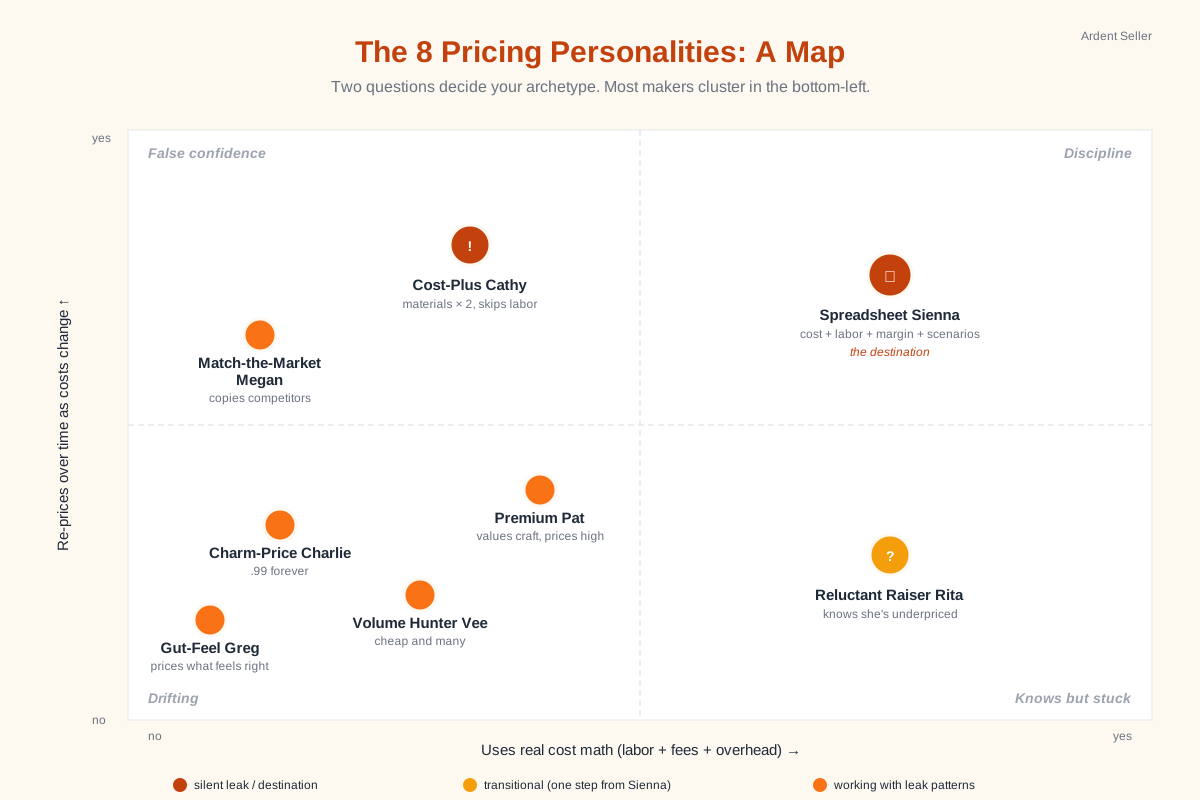
The short version. Most makers reliably fall into one of eight pricing personalities. Seven of them have visible failure modes: vibes, mimicry, charm pricing, undercutting. The eighth is the discipline target everyone is trying to reach. The single archetype that quietly leaks the most margin is the one whose math looks rigorous on paper — Cost-Plus Cathy — because the appearance of a system protects her from the scrutiny the other seven get.
This is a typology piece, not a self-help piece. The point of naming archetypes isn't to put you in a box. Most makers recognize themselves across two or three of the eight at once, which is the correct reading — pricing is a habit pattern, not a personality test. The point is to make the patterns nameable, so the one that's quietly costing you money becomes harder to keep doing by accident.
The eight archetypes below are the same ones the Pricing Personality Quiz maps against, so once you've finished reading you can take the 9-question version and find out where your real pricing decisions land — which is usually two archetypes away from where you'd predicted.
The eight pricing personalities
1. Cost-Plus Cathy
Cathy's pricing method has a formula, which is more than most can say. It is: materials × 2. Sometimes it is materials × 3, depending on the day and the product. The formula was passed down from a YouTube video she watched in 2019.
Cathy makes 8oz vessel candles. Wax, wick, fragrance oil, vessel, and label add up to $5.40. The candle is priced at $16. She feels good about the math. She has, after all, a math.
Pros:
- Faster than no method at all
- Resistant to vibes-based pricing drift
- Easy to explain at the farmers market when someone asks
Cons:
- Skips labor entirely
- Skips marketplace fees, payment processing, packaging, shipping, and the cost of inventory on the shelf
- The 2× or 3× multiplier is treated as physics when it's actually folklore
- Cathy thinks she's running a system; she's running half of one
Best for: absolute beginners pricing their first ten units before a proper costing tool exists. Skip if: you've been selling for more than six months. The folklore multiplier is hiding labor that's eating 30–40% of your apparent margin.
2. Gut-Feel Greg
Greg prices by feel. He looks at the soap, considers what he'd pay for it on a good day at the farmers market, and writes a number on the label.
His soap is $7. Has been $7 for three years. He's not sure why $7 specifically, but $6 felt too low and $8 felt too high. He has never costed the bar. He thinks materials are "around two bucks" and figures he's clearing four-and-change. Materials are $3.20.
Pros:
- Fast
- Surprisingly resilient — Greg's intuition averages to something defensible because he's been doing it for years
- No spreadsheet anxiety
Cons:
- No floor (some products are below cost without anyone noticing)
- No ceiling (some products are wildly underpriced because $11 felt aggressive)
- Wholly resistant to scenario testing
- The vibes update slower than the cost stack does
Best for: very small catalogs (under 5 products) where the seller has been pricing the same items for years. Skip if: you've added new products in the last twelve months. The vibes were calibrated for a 2022 cost structure, and we are not in 2022.
3. Match-the-Market Megan
Megan opens Etsy, searches "hand-poured candle 8oz," sorts by best-selling, and looks at the prices. Then she prices her candles in the middle of the pack. Slightly cheaper than the obvious premium sellers, slightly above the bottom of the market.
This is, in fairness, a coherent strategy. She's positioning. The problem is that she has imported the cost structure of every seller above and below her on the page.
Pros:
- Avoids both wildly overpriced and wildly underpriced extremes
- Provides a quick sanity check on whether you're in the right neighborhood
- Doesn't require costing math to start
Cons:
- Competitor prices reflect their cost structure, their channel mix, their growth stage
- A race-to-the-bottom dynamic if everyone matches each other
- You inherit any pricing mistake the market is currently making
- No defense against a tide that's drifting against your actual margins
Best for: a sanity check ("am I in the right neighborhood?") layered on top of real costing. Skip if: you're using it as your primary pricing system. Megan-alone is making decisions with someone else's numbers.
Rule of thumb. The market is a sanity check, not a pricing system. If you can't say why your candle is cheaper than the one above yours, you're inheriting another seller's mistake.
4. Charm-Price Charlie
Charlie's prices all end in .99. The candle is $19.99. The soap is $7.99. The earrings are $24.99. He's not sure where the convention started, but it feels professional, and "$20" looks like he's trying to round up to take more money.
The .99 convention is a 1980s grocery-store device, built for staples where small decimal differences read as discounts. For a $42 hand-poured candle, the difference between $41.99 and $42 is psychologically invisible and often subtly lowers perceived quality, especially in premium handmade categories where buyers expect clean dollar amounts.
Pros:
- Consistent rule, easy to apply across a catalog
- Reduces the agonizing of choosing a specific number
- Genuinely works in some commodity-feeling categories
Cons:
- Was designed for a buyer behavior that doesn't apply to handmade
- Anchors the seller's mental price ceiling at .99 increments, which silently caps premium positioning
- Reads as "discount brand" to buyers in handmade-craft categories
- Costs a real, measurable amount of revenue across a year (the missing dollar adds up)
Best for: truly commodity-style products in price-competitive markets (basic unscented soap, plain greeting cards). Skip if: your product is craft-positioned, gift-grade, or premium. Clean dollar amounts ($20, $42, $85) consistently outperform their .99 cousins in handmade categories.
5. Premium Pat
Pat values her craft. She has a clear sense of what her time is worth, the materials she sources are high-end, and her pricing reflects it. Her candles are $48. Her soap is $14 a bar. Her wholesale terms are non-negotiable.
Pat is closer to disciplined than most of this list. The risk is the inverse of the others: pricing high without the cost math underneath means Pat doesn't know she's profitable, she just feels confident she should be. Some Pats are right. Some are running a high-priced loss because the materials genuinely cost what the price suggests and the labor was the leak.
Pros:
- Naturally rejects race-to-the-bottom pressure
- Attracts buyers who self-select for quality
- Resistant to undercutting drift
- Often the right starting point for genuinely premium materials
Cons:
- Confidence isn't the same as costing
- A high price hides a small margin just as well as it hides a large one
- Pat can hold the same price for years while material costs walk away under her, because the price was set by feel in the first place
- Wholesale buyers test Pat's math hard; the math has to actually be there
Best for: makers using genuinely premium materials with provenance, in categories that reward craft positioning. Skip if: you've never actually run the math. Premium pricing without costing isn't premium; it's expensive vibes.
6. Volume Hunter Vee
Vee is the inverse of Pat. Her pricing strategy is cheap and many. The candle is $9. The soap is $4. The earrings are $11. She moves units. She'll do a craft-fair table that turns over forty pieces in an afternoon and call it a good day.
The volume strategy is real, and not stupid — there are categories where it wins. The problem is that Vee is competing on price against people who genuinely can produce at scale (machine-cut, drop-shipped, dropship-imported), and a one-person handmade workshop will lose the price war every time. The math doesn't favor it.
Pros:
- Strong cash velocity (lots of small transactions)
- Builds market presence and reviews fast
- Works in commodity-feel categories with real volume buyers
Cons:
- Almost always priced below true unit cost when labor is included
- Burns out the maker physically (Vee's hands hurt by year two)
- Anchors customers at low prices that are then impossible to raise
- Loses to actually-scaled competitors on price every time
Best for: truly commodity products, festival-only sellers, or makers using cheap-and-many as a deliberate market-entry phase with a planned exit. Skip if: the business needs to support a real income. Vee math at handmade scale doesn't.
7. Spreadsheet Sienna
Sienna has a spreadsheet. The spreadsheet has materials, labor, overhead, packaging, fees, and a margin target. The candle's true unit cost is $9.40. The margin target is 60%. The price is $24. The spreadsheet updates when wax goes up. When her supplier raises the box price by $0.40, the candle's listed retail moves $0.80 the next week.
Sienna is the destination. She isn't smarter than the other seven; she's done the math the other seven are postponing. The boring truth of pricing is that Sienna's discipline is available to every other archetype the moment they choose it.
Pros:
- Knows true unit cost on every product
- Can run scenarios (margin shift, volume shift, cost shift)
- Re-prices as inputs drift instead of two years late
- Holds wholesale conversations from a position of math, not hope
Cons:
- Spreadsheet maintenance is a tax on her time
- At scale, the spreadsheet stops working (this is where most Siennas move to dedicated software)
- The discipline is unforgiving when a cost line gets missed
Best for: every maker, ideally. This is the target. Skip if: you have under five products and aren't sure you'll still be selling in a year. For everyone else, this is where the math eventually has to go.
8. Reluctant Raiser Rita
Rita knows. She's known for eighteen months that her candles are underpriced. She has run the math. The math says the $22 candle should be at least $28. She has not raised it. She is waiting for the right time, which is, of course, never.
Rita is the archetype most pricing advice is actually built for. "Just charge more" is aimed at Rita. The problem isn't that Rita doesn't know what to do; it's that the catalog is too big, the inertia is too strong, and the idea of a "big pricing overhaul next month" has been the plan for eighteen straight months. The overhaul never comes.
Pros:
- Already has the diagnostic correct
- Has done the cost work — usually further along than she gives herself credit for
- One small action away from being Sienna
Cons:
- Inertia compounds: every month she doesn't raise is a month of lost margin
- The "big overhaul" plan is what makes the small move feel small
- Customers anchored at the low price will resist eventually anyway — better to move now
- The mental load of knowing the prices are wrong is itself exhausting
Best for: literally no one. Rita is a transitional state, not a destination. Skip if: you've been Rita for more than six months. The unsticking move below is for you.
The one that's quietly bleeding your profit
If this were a self-help piece, the answer would be Reluctant Raiser Rita. She's the obvious villain — she knows the prices are wrong and won't move. Easy target, satisfying narrative arc, neat resolution.
It's not Rita.
Rita's leak is loud. She tells you about it. Most Ritas have already told three friends, a forum thread, and the maker in the next booth at the farmers market that the candles should be $28 and aren't. The diagnosis is correct, the inertia is real, but the leak is visible. Visible leaks get fixed eventually.
The quiet bleeder is Cost-Plus Cathy.
Cathy doesn't think she has a problem. She has a formula. Materials × 2. Sometimes × 3. The formula is in writing. She can describe it at a craft show without flinching. When another seller asks how she prices, she has an answer that sounds like a system. The answer is missing roughly half the cost inputs of her business, but the appearance of a system is doing the work that scrutiny would otherwise do.
Three things make Cathy the silent leak:
She skips labor entirely. The $5.40 of materials becomes a $16 candle. The thirty-five minutes of hands-on time — pour, label, cool, pack, list, photograph, ship — is invisible in the formula. At a $25/hour target rate, that's $14.60 of unaccounted labor per candle. Cathy thinks her margin is $10.60. It is, in fact, a $4 loss against her own time, and Cathy will never know unless she stops using the multiplier.
She skips fees and overhead. Etsy's transaction, processing, and Offsite Ads fees can take 8–12% off the top before her hand touches the box. Payment processing is another 2.9% + $0.30. Free shipping, when offered, can eat another $4–7. The formula does not see these. Cathy does not see these. The candle she thinks earns $10.60 of profit may net her $2.
The multiplier doesn't update. When wax goes up $0.40 a pound, materials go up, and Cathy's price moves accordingly — that part of the system actually works. But the multiplier itself was set by a YouTube video in 2019, and the gap between what 2× actually covers in 2026 versus 2019 is the entire problem. The multiplier is a fossil. Cathy is pricing 2026 candles using 2019 assumptions about what "materials × 2" actually pays for.
The other seven archetypes have visible failure modes. Greg's vibes are easy to mock. Megan inherits other people's mistakes obviously. Charlie's .99 is a tic anyone can name. Pat is gambling with confidence. Vee is undercutting herself by design. Sienna is the target. Rita is the unstuck-able mid-state everyone recognizes.
Only Cathy has the cover of seeming to have done the work.
Pull quote. Pricing folklore is more dangerous than pricing intuition, because folklore comes with a number. The number protects the assumption from getting checked.
How to upgrade your archetype this week
If you've recognized yourself in two or three of these (which is the correct read), the move isn't to become Spreadsheet Sienna by Friday. The move is to add the one input your archetype is missing.
If you're Cathy: run a real cost calculation on one product. Not materials × 2. Materials + labor at your target hourly rate + fees + packaging + shipping. The number will surprise you. Use the Maker Hourly-Rate Pricing Calculator — it's specifically built to surface the labor and fee inputs your formula has been skipping.
If you're Greg: stop trusting the vibes and write down one number. Pick the product you sell most of. Cost it honestly. Compare it to your gut price. The gap will tell you which direction the vibes have drifted.
If you're Megan: keep the market sanity check, but add a cost floor. Your minimum price is now whatever your true unit cost × your target margin produces. The market check happens above that floor, not in place of it.
If you're Charlie: test clean dollar amounts on three premium products for sixty days. $42 instead of $41.99. $20 instead of $19.99. Measure. The handmade premium category usually rewards clean numbers; your sales data will say so.
If you're Pat: the math has to actually exist. Cost one product properly this week. If the math confirms Pat's intuition, great — keep going. If it doesn't, you've found a leak you couldn't have spotted from vibes.
If you're Vee: decide whether volume is a phase or a plan. If it's a phase, write down the exit price and date. If it's a plan, run the math on whether your handmade-scale labor can support the volume at the volume price. Usually it can't.
If you're Sienna: your spreadsheet is probably six months from being too slow for your catalog. The move from spreadsheet to dedicated recipe-driven costing is the next stretch — automatic cost updates across every product when a single material price changes.
If you're Rita: raise one product 10% this week. Not the whole catalog. One product. Sixty-day test. The small move breaks the inertia that the big overhaul has been protecting.
What to do this week
Take the Pricing Personality Quiz. It's nine questions and runs in your browser; nothing is stored. The result will name your dominant archetype and surface the two or three you blend with, which is more useful than reading a list and guessing.
Then pick one product. Run a real costing on it. Materials, labor at your target rate, fees, packaging, shipping, payment processing. Compare it to what you currently charge. Whatever the gap is between your archetype's price and Sienna's price, that gap is the homework.
For sellers running a catalog larger than a spreadsheet can comfortably hold, Ardent Seller ties cost to recipe so when materials drift, every product's true unit cost updates automatically — and the products quietly bleeding margin sort themselves to the top of the margin report. The Spreadsheet Sienna discipline, without the spreadsheet maintenance.
The pricing personality you have isn't a verdict. It's a habit. Habits update.
Related reading
- Against the "Just Charge More" School of Pricing Advice — The companion contrarian piece. If your archetype is Rita, this one is the unsticking framework. If your archetype is Cathy, this one names what the price hike alone won't fix.
- Margin vs Markup: The Pricing Math Mistake That's Quietly Ruining Your Profit — Why "I price at 50% margin" usually means you're pricing at a 33% margin. The math distinction every archetype needs before they can become Sienna.
- Recipe Costing 101 — The foundation under Sienna's spreadsheet. Five cost categories that Cathy's multiplier is hiding from her.
Free resources
Free companion downloads if you want to put any of this into practice:
- Pricing Personality Quiz — The 9-question interactive version of this post. Maps your real pricing decisions against the eight archetypes, including the two or three you blend with most.
- Maker Hourly-Rate Pricing Calculator — The tool Cathy needs. Enter your target hourly rate, hands-on minutes per unit, materials, fees, and overhead; it returns the minimum price that actually pays you that rate.
- Should I Raise My Prices? Decision Tool — Built for Rita. Runs +10%, +20%, and +30% scenarios on a single product, factors in realistic volume drops, and tells you which one clears the most monthly profit.
This article is provided for educational purposes only and does not constitute financial, tax, or business advice. Cost structures, pricing examples, and margin figures are illustrative and will vary by your specific circumstances. Consult a qualified accountant or small-business advisor before making financial decisions based on this content.