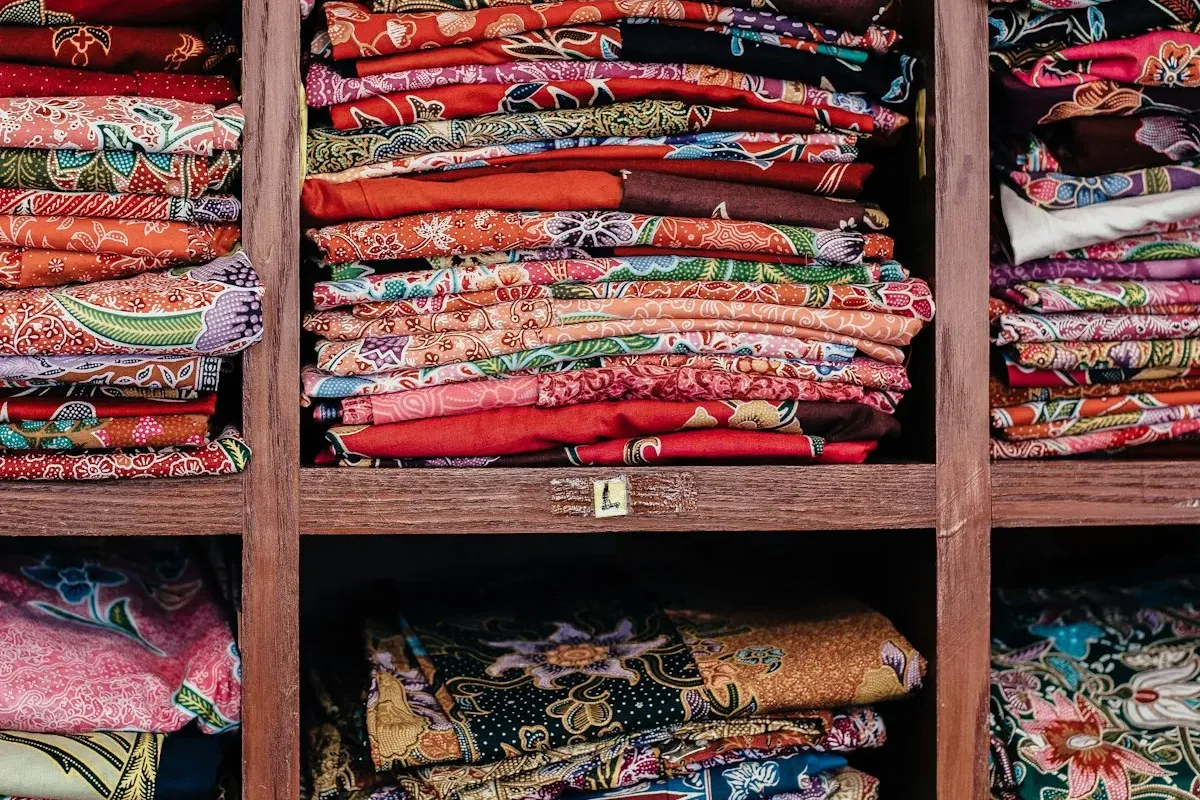
The most expensive fabric in your studio isn't the Liberty Tana Lawn at $38 a yard. It's the fabric you already cut — the pieces sitting in your scrap bin, the strips between pattern pieces that were too narrow to use, the half-yard remnants from a bolt you bought for one project and never touched again.
Most sewists and clothing makers track what they spend on fabric. Very few track what they use. That distinction is the difference between knowing your material costs and understanding them. Because fabric doesn't behave like other craft materials. You buy it in yards, your pattern calls for it in yards, and the math looks simple — until you realize that a pattern requiring 2.5 yards of 45-inch fabric doesn't consume the same amount of material as 2.5 yards of 60-inch fabric. Until you account for the directional print that forced you to cut one-way and wasted 15% more fabric than the pattern envelope suggested. Until you remember the three garments you cut in size XL that used 30% more fabric than the size S you based your pricing on.
Fabric costing has a geometry problem. Solve it, and you can price every garment you make with confidence. Ignore it, and you're subsidizing your customers with material you paid for but never charged for.
Problem: You're Pricing Off the Pattern Envelope, Not Reality
The back of a sewing pattern says "2.5 yards of 44/45-inch fabric." So you buy 2.5 yards, cut the pattern, and list the fabric cost as the price of those 2.5 yards. Simple.
Except it isn't. That yardage estimate assumes:
- No directional fabric. If your fabric has a nap, a one-way print, or a pattern that needs matching (stripes, plaids), you'll use 10-20% more yardage than stated.
- No layout waste. The pattern pieces don't tessellate perfectly. The irregular shapes between them — the slivers, triangles, and curves — are paid-for fabric that leaves the bolt but never becomes product.
- A single size. The yardage on the envelope is typically for the middle size in the range. If you make size XS through 3XL, your fabric consumption can vary substantially across the size range — as the measurement table below shows, an XS and a 2XL of the same pattern can differ by 60% or more in actual yardage used.
- Perfect execution. No cutting mistakes, no flawed sections of fabric you had to work around, no shrinkage from pre-washing.
The fix: Measure actual fabric consumption per garment, not theoretical. Here's how.
Lay out your pattern pieces on the fabric before cutting and measure the actual rectangle of fabric they occupy — length times width. That rectangle is your true consumption. Do this for each size you offer and record it separately.
| Size | Pattern Estimate | Actual Layout (45" fabric) | Actual Layout (60" fabric) | Waste % |
|---|---|---|---|---|
| XS | 2.0 yd | 2.0 yd | 1.5 yd | 8% |
| S | 2.25 yd | 2.3 yd | 1.7 yd | 10% |
| M | 2.5 yd | 2.6 yd | 1.9 yd | 12% |
| L | 2.75 yd | 3.0 yd | 2.2 yd | 14% |
| XL | 3.0 yd | 3.3 yd | 2.4 yd | 15% |
| 2XL | 3.25 yd | 3.6 yd | 2.7 yd | 17% |
Notice the waste percentage climbing with size. Larger pieces leave more unusable gaps between them. If you're charging the same flat fabric cost across all sizes — or worse, using the medium-size estimate for everything — you're undercharging on every large garment and slightly overcharging on smalls.
Record these measurements once per pattern in your inventory system, and you'll never need to guess again.
Problem: Fabric Width Varies, But Your Cost Calculation Doesn't
Fabric comes in different widths: 36", 44/45", 54/58", and 60" are the most common. The width directly affects how many pattern pieces you can fit side by side, which changes how many linear yards you need.
A dress that takes 3 yards of 45-inch fabric might only take 2.2 yards of 60-inch fabric. If the 45-inch fabric costs $12/yard ($36 total) and the 60-inch fabric costs $18/yard ($39.60 total), the wider fabric is actually more expensive for this project despite feeling like a better deal per yard.
The fix: Convert everything to cost per square yard (or square meter) for apples-to-apples comparison, then calculate using your actual layout measurements.
Cost per square yard = Price per linear yard / (Width in inches / 36)
| Fabric | Price/yd | Width | Cost/sq yd | Yards needed | Total cost |
|---|---|---|---|---|---|
| Cotton voile | $12.00 | 45" | $9.60 | 3.0 | $36.00 |
| Cotton lawn | $18.00 | 60" | $10.80 | 2.2 | $39.60 |
| Linen blend | $24.00 | 54" | $16.00 | 2.5 | $60.00 |
The per-yard price is misleading without width context. Track both the linear yardage used and the cost per square unit, and your fabric comparisons become meaningful.
Problem: Notions Add Up, But Nobody Tracks Them
Buttons, zippers, thread, elastic, interfacing, bias tape, hook-and-eye closures, snaps, grommets, labels, hang tags. Individually, these are cheap. A spool of Gutermann thread is $4. A zipper is $3. A set of buttons is $5. Easy to ignore.
But a lined blazer might use: an invisible zipper ($3.50), 8 buttons ($6 for the set), 2 yards of fusible interfacing ($4.50), 1.5 yards of lining fabric ($13.50), a spool of matching thread ($4), shoulder pads ($3), and a woven label ($0.60). That's $35.60 in notions and lining — on top of the outer fabric cost. Skip tracking these and your cost estimate is 30-40% too low.
The fix: Build a notions cost template for each garment type, not each individual garment.
Create a standard notions list for each product category in your line:
Simple top (no closures):
- Thread: $0.40 (estimated per garment from spool yield)
- Woven label: $0.60
- Hang tag: $0.25
- Total: $1.25
Lined dress with invisible zipper:
- Invisible zipper: $3.50
- Lining fabric: $13.50 (1.5 yd @ $9/yd)
- Fusible interfacing: $4.50 (2 yd @ $2.25/yd)
- Thread (2 colors): $0.80
- Woven label: $0.60
- Hang tag: $0.25
- Total: $23.15
Structured blazer:
- Buttons (set): $6.00
- Fusible interfacing: $6.75 (3 yd)
- Lining fabric: $18.00 (2 yd)
- Shoulder pads: $3.00
- Thread: $0.80
- Woven label: $0.60
- Hang tag: $0.25
- Total: $35.40
Store these templates in your inventory system and attach the right one to each product. When a notion's price changes, update the template once and every garment using it reflects the new cost.
One notions detail that catches people: thread yield. A standard 274-yard spool of all-purpose thread will sew approximately 10-15 simple garments or 6-8 complex ones. At $4 per spool, that's $0.27-$0.67 per garment. Not nothing — especially if you use specialty thread like silk ($12/spool) or heavy-duty upholstery thread ($8/spool), where per-garment thread cost can hit $1-2.
Problem: You Offer Multiple Sizes But Price Them Identically
This is where most clothing makers lose money without realizing it.
If you sell a linen dress for $85 in sizes XS through 2XL, and the fabric consumption ranges from 2.0 yards (XS) to 3.6 yards (2XL) at $22/yard, your fabric cost alone ranges from $44 to $79.20. That's a $35.20 spread — on a single product, at a single price.
The XS version has a 48% fabric cost ratio. The 2XL has a 93% fabric cost ratio. One is profitable. The other might be losing money after you add labor, notions, and overhead.
The fix: You have three options. Pick the one that fits your brand and market.
Option 1: Size-based pricing
Option 1: Size-based pricing Charge different prices for different size ranges. This is common in indie pattern companies and increasingly accepted in handmade clothing. Group sizes into 2-3 tiers:
| Size range | Fabric cost | Price |
|---|---|---|
| XS-M | $44-57 | $85 |
| L-XL | $66-73 | $95 |
| 2XL+ | $79+ | $110 |
Option 2: Blended average pricing
Option 2: Blended average pricing Calculate the weighted average fabric cost across your actual sales distribution. If 60% of your sales are S-M, 30% are L-XL, and 10% are 2XL+, your blended fabric cost is roughly $57 — and you price off that number with enough margin to cover the spread. This works when the range is moderate and your size distribution is predictable.
Option 3: Flat pricing at the highest cost
Option 3: Flat pricing at the highest cost Price every size as if it were the most expensive to make. Your smaller sizes will have higher margins, and your larger sizes won't lose money. This is the simplest approach but makes your smaller sizes less competitive.
Whichever you choose, you need the data first. Track fabric consumption per size, and your pricing becomes a decision instead of a guess.
Problem: Custom Orders Blow Up Your Cost Estimates
Custom work is where most textile makers' costing systems completely fail. A customer wants your wrap dress but in a different fabric, with longer sleeves, and in a size you don't normally make. You quote a price based on feel — and that feeling is almost always too low.
Custom orders deviate from your standard costs in every direction at once:
- Different fabric means different per-yard cost, different width, different cutting behavior (slippery fabrics take longer to cut, knits stretch during layout)
- Pattern modifications change fabric consumption in ways that aren't proportional (adding 3 inches of sleeve length uses more fabric than you'd guess because of the grain line)
- Non-standard sizes require pattern grading, which is labor — 30-90 minutes of skilled work depending on how far from your base size
- Single-unit production eliminates batch efficiencies (you can't cut 6 at once when it's a party of one)
The fix: Build a custom order pricing formula that stacks adjustments on top of your base garment cost.
Custom price = Base garment cost
             + Fabric cost difference (actual yardage x custom fabric price - standard fabric cost)
             + Modification fee ($15-40 per modification, based on complexity)
             + Pattern grading fee ($25-50 if outside standard size range)
             + Single-unit surcharge (15-25% of base price)
The single-unit surcharge is the one most makers forget. When you make a batch of 10 dresses, you're cutting fabric for all 10 in one layout session, sewing in assembly-line order (all side seams, then all hems, then all zippers), and pressing in one session. A custom order of one eliminates all of that efficiency. You'll spend 30-50% more time per garment on a single unit than on a batch — charge for it.
Problem: You Don't Track Cutting Waste and Remnants
When you cut a garment from a 3-yard piece of fabric, you don't use every square inch. The shapes between your pattern pieces — the triangles, crescents, and strips — are paid-for fabric that becomes scrap.
For most garments, cutting waste runs 10-20% of the fabric purchased. For garments cut from directional prints, it can hit 25-30%. Over a year of production, that waste adds up to a staggering amount of money you've already spent.
The fix: Track waste at the category level, not the individual garment level. You don't need to weigh every scrap — you need a realistic waste factor for each type of garment.
Measure your actual waste for 3-5 production runs of each garment type. Weigh the scrap fabric (a kitchen scale works fine) or measure the unusable remnant left on the bolt. Calculate the percentage.
| Garment type | Avg. fabric used | Avg. waste | Waste factor |
|---|---|---|---|
| Simple top (solid) | 1.8 yd | 0.2 yd | 10% |
| A-line skirt (solid) | 1.5 yd | 0.2 yd | 12% |
| Fitted dress (solid) | 2.6 yd | 0.4 yd | 13% |
| Fitted dress (directional) | 3.1 yd | 0.7 yd | 18% |
| Blazer (plaid, matched) | 4.2 yd | 1.3 yd | 24% |
Build the waste factor into your fabric cost calculation:
True fabric cost = (Yards used x Price per yard) / (1 - Waste factor)
If your dress uses 2.6 yards of $20/yard fabric with a 13% waste factor:
- Naive cost: 2.6 x $20 = $52
- True cost: $52 / 0.87 = $59.77
That $7.77 difference is real money. Over 100 dresses, it's $777 in untracked material cost.
What about the scraps? Some waste is genuinely usable — for small accessories, patchwork, stuffing, or scrap bundles you sell separately. If you systematically repurpose scraps, you can offset a portion of the waste cost. Track the revenue from scrap products separately and subtract it from your waste calculation. But be honest: if those fabric scraps have been sitting in a bin for six months, they're waste, not future inventory.
Problem: Labor Time Varies Wildly But Your Pricing Doesn't
A simple pull-on skirt takes 45 minutes to sew. A fully lined blazer with welt pockets takes 6 hours. Yet many clothing makers use a flat "labor" estimate — or worse, don't include labor at all because they view their time as free.
Your time is the most expensive input in every garment you make. If you value your labor at $25/hour (a modest rate for skilled sewing), the labor cost of that blazer is $150 — more than triple the fabric cost.
The fix: Time yourself on 3-5 units of each garment and average the result. Include everything: cutting, interfacing, sewing, pressing between steps, finishing, quality checking, tagging, and packaging.
| Garment | Cut | Sew | Press | Finish | Total | Labor @ $25/hr |
|---|---|---|---|---|---|---|
| Simple top | 10 min | 25 min | 10 min | 10 min | 55 min | $22.92 |
| A-line skirt | 10 min | 30 min | 10 min | 10 min | 60 min | $25.00 |
| Shirt dress | 15 min | 90 min | 20 min | 15 min | 140 min | $58.33 |
| Lined blazer | 25 min | 240 min | 45 min | 20 min | 330 min | $137.50 |
These numbers shift as you get faster. Re-time yourself every 6 months for garments you make regularly. Your 10th blazer will be faster than your 3rd, and your pricing should reflect that improvement — either as higher margins or more competitive prices.
Putting It All Together: The Full Cost Per Garment
Here's what a complete cost calculation looks like for a lined shirt dress in size M, made from a cotton lawn print at $18/yard:
| Cost component | Calculation | Amount |
|---|---|---|
| Outer fabric | 2.8 yd x $18.00 / (1 - 0.15 waste) | $59.29 |
| Lining fabric | 1.5 yd x $9.00 | $13.50 |
| Invisible zipper | 1 @ $3.50 | $3.50 |
| Interfacing | 1.5 yd x $2.25 | $3.38 |
| Thread (2 colors) | $0.80 | $0.80 |
| Woven label | $0.60 | $0.60 |
| Hang tag + packaging | $1.50 | $1.50 |
| Total materials | $82.57 | |
| Labor (140 min @ $25/hr) | $58.33 | |
| Overhead (15% of materials + labor) | $21.14 | |
| Total cost | $162.04 |
If you're selling this dress for $165, your margin is $2.96 — barely enough to cover a credit card processing fee. If you're selling it for $220, your margin is $57.96 (26%) — healthy enough to sustain a business. If you thought the dress "cost about $70 to make" because you only counted the outer fabric, you've been operating on a number that's less than half of reality.
An inventory management tool like Ardent Seller can automate most of this calculation. Set up your fabrics with cost-per-yard and width, create recipes for each garment with the fabric yardage, notions, and labor time, and it calculates the total cost per unit across every size. When your fabric supplier raises prices, update the ingredient cost once and every garment using that fabric reflects the new number instantly — no spreadsheet formulas to chase down.
The Pricing Conversation You Need to Have With Yourself
Once you have real numbers, you might not like what they tell you.
If your true cost per garment is $162 and the market price for similar handmade dresses is $120-150, you have a problem — but at least now you can see it. Without accurate costing, you'd sell the dress at $140 thinking you're making $70 in profit, when you're actually losing $22 per unit.
Knowing the real numbers gives you options:
- Reduce cost. Source more affordable fabric, simplify construction details, cut in larger batches to improve efficiency, or eliminate sizes that cost disproportionately more to produce.
- Increase price. Position the garment as premium, improve your marketing and photography, sell through channels where customers expect higher prices (your own website vs. a marketplace).
- Change the product. If a fully lined dress can't hit your target margin, maybe an unlined version with French seams can — at 40% less labor and no lining cost.
- Discontinue. Some products shouldn't exist. If the numbers don't work after honest optimization, your energy is better spent on garments that are actually profitable.
None of these decisions are possible without the data. And the data starts with measuring what you actually use — not what the pattern envelope says, not what you spent at the fabric store, but what goes into each finished garment and what ends up in the scrap bin.
Track the fabric. Count the notions. Time the labor. Price from reality. That's the entire system — and it works whether you're making 5 garments a month or 500.
If you're ready to move from a spreadsheet to a system that handles fabric tracking, recipe costing, and per-size pricing calculations in one place, give Ardent Seller a try. It's free to start, and it's built for exactly this kind of precision.
Related reading
- Recipe Costing 101 — Fabric, notions, and garment labor stacked into the same five-layer cost framework.
- Margin vs Markup — Why "marking up fabric 100%" is not a 100% margin — and how the difference shows up in your bank account.
- Wholesale Pricing for Handmade Products — Pricing for boutique pickup without absorbing the cutting waste in the discount.
Free resources
A few free downloads from the Ardent Workshop library that pair well with this post:
- Product Pricing Calculator (Excel) — Once your fabric and notion costs per garment are honest, drop them into the calculator with labor (hours × rate), packaging, shipping supplies, and the Etsy or Shopify fee %. Suggested retail comes back with platform fees netted out — the form that stops sewists pricing as if labor were free.
- Should I Raise My Prices? Decision Tool — A live web tool that runs the +10% / +20% / +30% price-hike math on one product — including the volume drop that comes with each — and tells you which scenario clears the most monthly profit.
- Craft Seller Startup Checklist — Pricing math, inventory cataloging, and the legal essentials for sewists ready to charge what their work is actually worth.
- Monthly Inventory Count Sheet — A printable count sheet for fabric, finished garments, and notions — useful for catching the gap between bolts purchased and yardage used.
This article is provided for educational purposes only and does not constitute financial, tax, or business advice. Cost structures, pricing examples, and margin figures are illustrative and will vary by your specific circumstances. Consult a qualified accountant or small-business advisor before making financial decisions based on this content.