The health inspector is asking about your vanilla bean custard base. Specifically, she wants to know the butterfat percentage. You made three batches this week — one with the heavy cream from your usual dairy, one with the new supplier's cream that was slightly cheaper, and one where you substituted half the cream with a higher-fat version because the first supplier shorted your order. Each batch has a different butterfat content, a different ingredient cost, and technically a different classification under your state's frozen dessert regulations.
You tell her it's 14%. She asks to see the documentation. You pull out your phone and scroll through a notes app looking for the recipe you adjusted on Tuesday.
This is the moment where most ice cream businesses realize they've been winging it — and that winging it has a cost that goes well beyond an awkward inspection.
The dairy base problem: your most expensive ingredient won't sit still
Three makers run through this post — Priya, Carlos, and Nadia. All three are composites, invented to stand in for familiar small-batch setups, with figures chosen to show the shape of the math. None of them is a real person or a real customer.
Meet Priya, who sells pints of small-batch ice cream at three farmers markets in the Pacific Northwest. She started her business eighteen months ago with a single base recipe: heavy cream, whole milk, sugar, egg yolks, and vanilla. Simple. The recipe worked beautifully — until it didn't.
In January, her heavy cream cost $4.80 per quart from a local dairy. By June, the same dairy raised the price to $5.60 — a 17% increase driven by feed costs and summer demand. Priya didn't adjust her pint price because she didn't realize how much the base cost had shifted. She was still using the per-pint ingredient cost she'd calculated when she launched.
Over three months of summer markets — her highest-volume season — that $0.80 per quart difference translated to roughly $0.22 more per pint in cream alone. Across 400 pints, that's $88 in margin she thought she had but didn't. Not catastrophic on its own, but cream wasn't the only ingredient that moved. Whole milk went up. Vanilla extract — already expensive — jumped again. Sugar was the only thing that held steady.
The fix: Track your base recipe ingredients at the batch level, not the recipe level. Every time you make a batch, record the actual cost you paid for the ingredients that went into it — not the cost from your original recipe card. This sounds tedious until you build the habit. The payoff is that you always know what a batch actually cost, and you can spot trends before they eat your margins.
Rule of thumb: If your primary dairy ingredient price changes by more than 5% from your last cost calculation, reprice your products immediately. Don't wait for the end of the month.
Priya now logs every cream purchase with the date, supplier, price per quart, and butterfat percentage. When she makes a batch, she pulls the actual cost from her most recent purchase — not a remembered average. Her per-pint cost calculations are never more than one batch behind reality.
Overrun: the number that changes everything about your yield math
Scenario: Carlos
Carlos runs a gelato cart in Austin. He makes his gelato in a commercial batch freezer and serves it from a display case at events and catering gigs. When he first calculated his cost per serving, he divided total ingredient cost by the number of scoops he got from a batch. The math was clean: a batch costs $38 in ingredients, yields about 40 four-ounce scoops, so each scoop costs $0.95 in ingredients. At $5 per scoop, he figured he was doing fine.
The problem was the number 40. Some days he got 40 scoops. Some days he got 48. Some days he got 34. The variation wasn't random — it was overrun.
Overrun is the percentage of air incorporated into ice cream or gelato during the churning process. It's the reason a gallon of ice cream base doesn't produce a gallon of ice cream — it produces more, because air takes up volume. Commercial ice cream can have 50-100% overrun (meaning the finished volume is 1.5 to 2 times the base volume). Gelato typically runs 20-35% overrun, which is why it's denser and more intense (Penn State Extension on ice cream (opens in new tab)).
Here's why this matters for your costs: overrun directly determines how many servings you get from a batch. A batch with 30% overrun yields 30% more volume than the same batch with 0% overrun. If you're calculating cost per scoop based on a fixed yield number, you're wrong every time your overrun varies — and it varies based on your machine, your mix temperature, your churning time, and even the sugar content of your base.
Carlos was calculating his scoop cost at 40 scoops per batch. His actual overrun fluctuated between 22% and 35% depending on the day, which meant his real yield swung between 36 and 46 scoops. At the low end, his per-scoop ingredient cost was $1.06 — not $0.95. At the high end, it was $0.83. That's a 28% spread in ingredient cost from the same recipe.
The fix: Measure your overrun for every batch. The formula is simple:
Overrun % = ((Volume of finished ice cream − Volume of mix) ÷ Volume of mix) × 100
Pour your base into the machine and note the volume. When it's done churning, measure the finished volume. Track this number alongside your batch records. After ten batches, you'll have a reliable average overrun for each recipe — and you can calculate cost per serving using that average instead of a guess.
Carlos discovered his average overrun for his chocolate gelato was 26%, while his fruit sorbets ran closer to 18% (less fat means less air incorporation). That meant his sorbet was actually more expensive per scoop than his gelato, even though the ingredients cost less — because he got fewer servings per batch. He'd been pricing them the same. Once he separated the pricing, his sorbet margins improved by about 12%.
Mix-ins are margin killers hiding in plain sight
Back to Priya. Her best-selling flavor is salted caramel with chocolate-covered pretzel pieces. Customers love it. She charges the same $9 per pint as her vanilla bean. But the mix-in cost tells a different story.
The pretzel pieces cost her $6.40 per pound from a specialty supplier. She uses about 2 ounces per pint — that's $0.80 per pint just in pretzels. The caramel ribbon takes 20 minutes to make per batch and uses butter, brown sugar, cream, and sea salt — roughly $0.45 per pint in ingredients plus the labor time. Her vanilla bean pint costs $3.10 in total ingredients. Her salted caramel pretzel pint costs $4.35. She'd been selling both at the same price for eight months.
Over those eight months, about 40% of her total pint sales were the salted caramel pretzel flavor — customers' favorite. Those 480 pints at the wrong price cost her $600 in uncaptured margin. Not a business-ending number, but enough to cover two market booth fees or a new batch of pint containers.
The fix: Cost every flavor independently. Your base recipe cost is the floor, but mix-ins, ribbons, variegates, and inclusions can add anywhere from $0.20 to $2.00+ per serving depending on the ingredient. Treat each flavor as its own product with its own cost sheet.
The most common mix-in cost traps:
- Nuts — Pecans, pistachios, and macadamias have volatile pricing. A pecan praline flavor that cost $0.60 per pint in mix-ins last fall might cost $0.90 this spring. Track nut prices the same way you track dairy prices.
- Chocolate — Couverture chocolate, cocoa nibs, and chocolate chips vary widely in quality and price. The jump from compound chocolate ($3/lb) to real couverture ($8/lb) changes your per-pint cost dramatically.
- Fresh fruit — Seasonal price swings can be 200-300%. Fresh strawberries at $2/lb in June cost $5/lb in December. If you run seasonal flavors, recalculate the cost every time you buy fruit.
- Alcohol-based flavors — A bourbon vanilla or rum raisin uses ingredients where a single bottle costs $25-40 but the per-pint usage is small. Easy to overlook in costing because you don't buy it often, but it's real cost that belongs in your recipe.
Pro tip: If a mix-in adds more than 15% to your base cost per serving, that flavor should be priced higher — or the mix-in should be used more sparingly. Customers will accept a $1-2 premium for premium flavors. What they won't accept is the flavor disappearing because you couldn't afford to keep making it.
Seasonal demand: the feast-or-famine cycle
Scenario: Nadia
Nadia operates a small gelato shop in a beach town in Massachusetts. Her business follows a pattern that would give most retailers nightmares: 70% of her annual revenue happens between Memorial Day and Labor Day. The other nine months, she's doing just enough business to keep the lights on — literally, because the freezers run 24/7 whether she sells ten scoops or a hundred.
Her first year, she made the mistake every seasonal frozen dessert business makes: she produced at summer volume until the last possible day, then suddenly had way too much inventory when foot traffic dropped in September. She threw away $1,200 worth of product that winter. Gelato has a freezer shelf life of about 2-4 weeks before ice crystal formation degrades the quality enough that she won't serve it.
The second mistake came the following spring: she under-produced for the Memorial Day weekend rush because she was still scarred from the September waste. She ran out of her three most popular flavors by 2pm on Saturday. Lost sales she'll never get back.
The fix: Track production and sales by week, not by month. Monthly numbers smooth out the demand curve too much to be useful for production planning. Weekly tracking reveals the real patterns — the slow ramp in late May, the peak weeks around July 4th, the gradual decline after mid-August, and the sharp drop after Labor Day.
Nadia built a simple weekly production plan based on her second year's sales data:
- Pre-season (April-May): 3-4 batches per week, building a small buffer of her top 5 flavors
- Peak (June-August): 8-12 batches per week, with daily production of the top 3 sellers
- Shoulder (September-October): 4-5 batches per week, reducing flavor variety to the top 8
- Off-season (November-March): 2-3 batches per week, limited to 5 core flavors plus one seasonal special
The key metric she tracks is sell-through rate per flavor per week — the percentage of each flavor's production that actually gets sold before it needs to be discarded. Any flavor consistently below 80% sell-through gets cut from the rotation or its batch size gets reduced. Any flavor above 95% sell-through might be under-produced — she's probably turning away customers who wanted it.
Cold storage: the overhead you can't turn off
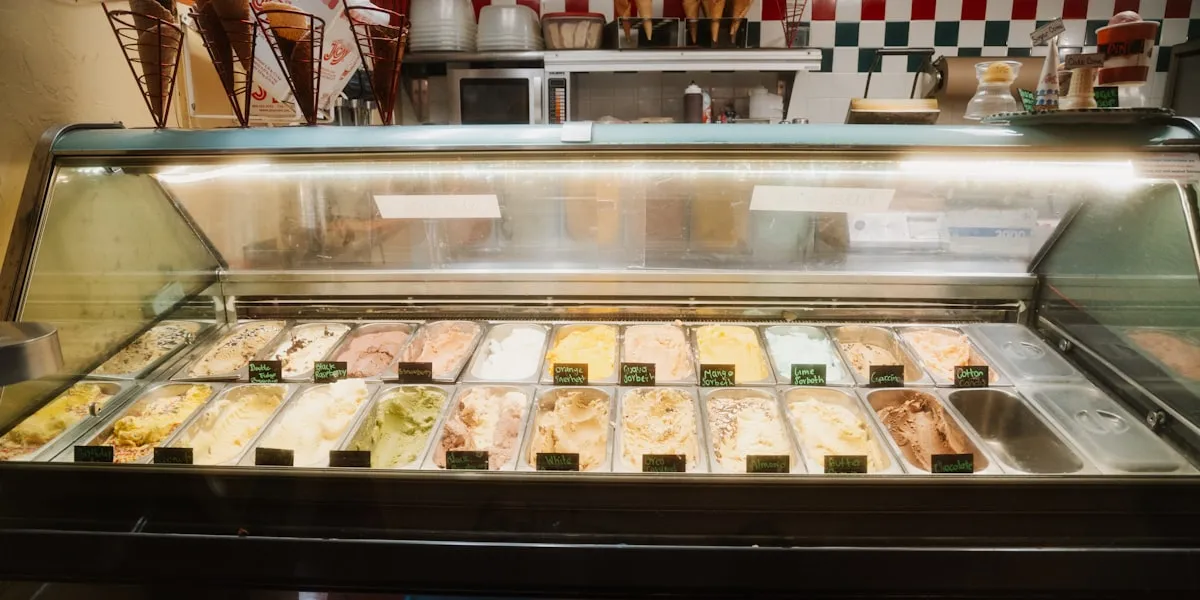
Every ice cream and gelato business has a cost that bakers, soap makers, and jewelry sellers don't: continuous refrigeration. Your product requires an unbroken cold chain from production to customer, and the electricity to maintain that chain runs 24/7/365 regardless of your sales volume.
Nadia pays roughly $380 per month in electricity specifically for her freezers and display case — she knows this because she had an electrician put her cold storage equipment on a separate meter. During her off-season months, when she might sell $2,000 worth of gelato, that $380 represents 19% of revenue going straight to keeping the lights on her freezers. During peak summer months with $12,000 in revenue, it drops to about 3%.
Most ice cream businesses never isolate their cold storage costs. The electric bill is just... the electric bill. But if you don't know what your freezers cost to run, you can't accurately price your product — especially during slow months when that fixed overhead per scoop or per pint skyrockets.
The fix: If you can't put your equipment on a separate meter, estimate the cost. Check your freezer's nameplate for wattage, multiply by 24 hours, multiply by 30 days, and multiply by your electricity rate per kWh. A typical commercial batch freezer draws 1,500-3,000 watts. A display case adds another 800-1,500 watts. A reach-in storage freezer, another 500-800 watts. Add them up and you'll likely land between $200 and $500 per month depending on your equipment and local electricity rates.
Then divide that monthly cost by your monthly serving volume. In Nadia's case, her off-season cost per scoop for cold storage alone is about $0.38. In summer, it's $0.05. Same freezers, same electricity, wildly different impact on her margins.
Rule of thumb: Budget cold storage as a fixed monthly cost and amortize it across your projected annual production volume — not your monthly volume. This prevents the per-unit cost from swinging wildly between seasons and gives you a more stable number for pricing decisions.
Putting it all together: what your scoop actually costs
Let's follow Carlos through a complete cost calculation for one batch of his dark chocolate gelato, using everything we've covered.
Base ingredients for a 2.5-gallon batch: Whole milk (1 gallon) at $4.20, heavy cream (1 quart) at $5.60, sugar (14 oz) at $0.52, cocoa powder (8 oz) at $3.80, dark chocolate (6 oz) at $2.70, egg yolks (6) at $1.50, salt at $0.02. Total base cost: $18.34.
Overrun adjustment: Carlos's average overrun on this recipe is 26%. His 2.5-gallon base produces approximately 3.15 gallons of finished gelato — about 100 four-ounce scoops.
Per-scoop ingredient cost: $18.34 ÷ 100 = $0.18 per scoop.
Add fixed overhead per scoop: Monthly cold storage ($340) ÷ monthly scoops (3,200 average) = $0.11. Monthly rent allocated to production ($600) ÷ 3,200 = $0.19. Cups, spoons, napkins = $0.08. Credit card fees at 2.9% of $5 scoop price = $0.15.
True cost per scoop: $0.71. At $5 per scoop, his gross margin is $4.29 — or 86%. That sounds great until you subtract labor. Carlos spends about 25 hours per week on production and another 20 on sales and events. At his target hourly rate of $30, that's $1,350 per week in labor, or about $0.42 per scoop at his volume. Real margin after labor: $3.87 per scoop, or 77%.
That's a healthy business. But only because Carlos knows his numbers. Before he started tracking overrun, his scoop cost estimate was off by 15%. Before he tracked mix-in costs per flavor, his premium flavors were subsidized by his simpler ones. Before he isolated cold storage costs, he was making pricing decisions based on ingredient costs alone.
From guessing to knowing
Priya, Carlos, and Nadia all started their businesses the same way — with a great recipe and a rough sense of what things cost. The recipes stayed great. The rough sense turned into real problems the moment volume increased, ingredient prices moved, or a slow season arrived.
The difference between an ice cream business that survives and one that thrives isn't the quality of the product. It's the maker's ability to see exactly what each batch costs, how much it yields, and whether the price covers everything — not just ingredients, but overrun variability, mix-in premiums, seasonal production swings, and the freezer that never stops running.
You don't need a finance degree to track this. You need a system that lets you log batch-level costs, calculate yields based on actual overrun, cost each flavor independently, and see your numbers in one place. Tools like Ardent Seller are built for exactly this kind of production tracking — batch-level ingredient costs, recipe management with yield calculations, and inventory tracking that understands the difference between raw materials, work-in-progress, and finished goods. If you're currently running your ice cream business on a spreadsheet that hasn't been updated since last summer, it might be time to graduate to something that keeps up with your production pace.
Summer is coming. Your freezer is already running. Make sure your numbers are running with it — start tracking your production costs today.
Related reading
- Recipe Costing 101 — The five-layer cost stack applied to dairy production with overrun and mix-in adjustments.
- Batch Tracking for Food Sellers — How to set up the lot-tracking spine that makes a recall a 40-pint problem instead of a 400-pint one.
- Shelf Life, Spoilage, and Shrinkage — Freezer shrinkage and freezer-burned inventory — the costs you only see when you measure them.
Free resources
Free companion downloads if you want to put any of this into practice:
- Cottage Food Laws by State: The 50-State + DC Quick Reference — Most states exclude frozen desserts from cottage food entirely. This 50-state reference tells you up front whether your state classifies you as cottage, frozen-dessert, or licensed processor — and what each path requires.
- Recipe Scaling & Batch Calculator (Excel) — A working scaler with whole milk (1.03 g/ml) and sugar (0.85) densities baked in. Set a target pint count, the workbook rewrites every dairy, sugar, and inclusion weight with oz↔g↔ml conversions handled. The Batch Cost & Yield tab compares per-pint cost across batch sizes — useful when sizing the next pasteurization run against next weekend's farmers' market.
- Monthly Inventory Count Sheet — A printable count sheet for raw dairy, finished pints, and packaging — useful for catching freezer drift between production runs.
- Small-Batch Production Planning Playbook — Six-page PDF with five planning principles, the demand-driven batch-sizing formula, and four printable worksheets (Batch Sizing, Run Log, Weekly WIP, Post-Run Audit). Sizes each pasteurization run from the smaller of the freezer-cabinet shelf-life ceiling and the pasteurizer cost-curve elbow — so the freezer never holds more pints than next month's farmers' markets can absorb.
This article is provided for educational purposes only and does not constitute financial, tax, or business advice. Cost structures, pricing examples, and margin figures are illustrative and will vary by your specific circumstances. Consult a qualified accountant or small-business advisor before making financial decisions based on this content.